Category Archives: Health

Wind Turbine Noise Conference 2017

noise-sensitive

Noise made by industrial wind turbines will be generating a lot of discussion at the upcoming international conference May 2017 in Rotterdam.

noise-wave

Wind Turbine Noise 2017

Abstracts Accepted 2017

Here is a list of abstracts submitted for WTN 2017 in alphabetical order of lead author.

Presentations will be either oral, poster or part of a workshop session. The type of presentation will be notified when the full paper is accepted.

You can also download a PDF here

Managing tonality during the planning, design and construction of a wind farm. Justin Adcock, Christophe Delaire, Daniel Griffin, Alex Morabito.

Noise measurement on a Small Wind Turbine preliminary results. Mariano Amadio.

Trailing edge serrations – effect of their flap angle on flow and acoustics. Carlos Arce León, Roberto Merino-Martínez, Daniele Ragni, Stefan Pröbsting, Francesco Avallone, Ashish Singh, Jesper Madsen.

An investigation into the effect of wind shear on the noise emission of modern wind turbines. Payam Ashtiani, Duncan Halstead.

Airfoil noise reduction using active flow control. Mahdi Azarpeyvand, Mate Szoke, Weam Elsahhar, Yannick Mayer.

Investigation of Amplitude Modulation Noise with a Fully Coupled Noise Source and Propagation Model. Emre Barlas, Wei Jun Zhu, Wen Zhong Shen, Kaya Dag, Patrick Moriarty.

Windfarm noise assessment methodologies comparison: UNI 11143-7 and ISPRA guidelines. Different approaches, results, features. Andrea Bartolazzi, Michela Spizzichino.

Pre-construction Site Prediction Tool for Wind Farm AM – Do We Now Know Enough?. Jeremy Bass, Andrew Birchby.

Wind turbine noise – an overview of current knowledge and perspectives. Andrea Bauerdorff, Steffen Körper.

Coupled wind turbine noise generation and propagation – A numerical study. Franck Bertagnolio.

Wind turbine noise prediction using Olive Tree Lab. Alexis BIGOT, Panos ECONOMOU, Costas ECONOMOU.

The influence of aero-elastic coupling on rotor sound predictions. Remy Binois, Thomas Klemme, Sascha Erbsloeh.

Annual analysis of sound propagation from a boreal wind park. Karl Bolin, Ilkka Karasalo, Esbjörn Olsson.

Developing and presenting a unique and innovative acoustic installation template to offer a spatial, frequency and calibrated reproduction of a wind turbine noise to the public.. Dominique Bollinger, Xavier Falourd, Lukas Rohr.

Efficient tools for assessing the emergence, audibility and masking potential of wind turbine noise by background noise. Dominique Bollinger, Xavier Falourd, Romain Feuz, Patrick Marmaroli.

An Investigation into Short-Term Fluctuations in Amplitude Modulation of Wind Turbine Noise. Ian Bonsma, Nathan Gara, Brian Howe, Nick McCabe.

Wind turbine noise measurement in controlled conditions. Koen Boorsma, J.G. Schepers.

Use of the Acoustic Camera to accurately localise wind turbine noise soiurces and their Doppler shift. Stuart Bradley, Michael Kerscher,, Torben Mikkelsen.

The Challenges and Benefits of Long-Term Noise Monitoring of Wind Farm Sites. Ethan Brush, James Barnes, Marc Newmark, William Yoder.

Characterizing the acoustic noise from wind turbines by using the divergence of the sound pressure in the ambient. Valentin Buzduga, Alexandru Buzduga.

An Experimental Parametric Study of Airfoil Trailing Edge Serrations. Thomas H. CAROLUS, Farhan A. MANEGAR (Univ Siegen) ; Elodie THOUANT (ECL) ; Kevin VOLKMER (Univ Siegen) ; Isabelle SCHMICH-YAMANE (EDF).

A scoping study on assessment practices for noise impacts from renewable technologies in Scotland. Matthew Cassidy, Susanne Underwood (Land Use Consultants), Nick James (Land Use Consultants). .

Numerical Prediction of DU96 Airfoil Self Noise using Detached Eddy Simulation. Kenan Cengiz, Yusuf Özyörük.

Application of the UK IOA Method for Rating Amplitude Modulation. David Coles, Tom Levet, Matthew Cand.

Sound propagating from wind turbines in winter conditions. Kristina Conrady, Anna Sjöblom, Conny Larsson.

Variation in wind turbine sound power measurements. Jon Cooper, Tom Evans.

Using long term monitoring for noise assessment of wind farms. Eugène de Beer. . Australian Criteria for C-weighted Wind Farm Noise Levels. Christophe Delaire, Justin Adcock, Daniel Griffin, Lachlan Deen.

The different evaluation-methods of the wind farm noise in Switzerland – computer models/in-situ measurements. Victor Desarnaulds, Ronan Fécelier, Dimitri Magnin.

Comparison of Sound Propagation Models for Offshore Wind Farms. Guangsheng (Sam) Du, A.D. Lightstone, Joseph Doran.

Perceptual aspects of wind-turbine noise. Pierre Dutilleux.

Wind turbine noise assessment by regression tree analysis.. David Ecotière.

Wind turbine noise at neighbor dwellings, calculations versus measurements.. Rune Egedal, Lars Sommer Søndergaard, Morten Bording Hansen.

Wind turbine noise: Sound power level measurements 3.0. Leon Eilders, Eugène de Beer.

Vertical directivity observations based on statistics of low frequency tonal components measured at downwind and upwind locations.. Xavier Falourd, Dominique Bollinger, Romain Feuz, Patrick Marmaroli.

Effects of Individual Pitch Control on Amplitude Modulated Noise. Chris Feist, Matt Lueker, Bill Herb, Peter Seiler, Daniel Ossmann.

Modeling and localizing low frequency noise of a wind turbine using an array of acoustic vector sensors. Daniel Fernandez Comesaña, Krishnaprasad Ramamohan and David Perez Cabo.

Investigation of turbulence interaction noise generated in wake operation. Andreas Fischer, Helge Aagaard Madsen, Franck Bertagnolio.

Assessment of WTN by separating residual noise without the farm shoutdown. Luca Fredianelli, Paolo Gallo, Gaetano Licitra, Diego Palazzuoli, Stefano Carpita.

Comparison of the IOA method and Japanese F-S method for quantitative assessment of amplitude modulation of wind turbine noise – A study based on the field measurement results in Japan. Akinori Fukushima, Hideki Tachibana.

Low-frequency micro-seismic radiation by wind turbines and it’s interaction with acoustic noise emission. Theodore V. Gortsas, Zieger, Toni; Triantafyllidis, Theodore; Kudella, Peter; Ritter, Joachim; Polyzos, Demosthenes

Comparison of Measured and Modelled Wind Turbine Noise in Indian Terrain. ARIVUKKODI GUNASEKARAN, Dr.S.Gomathinayagam, Dr. S.Kanmani.

An investigation into correlation between stron wind turbine amplitude modulation and environmental conditions. Duncan Halstead, Payam Ashtiani, Adam Suban-Loewen.

The occurrence of nocturnal wind farm rumbling noise. Kristy L Hansen, Branko Zajamsek, Colin H. Hansen.

Annoyance caused by amplitude modulated wind turbine noise, a study carried out with real far- field recordings of amplitude modulation. Morten Hansen, To be determined.

LOW FREQUENCY TONES AND BUILDING ELEMENTS. Malcolm Hayes.

Human response to wind turbine noise: infrasound and amplitude modulation. William Herb, Peggy Nelson, William Herb, Matt Lueker, Jeff Marr, Noah Stone, John Wachtler.

Low-frequency noise incl. infrasound from wind turbines and other sources. Lorenz Herrmann, U. Ratzel, O. Bayer, K.-G. Krapf, M. Hoffmann, J. Blaul, C. Mehnert.

Predicted and Measured Trailing-Edge Noise Emission for a 2.3 MW Wind Turbine. Cordula Hornung, Christoph Scheit, Christian F. Napierala, Matthias Arnold, Andree Altmikus, Thorsten Lutz.

The Institute of Acoustics Reference Method for Rating Amplitude Modulation. Gavin Irvine. .

Epidemiological Study on Long-Term Health Effect of Low-Frequency Noise Produced by Wind Power Stations in Japan. TATSUYA ISHITAKE, KUNIO HARA, YOSHITAKA MORIMATSU, TATSUHIKO KUBO, YOSHIHISA FUJINO.

Partial masking and the perception of wind turbine noise in ambient sounds. Anders Johansson, Karl Bolin.

Wind Turbine Rotor Noise Prediction and Reduction for Low Noise Rotor Design. Mohammad Kamruzzaman, Jeremy Hurault, Kaj Dam Madsen.

Comparison of measured and calculated noise levels in far distances of wind turbines. Ulf Kock, Arno Trautsch.

International Legislation and Regulations for Wind Turbine Shadow Flicker Impact. Erik Koppen, Mahesh Gunuru.

Cotton Farm Wind Farm long term community noise monitoring 3 years on: testing compliance and AM control methods.. Sarah Large, Stigwood, Mike; Stigwood, Duncan.

Long-term experimental campaign on an operating wind turbine for trailing edge serrations verification. Irene Lauret-Ducosson, Albert ALARCON, Isabelle SCHMICH YAMANE.

Why do some people feel that they are “made ill” by wind turbine noise. Geoff Leventhall.

Frequency Content of Measured Wind Farm Noise Levels in Comparison to Background Noise Levels. Tom Levet. . Presenting insights from shadow flicker compliance monitoring. Peter Longbottom.

Putting the IOA preferred AM assessment method and the penalty into practice – an outlook for future developments of wind farms in the UK. Krispian Lowe, Sylvia Broneske.

ASSESSMENT OF THE ERROR BETWEEN MEASURED AND PREDICTED NOISE LEVELS FROM WIND FARMS. Luc SCHILLEMANS Luc SCHILLEMANS, Marc VAN CAILLIE, Colin LE BOURDAT, Simon COURRET

Simulated low frequency wind turbine noise from wake operation. Helge Aagaard Madsen, Franck Bertagnolio, Andreas Fischer.

High Fidelity Airfoil Trailing Edge Noise Predictions via Lattice-Boltzmann Simulations. Farhan Ahmed Manegar, Thomas Carolus, Sascha Erbslöh.

Perceptual confusion between an 8-Hz tone plus 125-Hz tone mix and an 8-Hz amplitude- modulated 125 Hz tone. Torsten Marquardt.

Development of an Airfoil Inflow Noise Prediction Tool. Alexandre Martuscelli Faria, Marcos de Mattos Pimenta.

Accurate Prediction of Noise from Aerofoils with Serrated Trailing Edges. Yannick Mayer, Benshuai Lyu, Hasan Kamliya Jawahar, Mahdi Azarpeyvand.

A COMPREHENSIVE HAMILTONIAN RAY TRACING TECHNIQUE FOR WIND TURBINE NOISE PROPAGATION UNDER ARBITRARY WEATHER CONDITIONS. Sterling McBride, Ricardo Burdisso.

Acoustic measurements of a wind turbine cambered airfoil with flow-misaligned serrations in a closed wind tunnel test section. Roberto Merino-Martinez, Wouter van der Velden, Francesco Avallone, Daniele Ragni.

Measurement Techniques for determining Wind Turbine Infrasound Penetration into Homes. Andy Metelka, Andy, Metelka.

A single aggregated exposure response relationship for all magnitudes of annoyance toward multiple wind turbine features. David Michaud, Leonora Marro.

Evaluation of Wind Turbine Noise in Japan. Mimi NAMEKI, Hitomi KIMURA: Hiroya DEGUCHI: Nobuo MACHIDA; Hideki TACHIBANA.

Analysis of sound emission by using amplitude modulation components of wind turbine noise. Yasuaki Okada, Shinya Hyodo, Koichi Yoshihisa, Teruo Iwase.

Wind Turbine Noise Dose Response – Comparison of Recent Studies. Isaac Old, Kenneth Kaliski.

The Variation of WTN Limits Across the United States – Should there be a Bright Line. Christopher Ollson.

A Rigorous Method of Addressing Wind Turbine Noise. William (Bill) K.G. Palmer.

Addressing a management strategy of Wind Farms Noise Control in Chile. José David Parra Cuevas, Igor Valdebenito, Víctor Hugo Lobos.

Assessment of commercial codes for the prediction of wind turbines noise. José David Parra Cuevas, Enrique Suárez.

Background Noise Variability Relative to Wind Direction, Temperature, and Other Factors. Patricia Pellerin, Kristjan Varnik, Erik Kalapinski, Kevin Fowler.

A REVIEW OF RESEARCH INTO THE AMPLITUDE MODULATED COMPONENT OF WIND TURBINE NOISE AND DEVELOPMENT OF A CONTROL METHOD FOR IMPLEMENTATION IN THE UK. RICHARD PERKINS, Michael Lotinga, Bernard Berry, Colin Grimwood, Stephen Stansfeld.

Acoustic Directivity Pattern of Multi-Megawatt Wind Turbines. Benoît Petitjean, Drew Wetzel, Roger Drobietz, Jonathan Luedke, Kevin Kinzie.

Impact of noise from suburban wind turbines on human well-being. Fei Qu, Jian Kang, Aki Tsuchiya.

MEASUREMENT OF NOISE IN WINDFLOW. Per Rasmussen.

Real atmospheric propagation makes blade passage harmonics audible. Werner Richarz, Harrison Richarz.

The development and limits of the German shadow flicker guidelines. Peter Ritter.

A new characterization of wind turbine noise from Life Cycle Assessment. Andrea Rivarola, Pablo Arena, Héctor Mattio. Aeroacoustic simulation of multiple wind turbine source interaction. Xavier Robin, Cesar Legendre, Diego Copiello.

Variation of wind induced non-turbine related noise due to position, shelter, wind direction and season. Lars Sommer Søndergaard, Rune Egedal, Morten Bording Hansen.

Verification and Validation of the QBlade Airfoil Trailing-Edge Noise Prediction Module. Joseph Saab, Marcos de Mattos Pimenta, José Roberto Castilho Piqueira, David Marten, Geoarge Pechlivanoglou, Christian Navid Nayeri, Christian Oliver Paschereit

iEar dynamic acoustic windfarm curtailment. Jérémy SCHILD, Vincent CHAVAND.

Origin, Transfer and Reduction of Structure-Borne Noise in Wind Turbines. Lukas Schneider.

Wind turbine sound predictions: Literature survey, model assessment and case study on the effect of blade elasticity. Leonard Schorle, Thomas Carolus, Sascha Erbslöh.

Wind farm design including noise contraints. Javier Serrano González, José Miguel Riquelme Dominguez, Jesús Manuel Riquelme Santos, Manuel Burgos Payán.

Modelling activities in wind turbine noise generation and propagation at DTU Wind Energy Wenzhong Shen, Wei Jun Zhu, Emre Barlas, Harald Debertshauser, Jens Noerkaer Soerensen, Franck Bertagnolio, Andreas Fischer, Helge Aagaard Madsen.

Wind turbines in hilly terrain – response of residents to sound disturbance related to sound and meteorological measurements. Anna Sjöblom, Conny Larsson, Kristina Conrady.

Tonal noise mitigation on wind turbines. Jutta Stauber, Brett Marmo, Donald Black, Mark-Paul Buckingham.

Experience of reviewing wind farm noise assessments for Scottish local authorities and the implementation of the IOA Good Practice Guide to the Application of ETSU-R-97 for the Assessment and Rating of Wind Turbine Noise. Steve Summers, Graham Parry.

An Update on the Prediction, Assessment and Compliance of Wind Farm Noise in Australia. Peter Teague.

A case study of how to involve impacted neighbors in measuring and characterizing windfarm noise. Sveinulf Vagene.

A ‘social review’ of wind turbine noise. Frits van den Berg, John Bolte.

Variations in measured noise emission of wind turbines due to local circumstances. Wim van der Maarl, Eugène de Beer.

Small Horizontal Axis Wind Turbine: Aeroacoustic and Aerodynamic Optimization of Airfoil and Blade. Kevin Volkmer, N. Kaufmann, T. Carolus.

Extended simulations of wind noise contamination of amplitude modulation ratings. Sabine von Hunerbein, Paul Kendrick; Trevor Cox.

Influence of Harmonic Phases on Subjective Response to Periodic Infrasonic Pulses. Bruce Walker, Joseph Celano.

Computational Aeroacoustics of Small Vertical Axis Wind Turbines by Applying a Hybrid Approach. Johannes Weber, Matthias Tautz, Andreas Hüppe, Stefan Becker, Manfred Kaltenbacher.

Objectify wind turbine noise complaints by longterm sound measurements. Friedrich Wilts, Thomas Neumann.

The visual effects of wind turbines in Japan. Takashi Yano, Sonoko Kuwano, Hideki Tachibana.

An Amplitude Modulation Noise Measurement and Analysis for IEEE P2400 Standard Project. Xiang Ye, Dr. Xue, Yu.

Subjective experiments on the perception of tonal component(s) contained in wind turbine noise. Sakae Yokoyama, Tomohiro Kobayashi, Hideki Tachibana.

HEARING AT LOW FREQUENCIES IN THE PRESENCE OF INFRASOUND. Branko Zajamsek, Peter Catcheside, Gorica Micic, Kristy Hansen, Colin Hansen.

MORE INFORMATION: https://www.windturbinenoise.eu/content/conferences/1-wind-turbine-noise-2017/2017-abstracts/

Researchers respond to paid wind consultants

dscn1004
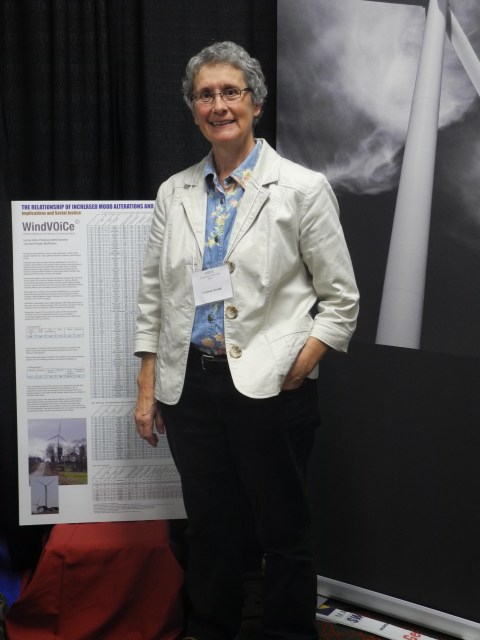
Carmen Krogh presenting her research at a Primary Health Care provider conference

Independent researchers Carmen Krogh and Dr McMurtry  provide a detailed response in the December 2016 edition of  Noise & Health publication to Dr McCunney’s et al critical commentary of the peer reviewed and published paper- Diagnostic criteria for adverse health effects in the environs of wind turbines.

“The content of the article by McCunney et al. suggests that its authors may not have understood the procedure presented for diagnosing patients suffering from ‘annoyance’ and the ‘well-known stress effects of exposure to noise’. While this response does not address all the weaknesses contained in the analysis by McCunney et al., it is our hope it will help clarify understanding of this diagnostic tool. We invite readers to explore the work of McMurtry and Krogh, and as always we welcome constructive commentary.”

Response to McCunney et al.: Wind turbines and health: An examination of a proposed case definition.  http://www.noiseandhealth.org/article.asp?issn=1463-1741;year=2016;volume=18;issue=85;spage=399;epage=402;aulast=McMurtry

Diagnostic criteria for adverse health effects in the environs of wind turbines. https://www.ncbi.nlm.nih.gov/pubmed/25383200

McCunney RJ, Morfeld P, Colby W D, Mundt KA. Wind turbines and health: An examination of a proposed case definition. Noise Health 2015;17:175-81; http://www.noiseandhealth.org/article.asp?issn=1463-1741;year=2015;volume=17;issue=77;spage=175;epage=181;aulast=McCunney

Letter to Trudeau-Give Voice to Families Harmed by Wind Turbines

barb-ashbee
Barb Ashbee and her family were forced out of their home due to adverse health effects from wind turbines

December 14, 2016

Dear Prime Minister Trudeau,

I am writing you to let you know that on September 22nd we received a response from Minister Jane Philpott to our open letter dated June 15. The response is attached. 

Prime Minister, your appointed Health Minister discarded our concern to give voice to the families being impacted by wind turbines. 

She suggested we would hear from departmental officials regarding the Radiation Emitting Devices Act and the Health Canada Wind Turbine Noise and Health Study, which we have received. It is not helpful.

Let me be clear. The families that are being impacted right now as I write this have been waiting years to have voice with our government. Some have passed on from this earth without resolution or acknowledgement of the harm that has been imposed on them without consent.  Your renewable energy policy continues to aggressively promote wind energy while completely ignoring those who are being directly harmed by it.

Many of us have communicated with your governmental departments on the aforementioned health study and the RED Act. If things were settled with those two exercises I can guarantee, we would not be writing to you in plea for an appointment. In fact, the RED Act has been violated and the health study is widely known to be flawed, undoubtedly in effort to support continued implementation. We’re not buying it Prime Minister and we have had enough.

Please, try to understand the frustration at being harmed, literally having to lose our health and our homes by wind turbines that are operating around us. 

Where is the compassion of the Canadian Government for our families? Why are rural people so callously discriminated against as if we do not count when it comes to protection from industrial facilities?

Your Minister “commended” me on advocating for rural communities. How insulting it is to be artificially commended at the same time that our concerns are blown off.  I am not an advocate any more than the 250 people who signed on to the open letter and to the thousands others who have been lodging formal complaints, attending government and community meetings, researching and writing letters to authorities for over 10 years demonstrating the harm to them. Is this a responsible answer when there are suffering families who have lost all hope waiting to hear something meaningful from our government? What of those advocates who are ill right now and who have lost all faith in you and your ministers? Any optimism at your promise to care about all Canadians has been shattered.

I lost my home Prime Minister. My husband and our pets suffered the health impacts from the wind turbine operations to the point we could no longer live there. That was our home. Not coming from entitlement – our families, our homes and our communities are very important to us. Yet these wind turbine projects have had rural families under attack for at least a decade. I recently heard a comment about how undignified protesters can become when government officials present themselves in their communities. Where is the dignity in imposing repeated, unending harm without consent that is never addressed by any official of any level of government? How would you feel and what would you do if your young children were feeling the way these children in rural Ontario feel every day and night?

Do you know how it feels to have extended family members and friends look at you as an oddity because our government continues to tell them there are no problems with noise and infrasound from wind turbines and it is just our bad attitude about them that is causing all of our grief? How degrading.  Do you know how it feels to sit in your driveway at 11 o’clock at night having just finished loading the last bits of your belongings in your car because you had to leave the home you loved, and not for any reasonable life event but because you were bullied and harmed by the very ones who were supposed to protect you? The anger and the pain brought upon families by this government’s irresponsibility is hard to reconcile.

Has this government not recently learned a strong lesson from years of neglect in our Indigenous communities? Yet here you are doing exactly the same thing to rural families. Denying and allowing continued harm is not an answer to this problem any more than it was for our native Canadians. 

Prime Minister, you can rest assured there are a lot of families right now who are suffering from the indignities brought on by these wind turbine projects. My heart is with those families who have lost everything. They have lost the ability to control their health, some have lost their homes or have abandoned them, they’ve lost their livestock and pets, and their children because some parents won’t allow their children to live in their house anymore and have relocated them.

Your Health Minister’s answer is unacceptable. 

You need to act on this Prime Minister and it must be dealt with just as you deal with discrimination and harm to others. We have our own refugees who cannot live in their own homes in this country all due to a bad policy. 

We are all asking once again for a meeting. I hope that your Minister (or you yourself) will reconsider the decision to download these serious concerns onto your departmental officials.

We are asking for collaboration, not defense and deferral, on this serious issue. 

In this spirit I have attached a copy of your mandate to your Health Minister. 

Yours truly,

Barbara Ashbee

676425 Centre Road 

Mulmur, Ontario

L9V 0C8

Excerpts from your mandate:

“Canadians need to have faith in their government’s honesty and willingness to listen. I expect that our work will be informed by performance measurement, evidence, and feedback from Canadians.”

“Canadians expect us, in our work, to reflect the values we all embrace: inclusion, honesty, hard work, fiscal prudence, and generosity of spirit. We will be a government that governs for all Canadians, and I expect you, in your work, to bring Canadians together.”

“When Canadians are in good physical and mental health, they are able to work better, be more productive, and contribute more fully to our economy while living healthier, happier lives.”

” We have committed to an open, honest government that is accountable to Canadians, lives up to the highest ethical standards, and applies the utmost care and prudence in the handling of public funds. I expect you to embody these values in your work and observe the highest ethical standards in everything you do. When dealing with our Cabinet colleagues, Parliament, stakeholders, or the public, it is important that your behaviour and decisions meet Canadians’ well-founded expectations of our government. I want Canadians to look on their own government with pride and trust.”

Posted: http://www.windvictimsontario.com/10/post/2016/12/letter-dear-prime-minister-trudeau.html

Families Forced From Their Homes Win Case Against Enercon

wind-turbine-syndrome

“The case was taken against wind turbine manufacturer Enercon who have accepted full liability for causing nuisance to seven families who live up to 1km from the wind farm.

Seven families in Ireland have succeeded in their legal actions against Enercon for their suffering due to wind turbines erected in November 2011. Punitive damages are to be decided by the High Court in early 2017.

Families forced from homes due to wind farm noise win court case

windturbinessep15_large

A number of families in Co Cork who were forced to leave their homes because of noise from a nearby wind farm have won a significant case in the High Court this week.

The families claim they have been severely impacted by noise since the wind farm began operating in 2011.

This is the first action of its kind in Ireland and may now open many wind farm developers to the prospect of legal challenges from families in similar situations.

The case was taken against wind turbine manufacturer Enercon who have accepted full liability for causing nuisance to seven families who live up to 1km from the wind farm…

READ AT: http://www.breakingnews.ie/ireland/families-forced-from-homes-due-to-wind-farm-noise-win-court-case-768141.html?campaign_id=A100

READ AT: http://en.friends-against-wind.org/oppositions/families-forced-from-homes-due-to-wind-farm-noise-win-court-case

Wind Infrastructure and Fatal Collisions

This slideshow requires JavaScript.

Who is liable?

It can no longer be said that wind infrastructure placements are an accident waiting to happen.  Guardrails, junction boxes and monster transmission poles are all part and parcel of any wind powered installation. Under the Green Energy Act normal planning controls have been removed from the jurisdiction of local municipalities. This has seen transmission poles placed precariously close to road edges in the right of ways along our public roads.  These “engineered” marvels are more then visual blight or examples of questionable planning as they are claiming human lives in multiple fatal collisions.  Recently a transmission pole owned by Kerwood Wind ILP project which is a subsidiary of NextEra was involved in a collision that claimed the life of the car driver and resulted in serious injuries to the passenger .

READ HERE: http://www.strathroytoday.ca/default.asp?pid=9149287&wireid=02598_Kerwood_Road_Fatality_072156#.V_4p2GvbakF.twitter

(Photos Courtesy of Ontario Wind Resistance: Infrastructure located in Kent- Lambton- Middlesex for the wind projects)

This slideshow requires JavaScript.

MPP Monte McNaughton of Kent- Lambton- Middlesex wrote to Minister of Energy Glen Thibeault asking Who is liable?

Letter to Minister of Energy from MPP McNaughton; Nov.10.16


Is it ethical to study harm from wind turbine exposure?

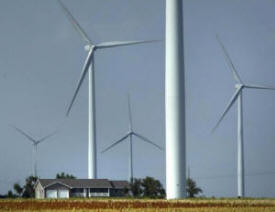
house-surrounded-by-wind-turbinesIn scientific study human research subjects must be informed of possible harms from exposure to give informed consent. Industrial wind turbines have and continue to generated uncounted reports of harmful health impacts suffered by adjacent residents. Huron County Public Health in Ontario is undertaking an investigation in response to the reports they have received. READ MORE: http://www.huronhealthunit.ca/reports-and-statistics/investigations/wind-turbine-investigation/

Richard Mann is an Associate  Professor of  School of Computer Science at the Faculty of Mathematics at the University of Waterloo located in southern Ontario.   His passion is sound.  He is a published and peer reviewed researcher working in partnership pursuing methods to improve measurements of infrasound and recently with his co-author presented at Wind Turbine Noise 2015, INCE/EUROPE, in Glasgow, Scotland in April 2015.

He stated his current position about health investigations into the exposure of noise emitted by Industrial Wind Turbines as follows (Bolded and underlined for emphasis):

“There have also been many surveys and studies regarding human health effects related to Industrial Wind Turbine exposure.  Sadly many of them have actually increased suffering by concluding that the subjects were imagining their symptoms, and by varying degrees, labeling them with the “It’s all in your head” designation.”

It is also of note that while many people did agree to participate in these surveys and studies inthe hope that their concerns would be heard, they were certainly captive participants by being forced to live in proximity to the turbines.”

Letter to Epidemiologist, Dr. Erica Clark of Huron County:


WLGWAG Public Meeting 2016

“This is a community that has said enough is enough,” said Mike Jankowski. Chair WLGWAG

MPP hears of health concerns, excessive tree removal and a new machine to monitor noise

Grimsby Lincoln News December 8,2016

SMITHVILLE—Sam Oosterhoff isn’t an expert on windmills, but the newly elected MPP, did have one thing in common with the members of the West Lincoln Glanbrook Wind Action Group — they both wanted to decrease hydro rates.

Oosterhoff, whose election platform centered on the cost of hydro, connected with the group in their mutual concern about the production of energy in Ontario.

He attended the group’s annual general meeting where he heard about their efforts over the past year and the current state of wind energy in the wake of the Liberal government halting green energy plans.

“Even though the demand for hydro has gone down, our supplies have increased and our costs have increased,” Oosterhoff said to the crowd from inside the Covenant Christian School in Smithville. “We need to be seeing what we can do to make sure it’s competitive across the board.”

Oosterhoff encouraged the crowd to come forward with ideas to tackle the hydro issue and to join the PC Party.

“This is a community that has said enough is enough,” said Mike Jankowski, director of the group.
Speakers at the event reiterated their concerns about the turbines, about the proximity to homes and the physical effect it may have on people. They spoke about the removal of thousands of trees in the area to make way for transmission lines; trees that they say were promised but never replaced.

They also spoke about the overproduction of electricity in the province and the unnecessary amount of debt being incurred by green energy projects such as those in Smithville, Wainfleet and across the province.

The group has now aligned with Wind Concerns Ontario and have purchased equipment that they hope will prove that wind turbines are affecting their health.

 “We have purchased a noise monitoring system,” said Jankowski.

The system, he said, aligns with the Ministry of Environment and Climate change’s monitoring standards.

He hopes that by monitoring the low level noise that is undetected by the human ear they can lay some sort of foundation for government research on the effects of placing wind turbines close to residential dwellings.

Some members of the audience at the meeting spoke of an inability to sleep, a ringing in their heads and a general sense of discomfort since the turbines have went up.

“My goal when I started was, let’s at least erase any doubt as whether or not wind turbine emissions are inside people’s homes,” said Jankowski, who says so far they are picking up noise emissions in nearby homes.

West Lincoln Councilor Joann Chechalk was also present and said she were there to listen.

“I’m very much listening with an open mind,” said Chechalk explaining that she has heard much of the information before.

“The province holds the collar on understanding what that machine is recording; it’s the province that’s going to have to determine whether or not that machine is capturing the information the way that they want it captured.”

READ HERE: http://www.niagarathisweek.com/news-story/7007936-oosterhoff-talks-hydro-rates-with-anti-wind-power-group/

Public Information Meeting 2016

“This Great Blue Heron was found injured along a fenceline south of Smithville on August 28, 2016. Its location was approximately 600 meters west of an Industrial Wind Turbine that had been in testing phase for several previous days. The SPCA was called and the bird was taken away. Remediation was not practical, for both legs were broken. The bird was euthanized a few days later.”    Loretta Shields presentation

West Lincoln Glanbrook Wind Action Group(WLGWAG) held their annual general meeting which was followed by a public information meeting held in alliance with Mothers Against Wind Turbines Inc. (MAWTI). Good eats, good people and good discussions ensued. The meeting was well attended including local West Lincoln Council members and the newly elected MPP of Niagara West- Glanbrook, Sam Oosterhoof.  The MPP took multiple questions ranging from rising electrical rates and included impacts and harms of the wind projects.  The area is the unwilling host of several wind projects including HAF Wind Energy and Niagara Wind.  The groups are hard at work to ensure protection of all residents from the risks now present in our communities.

Public Information Meeting and AGM – December 1st, 2016

The following documents were presented and discussed at WLGWAG & MAWT’s Public Information Meeting session;

1.) What’s New? – Dec. 2016 Update – By Mike Jankowski:
In Niagara, one of the world’s largest wind power generation facilities has risen above our landscape. Here, we discussed a brief overview of recent events, what we are doing about it and who we will work with to see it through.
Click here to view Mike’s presentation.

2.) The High Costs of Keeping the Lights On – By Deb Hughes:
From 2006-15, electricity costs have risen over 60% and continue to. Here, Deb discussed how this happened and explains how Wind Power Generation is playing a significant part in this.
Click here to view Deb’s presentation.

3.) Why We Didn’t Need Wind Capacity and What Really Replaced Coal? – By Catherine Mitchell:
In Ontario, businesses are challenged to be profitable and people struggle to pay their bills due to the high cost of electricity. Here we discuss why we already had extra power capacity without wind and that actually Hydro and Solar did more to replace coal than wind.
Click here to view Catherine’s presentation.

4.) Tree Cutting: Consequences to Ecological Services & Destruction of our Roadside Landscape – By Loretta Shields:
One of the main drivers behind the Green Energy Act was to reduce carbon dioxide emissions.  Carbon dioxide is considered a greenhouse gas, and shown to have a role in climate change.  Trees absorb or “sequester” carbon dioxide, and provide a means to store atmospheric carbon for many, many years.
West Lincoln, Wainfleet and Haldimand lost thousands of trees which were cut down or trimmed to make way for industrial wind power.  Ironically, no remediation plans for the replacement of these trees has been announced by the Niagara Region Wind Farm.  Our Community is now in a deficit position in terms of carbon sequestration.  Other ecological services provided by trees, including oxygen production, habitat for wildlife, the reduction of home emissions due to shading homes (cooling effects) and windbreaks (reducing heating costs) are now also reduced.

US Forest Carbon Calculator:  Click here

Click here to view Loretta’s presentation.

5.) Reporting Issues: What and Where Should I Report? – By Anne Fairfield:
The Ministry of Environment and Climate Change has authority over wind power generation and is the regulator mandated to protect communities. If you experience issues you suspect are due to wind turbines, it is essential you report them. If you do not report – it didn’t happen as far as the documented record is concerned – they can’t manage what they can’t see. Learn what to report and how.

Spills Action Centre: 1-800-268-6060     Call at any time to report
Click here to view Anne’s presentation.

Wind Turbine Investigation

wind-turbine-investigationMedia Release                                  

Huron County Health Unit

FOR IMMEDIATE RELEASE:

November 29, 2016

Information Session on Wind Turbine Investigation

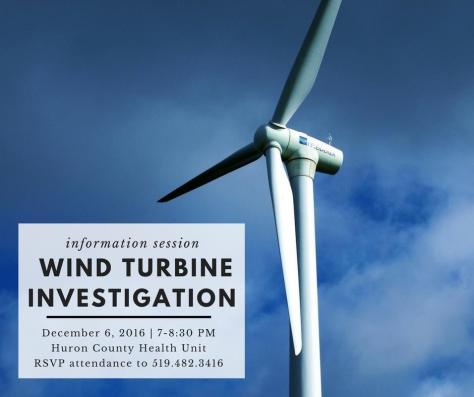
Huron County, ON – Residents of Huron County are invited to an information session hosted by the Huron County Health Unit.  The session is about the upcoming investigation related to reported human health concerns associated with residential proximity to industrial wind turbines.  There will be information on the investigation survey, and time for residents’ questions.

December 6, 2016

7:00 p.m. to 8:30 p.m.

Huron County Health Unit

Health and Library Complex, 77722B London Road, Clinton, Ontario

Please let us know if you plan to attend at 519-482-3416 (dial 0 to speak to the receptionist)

Heat or Eat- Green Energy Benefits Few

energy-povertty-2016“Soaring hydro costs have become an Achilles heel for the Liberal government, which took a costly plunge into green energy in 2009 and has been raked over the coals by the auditor general for ignoring its own energy planners and saddling consumers with billions of dollars above market prices for power.”


High hydro costs sending Ontarians to food banks, report says

By John Miner, The London Free Press

Rising power bills — not just lack of good jobs and high food prices — are forcing hundreds of thousands of Ontarians to turn to food banks, a new report by a food bank umbrella group warns.

In yet another sign of the crisis caused for many in the province by soaring electricity rates, the Ontario Association of Food Banks says the fallout is putting the squeeze on the basic needs of many.

“If people have to choose between keeping the lights on and going hungry, they go without food,”

Carolyn Stewart, executive director of the association, said ahead of Monday’s release of the group’s Hunger Report 2016…

READ AT: http://www.lfpress.com/2016/11/27/new-report-says-soaring-power-bills-help-force-hundreds-of-thousands-in-ontario-to-food-banks