Category Archives: Property Rights

Saugeen Shores Turbine Noise Testing

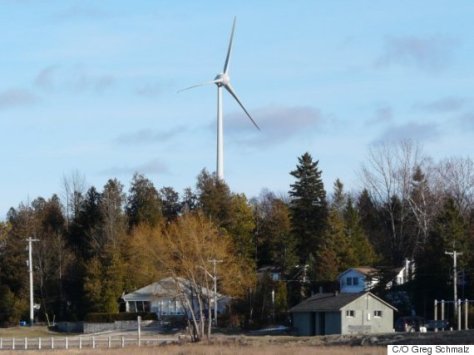
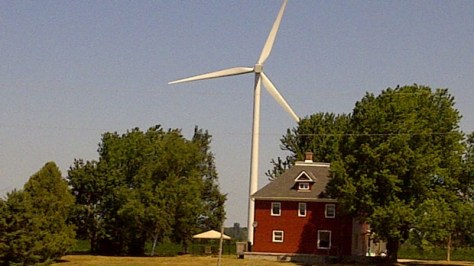
unifor wind turbineThe Unifor wind turbine continues to generate ongoing noise complaints and the residents are fed up with the Ministry of the Environment and Climate Change failure to act. 100’s of complaints and counting. The industrial wind turbine is located adjacent to at least 100 homes within 550 metres of proximity and no independent third party noise audit completed to date.  Turbines and their noise do not make good neighbours.

Saugeen Shores wind turbine testing

Credit:  By Jordan MacKinnon | Blackburn News | March 14, 2017 | blackburnnews.com ~~

Saugeen Shores council is once again taking aim at the Unifor wind turbine.

Council passed a resolution seeking to hire a third-party to conduct parallel testing when the union carries out an acoustic audit this spring of its wind turbine, located at its family education centre at the south end of Port Elgin.

Mayor Mike Smith says there’s ongoing frustration with the Ministry of Environment and Climate Change over inaction toward the turbine, pointing hundreds of complaints have been filed and preliminary data suggests the turbine has operated outside of its noise regulations in the past.

The acoustic audit of the Unifor wind turbine had been slated to be completed last year, but was delayed on several occasions and is now scheduled to be completed by the end of June.

Smith says they are fed up with the Ministry of Environment.

The delays in completing the acoustic audit prompted Saugeen Shores council to file a complaint with the Ontario Ombudsman’s office this past October and Smith says he recently received confirmation that the ombudsman is still investigating the complaint.

About 100 homes and cottages are located within the 550-metre setback typically required for industrial wind turbines.

READ AT: http://blackburnnews.com/midwestern-ontario/midwestern-ontario-news/2017/03/14/saugeen-shores-wind-turbine-testing/

Wind Power is an attack on Rural America

farm-and-turbinesBy: Robert Byrce  February 27, 2017

Urban voters may like the idea of using more wind and solar energy, but the push for large-scale renewables is creating land-use conflicts in rural regions from Maryland to California and Ontario to Loch Ness.

Since 2015, more than 120 government entities in about two dozen states have moved to reject or restrict the land-devouring, subsidy-fueled sprawl of the wind industry.

The backlash continued last month when a judge in Maryland ruled that the possible benefits of a proposed 17-turbine project did “not justify or offset subjecting the local community to the adverse impacts that will result from the wind project’s construction and operation.” The judge’s ruling probably spells the end of an eight-year battle that pitted local homeowners and Allegany County against the developer of the 60-megawatt project.

Objections to the encroachment of wind energy installations don’t fit the environmentalists’ narrative. The backlash undermines the claim – often repeated by climate activists such as 350.org founder Bill McKibben and Stanford engineering professor Mark Jacobson – that we can run our entire economy on nothing but energy from the wind and sun. Many of those same activists routinely demonize natural gas and hydraulic fracturing even though the physical footprint of gas production is far smaller than that of wind. Three years ago, the late David J.C. MacKay, then a professor at the University of Cambridge, calculated that wind energy requires about 700 times more land to produce the same amount of energy as a fracking site.
house-and-turbines-1
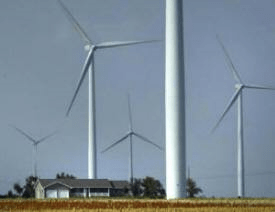
Rural residents are objecting to wind projects to protect their property values and viewsheds. They don’t want to live next door to industrial-scale wind farms. They don’t want to see the red-blinking lights atop the turbines, all night, every night for the rest of their lives. Nor do they want to be subjected to the audible and inaudible noise the turbines produce.

Even in California, which has mandated that 50% of the electricity sold in the state be produced from renewable energy sources by 2030, there is resistance to wind power. In 2015, the Los Angeles County Board of Supervisors voted unanimously to ban wind turbines in L.A.’s unincorporated areas. At the hearing on the measure, then-Supervisor Michael D. Antonovich said the skyscraper-sized turbines “create visual blight … [and] contradict the county’s rural dark skies ordinance.”

In New York, angry fishermen are suing to stop an offshore wind project that could be built in the heart of one of the best squid fisheries on the Eastern Seaboard. Three upstate counties – Erie, Orleans and Niagara – as well as the towns of Yates and Somerset, are fighting a proposed 200-megawatt project that aims to put dozens of turbines on the shores of Lake Ontario. As in California, New York has a “50 by 30” renewable-energy mandate.

Outside the U.S., about 90 towns in Ontario have declared themselves “unwilling hosts” to wind projects.In April 2016, a wind project near Scotland’s famous Loch Ness was rejected by local authorities because of its potential negative effect on tourism. Poland and the German state of Bavaria have effectively banned wind turbines by implementing a rule that allows turbines to be located no closer than 10 times their height to homes or other sensitive areas.

The defeat of the Maryland wind project came as a relief to K. Darlene Park, a resident of Frostburg and the president of Allegany Neighbors & Citizens for Home Owners Rights. “We were up against an army of suits,” she told me. “It’s like a brick has been taken off our shoulders.”Park’s tiny group relied on volunteers and a budget of about $20,000 as it fought the turbines all the way to the state’s public service commission.

Neither the communications director nor the CEO of the American Wind Energy Assn., which spends more than $20 million per year promoting wind power, would comment on the rural opposition to wind turbines. Their refusal isn’t surprising. If the wind lobby – and their myriad allies at the Sierra Club, Natural Resources Defense Council and other environmental groups – acknowledges turbines’ negative effects on landscapes and rural quality of life, it would subvert their claims that wind energy is truly green.

Just as problematic for the industry’s future: to increase wind-energy production to the levels needed to displace significant quantities of coal, oil and natural gas will require erecting more – and taller – turbines (new models reach to 700 feet). But the more turbines that get installed, and the taller they are, the more nearby residents are likely to object.

Wind energy simply requires too much territory. That means we can’t rely on it for major cuts in emissions. Indeed, the more wind energy encroaches on small towns and suburbs, the more resistance it will face. That resistance will come from homeowners like Park who told me, “We feel this renewable energy push is an attack on rural America.”

Robert Bryce is a fellow at the Manhattan Institute and the author, most recently, of “Smaller Faster Lighter Denser Cheaper: How Innovation Keeps Proving the Catastrophists Wrong.”

READ AT: http://www.latimes.com/opinion/op-ed/la-oe-bryce-backlash-against-wind-energy-20170227-story.html

Take Care of the Land.

clinton-county-wind

“Take care of the land, because they aren’t going to make anymore.”

Dear Editor:

Wendell Berry, an American environmental activist, cultural critic and farmer says it best: “The economy of money has infiltrated and subverted the economies of nature, energy and the human spirit.” Berry is an educated farmer who is the sum of what he believes. Government, he believes, should take its sense of reality from the ground beneath our feet and from our connections with our fellow human beings.

Last summer, The Clinton County Planning and Zoning Board held a series of hearings as to whether or not industrial (skyscraper sized) wind turbines be allowed to be built in Clinton County. These hearings presented (under-oath) testimony from expert witnesses from all over the country (and Canada) on both sides of the issue.

One of the topics discussed and testified to in a 6-hour session was the question of property values. I am going to refer to research done and testified to in the hearings by Mike McCann of Mike McCann Appraisers, LLC. Mr. McCann has done decades of studies and appraisals of properties located near wind turbine developments. His studies indicate that losses in value can be up to 40% where turbines are up to 3 miles from homes. He referred to a current study by the Economic Financial Studies School of Business at Clarkson University. The Clarkson study clearly shows value impacts out to three miles…..and clearly shows the closer the turbine, the greater the impact.

I found it most interesting that some of the loss of value happens when communities get “wind” of a turbine project coming to their areas and even greater when the project gets built. The value continues to go down when people hear of pending and increased wind turbine projects coming to their areas or neighboring communities. These can be staggering, in my opinion, and cause a no-growth epidemic in counties with potential wind turbine project growth. I can only guess that is why you see abandoned farms and homes in the middle of turbines.

Lastly, but not surprising, I want to list a small portion of the reasons these will affect your property values. They cannot be disputed.

1. Audible sound and low frequency sound.

2. Health concerns and widely reported adverse effects at sites.

3. Sleep deprivation due to noise and flashing red lights.

4. Aesthetic impact due to introduction of large industrial-scale turbines into immediate neighborhoods, which affects perception of compatibility and view from residential property values.

On the last day of the hearings in Clinton County, over 40 residents got up and gave compelling testimony of their own. I will always remember when Clinton County resident Mindy Masters quoted her dad John Thompson with a phrase he always told her as a young child. “Take care of the land, because they aren’t going to make anymore.”

Leslie Dyer,

Is there a remedy to Industrial Wind Turbines?

Is there a Remedy for People Suffering, Health Issues, Financially, etc. from Industrial Wind Turbines in Ontario ?– approximately 7700 planned for Ontario.

shawn-tricia
Trish & Shawn Drennan

“Congratulations to Trish and Shawn Drennan!”

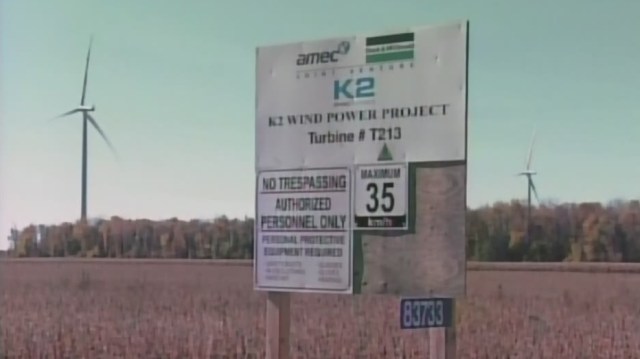
The Goderich Superior Court Room was filled to capacity when Shawn and Trish Drennan went to Court on January 19th to reverse the negative impact that the 140 Industrial Wind Turbine Project (K2), two transformer stations and several transmission lines have on their family, home and their Heritage Farm operation.

They put a compelling and sensible case together and spoke with passion and the strength of truth behind their words.  One comment was that some felt they were witnessing an important step in this fight.  I heard, from a lawyer,… “that a lawyer could not have done a better job in arguing the case”.  Most felt the judge really got it and it was in no small part because of the time, work, expense and personal sacrifice they both have given to their case to put the facts on the table.

shawn-drennan
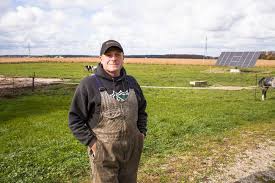
Shawn Drennan at home on his farm operation

Shawn, “presented himself”, and told the court that the government has created an impossible barrier when he has to prove “Serious Harm to human health” at an Environmental Review Tribunal (ERT), when the turbines have not been installed or in operation yet. The ERT appeals and Divisional Court Hearings occur prior to the IWTs becoming operational. The Divisional Court also confirmed that the ERT’s lack the jurisdiction to determine the validly of section 47.5 of the Environmental Protection Act (EPA) and its constitutionality. In addition, to date, there appears to be no definition for the term “Serious Harm” even after all the ERT’s, Judicial Reviews and Divisional Court cases here in Ontario.

Shawn declared that the many witnesses who have come forward to testify that they have been harmed by turbines all over this province have not been given the gravity and respect they deserve for putting their testimony forward.  Shawn told the hearing that the government and K2 knew the turbines will harm people even before wind project proposals and permits went ahead.  The Canadian Wind Energy Association (CanWEA) lobbied the government to remove Infra and Low Frequency Sound regulations and testing when the Green Energy Act was written and this requirement was subsequently removed. If Judge Raikes had asked, at least half or more of the people in the court room that day could have stood up and said, “ I am the evidence of harm from Industrial Wind Turbines (IWTs).”

Shawn told the hearing that the difference between then, (ERT Hearings prior to operation) and now (May 29 2015), is that now the switch has been turned on, and the IWT’s are operational and we are being harmed.k2-wind-turbine

Judge Raikes challenged K2 and the MOE to tell him what remedy the Drennans have besides more time in court. We all watched them try to answer to no avail, because as was pointed out the only remedy right now is to move away. “Most people do not want to move away to begin with but do so to regain health.  They  are often penalized yet again when they have to lower the sales price to even get the home sold.

kingsbridge-120910
Home with a K2 industrial wind turbine just a few hundred metres away

When Judge Raikes looked at the K2 lawyer, Mr Bredt,  the judge tried to paraphrase what the lawyer had just said to him, “ So, the Drennans went to the ERT and Divisional Court, have complained to MOE, and still have no remedy, so it’s tough luck for them?  Bredt replied, “Yes.” which drew gasps of disbelief from the full gallery of people who attended.

When it came time to argue about who should be named as defendants in the Charter Challenge; K2 and /or govt., it was interesting to watch the judge see both parties try to throw each other under the bus.

Those in attendance are waiting to hear Judge Raikes decision and keep their fingers crossed that Shawn and Trish can move forward in finding a remedy for the harm they have experienced.  This hearing has implications for property owners and people living within at least a 10 km radius of a turbine project here in Ontario.

Thank you, on behalf of a whole lot of us in Ontario.

Dave Hemingway, Reporter, The Landowner

Niagara Wind CLC Meeting #4

enercon-wind-turbine

Tuesday February 7th, 2017 | 6pm
Wellandport Community Centre
5042 Canborough Road
Wellandport, ON L0R 2J0

The purpose of the CLC is to facilitate two-way communication between NRWF and CLC members with respect to issues relating to the construction, installation, use, operation, maintenance and retirement of the facility. All CLC meetings are open to the general public for observation.

Questions can be submitted in advance up until January 31st to Karla Kolli, CLC Chair and Facilitator at kkolli@dillon.ca or 416-229-4647 ext. 2354.

Ocotillo Wind Turbine 126 Collapse

November 21, 2016  turbine 126 suffered a catastrophic structural collapse as documented in photos shared on Facebook. Ocotillo Wind Energy consists of 112- 2.37 MW Siemens  wind turbines. The project was built on California public lands by Pattern Energy and began commercial operations in 2013.  It is now 3 years and the project continues to demonstrate ongoing structural and operational issues for this ill conceived facility.

The project responded with the following statement:

“Ocotillo Wind

On November 21, 2016, one of the turbines at the Ocotillo Wind facility fell within the designated setback zone surrounding the turbine’s base. No one was injured in the incident. We are working closely with the turbine manufacturer, Siemens, to identify the root cause of the failure and a full investigation is currently underway. Relevant authorities have also been notified.

Our first priority is the safety of our employees, contractors, neighbors and the environment. We are taking this issue very seriously and will communicate more information as it becomes available.

Pattern Energy is proud to be part of the Imperial Valley. Our Ocotillo Wind facility is an investment in the region that is creating many economic benefits, including jobs and substantial growth in the property tax base.

The facility supports local initiatives through the Ocotillo Wind Community Benefits Program, which established the Ocotillo Wind Community Fund, Ocotillo Wind Education Fund and Ocotillo Wind Imperial Valley Fund, and is administered by the Imperial Valley Community Foundation. Sign up here to receive updates about the community benefits program and facility news.

Pattern Energy is focused on being a responsible community partner by respecting the land, its resources and the people of the Imperial Valley. The Ocotillo Wind facility is located on public lands administered by the BLM, with a small portion on lands under the jurisdiction of Imperial County. The permanent footprint is approximately 120 acres, which is less than 1% of the total project area, allowing the overwhelming majority of the project land to be preserved in its natural state and allowing the project infrastructure to be sited in areas that do not directly impact cultural resources.”

READ AT: http://www.ocotillowind.com/

Why Size Matters

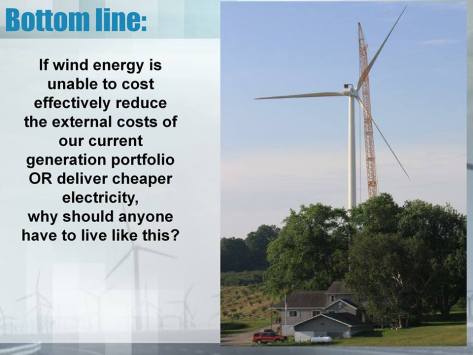
why-would-anyone-live-like-thisWhy pro-wind studies often use a 10 km radius

Author:  Salt, Alec | Health, Property values (published 2011)

Last week I was reading of an Australian study, by a Professor Gary Wittert, which had shown sleeping pill usage for those living near wind turbines was no greater than the general population . The study compared those living within 10 km of turbines with those living more than 10 km away. There have been similar studies with property values using a 5 mile or 10 km radius that showed property values are not affected by wind turbines. Had you ever thought why they pick a 10 km radius?

Consider this graphic. It shows 1 km bands with the calculated area for each band shown in blue.

Let’s keep it easy and assume that households are evenly distributed and there is one household for every 10 square kilometers.

So, within 2 km (the two innermost bands) of the turbine, the area is 3.1 + 9.4 km² (=12.5 km²) which would represent 1.2 households.

Now let’s consider the two outermost (9 km and 10 km) bands. The area of these bands is 53.4 + 59.7 km² (=113.1 km²) which represents 11.3 households. So the outermost bands have about TEN TIMES the number of households of those living within 2 km, making sure that the contribution of the inner bands is diluted, swamped, covered up or however else you would describe it.

Or consider if you live within 2 km of a turbine. The outer bands of those living from 2–10 km from the turbine adds up to 301.6 km², which would represent 30.1 households – which is 24 TIMES the number of households within 2 km.

No wonder your voice is being “drowned out”. The bigger the circle, the more “dilution” occurs.

Add this to the list of things where “size matters”, and next time you see a study like this, consider the radius and area that was chosen. The choice of the circle size plays a major role in the result obtained and speaks volumes about the motivation of the author.

by Alec Salt, Professor, Department of Otolaryngology, Washington University School of Medicine


Hungarian Law that would Kill wind turbines

hungarian-wind“Hungary’s President János Áder has referred an amendment of the electricity act back to Parliament for review for it has practically bans the installation of wind turbines in the country. ”

October 21, 2016, 1:27 pm  english version Hungarian version

The Hungarian government created a series of new regulations with the aim to prohibit the installation of new wind turbines in the country. The amendment of the energy law was worded carefully so it does not explicitly ban wind farms since the EU would most certainly object to that. Instead, the new law bans wind turbines in a 12-kilometre radius around populated areas.

A colleague of the Faculty of Science at the Eötvös Loránd University created a map with a geoinformatics software which illustrates the areas where the law applies. Red marks the banned and white the permitted areas. Cannot see any white spots? Exactly!

Áder referred the bill approved on 11 October back to Parliament for a review, saying it

  • does not help the execution of the Paris climate agreement (At the Paris climate conference in December 2015, 195 countries adopted the first-ever universal, legally binding global climate deal. The agreement, which is due to enter into force in 2020, sets out a global action plan to put the world on track to avoid dangerous climate change by limiting global warming to well below 2°C.)
  • contradicts the action plan on the utilisation of renewable energy for 2010-2020; and
  • implements unjustified administrative restrictions.

 The government secured itself from all sides against wind turbines. Additional clauses in the new law stipulate that wind turbines cannot be installed “within 40 km of Hungarian Defence Force radars, and within 15 km of military airports”, as well as any area where they would “decrease military and defence capabilities”.

According to another clause, the installation of wind turbines on agricultural land is restricted to those which have been officially out of cultivation for at least three years. Additionally, only 2-megawatt wind turbines, i.e. those with outdated technology are allowed and at no more than 100 m height.

READ AT:  http://www.portfolio.hu/en/economy/hungarian_president_throws_back_law_that_would_kill_wind_turbines.31987.html


Random Niagara Wind- A Lousy Neighbour

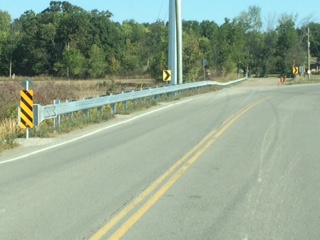
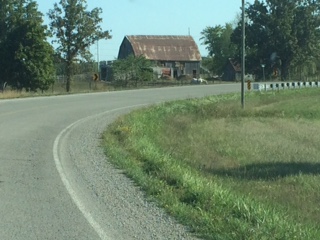
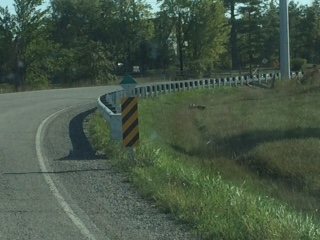
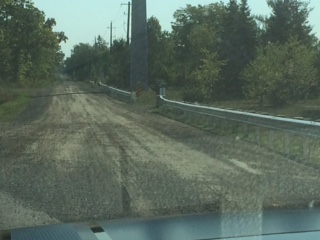
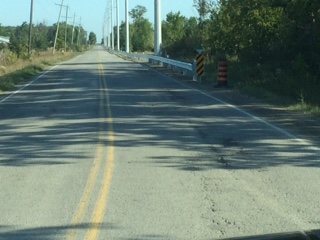
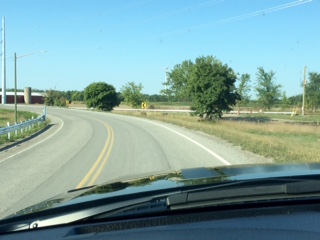
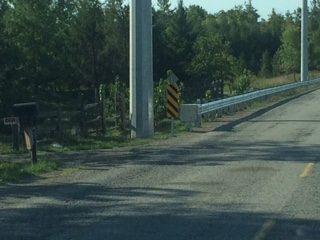
What are they thinking?  Look at the following pictures of the guardrails being installed in West Lincoln for the Niagara Wind project to protect their hydro poles.  They are taken as if viewed while driving north from Smithville and show the random and lack of a consistent pattern in guardrail installation at various locations:

1


Some guardrails are many feet past the hydro poles and some are

even shorter…


Coming into the bend…

2

In the middle of the bend…3


In front of the neighbour’s house…4

Coming out of the turn! Come winter this could be a real danger! People coming out of the turn could slam right into this mess…5


This picture is heading south …6

Final photo of today’s drive- The section of guardrail doesn’t even cover the  hydro pole!

(but it sure does”enhance” the value of the neighbour’s frontage)

7

Wind projects make lousy neighbours.

Turbine Collapses when is it too close?

PointTupper_Canada_Enercon-20160822111754578

August 17, 2016 in Nova Scotia an Enercon turbine collapsed. The technician working in the turbine was able to exit the turbine safely.

Source: http://www.windpowermonthly.com/article/1406395/enercon-investigating-turbine-incident-Canada

“Enercon has launched an investigation into the collapse of a turbine at the 23.3MW Point Tupper wind farm located close to Port Hawkesbury in Nova Scotia, Canada.

The German turbine manufacturer said the incident, which occurred during a component exchange last Wednesday, triggered an evacuation alarm before the turbine collapsed and that nobody was injured.

The wind farm was developed by a joint venture between Canada’s Renewable Energy Services, which is the controlling shareholder, and Nova Scotia Power.

It uses Enercon E-82 and Enercon E-48 turbines, although Enercon did not specify which model was involved in the collapse.

“With close to 1000 wind turbines installed in Canada over the course of the last 15 years, this is the first time that such an event has occurred,” Enercon said in a statement.

A technical team is probing the incident, which did not occur during regular operations and is “undoubtedly an isolated one”, Enercon said…”

READ MORE: http://renews.biz/103859/enercon-probes-canadian-collapse/#.V7srAMS-P6U.twitter

A dramatic multiple turbine collapse event involving 8 Enercon turbines occurred in Brazil during an extreme weather event in 2014.

Source: http://www.portal-energia.com/forte-tempestade-derruba-8-aerogeradores-em-parque-eolico-no-rs-brasil/

The issue of turbine failures,setbacks to homes and safety was heard at the tribunal appeal hearing challenging the renewable energy approval granted for the Niagara Wind project.  The community was assured by their experts that catastrophic turbine failures and component liberation are rare events and the setbacks in the project are adequate.

The chart below is taken from the closing written reply of Mothers Against Wind Turbines and gives the reader an idea of how close the 3MW Enercon 101 turbines of 124m in height are placed to homes in the Niagara Wind project.

Ontario’s 550 metre setback and noise limits are waived if you agree to host a turbine on your land.  Something to ponder in light of the recent “isolated” event.

155. Participating receptors predicted noise exposure levels as extracted from the Niagara Region Wind Farm Noise Assessment Report, September 30, 2014   often exceed the 40 dBA worst case sound power level thresholds detailed in the chart below:

“P” stands for participating


Receptor Number


Sound Limit in dBA


Distance to Closet Turbine


Closet Turbine


Page of Noise Assessment Report

P1191 40.6 529 m T75 Pg.40 of 291
P1235 41.3 451m T75 40
P1562 41.5 370m T36 40
P1610 42.7 429m T36 40
P1666 46 253m T65 40
P1688 40.6 612m T01 40
P1703 41.7 488m T65 40
P1711 40.3 702m T01 40
P1765 41.4 590m T76 40
P1846 41 629m T76 40
P1848 41.5 427m T55 40
P1872 41 593m T76 40
P191 43.4 336m T88 40
P1981 40.2 671m T76 40
P2293 40.2 573m T31 40
P2529 40.5 446m T56 40
P2548 40.9 632m T33 40
P2550 40.9 693m T34 40
P2579 43.8 380m T33 40
P2590 45.4 280m T35 40
P2614 41.4 693m T02 40
P2636 40.6 506m T35 40
P2640 41.1 510m T23 40
P3160 40.4 564m T18 40
P3171 40.3 574m T60 40
P3893 41.7 425m T24 41
P3897 42.1 398m T04 41
P411 40.4 563m T51 41
P439 40.3 546m T39 41
P580 40.1 537m T90 41
P595 44.7 299m T94 41
P689 44 289m T07 41