“How do you report that birds are taken, are you counting them, and are they reporting them?” Kasperik asked.
“The short answer is, no,” Abbott said.
“Pretty much with all the projects out there, unless the company that is running that operation is going out there and conducting surveys of their own, there are no data being collected in terms of the number of migratory birds being taken.”
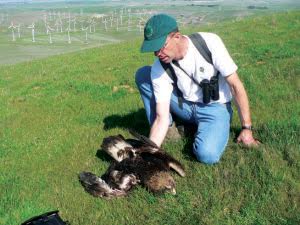
Doug Bell of the East Bay Regional Park District, in a 2007 photo with a golden eagle found near turbines in California’s Altamont Pass Wind Resource Area. The raptor, which had a compound wing fracture, later was euthanized. Janice Gan/Courtesy East Bay Regional Park District
Eagle Take Permit Considered at Hearing
A new federal regulation that would give the wind industry 30-year permits for unintentional eagle deaths was the topic of a recent legislative committee hearing in Casper.
The issue centers on a 2013 U.S. Fish and Wildlife decision that increased the length of eagle take permits from the current five years to 30, but only for wind energy projects and related infrastructure, such as transmission facilities.
A federal judge in California struck down the rule in 2014, shortly after it was issued, after conservation groups challenged it on environmental grounds. This past February the federal government decided it was not going to appeal the court’s decision.
Tyler Abbott, a deputy field supervisor for the U.S. Fish and Wildlife Service, Wyoming Ecological Services, told the Select Federal Natural Resources Management Committee that a new rule was emerging as a result of those actions.
“The Fish and Wildlife Service … is in the process of developing some definitions, some draft regulations and an environmental impact statement that could potentially lead to the authorization of an incidental take permit in the future, but right now it’s in development, and it’s not active legally,” Abbott said.
The proposed new rule would continue to allow 30-year permits for wind energy, but it now also includes a review every five years, bringing it somewhat in line with present permit length. The rule also has stipulations that companies seeking eagle take permits work collaboratively with Fish and Wildlife on a bird protection plan.
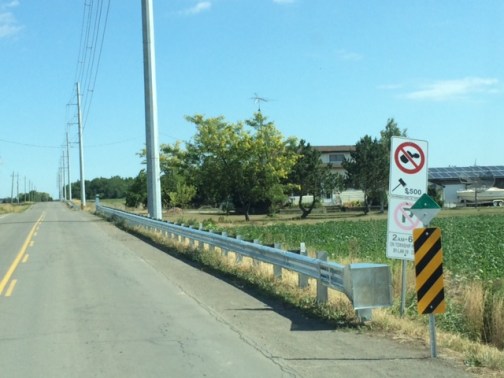
WEST LINCOLN — When massive transmission towers were erected alongside rural roads, farmers took notice. Now that guide rails have been installed alongside them, those concerns have been amplified.
Since the rails were installed in close proximity to Port Davidson Road several farmers have reached out to the local office of the Ontario Federation of Agriculture to express their concerns. Chief among them is road safety.
“The poles raised concerns about safety, being that close to the road,” said Henry Swierenga, OFA member services representative. “The guiderails are even closer. It’s a concern for the farm community and the travelling public. Unfortunately, we’ve had incidents involving farm equipment in the past and this just adds to the risk.
“There’s not a lot of room to get yourself out of trouble.”
According to Montreal-based Boralex, which owns a 25-per-cent stake in the Niagara Region Wind Farm project, the guide rails have been installed to follow provincial road safety regulations and with the approval of the local municipality.
“We have contracted a professional engineering consulting firm to do the design of these, including defining how close to/far away from the road the guide rails should be,” said Marc Weatherill, project manager, via email. “That said, we have asked them to keep the guide rails as far from the road as possible so that there is room for larger vehicles and equipment to pass through, particularly farm equipment.”
Weatherill said they are working with the municipal and regional governments on the placement of the guide rails.
“We are working together with local representatives and professional advisors to do what we can to keep the guide rails away from the road while still abiding by road safety regulations,” he said.
Farmers say those considerations are not enough, and the placement will present a challenge in just a few weeks when the harvest begins.
Cash crop farmer John Sikkens said it’s a risk every time he takes his large machinery down the road. While the majority of drivers are patient with farmers, there are some who are in such a hurry they put themselves and farmers in danger, he said. Sikkens said there is not much room to pass as it is on rural roads in the township, as shoulders are close to non-existent. He suspects the guide rails will present challenges come fall when crops like soybean and corn need to be harvested….
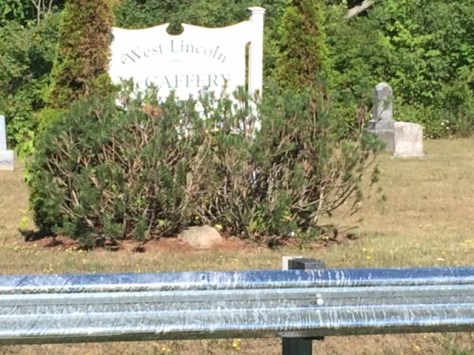
Niagara Wind blocked access to the West Lincoln McCaffery heritage cemetery at the beginning of August. The guardrails are installed along the rural road edges to protect huge transmission poles required for the sprawling intrusive 77 industrial wind turbine complex.
Responding to complaints a portion of the guardrail has been cut out to allow access to the cemetery.
McCaffery Cemetry Niagara Wind Guardrail now cut to allow access
Guardrails of Niagara Wind
Guardrails and massive hydro poles & transmission lines of Niagara Wind
Just wondered since I have never had a reply to my question regarding all the excess guard rail being put up on Port Davidson Road, if there had been any resolution to what was considered safe and what was considered overkill. I supplied some photos in my last email which I will include again in this email of guard rail that is 6 lengths(approx. 72′ ) and some that is 27 lengths (approx. 324′ ) past the transmission towers. My question was if 6 lengths is safe in one spot (actually more then one spot along the road), why do we need to cover someone’s entire road frontage including their beautiful homes with 27 lengths of this horrible looking guard rail that they need to now trim around weekly and look at day after day??
Going back to the cemetery if only 6 lengths are used there most of the frontage for the cemetery will be open and it will still be safe for motorists. If 6 lengths are not safe enough what is being done to change those areas?
On August 24, 2016, Barbara Ashbee from Ontario wrote to Marie-Eve Héroux, member of the panel developing the WHO Environmental Noise Guidelines for the European Region:
Dear Mme. Héroux,
My name is Barbara Ashbee.
I live in Mulmur, Dufferin County, Ontario and I am writing to submit information on wind turbine noise in our communities to include in your research.
An industrial wind turbine installation had serious impact on our family personally and many others in our neighbourhood, our province, country and globally.
I have met with many impacted families here in Ontario and have corresponded with others out of province. I didn’t know any of these people before the effects of wind turbines changed our lives.
In 2008/2009 my husband and I both had our health seriously impacted after a turbine project started up around our home. The adverse health effects started petty much right away.
We had loud cyclical noise and a vibration and humming in our house that made sleep impossible, ongoing, multiple nights in a row. I had no idea how serious and dangerous sleep deprivation was until I experienced it first-hand. Due to ongoing exposure to the emissions from the turbines our health declined to the point that we had to leave our home.
My husband and I were both healthy and happy adults. We took no medications and we enjoyed life and our work outside the home. We had purchased our bungalow 3 years before the turbine project was built and had done a lot of updating with plans for it to be our retirement home. We were building my husband’s new garage/workshop at the same time the turbines were being built. We had no idea that they were going to cause us problems as we had not heard of any issues from the first phase that was erected in 2006. I was taking photos and sharing them with my family as the project was erected. In fact when one of our neighbours came to us in 2006 and asked if we would have any concerns with them putting one on their property we said of course not.
We were not anti-turbine or anti-wind and we had not been informed by anyone that there were problems.
We were harmed by these wind turbines surrounding us and even as we had engineering noise reports showing out of compliance cyclical noise, a vibration and infrasound measured inside of our home and dirty electricity our government continued to tell us that the wind company was running in compliance and there was nothing they could do. Only after our pleas to our government and attempts to have the noise and vibration problems corrected did we find out that there had been many families before us that had been billeted, bought out by the developer, or forced to move because they couldn’t take living in their homes anymore.
Along with sleep deprivation we experienced headaches, stomach aches, episodes of dizziness, nausea, impaired cognitive and memory function, heart palpitations and chest pressure, infection requiring antibiotics, pressure in the head and ears, a bleeding nose that required liquid nitrogen treatment, and just before we moved out of our home my husband was diagnosed with hyper thyroidism, something he had never had before. We knew what was causing it and informed his specialist. He was not put on any medication and after we moved his levels returned to normal and he has not had an issue since.
Being exposed to the cyclical noise, the low frequency noise and infrasound left us physically ill and with no resolution offered and no ability to shut the turbines off, we were completely disempowered. Unable to have the problems fixed and unable to stay in the home we loved has been very distressing. The realization that our lives were deemed worthless by authorities was hard to take.
Our pets were also affected with one dog in particular whimpering and crying when the conditions were the worst. They were at times antsy, restless and bothered, sometimes crying, sometimes going from room to room. It was not normal behaviour. It was heartbreaking and so we started to look for a place to move. We asked locally about renting a mobile home to park on our driveway to get out of our house. We were not successful. We moved our bed into our detached garage but the noise and vibration was no better. We started to make inquiries about renting another house but with three dogs and 2 cats it was not easy and it is extremely hard to leave everything we had knowing that if they would just shut the project off we could at least get some sleep. We kept hoping a solution was around the corner. We just kept trying to resolve it.
An attempt by the wind company was made to move us to a property that they had purchased one concession over from us but it was rank with mold so we had to abort that. In the end we purchased a tent and we moved our bed, a night table, a lamp and a heater out into the tent and spent our remaining days on our property sleeping outside. The vibration was not as bad as it was in the house and they had agreed to shut 5 surrounding turbines down. While it was pretty cold some nights, it was better than in our house. Our pets slept outside with us.
I am quite confident you will hear the word torturous from other impacted people and I can attest to the fact that description nails it. To be deprived of sleep, with no power to shut the noise or vibration off, to have your health decline from the impacts of the noise, infrasound and vibration in the sanctity of your own home, the very place you normally turn for restorative sleep and relaxation is pure torture. It is unbearable. It is spirit crushing and heartbreaking.
The ultimate insult of having gone through this, to having fought for our home and lost, to losing faith and trust in any authority that we thought was concerned about people’s health and wellness, is to have it happen to even more families in our area and globally because it continues.
Were you to meet any of these families, the small children, the seniors, teens, it doesn’t matter age, gender, race, religion or economic background, if you could meet with these people and listen to them, it would be a huge step in understanding. Please, as you consider the research, the academic input, the physicians, acousticians and others who are giving you information, please also talk to the people. Talk to the ones who have been harmed. Talk with the families who have first-hand experience. You will find their personal accounts and symptoms are the same regardless of what country they come from or what language they speak.
I am appealing to you to investigate fully and to order turbines cease operation until the people have had a genuine hearing of their complaints. Nobody consented to having their lives so negatively impacted. This is clearly a case of terribly flawed policy trumping health and wellness.
It should never have happened.
– Attached is a compilation of statements from wind turbine affected families in Ontario that were drawn from early news reports, personal comments from meetings and testimony from different communities in Ontario. This compilation is a number of years old now and represents a small snapshot of affected families. The purpose for compiling it was to inform our government that the complaints are the same and that they are growing. Hundreds more turbines have been built since and every project has additional impacted families. Not only did early turbine projects cause harm but the newer turbines are much larger and yet the setbacks remain the same. Wind Turbine Impacts in Ontario – A small collection of testimony
– I am attaching an abatement plan, drawn up by Ministry of Environment field officers in our area that ultimately never made it to the public. It was shelved by authorities.
The officers acknowledged and reported on many occasions that they knew people were being harmed and that it was not trivial but nothing happened to help the people they were trying to help. FOI_1NR_03046.pdf FOI_P00_03046_11.12 02.pdf
– This is a link to windvictimsontario.com where testimony, video statements, and interviews of impacted people can be found. Much of this info is found on websites as no ministry or agency in any level of government in Canada has gathered or reviewed the complaints.
In the past 8 years since this happened to us, I could supply reams of letters, documents and testimony all supporting the need for an investigation and for the turbine projects to cease operating so innocent families can live in their own homes and try to recuperate from the turbine emissions that harm them.
The people living among these wind power centers need relief.
That these projects are allowed to continue to operate where complaints, illness and home abandonment have been made is cruel and inhumane.
Please keep me posted on your progress with your research and please contact me if I can help in any way. I am pleading with great urgency that you please help those who are being impacted right now.
There stands to be a landmark Huron County Board of Health Meeting, Thursday, September 1, 2016, starting at 9:00 a.m.in the Auditorium of the Health and Library Complex, Huron County Health Unit, 77722B London Rd., Clinton, Ontario.
Under section 8.1 of the agenda is a recommended motion that
“the Board of Health agrees to the request made during its August 4, 2016 meeting for the Health Unit’s participation in the proposed investigation into wind turbines and reported associated human health effects, to be conducted in partnership with Wind Concerns Ontario and the University of Waterloo”
It is expected that the Board will pass the above motion. Given the public is typically not allowed to speak, I would hope there will also be additional clarification on next steps, providing residents with an opportunity to make informed choices on how each can best support efforts moving forward.
Many people are suffering and I encourage everyone who is able to please attend. A crowd in the public gallery at these meetings is important and powerful. Don’t leave it to others to show up and please pass the word along to family, friends and neighbours.
It takes great courage for people to share their concerns, especially when it comes to something as personal as health. Tremendous efforts on the part of many have brought us to this point and I want to thank all who have worked so hard to ensure the health concerns of Huron County residents are going to be addressed.
In the run up to the Association of Municipalities of Ontario 2016 Conference this week in Windsor, mayors and municipal councillors from across Ontario, together with representatives from the Independent Electrical Systems Operator (IESO), attended a symposium on wind turbine development in the province.
They are calling on the Ontario Liberal government for a moratorium on the procurement of new renewable energy infrastructure, including solar.
Prince Edward County Mayor Robert Quaiff was the symposium’s moderator.
“For the past few years, municipalities from across the province have repeatedly raised their concerns over the procurement process of Industrial Wind Turbines (IWT) to the provincial liberal government. To date, the government has taken no actions to resolve these concerns,” said Quaiff. “As moderator, I witnessed the level of anger and frustration that other municipal representatives are feeling because of this issue. The message from the symposium was crystal clear: municipalities have had enough. Participants left with a unified sense of purpose and we are demanding immediate action from the provincial government.”
Quaiff said that while the provincial government has been unwilling to budge, in contrast, IESO representatives were responsive and amenable at the symposium, expressing interest in working with municipalities to find a middle ground. The problem, said Quaiff, is the IESO’s hands are tied by ministerial directives.
“A main area of contention is that municipalities would like to have a veto on proposed IWT projects in their jurisdictions, but the provincial government opposes this idea.”
Currently, 83 municipalities in Ontario have made it clear that they want municipal support to be mandatory for IWT projects to move forward.
“As a result, municipalities are asking the provincial government to impose a moratorium on the procurement of new renewable energy infrastructure until a compromise can be reached,” said Quaiff.
“This would allow municipalities and the Liberal government to sit down and collaborate on a process that is acceptable to all involved. A moratorium would allow time for consultation on the issues that are most pressing to municipalities, including: community vibrancy allocations, community and stakeholder engagement processes, wind turbine placement, compensation for lost property value and the availability of funding for municipalities to manage implementation.
“Without a moratorium, we are headed toward increased conflict between municipalities and the provincial government and an even greater risk of litigation going forward.”
Audiologist’s are among allied health care providers that are seeing increasing numbers of patients seeking assessment for a range of symptoms that can include migraines, vertigo, tinnitus,and sleep deprivation in response to exposure of wind turbine sound. The following article while slanted in favour of wind energy also demonstrates the widening cracks in the veneer of the wind industry’s posturing that all is well for the health of those who live near the turbines.
Articles about Visceral Vibratory Vestibular Disturbance (WVD), Vibroacoustic Disease, and Wind Turbine Syndrome are appearing in books, newspapers, and on websites with increasing frequency. While the effects of intense noise in the range that we can hear are becoming more widely recognized and publicized, physicians and researchers are now concerned that infrasound – sounds that are in the frequency range too low for the human ear to hear – are the cause of these symptoms. They theorize that the low-frequency sounds and vibrations emitted by wind turbines may interfere with the ear’s vestibular system, which controls our sense of balance, or may affect heart and lung tissues.
By Andrea Graham
Audiologist, M.Sc. (C) Reg. CASLPO
Heritage Hearing Care
The Therrien family were forced to abandon their home after the wind turbines went up and now the property is set to become a test centre for noise monitoring by Energize Vermont.
Media has picked up the tragic tale of the family who have had to flee at great cost to their health and resulting financial hardship. The former home will now be a laboratory and classroom of the impacts of wind turbine sound on human health.



 We were harmed by these wind turbines surrounding us and even as we had engineering noise reports showing out of compliance cyclical noise, a vibration and infrasound measured inside of our home and dirty electricity our government continued to tell us that the wind company was running in compliance and there was nothing they could do. Only after our pleas to our government and attempts to have the noise and vibration problems corrected did we find out that there had been many families before us that had been billeted, bought out by the developer, or forced to move because they couldn’t take living in their homes anymore.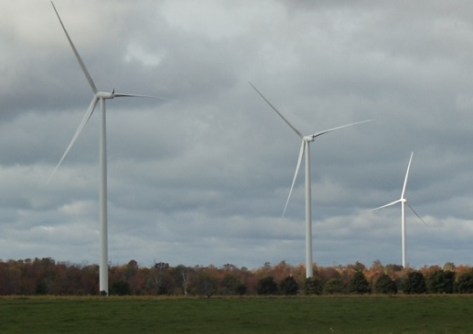


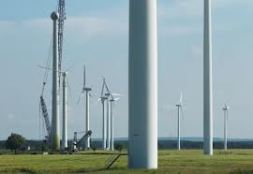 Audiologist’s are among allied health care providers that are seeing increasing numbers of patients seeking assessment for a range of symptoms that can include migraines, vertigo, tinnitus,and sleep deprivation in response to exposure of wind turbine sound. The following article while slanted in favour of wind energy also demonstrates the widening cracks in the veneer of the wind industry’s posturing that all is well for the health of those who live near the turbines.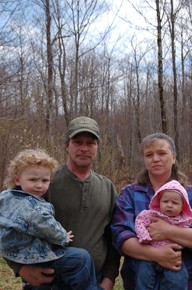


 Mothers Against Wind Turbines Inc.