If you’ve been following this story, you’ll know that the East Oxford Community Alliance has been protesting the fact that the wind power developer, Prowind (headquarters in Germany), achieved the status of having the project’s documentation “complete” when the fact was important studies and documents were incomplete or missing altogether.
The East Oxford group compiled 26 pages of errors and omissions, which were then sent to the MoE and the Ombudsman’s office.
The comment period for the documents (incomplete or not there at all) was extended by the Ministry of the Environment, but the documentation was still not complete —which means the public is commenting on documents that aren’t 100% accurate.
This is a letter from the group leader, Joan Morris, to protest the situation:
Dear Ms. Garcia-Wright,
Garcia Wright MOE
I am in receipt of your letter dated August 6 indicating that the EBR comment period for the Gunn’s Hill wind project will end tomorrow, August 7, 2014, and that no extension will be granted to allow for proper public input on revised information relating to this project. While you state that this was a “30-day comment period”, you must know that is not truly the case, as most residents were not even aware of the posting until half way through this timeframe due to the proponent’s delay in notifying the public. In fact some residents (who were on the mailing list for previous notifications) have never been notified by the proponent regarding this most recent development, even as the comment period closes.
I am concerned that you have justified implementing a “30-day comment period” in this case by indicating the original comment period was 45 days, given that the information available during the previous 45 day comment period was incorrect and does not accurately reflect the project the proponent now proposes to construct. Surely it would be in the best interest of citizens to have the opportunity to adequately review and comment on ACCURATE information. In this case, the rights of citizens are not being respected and for this reason I have copied the offices of the Ombudsman, the Attorney General and Legal Counsel for East Oxford Community Alliance for further investigation of this file.
Your ministry is surely aware that the documents provided to the public and submitted to your office by Prowind Canada do not clearly describe the project it now proposes to build and the public has been denied the right to conduct an adequate review. The “iterative process” you have acknowledged occurs between the proponent and the Ministry, without public involvement is further evidence of the manner in which public input is stifled. This is contradictory to the “open and transparent” environment in which the Ministry and the current government purport to operate.
It is unfortunate that your office has chosen not to allow a proper comment period, as this has the appearance of expediting this project for the benefit of the proponent while trampling the rights of citizens.
WEST LINCOLN — The case against the five industrial wind turbines already spinning in West Lincoln is “still partially alive.”
Anne Fairfield, who appealed the province’s approval of the HAF Wind Energy Project, appeared before the Environmental Review Tribunal for a preliminary hearing last week. All of the issues raised in her original appeal were quashed, meaning only those mentioned in her appeal to the province’s subsequent approval of an amendment to the project will be heard at a hearing next month.
“They knocked out everything not mentioned in the amendment,” said Fairfield. “All we’re left with are property lines and the withdrawing of post construction raptor monitoring.”
Project proponents Rankin Wind Energy and Vineland Power Inc
Judges quashes majority of turbine appeal FILE PHOTO The Environmental Review Tribunal has ruled that only issues related to an amendment to the HAF Wind Energy Project will be heard next month. The majority of the issues raised in West Lincoln resident
. had to submit an amendment to their application after it came to light that four of the five turbines were built closer to property lines than regulations allow.
According to the Green Energy Act, turbines must be located a minimum of a blade length from the nearest property — in this case, 95 metres.
The province approved the amended application June 20. Fairfield filed her appeal July 3.
Come Sept. 3 Fairfield will only be able to argue on the issue of property line setback infractions and post-construction raptor monitoring. The West Lincoln resident will no longer be able to present on issues of health, gas wells. hazardous waste and the impact on Charter rights — the issues Fairfield raised in her original appeal to the project’s approval.
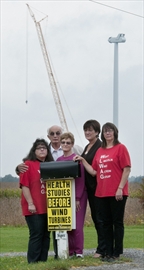
Fairfield and members of the West Lincoln Glanbrook WInd Action Group met with Niagara West-Glanbrook MPP Tim Hudak Monday to discuss the upcoming tribunal.
Judges quashes majority of turbine appeal FILE PHOTO West Niagara-Glanbrook MPP Tim Hudak has lent his support to West Lincoln residents set to take part in an environmental review tribunal against a turbine project in the township.
Hudak was vocal in his opposition to the Green Energy Act in his time as PC Party Leader. He raised the issue several times at Queen’s Park on behalf of his constituents in West Lincoln and the province at large, calling for a complete moratorium on more than one occasion. He has called on the Minister of Energy, Bob Chiarelli, twice now to “do the right thing” in the case of the HAF project.
“If you had been caught speeding on Twenty Road, you wouldn’t get a redo,” said Hudak, speaking on the province’s approval of the amended application.
“It only makes sense for the government to follow its own laws.”
Hudak, fresh on the heels of his loss to Kathleen Wynne in the race to become premier, said he would do what he can to help his constituents but realizes his influence is not as strong as it could have been had the outcome had been different in June.
“My goal was to win the election and stop this thing in its tracks,” said Hudak. “I’ve met with Wynne and McGuinty, face to face like we are now, to say this is a bad idea for the province as a whole.”
Fairfield asked if the PC party would continue to push against the Liberal’s green agenda without Hudak at helm. Hudak said he appointed Lisa Thompson to the post of energy critic because her own riding of Huron-Bruce was home to several turbine projects. He was confident the party would continue to push against “one of the most destructive policy decisions in recent history.”
Hudak, like the half dozen residents gathered at Veldman’s house, did not have the same level of confidence the Environmental Review Tribunal would side with Fairfield.
“It’s an incredibly stacked deck,” said Hudak.
“ERTs don’t work,” said Fairfield, noting ultimately the decision will lie in either appeals court or in a judicial review, both of which she is prepared to more forward with.
“We don’t have a choice,” she said. “We have to stop these turbines. Not only here, but across the province.”
Please follow the link provided and leave a comment of Support for Anne!
HAF given second green light by province
WEST LINCOLN — Wind turbine opponent Anne Fairfield has filed a second appeal to the province’s approval of an industrial wind turbine project in Caistor Centre.
While Fairfield is still awaiting a decision on her appeal filed last summer, she has filed another one against the same project after the province re-approved the five-turbine operation in June.
Project proponents — Vineland Power Inc. and Rankin Wind Energy — had to resubmit the application after it was discovered four of the five turbines were built in contradiction of property line setbacks outlined in the province’s Green Energy Act. Approval was given to the amendment on June 20.
Fairfield, who’s home is surrounded by the HAF project, filed her appeal July 3.
“We have too much to lose not to do anything,” said Fairfield in an earlier interview.
Fairfield also continues to push her original appeal, based on the proximity of the turbines to gas wells in the area, including one near her home.
A preliminary hearing was set to take place Wednesday at the Jordan Harbour Ramada Motel. Notice was given to nearby residents July 15. Fairfield and partner Ed Engel were to argue a stay motion to stop the project while the gas well matter is dealt with. The actual hearing will commence in early September.
Niagara West-Glanbrook MPP Tim Hudak has already called on the province to take action against the project’s proponents.
In a letter to Energy Minister Bob Chiarelli, the former Ontario PC party leader again called for a stop “to the reckless industrial wind turbines constructed in West Lincoln” and other areas of the province. Hudak was responding to news that the project was operating without ministry approval for a week in June.
“Sadly, this is not the first time this company has defied the rules of the province,“ Hudak wrote in his letter. “When the industrial turbines were constructed, four of the five were built outside allowable setbacks. When I wrote to you earlier on the issue, your response — that HAF need simply file an amendment that would bring the turbines into conformity with regulations — was unsatisfactory. The response when somebody breaks the rules is not simply to change the rules.”
Hudak will meet with Fairfield and several of her neighbours Monday.
“Throughout the approval process for these industrial wind turbine projects, the residents of West Lincoln and surrounding areas were opposed to the five turbines based on very real concerns for their health, happiness and property values,” Hudak wrote to the energy minister. “To add insult to injury, these law-abiding, hard-working residents are now faced with your government’s unwillingness, or inability, to impose its authority on these big corporations.If one of these citizens were to break the law, they would be punished.Why is there a double standard for these well-connected corporations?”
In his letter, Hudak renewed his call for a moratorium on all new wind projects in the province as well as a halt those already in the approvals phase — including Niagara Region Wind Corp. which plans to build 77 turbines, the bulk of which will be located in West Lincoln. He also called on the ministry to enforce the law in relation to the HAF project.
The German authorities are now clear in that there is a very real issue with low frequency sound and recognise that they both need to update their regulations and complete more research.
This feasibility study evaluated the state of knowledge about the effects of infrasound on human beings, the identification of infrasound sources and the potential concernments in Germany due to infrasound. Furthermore, a study design was developed for a noise impact study concerning infrasound immissions. Based on these findings, recommendations for the further development of regulations on immission control were made. The study led to the following conclusions:
The literature review does not present a coherent picture about the determination and assessment of low frequency sounds. Especially in Germany, there are just a few studies that deal with infrasound. A database was created for further research projects.
Survey tools that allow for an initial acoustic description and classification were developed for the acoustic identification and assessment of potential infrasound sources.
The surveys of the immission control authorities of the Länder (German states) and the evaluation of Internet communication on infrasound show a somewhat higher level of noise pollution in Southern Germany. Above all, noise pollution from air-conditioning systems and biogas facilities were mentioned. In the official practice, the Technical Instructions on Noise Abatement and DIN 45680 generally apply in cases of conflicts concerning infrasound.
A study design was developed for an interdisciplinary field study and the essential survey contents and sources were defined.
The DIN 45680 Measurement and Assessment of Low Frequency Noise Immissions in the Neighbourhood can be used for the assessment of low frequency noise (<100 Hz). The international standard ISO 7196 Acoustics – Frequency-Weighting Characteristic for Infrasound Measurements was especially created for the measurement of infrasound immissions (<20 Hz). The research findings indicate that these standards have deficits with regards to the assessment of infrasound and should be further developed. The current revision of DIN 45680 shows a path for how inconsistencies in the area of low frequency sounds can be rectified.
On page 15 of the document, which is about the state of knowledge about the effects of infrasound on people, we get a really important conclusion:
Wind energy plants are a frequently studied source of noise in connection with infrasound. The publications show that the measurement of emission and propagation of noise from wind energy plants is plagued by uncertainties that complicate a substantiated noise forecast. With an increasing height of the wind energy plants, the rotor blades cut through an even more varied wind profile. It is therefore questionable whether the emission and propagation models of smaller wind energy plants can be applied to more modern and larger wind farms. This is very unlikely given the theoretical observations of aeroacoustic scientists. Deeper knowledge of the above-mentioned processes would not only be a prerequisite of better immission forecasting, but the acquired knowledge could also provide information for an improved noise reduction of wind energy plants.
On Page 55 we have another important statement:
The A-evaluation method is seen many times in the literature as unsuitable, in order to correctly assess the the impacts of low frequency sounds.
The next page (P 56) states how with wind energy there are frequent discrepancies between measured results and those predicted by the models. This is also followed by a section, which explains as to why wind turbines have a more pronounced impact at night, due to the meteorological conditions. Page 110 talks about the harmonics in wind turbine noise found in the range 1 Hz to 8 Hz.
There seems to be quite a bit in this document, maybe one could criticise it for being a bit of a literature review rather than a new study. However, the main thing is that the German authorities are now clear in that there is a very real issue with low frequency sound and recognise that they both need to update their regulations and complete more research. On the other hand here in Scotland and the UK we are in absolute denial that there is a problem with such low frequency noise.
[She scoffed at regulations that mandate 500-meter setbacks to neighbouring homes pointing out the rule doesnt take into account the cumulative, “overlapping” impact of multiple turbines that surround. Nor does the regulation change with the actual size of a turbine, she adds, asserting that, at 3-megawatts apiece, “these are the largest turbines in Ontario.”]
BRINSTON Leslie Disheau has her ear to the ground in South Dundas, and for 10 days last month, a very powerful ear trained on the sky around her Brinston home as well.
Ontarios Ministry of Environment and Climate Change installed the basketball-sized microphone atop a temporary 30-foot listening post in her backyard, along with a smaller meteorological tower.
The ministrys move was prompted by Disheau and partner Glen Baldwins complaints about nighttime noise emanating from two industrial wind turbines on either side of their place, one to their immediate northwest, the other to the southeast. Comprising part of the 10-turbine South Branch project that went into service earlier this year, both of the nearest units are less than one kilometre away from the home the couple shares with their two teenaged children.
But Disheau, candidate for deputy mayor in the municipal election and a fierce critic of the turbine industry, feared that developer EDP Renewables was intentionally slowing the two windmills to quiet them down while the ministry data-collection and audio-recording effort was underway with her participation.
The Houston-based firm almost immediately learned about the microphone on the day of the install, she said with some frustration.
Located just down the road from the projects main depot, it wasnt more than three hours after the arrival of two ministry trucks in her driveway that EDP called the same ministry to question the presence of those vehicles, according to Disheau.
TENS of thousands of Scots may be suffering from a hidden sickness epidemic caused by wind farms, campaigners have warned.
Andrew Vivers has suffered from headaches since a wind farm was built near his home [PAUL REID]The Sunday Express can reveal that the Scottish Government has recently commissioned a study into the potential ill effects of turbines at 10 sites across the country.
More than 33,500 families live within two miles of these 10 wind farms – which represent just a fraction of the 2,300 turbines – already built north of the Border.
Hundreds of residents are now being asked to report back to Holyrood ministers about the visual impacts, and effects of noise and shadow flickers from nearby wind farms.
Campaigners fear that many people do not realise they are suffering from ailments brought on by infrasound– noise at such a low frequency that it cannot be heard but can be felt.
One such person is Andrew Vivers, an ex-Army captain who has suffered from headaches, dizziness, tinnitus, raised blood pressure and disturbed sleep since Ark Hill wind farm was built near his home in Glamis, Angus.
Mr Vivers, who served almost 10 years in the military, said the authorities had so far refused to accept the ill effects of infrasound despite it being a “known military interrogation aid and weapon”.
He said: “When white noise was disallowed they went on to infrasound. If it is directed at you, you can feel your brain or your body vibrating.With wind turbines, you don’t realise that is what’s happening to you.
“It is bonkers that infrasound low frequency noise monitoring is not included in any environmental assessments. It should be mandatory before and after turbine erection.”
He is raising concerns about an “acknowledged and unexplained increase of insomnia, dizziness and headaches in Dundee”, where two large wind turbines have been operating since 2006. Mr Vivers, 59, said all medical explanations of his own sudden health issues had been ruled out and it was more than 12 months before he was convinced of the link to the wind farm.
We are only just getting started Hope you can come out to Support our very own at the Appeal
A big Thank You goes out to Anne and Deb for their continued dedication to the fight and for all the hard work they have put into preparing for this Tribunal. All of West Lincoln’s, and Ontario’s , eyes will be on you!!
Hearing set for September 3th at Kerr Church
A report from the troops on the ground regarding the appeal Fairfield vs MoE.
The Appeal can go forward except for what the Tribunal has struck, in part, which includes the Gas Wells and electrical collector Lines & pipeline
Hazardous Waste
Health Issues
Charter Challenge under s. 47.5
……………so, only what was in the Amendment per se stays.
What is left for the ERT are:
the Property line setback issues
the Raptor post -Construction Monitoring
the Constitutional Challenge under 142.1 of the EPA.
So, what we have told the Approval Holder and the MOE / Att. Gen. is that we will be going forward ASAP to either an Appeal or a Judicial Review. We would still like to go ahead with Mediation as discussed Wednesday, and would they provide Transcripts, even Drafts, as they did in the Wainfleet case which assisted in Closing Arguments, and would they please respond as to any points by next week.
But the Gas Well and Electrical Collector Line issue cannot be dismissed, even though it was not mentioned in the Amendment.
The Tribunal will issue an Order shortly with reasons to follow for its Disposition, which we think will include the above statement.
What about all the Children living in the lease holders homes where the turbines can be placed anywhere within the 550m (already to close) setback??
Conclusion: potential mechanism
Stansfeld at al. (2010) mentioned several mechanisms by which nighttime noise exposure and sleep disturbance could lead to cognitive impairments. Evidence is still lacking but narrowing of the attention focus, impairments of auditory discrimination and speech perception, and communication difficulties in the classroom and learned helplessness were brought forward as plausible candidates. Especially the role of learned helplessness needs more attention. It is not clear yet if and how noise-related behavior in the long term has a negative influence on children’s health and learning. Evidence is increasing that chronic sleep disturbance can increase the risk of obesity and diabetes through the mechanisms of circadian disorganization and via this pathways could affect the cardiovascular system. Childhood elevated blood pressure is seen as a risk factor for hypertension. The mechanism of non-dipping of diastolic blood pressure might play an important role in this, as indicator of poor restoration during sleep. Finallychildhood noise related sleep disturbance could lead to more serious sleep disturbance and insomnia later on in life. And finally, new notions include the early gene-environment interaction model (Lupien et al. 2009) suggesting that lifespan exposure to stress influences brain structures involved in cognition and mental health and emphasize the importance of developmental sensitive periods.
Future studies into the health effect of environmental noise exposure in early life should address these potential mechanisms and pay specific attention to the mediating role of sleep related aspects, including noise as well as other environmental exposures such as indoor climate and exposure to sounds and light from electronic devices.




![Andrew Vivers has suffered from headaches since a wind farm was built near his home [PAUL REID]](https://mothersagainstturbines.com/wp-content/uploads/2014/08/windfarm-health-497525.jpg)




 Mothers Against Wind Turbines Inc.