
Some photos recently shared to Mothers Against Wind Turbines
Category Archives: The problem with Wind Turbines
Neighbours at odds over noisy wind project
“We want to be able to be outside of our home when it’s calm,” Huffman told commissioners at a hearing in Palmerston North on Wednesday.
“We want to be able to open our windows and not hear the whine… or the roar.
“We want to be able to open our windows at night.”
On a still day in the countryside, there could be “whining, roaring and grinding so intrusive that we don’t want to be outside”.
The first time Huffman heard the Te Rere Hau farm, it woke her up. She wondered what her husband Graham Devey was doing. “What was he doing in the barn that was causing such a racket?”
Neighbour of Te Rere Hau wind project located in New Zealand
Don’t Buy Near a Wind Project
Recent posting spotted on an online sell & buy website:
Don’t buy anything in a wind farm (Everywhere)
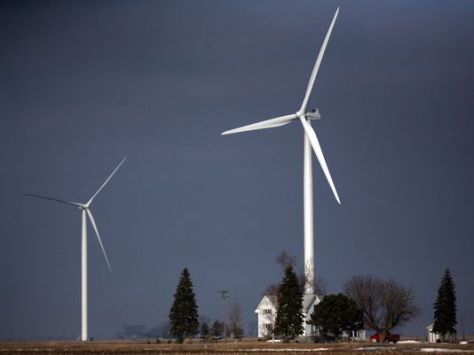
Sign of the times
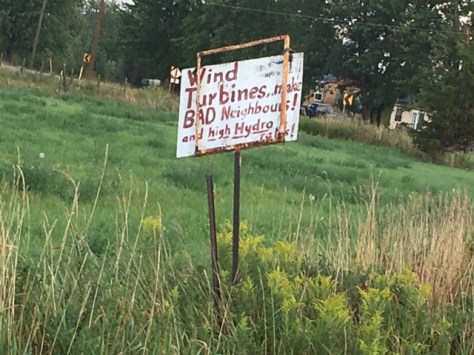
Oops it has happened again!
Wainfleet has a turbine missing its blade or what the wind industry likes to call “a rare event” or in fanciful terms, a component liberation.
Turbine 5 haunts the horizon in the Wainfleet Wind Energy project. The installation is comprised of 5 Vestas V100-1.8 MW which have a hub height of 95m and a rotor diameter of 100m. This smaller project began commercial operation in 2014 and is one of many wind projects for the rural area of southern Ontario. Only three years old and a broken blade already needing to be removed. Nothing new to see here, just a whole lot of useless mess to get rid of.
Wainfleet Wind Energy turbine 5 missing a blade, 3 years after being erected. Ontario, August 2017
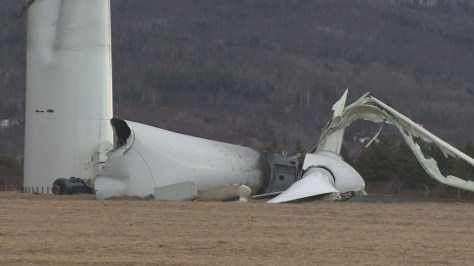
Grand Etang Wind Turbine Removal

Nova Scotia Power Inc.
Grand Etang wind turbine removal gets underway
June 12, 2017Nova Scotia Power is undertaking site cleanup and removal of the Grand Etang wind turbine, which is expected to be completed within the next two weeks.
The turbine has not been in operation since early January following an unexpected collapse of the turbine structure. No one was onsite at the time of the incident and there we no injuries.
A detailed investigation into the turbine collapse has been underway over the past few months, with further analysis of the data and equipment required before the cause of the incident can be confirmed.
Crews have been on-site cleaning up debris from the property and mobilizing a crane that will lift the wind turbine and tower components onto flatbeds for transport. It’s expected that site cleanup and removal of the turbine will be completed within the next two weeks.
Constructed in 2002, Grand Etang was one of the first wind installations in Nova Scotia, with a single 660 kilowatt Vestas V47 wind turbine. That particular turbine model is not used at any other site in the province, either by Nova Scotia Power or independent wind producers.
Nova Scotia Power purchases electricity produced from over 300 public and privately-owned wind turbines in operation across the province.
For more information:
| Organization: Nova Scotia Power Inc.Address: PO Box 910 Halifax, Alberta Canada, B3J 2W5 www.nspower.ca Tel: 902-428-6230 |
Source: Nova Scotia Power Inc.
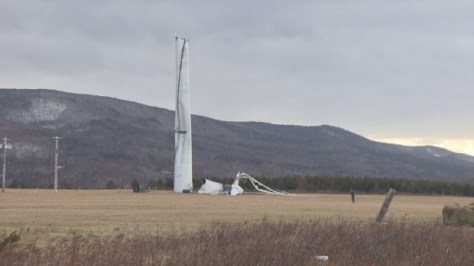
“If it’s too windy, then maybe it’s not the right place for it,” said Aucoin. “Because it is close to houses and I imagine the people up the hill … they must have been scared because it was right near to their house.”
Laurette Chiasson, a resident who has lived in the area for 59 years, said she’s never had a problem with the windmill, though she was scared after the collapse about pieces hitting the house.
CBC article January 5, 2017: People near snapped wind turbine say winds were high but not unprecedented
Blade construction uses pollutant implicated in water contamination
Wind power promises it is clean and green using the wind to generate electricity by spinning the blades of wind turbines. Focusing on the manufacturing process “clean and green” claims are tainted with growing issues surrounding the use of known pollutants used to make turbines. Turbine blade production involves plastics and composite materials to create the finished product. Like any industrial production the chemicals used can involve toxic water pollutants. Pollutants which if released into the environment (and includes exposure risk to health for the people on the shop floor) that can be persistent. Risks and remedies are being studied by looking at known and unknown adverse effects. Drinking water contamination concerns are heightened surrounding the types of plastics being used in the construction of industrial wind turbines. Additionally it raises questions about risks of harm to the environment once the blades are exposed to the natural elements after installation.
“A highly toxic water pollutant, known as perfluorooctanoic acid (PFOA), last year caused a number of U.S. communities to close their drinking water supplies. Because of its historical use in Teflon production and other industrial processes as well as its environmental persistence, PFOA contamination is a pervasive problem worldwide.”
Read more at: https://phys.org/news/2017-06-pfoa-threat.html#jCp
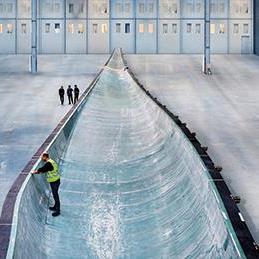
The following is an example of PFOA containing products advertised for use in wind turbine blade manufacturing.
What is Wind Turbine Blade Mould Release Fabric?http://www.krteflon.com/list/?2_1.html
A Welland wind turbine blade plant received approval to discharge emissions into the environment from Ontario in 2014. The list of allowed discharges reads like a chemical alphabet soup and clearly states that contaminates are surrounded by unknowns and no ministry standards. Ironically this particular plant was closed shortly after citing a lack of new wind projects in Ontario. READ about the plant closure.
“Emissions to the atmosphere include ammonia, petroleum distillates, ethylbenzene and suspended particulate matter.”
“Suspended particulate matter emissions occur from the sanding of the turbine blades and includes Bisphenol-A-(epichlorhydrin), formaldehyde, 1,6-bis(2,3-epoxypropoxy)hexane, Epoxy Resin, Phenolic Novolac Resin and Glycidated Alcohol. These contaminants do not have ministry POI standards. Ministry toxicologists have determined that, based on an assessment of available toxicological information and of guidelines from the MOE and other jurisdictions, the estimated maximum POI concentrations listed in this application for these contaminants are considered acceptable.”
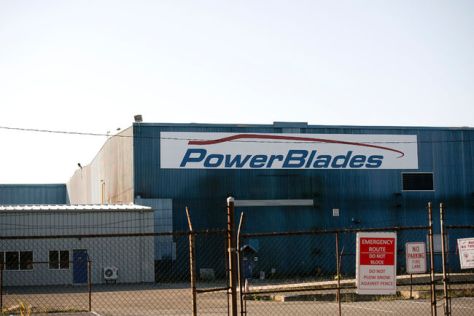
““Unfortunately, because of a lack of future projects we cannot continue”
No Bats? Not if a wind developer takes a look
Bats are being killed at a rate by wind power plants that have experts raising the alarm about sustaining population levels (in blunt terms for some bat species- extinction level threat). In Ontario 3 of our 8 species of bats are considered critically endangered and are facing possible extinction. Kills by wind turbines add to existing pressures for their survival. Evidence mounts daily and it has the wind industry on the defensive. It is more than convenient that a recently study of a woodlot being steward by an Ontario landowner was reported not to have any bats detected. Bats which are so numerous that Theo Heuvelmans has had to hang a bamboo curtain over his home’s entrance to stop them from flying into his home. What other industry is allowed to kill, harm and harass endangered species? Wind power is allowed to not only self evaluated risks but once the projects are built they employ the clean- up crews to collect any found bodies and self report the deaths. Time for being polite and time to say it out loud- bull! It stinks.
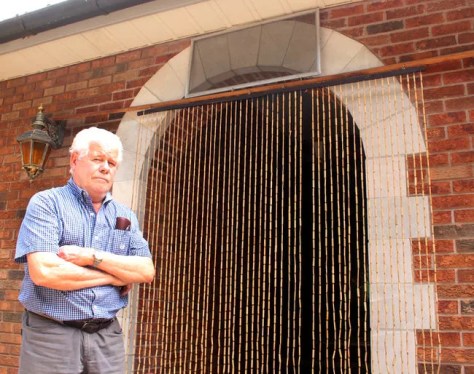
Study says winged critters not detected in woodlot near where turbines to be erected

By Ellwood Shreve, Chatham Daily News
Friday, June 9, 2017
DRESDEN – To put it politely, Theo Heuvelmans doesn’t believe the results of a yet-to-be-seen study that says there are no bats in a 36-acre woodlot on his property near here.
As of Friday, Heuvelmans still hadn’t heard or received any information about what biologists found after they went through his woodlot several times last spring and summer ahead of the North Kent 1 industrial wind farm project which is about to be built nearby by Samsung Renewable Energy and Pattern Energy.
However, he was astounded when The Chatham Daily News informed him on Friday that the newspaper had received a response that no bats were found in the area.
“They’re telling me there’s no bats here? I can’t believe it,” Heuvelmans said.
“The study found there were no bats detected on his property,” according to an e-mail The Daily News received from Pattern Energy’s media spokesperson.
The e-mail also noted the firm that completed the study will be reaching out to Heuvelmans to discuss their findings with him.
The Daily News has requested a copy of the study or to be able to speak with someone about it.
Heuvelmans recently contacted The Daily News after growing frustrated that repeated calls to try to get information about the study have not been returned.
For the past five years he has had to put up a bamboo curtain and a screen to the entrance of the alcove that is part of the entrance to his home, because it attracts so many bats.
“This is the only way I could keep them out,” Heuvelmans said.
He initially refused a request by the wind farm developers to have his woodlot be studied. However, he noted company officials with AECOM Canada, an engineering consulting firm hired by the wind developers to study his woodlot, persisted and told him if bats were present it could impact where the turbines are built.
Heuvelmans agreed, hoping the presence of the bats would result in the wind turbines being constructed further from his woodlot.
However, judging from roads recently built on nearby fields, it appears two turbines will each be constructed within 300-400 metres of the woodlot – one on the west side and another to the north.
Heuvelmans said he put up several bat houses in the woodlot and nearby meadow about a year ago, with the hopes of moving the bats away from his home. He also admits he hoped it would help ensure the turbines would be built farther from the woodlot.
Heuvelmans also said he was told if bats were found in the woodlot, the turbines could be shut down at night to accommodate that.
He is worried that the turbines will negatively impact the wildlife living there, noting great horned owls are regularly seen flying from the woodlot to another nearby bush.
Heuvelmans questions why the turbines can’t be built farther way from woodlots. He would also like to see the Municipality of Chatham-Kent, which is purchasing a 15 per cent stake in North Kent 1, take a more active role in protecting these kinds of areas.
However, the approvals for industrial wind farms are provided through the Green Energy Act, which is under the jurisdiction of the province of Ontario.
Time for the truth in Ontario


 Mothers Against Wind Turbines Inc.