Category Archives: Uncategorized

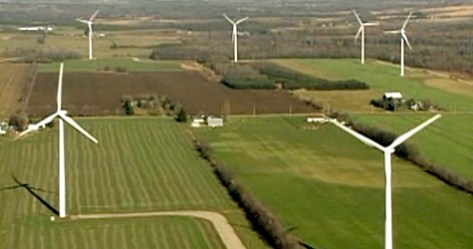
The View from above of Niagara Wind

The visual impacts of the Niagara wind installation have taken over the skylines of West Lincoln, Niagara, and Haldimand in southern Ontario.   Wind projects also include miles and miles of access roads, transmission lines, hydro poles and guardrails.  Even in rural lands they become a dominating industrialization feature of our landscape.

This slideshow requires JavaScript.


Scaring Children isn’t the Answer

Ontario has been paying for TV ads to promote its policies concerning climate change.  One such ad is where media personality David Suzuki lectures to an audience of children that if action isn’t taken we are all doomed. Wind power generation has been held out as part of the renewable energy solution but it is done without regard to the reported harms to health and harm to the environment. Every time this ad is broadcasted adults should stop and consider if the solutions being offered are the right ones for the right problem. We need to protect our children.  Our government should not be in the business of scaring children.


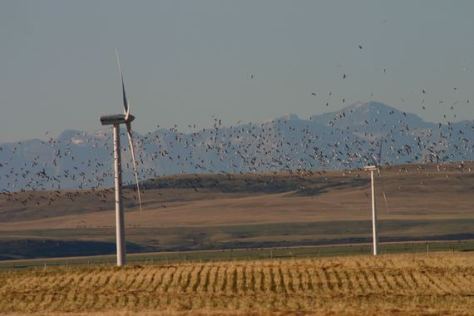
Nature Counts. Counting the dead birds & bats due to wind turbines

The Wind Energy Bird & Bat Monitoring Database is a joint initiative of the Canadian Wind Energy Association (CANWEA), Canadian Wildlife Service (CWS, Environment Canada), Bird Studies Canada (BSC) and the Ontario Ministry of Natural Resources (OMNR). The goals of this project are to facilitate improved understanding of the impacts of wind turbines on birds and bats, allow for greater consistency in assessment of wind power impacts across the country, and lead to future improvements in the Environmental Assessment and approval processes. The database is designed to allow individual industry proponents (and individuals or consultants working on their behalf) to enter field data derived from bird and bat population monitoring projects in a confidential environment, while providing the ability to analyse the data and create summaries for the public on the website. Results from such analyses will be used to inform future wind power developments, and to improve the EA and approval processes, particularly by streamlining data collection requirements.

READ MORE:   http://www.bsc-eoc.org/birdmon/wind/main.jsp

birds and turbines

Health director shouldn’t ignore victims

noise child 2

“Unnecessary noise, then, is the most cruel absence of care which can be inflicted either on sick or well.”

Elizabeth Ebertz.  Published in Fond du lac Reporter on July 8, 2016

This excerpt is from “Chapter IV Noise” of Florence Nightingale’s famous 1898 work: “Notes on Nursing What It Is, and What It Is Not”, which offers many cautions about noise and health that she believed nurses should practice. Her understanding was very progressive. Not until the 1960s did epidemiology demonstrate that long-term exposure to low levels of noise causes significant adverse health effects. Not until the 2000s did epidemiology prove that low sound levels over long periods at night result in significant health effects including cardiovascular impacts. Nurse Nightingale did not wait for that epidemiological evidence when she saw the evidence directly in the sick people she was trying to help.

In contrast, county Health Officer/Director Kimberly Mueller claims to be waiting for scientific evidence that proves adverse health effects are caused by the wind turbines before she will take action to address the reported harmful effects. Is this what Florence Nightingale would have decided?

Mueller needs to take action based on evidence in her own community. Fond du Lac County has seen a long list of people filing complaints about wind turbine noise and the resulting health effects. Ignoring evidence that should be relied upon from direct witnesses, residents who have been pleading before the Board of Health at meeting after meeting, is not the way a health officer should respond.

What more “evidence” is needed to motivate Mueller to act? How many more people must stand before her begging for relief? County health officers should be protecting the community, not defending the wind energy projects.

The board is seeking more studies. Why? The evidence has been before them for years. The people who are ill remain ill as a result of the board’s failure to act on complaints, and the poor advice from the health director.

Denial of evidence from the people who are adversely impacted by the noise, both audible and inaudible infra sound, is not acceptable for public health officials. They have a duty to act to protect public health, yet continue to ignore the evidence brought to them by their residents.

Florence Nightingale taught that a nurse must address the concerns of a person who complains of symptoms that make them sick. By her standards, the medical professionals advising the county should be ashamed.

The recent Health Canada study shows that living within 1.25 miles of a wind energy utility can double risks of adverse health effects like migraines, dizziness and tinnitus. It covered people living near six wind projects in Ontario where the sound limits are not to exceed 40 dBA. This is well below the 50 dBA that the county accepted for wind energy projects. The county decided it would make the rural areas industrial noise zones. It is time they stand up and take ownership of the problems they created.

(Reference: http://nursingplanet.com/Nightingale/noise.html)

READ AT: http://www.fdlreporter.com/story/opinion/2016/07/08/commentary-health-director-shouldnt-ignore-victims/86854604/

WHO Noise Guidelines

who logo

WHO/Europe is currently in the process of developing the WHO Environmental Noise Guidelines for the European Region as a regional update to the WHO Community Noise Guidelines. The Guidelines will include a review of evidence on the health effects of environmental noise to incorporate significant research carried out in the last years.  The health outcomes for which the evidence will be systematically reviewed include: sleep disturbance, annoyance, cognitive impairment, mental health and wellbeing, cardiovascular diseases, hearing impairment and tinnitus and adverse birth outcomes.

The guidelines will assess several environmental noise sources such as aircraft, rail, road, wind turbines and personal electronic devices. The document will also consider specific settings such as residences, hospitals, educational settings and public venues.  In addition, the guidelines will review the evidence on health benefits from noise mitigation and interventions to decrease noise levels.

The process of developing the guidelines is complex, involving the work of top scientists from across the world under the coordination of WHO. The guidelines will focus on the WHO European Region and provide guidance to its Member States that is compatible with the noise indicators used in the European Union (EU) Directive on Environmental Noise.

READ MORE:  http://www.euro.who.int/en/health-topics/environment-and-health/noise/activities/development-of-who-environmental-noise-guidelines-for-the-european-region

Bottled Water Not Practical

Water-bottles

By Trevor Terfloth, Chatham Daily News

Water Wells First held a demonstration at a Chatham Township farm on Friday to show how difficult it would be logistically for farmers and their livestock to use bottled water.

The proposed North Kent 1 Wind Project, which calls for 40 to 50 wind turbines to be constructed in the area, has some residents worried that the vibrations from the turbines could result in dirty water in their wells.

The Ministry of the Environment and Climate Change’s renewable energy approval states that the company “immediately provide an adequate amount of bottled water to the impacted party until such time that the issue has been resolved.”

About a dozen residents were in attendance for Friday’s event, with people acting out various scenarios using bottled water.

Some of these included trucks lining up for cases, pouring bottled water into a trough for horses and creating a makeshift shower with bottles hanging from a tree.

Scott Brooksbank, who owns the Countryview Line farm, said an average horse can consume two to five cases of water per day.

“How are we supposed to water livestock?” he asked.

READ MORE:  http://www.chathamdailynews.ca/2016/07/08/water-wells-first-concerned-about-wind-turbine-vibrations

Gilead Power 99% down the drain at Ostrander Point

CCSAGEadmin's avatarCCSAGE Naturally Green

We are delighted to report that as of 5.00 pm yesterday, July 6th , Gilead Power had NOT appealed the revocation of its Renewable Energy Approval for 9 turbines at Ostrander Point to the Divisional Court on points of law. It is thus out of time.

The 1% which we are so far unable to confirm is whether or not it appealed to the Minister of the Environment on points other than of law. We are assuming (only) that it did not. (Under the rules governing Environmental Review Tribunals their decisions can be confirmed, altered or revoked if the Minister believes any such action is “in the public interest”).

This is an outstanding and major success for PEC Field Naturalists, the first ever defeat of a Renewable Energy Approval for a wind factory and thus of the flawed and undemocratic Green Energy Act.

This Approval should never have been granted. It was evident from the get-go that…

View original post 97 more words

Effect of Wind Turbines on Meat Quality

2

Avoiding noise-induced stress is important not only for maintaining meat quality but also for improving animal welfare.

The Effect of Varying Distances from the Wind Turbine on Meat Quality of Growing-Finishing Pigs

Abstract

This study was conducted to assess the effect of rearing pigs at three different distances from a wind turbine (50, 500 and 1000 m) on the physicochemical properties and fatty acid composition of loin and neck muscles. The experiment was carried out on 30 growing-finishing pigs, derived from Polish Landrace × Polish Large White sows mated to a Duroc × Pietrain boar. The results obtained during the noise measurement showed that the highest level of noise in the audible and infrasound range was recorded 50 m from the wind turbine. Rearing pigs in close proximity to the wind turbine (50 m) resulted in decreased muscle pH, total heme pigments and heme iron as well as reduced content of C18:3n-3 fatty acid in the loin muscle. Loins of pigs reared 50 m from the wind turbine were characterized by significantly lower iron content (6.7 ppm g-1) compared to the loins of pigs reared 500 and 1000 m from the wind turbine (10.0-10.5 ppm g-1). The concentration of α-linolenic acid (C18:3n-3) in loin and neck muscles decreased as the distance from the wind turbine increased. Avoiding noise-induced stress is important not only for maintaining meat quality but also for improving animal welfare.

Download Article:

http://www.degruyter.com/view/j/aoas.2015.15.issue-4/aoas-2015-0051/aoas-2015-0051.xml

The Battle has been Won

ostrander point shoreOstrander Point, Prince Edward County, Ontario

Media Release

PECFN breathes out

July 6, 2016

For immediate Release

On June 6, 2016 we reported that “The Tribunal in the Ostrander Point ERT hearing has found that “the remedies proposed by Ostrander [Gilead] and the Director are not appropriate in the unique circumstances of this case.  The Tribunal finds that the appropriate remedy under s.145.2.1 (4) is to revoke the Director’s decision to issue the REA [Renewable energy Approval]”. (underlining mine)”

Following that decision both the Director (Minister of Environment and Climate Change) and Gilead Power had the right to to appeal to the Divisional Court based on legal errors in the decision of the Environmental Review Tribunal. The proponent had thirty days to submit their appeal and today was the deadline.  As of 5 pm today no notice has come of that request to appeal.

In early 2012 Myrna Wood, Pamela Stagg and I started a blog on Countylive to try to let people know how important the habitat at Ostrander Point Crown Land Block was to migrating birds, bats, and butterflies.  We also spent time writing about reptiles and amphibians at risk and the important imperilled alvar habitat.  At the same time Nature Canada, Ontario Nature and PECFN were writing comments to the Environmental Bill of Rights about the proposed project which the government claimed was public input under the Green Energy Act.  All organizations pointed out the importance of this site to migrating birds, bats, monarchs and species at risk such as the Whip-poor-will and the Blanding’s Turtle.  In spite of all this input the Ministry of the Environment approved a project on December 20, 2012 to install 9 turbines and their associated roads and ancillary equipment at Ostrander Point Crown Land Block.  Given 15 days to appeal, PECFN moved forward, solid in the knowledge that Ostrander Point was the wrong place for wind turbines.

This action has been described as a David versus Goliath battle.  PECFN, a rural organization of about 60 members was up against the Ministry of Environment and Climate Change and a large oil company-owned business.  It is particularly wonderful to finally realize that the battle is over and that “David” has prevailed.  Myrna Wood comments “This was a long and hard battle, but totally worth it – important habitat has been conserved and we are very happy.”

For information:

Myrna Wood

613-476-1506

myrna@kos.net

Cheryl Anderson

613-849-7743

cherylanderson23@sympatico.ca