Category Archives: Uncategorized

Public Health’s Bias for “green energy”

Ever wonder why some of the  Medical Officers of Health from public health department have such a hard responding to complaints of their resident’s complaints of adverse health effects from wind turbines?

See page 34 of the following to see what is being presented for their consideration (Cavan monaghan- Peterborough)

635248636228891014

Wainfleet Wind Turbine Forum

It was a full house  on September 30, 2015 at the local school in Wainfleet as residents came to hear Mike Jankowski and Stephana Johnston speak about their experiences living next to industrial wind turbines. Information about impacts to property values was also presented  The Niagara wind project of seventy seven 3MW turbines is currently under construction in Wainfleet, West Lincoln, Haldimand and Niagara and has already been issued stop work orders issued due to complaints. The issues surrounding this project remain contentious and a hot topic for the residents.  The event was hosted by the Wainfleet Ratepayers and co-sponsored by Mothers Against Wind Turbines Inc.

This slideshow requires JavaScript.

Hearing Venue Update: 14-063 Biddle v. Ontario (Environment and Climate Change) – Environmental Appeal

Good Afternoon Interested Persons


I am writing to confirm that the hearing will commence at 10:00 a.m. from Monday, October 5th and continue until Thursday, October 8th, 2015. The Tribunal has reserved the Travelodge, located at 385 Queensway W., in Simcoe, Ontario. This information will also be available on the Tribunal’s website at http://elto.gov.on.ca/ert/hearings/ or alternatively I may be reached at this email for inquiries.


Sincerely,

Eva Pietrzyk

Case Coordinator | Planner

Environment and Land Tribunals Ontario

Environmental Review Tribunal | Niagara Escarpment Hearing Office | Office of Consolidated Hearings

655 Bay Street, Suite 1500, Toronto ON M5G 1E5

Tel.: (416) 314-4712 | Toll Free: 1(866) 448-2248

ERT Fax: (416) 314-4506 | ELTO Fax: (416) 326-5370

Email:eva.pietrzyk@ontario.ca | Alternate Email:ERT.NEHO.OCH.Case.Manager@ontario.ca Web:http://www.ert.gov.on.ca/english/home.html


We are committed to providing accessible services as set out in the Accessibility for Ontarians with Disabilities Act, 2005.  If you have any accessibility needs, please contact our Accessibility Coordinator at ELTO@ontario.ca as soon as possible.  If you require documents in formats other than conventional print, or if you have specific accommodation needs, please let us know so we can make arrangements in advance.

Ontario Coalition Against Wind Turbines Letter to MP Dean Allison

A coalition of several community groups West Lincoln Glanbrook Action Group (WLGAG),  Wainfleet Ratepayers, and Mothers Against Wind Turbines Inc. (MAWTI)  are jointly demanding enforcement of the Radiating Emitting Devices Act in regards to the siting and operations of 77 x 3MW  Industrial Wind Turbines and seeking intervention over the issues of the approvals, permitting and placement of these turbines . Read the letter in its entirety below.

September 30, 2015

Dear Mr. Allison,

As executive officers of Mothers Against Wind Turbines Inc. (MAWTI), the West Lincoln Glanbrook Wind Action Group (WLGWAG) and the Wainfleet Ratepayers Association (WRA), we are writing to you at this time to seek your support in encouraging enforcement of the federal Radiation Emitting Devices Act.

A number of our members met with you on July 28, 2015 and raised a number of issues regarding industrial wind turbine projects within your riding.  We expressed concern with two particular issues and you indicated that you would follow up on them.  First, we raised the issue of Health Canada’s requirement for a $5000.00 fee to be paid before the raw data from their study on wind turbine noise could be released.  We have since been informed that researchers are prepared to pay the fee but are having some difficulty in sorting out which department holds which data and whether access to the “raw” data will be granted.    Continue reading Ontario Coalition Against Wind Turbines Letter to MP Dean Allison

EnviroCan wins tilt at radar-hexing windmills

1297753659793_ORIGINALEnvironment Canada can’t block wind farms from being built close enough to throw off its weather radar readings, but it’s won the right to order turbines curtailed during severe weather in Southwestern Ontario, documents obtained by The London Free Pressshow.

Under a 32-page agreement negotiated with NextEra Canada, Environment Canada can order the Florida-based wind energy giant to reduce wind farm operations in extreme weather that could jeopardize public safety.

Following a call from Environment Canada to its operation centre in Juno Beach, Fla., Next­Era has 20 minutes to “feather,” or adjust, turbine blades back in Ontario so they won’t contaminate radar readings, according to the agreement provided to The Free Press under the federal Access to Information Act.

The curtailment can last up to an hour, but can be extended by Environment Canada if dangerous weather conditions — Southwestern Ontario is located in a tornado alley and heavy snow belt — persist.

Ground Zero for industrial turbines in Ontario, with the biggest and largest number of wind farms in the province, Southwestern Ontario has been a hotbed of rural opposition to the highrise-sized installations, which took off after the Liberal government began signing sweetheart deals with energy companies — paying them far more for their electricity than consumers pay — under its Green Energy Act in 2009.

But while much of the opposition to wind farms has come from activists concerned about health, land values and control over where the towers can be built, which the province took away from municipalities, the contamination of weather radar readings by spinning turbine blades — known as “clutter” — is an international concern.

read more: By John Miner, The London Free Press Sunday, September 27, 2015

Rally says industrial wind turbines Too Big, Too Close, Too Many

Residents and friends who believe Prince Edward County is the wrong location for industrial wind turbines vowed to continue their fight to protect the south shore and its inhabitants.

Too-Big-Too-Many-Too-Close-RallyA couple hundred participants at the ‘Too Big, Too Close, Too Many Rally’ joined hands Sunday and circled Mt. Tabor in a show of solidarity in disapproval of two wind projects that, if allowed to move forward, would result in “Too Many” – 36 industrial turbines in Athol and South Marysburgh townships – “Too Big” at 50 storeys each and “Too Close” for people and wildlife habitat.

The rally, hosted by the Alliance to Protect Prince Edward County (APPEC), featured an information session that included displays from other County groups including the Prince Edward County Field Naturalists (PECFN) and the Coalitition for Safe and Appropriate Green Energy (CCSAGE).

Donations for legal appeals were accepted by PECFN for their ongoing Environmental Review Tribunal (ERT) against Gilead Power’s nine turbines, expected to be continued in Demorestville at Oct. 27-29 and for the appeal by APPEC, over the wpd Canada White Pines project of 27 turbines that is expected to begin the first week of November in Wellington.

“It’s crucially important every seat at the Environmental Review Tribunal be filled for three days and ditto for in Wellington,” said councillor Steve Ferguson. “We have to let the tribunal know how people feel in South Marysburgh, and Prince Edward County at large.”

read more: http://countylive.ca/blog/?p=55741#.Vgnjyya7tNs.twitter

Bit by bit the Green Energy Act is unravelling.

On the beach

Social media lit up. Suddenly, if you were anywhere near Ostitional Beach in Costa Rica earlier this month, you had to get down to the shoreline to observe an amazing natural phenomenon. Hundreds of thousands of olive ridley turtles were crawling out of the ocean to lay their eggs in the sand. Soon, vacationers and daytrippers lined the beach. So many in fact, there was little space left for the turtles. Gleeful tourists waded into the surf to frollick among the landing party of large turtles. They snapped selfies and filled Facebook pages with images of the determined, purposeful animals. But with virtually all of the sandy beach occupied by gawkers and pests, many of the turtles turned back, retreating into the Pacific Ocean.

The incident has served to chasten Costa Rican conservation authorities about their stewardship of the vulnerable species. They are acting swiftly to improve their protection for the animal. Another wave of turtles is expected in early October. The Tempisque Conservation Area, which covers Ostitional Beach, plans to use security guards, police and the Coast Guard to secure the shoreline for the nesting turtles. It is unknown what long term effect, if any, the disruption of olive ridley turtles nesting behaviour will have on the species.

We are a bit less queasy about destroying the habitat of vulnerable turtles in Ontario. Despite warnings by its own expert that an industrial wind project would wreak havoc on a species considered at risk, Ontario’s Minstry of Natural Resources and Forestry issued the developer a permit to ‘harm, harass and kill’ the Blanding’s turtle.

The question we all must ask is: Why? Why does the Ontario government consider this vulnerable turtle to be expendable? Is it money? Can’t we afford to protect species at risk in this province? Costa Ricans earn about $10,000 per capita annually. In Canada, gross national income is about five times greater. Why is Costa Rica poised to act to protect its species at risk, while Ontario grants permits to kill them?

The town hall in Demorestville was expected to be full this morning as the Environmental Review Tribunal was scheduled to resume with Joe Crowley in the witness chair. On Tuesday the hearings were cancelled and rescheduled for the end of October.

Crowley is an at-risk specialist with the MNRF. He is the ministry’s turtle and snake expert. The Tribunal was nearing the end of a two-year-long appeal with the Prince Edward County Field Naturalists (PECFN), a small but devoted group of conservationists arrayed against the province and a developer hoping to construct nine 50- storey-high industrial wind turbines and carve a road network into a rare alvar habitat on Crown land at Ostrander Point on Prince Edward County’s south shore.

read more:  http://wellingtontimes.ca/?p=14813

The Green Energy Act exposed

The Green Energy Act (GEA) was introduced in 2009 by the Dalton McGuinty Liberal government. To get a perspective on the content and intent of the Act, I went to the actual legislation for some reference points.

Part II, section 5 (1) Permissive designation of renewable energy projects, identifies the intent “to assist in the removal of barriers to and to promote opportunities for the use of renewable energy sources.”

 Section 5 (2) Effect of Designation states, “A person is permitted to engage in activities with respect to a designated renewable energy project… despite any restriction imposed at law that would otherwise prevent or restrict the activity.”

 According to Rick Conroy of the Wellington Times, “The real goal of the GEA was not about renewable energy at all. It’s primary function was to neuter McGuinty’s own ministries of energy, environment, heritage and natural resources. Other government agencies — Ontario Power Authority, Ontario Energy Board, Hydro One, OPG — were forced to fall in line.”

 Before the GEA, McGuinty was growing impatient with the slow pace of wind and solar development. His vow in 2003, and repeated many times afterwards, to see that thousands of wind turbines and solar panels constructed across the province, had not been fulfilled. In 2009, he convened a committee of developers and renewable energy advocates to advise him on what was needed to speed up the proliferation of renewable energy projects.

The committee’s message was that the province’s own regulatory apparatus, erected to safeguard the environment, nature, health and the electricity distribution system, was itself the problem. The province’s own protections discouraged investments in these projects. Developers need certainty. At each stage, a ministry bureaucrat could stall the process, creating delays that cost money.

With the enactment of GEA, the renewable energy business blossomed just as McGuinty had hoped.

Today, renewable energy applications are expedited within ministry walls away from the curious and probing eyes of the public; with just a single appeal opportunity, the Environmental Review Tribunal.

The resulting divide between urban and rural has widened. Despite requests for local autonomy, the provincial government has removed all authority for municipal governance over the approval process for renewable energy projects.

Sadly, permits to “harm, harass and kill” endangered species are being granted to developers by Ministry of Natural Resources and Forestry — all in the name of promoting renewable energy projects.  All in the name of progress.

Burlington Post

Wainfleet forum to address turbine concerns

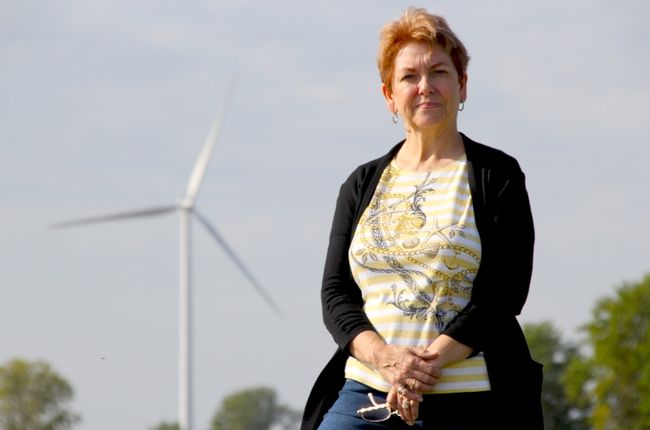
Betty Konc is pictured in Wainfleet with an industrial wind turbine behind her. (Greg Furminger/Welland Tribune/Postmedia Network)

People concerned about industrial wind turbines popping up near their homes may want to turn out to a Wainfleet Ratepayers Association meeting Wednesday.

The association founded in the late-2000s by Betty Konc, now a township alderman, typically holds a fall meeting for the broader community. The one being held at William E. Brown School, with sponsorship from Mothers Against Wind Turbines, is an opportunity to not only field residents’ concerns but to keep wind energy in the spotlight.

Konc says she’s tired of waiting for provincial government discussions with Ontario residents on wind turbines, and feels the matter is falling of the media’s radar as to how safe — or not safe — they are.

Two guests are scheduled to speak Wednesday.

Stephana Johnson, a retired schoolteacher in her 80s, will relate her experiences after moving a few kilometres from wind turbines in Long Point. At previous forums, the 2008 federal Green party candidate for Haldimand-Norfolk has told of hearing loss, buzzing in her ears, insomnia and a stuffiness she attributes to living near turbines.

“She’s going to try to connect the dots for people,” Konc says of Johnston’s presentation.

Caistor Corners area resident Mike Jankowski will also relate his experiences, she says.

Konc suggests that people consider getting a “baseline” medical report from doctors prior to any installation of industrial turbines nearby their homes, so that any ensuing changes to health can be documented.

Flyers promoting the community meeting suggest attendees can learn more about making complaints about turbines, property values in relation to turbine development and applying for property reassessments.

Ben Lansink, a London, Ont.-based certified property appraiser who specializes in diminution in value analyses, including in relation to proximity to turbines, was expected to attend Wednesday, but has had to cancel his appearance.

The open two-hour event starts at 7 p.m.

greg.furminger@sunmedia.ca

Do Wind Turbines Lower Property Values?

12049563_817464448374849_1700640773389809158_nA key point of contention against wind (and solar) farms is that they require much larger amounts of land to generate the same amount of electricity, an important downgrade of their “greenness” that goes conveniently ignored. Wind power is naturally intermittent, and plants typically operate at about 25% of full capacity, compared to coal and natural gas plants operating at 90%.

Thus, it can take 4-5 wind plants to produce the same amount of electricity as a single fossil fuel plant.

The U.S. Department of Energy has concluded that generating 20% of electricity (which is likely the highest we could go, see here) with land-based wind installations would demand at least 20,000 square miles, or the size of Maryland and Vermont combined. By comparison, all U.S. nuclear power plants, which produce around 20% of power, occupy only 110 square miles.

One headline is indicative: “Wind farm ‘needs 700 times more land’ than fracking site to produce same energy.” 

The main reason industrial wind farms take up so much land is that each turbine can be spaced a half mile or more apart. And bigger, taller, and more spaced apart turbines are better because they can generate more electricity. Standing 650 tall (200 meters), these giant wind turbines dwarf nearby buildings. Along with the complexity of siting, this explains why getting wind farms built is much harder in real life than in the Sierra Club’s mind.

http://www.forbes.com/sites/judeclemente/2015/09/23/do-wind-turbines-lower-property-values/