Category Archives: Health

Amherst Island Project- High Risk to Public Safety

Amherst Island Wind Project – High Risk to Public Safety
(Marine Logistics and Hazardous Materials)

Over 1400 barge trips across the Amherst Island ferry path will be needed to transport all turbine parts, heavy haul trucks, cranes, a cement batching plant, materials, fuel, fuel trucks, and supplies from the mainland to Amherst Island. The potential for collision is exacerbated by the plan to undertake all construction from September to March.

Two industrial docks, one on the mainland and one in Kerr Bay on the Island are proposed. A 4.6 km transmission cable laid by a specialized ship will follow the barge path and similarly intersect with the ferry route. This constant intersection of barges and ferry poses a multitude of risks for residents of the Island, all those using the ferry, and hundreds of recreational boaters.

Hazardous materials transported by barge include dynamite, fuel trucks, diesel, gasoline, transmission and hydraulic fluids, anti-freeze, motor oil, cementitious materials, nacelles containing oil, turbine parts composed of over thirty different minerals, 300 heavy haul trucks and several cranes. Every barge trip will intersect with the ferry path to Amherst Island. Two barges will be used for transport: a 300-foot-long component barge and a 150-foot civil barge. A marine accident involving hazardous materials in the channel is an unacceptable risk.

Loyalist Township documented their concerns with the proposed routes of the barge traffic and the submarine cable used to connect the transmission line to the mainland. Both routes cut across the ferry path. The Frontenac II ferry crosses the North Channel every 30 minutes from 6:00 am until 2:00 am between Millhaven and Stella and has right-of-way over all other marine traffic.

It is impossible to exaggerate the importance of this right of the ferry to pass freely on its scheduled route: it is literally a lifeline for Island residents. An island offers no alternative routes for residents, commuters, suppliers, and most significantly, emergency vehicles. Most regular users of the ferry have encountered the situation in which the ferry, in mid crossing, makes a sudden course reversal, returning to the mainland to pick up an ambulance. Maneuverability and speed are essential, factors which would obviously be impeded by the presence of constant barge traffic crossing the ferry path.

The barge traffic will also pose serious navigational hazards for the hundreds of recreational boaters in the waters north of the Island and impede access to several well-known safe anchorages on the Island’s north shore.

The daily traffic from tugs with barges crossing the ferry route and entering Kerr Bay will create an unacceptable hazard in violation of the Navigable Waters Act. The ferry and the hundreds of other mariners in the waters off Amherst Island would have their right to safety threatened and, particularly for the recreational boaters, their access to safe anchorage or moorings impeded by the heavy volume of barge traffic.

This hazardous situation is exacerbated by the fact that the barge traffic, unlike the scheduled ferry crossings, would be constant but irregular, increasing the risk of a marine collision.

Windlectric has not provided the Marine Safety and Logistics Plan required in the MOECC Decision on Instrument for this project nor has it produced an Emergency Response and Communications Plan acceptable to Loyalist Township.

Our entire community is at risk.

Please ask Minister of the Environment Glen Murray (minister.moe@ontario.ca) to revoke approval of the Amherst Island Wind Project.

Protect Amherst Island: http://www.protectamherstisland.com/

Global News September 26, 2016:

http://globalnews.ca/video/2965085/amherst-island-residents-want-renewable-energy-development-rethink

Who Owns the Wind?

dscn1776

You can’t eat money.

Credit:  Emmetsburg News | September 20, 2016 & September 22, 2016 | www.emmetsburgnews.com | emmetsburgnews.com

“So, how much dough will I make on this wind farm deal?” That question remains utmost in the minds of farmers interested in squeezing every drop of income from their operation. As a native Iowa farm boy, I understand “the bottom line is the bottom line.”

Drought, hail storms, and low commodity prices sometimes made profit margins tight on our 160 acres. But growing up on that farm also taught me priceless values that sustained our family farming operation through thick and thin. A strong work ethic, resilient attitude, spirit of fair play, watching out for your neighbor, caring for the wildlife that shares our land, and being a good steward of the soil shaped this rural legacy of values passed on to me from my ancestors to whom I am forever indebted. Wind farms threaten this legacy.

At first glance, it seems like a good deal. A “windfall” of cash. “Free money” for the taking. A winning night at Vegas! After all, the wind is “free” isn’t it? Well not exactly. I recall wise farmers in our community who lived by the credo, “Free money never comes without strings attached.” And those “strings” are front and center of the wind farm debate, driving to the more important question, “Who owns the wind?”

Winning over the farmers

Wind farm corporations know this and work hard to incentivize farmers with promises of “free money,” avoiding the “Who owns the wind” question until it’s time to sign the contract. In the words of a fellow Iowan and respected writer, “They act as though eminent domain extends to the sky.” They control the script. They control the outcome. They control the strings. That’s why the “promise” of free money dominates the debate, overshadowing other urgent concerns. Who owns the soundscape we all listen to? Who owns the horizon we peer into day and night? Who owns the wildlife that depend on unobstructed flyways and migratory routes of our beautiful Iowa skies?

Wind farm planners minimize these concerns, seeking to control the debate with promises of quick and easy money-another source of “low-hanging” tax revenue for the county and a way of reducing our dependence on foreign oil. What happens when this “free money” wins out over responsible stewardship of wind, land and wildlife?

Delivering on the promise

Unfortunately, wind power can’t deliver on its promises. Carbon footprints remain unchanged because wind power is too unreliable to permanently replace existing power generating sources. Denmark is the latest nation to scrap plans for building more wind farms. The Danish government says wind power has become too expensive. (Matzen, Erik and Boyle, Jon; “Danish Government Says Wind Power Became Too Expensive.” Reuters Daily Mail Wires 13 May 2016 at dailymail.co.uk/wires/reuters /article-3589130/Danish-government-says-wind-power-too-expensive.html #ixzz4BHeWSohs)

Sprawling wind farms indelibly scar the rural landscape with giant towers that cast moving shadows during the day and a sea of blinking red lights at night. Residents living near wind farms report chronic health problems and we see mounting evidence wind farms kill our most treasured bird species (Cohen, Bonner R. “Minnesota Wind Farm Seeks Permit to Kill Bald Eagles.” Heartlander Magazine March 8, 2013 at news.heartland.org/newspaper-article/2013/03/08/minnesota-wind-farm-seeks-permit-kill-bald-eagles)

This is an enormous price to pay for economic gain enjoyed by only a handful of farmers, while their neighbors are doomed to live in the shadow of these hulking, blinking skyscrapers literally “scraping” the beautiful Iowa horizon with turning blades, hundreds of feet long. That “free money” carries a huge price tag.

Despite these undesirable consequences, some farmers “bend with the wind” toward the foreign wind farm corporations, enticed by their offers. The promise of “free money” becomes irresistible. And when we give in, we have just answered the question, “Who Owns the Wind?” They do. Until that point in time, no individual owned the wind. Wind was a shared resource that benefited all. No one could claim an exclusive right to it. But now the wind farm corporation has us “all turbined up.” They own the wind.

Tragically, they own more than the wind. They own the farmer who has surrendered control of the land. They own the “future” of that land destined to become a gravel road, tons of buried concrete, and towering steel monstrosities held together by nothing more than a “promise” to pay. The farmer has abdicated total control of that piece of land with no reasonable recourse to reclaim it, if and when the “promise” is broken.

The wind farm companies did it without Firing a shot. They took control. They expropriated our shared resource that benefited all. Most of us get nothing but a landscape littered with moving, blinking, noisy machines. Gone is our wildlife, gone our rural quiet, gone our peaceful evenings sitting on the deck, gone our unrestricted views of red/orange Iowa sunsets. Gone is our spectacular, unimpeded view of the Milky Way, and our community spirit of solidarity built by generations of farm families; while city dwellers thousands of miles away get cheap electricity without sacri?cing anything.

Giving up our freedom

But this isn’t just about giving in to a foreign occupation that has decimated our land, wildlife, skies, horizons and our rural way of life. Perhaps most importantgone is the freedom that comes with full ownership of the land. Gone is the legacy of unencumbered land handed down to us from our ancestors. Gone is the promise of passing this unencumbered land to our children and grandchildren, free and clear. For we now share air space with foreign entities unconcerned with preserving our way of life, which we have just traded for tons of steel, concrete, asphalt, and gravel covering our rich Iowa dirt.

This is a tragic irony

“So, how much dough am I going to make on this wind farm deal?” Ironically, our life is diminished in proportion to the lease payment. The greater the payment, the more restricted and smaller our life becomes. The greater the payment, the more power we have ceded to these invaders. The irony of all this centers on power. The farmer loses power, loses the ability to shape the destiny of their farm-to a wind farm corporation. The farmer gives away the power of ownership of land, their birthright.

How much is that power worth, the power the farmer just gave away? Can we put a price on it? Is getting “all turbines up” worth it when we abdicate our responsibility to protect a family birthright: the land? Do we really want to give that away? Who owns the wind? Now, they do. And the land. And the farmer. And the close-knit community that raised me. Our tragic loss is their “wind-fall” gain. Their Vegas win.

Is this the legacy we farmers want to pass on to the next generation? How much is that “promise” piece of paper called a lease really worth? Our land? Our wildlife? Our dignity? Our legacy? Now, all of this is “gone with the wind.”

(signed) Wayne R. Knutson, Jr.

former Palo Alto County resident, from San Antonio, TX

Knutson, raised on the family farm in NW Iowa, is a Colonel in the U.S. Air Force. His mother lives on the farm and is involved in managing the operation. His commentary was first published in Wallaces Farmer, August 2016.

The Reality of Wind Power Contracts

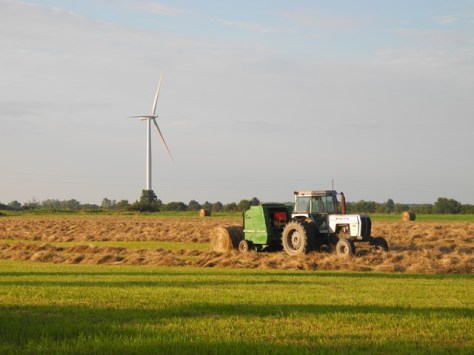
turbine-and-tractor

“Should the client sign the documents, in effect, he or she is affecting the use and viability of the property and any family plans for it for a minimum of 20 and perhaps as much as 40 years. From the Ontario experience, we know that neighbours are rarely appreciative and old friendships often suffer.”  

Law Times.  Speakers Corner: The Reality of Wind Power Contracts

Monday, 19 September 2016 09:00 | Written By Garth Manning

Rural landowners who are approached to permit a wind turbine or turbines or associated equipment on their acreage badly need sophisticated legal advice on these complex agreements.

What happens too often, however, is that landowners simply tick the box in the documents presented to them that says they waive independent legal advice.

As a public service, lawyers should change this practice, and soon.

Wind power projects are part of a policy for renewable sources of power within Canada. In Ontario, many projects are already operating in rural parts of the province with an additional 600 megawatts scheduled to be added in 2017. More are planned for several other provinces, including Alberta and Saskatchewan.

Lawyers advising rural landowner clients considering such agreements should be aware of the characteristics of these leases in order to advise clients appropriately. Often clients focus on the dollar amount offered by the developer without considering other important impacts of the agreement.

Typically, the wind power proponent incorporates a subsidiary for each individual project. Its agents obtain turbine sites from farmers who have limited understanding of what they’re being asked to do, which is to sign an Option to Lease many pages long; in this option may be a “further assurances” clause that obligates them, if the option is exercised, to sign a form of lease.

That document, many more pages long, is by far the most lessee-friendly imaginable to any real property lawyer, experienced or otherwise.

Those farmers badly need legal advice; local law associations should emphasize this to their members.

READ MORE: http://www.lawtimesnews.com/201609195645/commentary/speaker-s-corner-the-reality-of-wind-power-contracts

Turbulence in West Lincoln

13241387_952879334831276_3080059692547901511_n

Tempers flared in West Lincoln County chambers over a report on Industrial Wind Turbines.

A local resident spoke earlier to the members that her water well had stopped flowing after drilling occurred several hundred feet away for the installation of a Niagara Wind electrical pole (her deputation starts at around 6 minute mark of the video).

View Council meeting on video:

Niagara This Week  published the following article:

By: Amanda Moore

A newly formed public advisory committee knows it can’t go back in time and change decisions regarding industrial wind turbines. But the West Lincoln Industrial Wind Turbine Advisory Committee is hoping lessons learned can make an impact on future projects in Ontario.

However, councillors on the planning, building, environmental committee think the WTAC’s recommendations need to be cleared up before they can be endorsed.

There was much debate at this week’s planning, building, environmental committee over a set of recommendations from the advisory committee. The recommendations involve reaching out to other municipalities living with wind turbines, joining two organizations and re-emphasizing the township’s status as an unwilling host. Coun. Dave Bylsma, who chairs the committee, said the eight recommendations are the “absolute least” the township can do. He said not approving the committee’s recommendations sends the wrong message to residents.

“If we’re not willing and ready to do those eight, then I honestly don’t think this council cares anymore about the turbine issue,” said Bylsma, after members around the horseshoe debated the motion. “There is nothing offensive in here. It’s about getting information and networking. It commits us to continue working, to continue to network.”

READ MORE: http://www.niagarathisweek.com/news-story/6859535-turbulence-in-west-lincoln-council-chambers/

Eight Requests of the Industrial Wind Turbine Public Advisory Committee that were debated:

(c) ITEM P86-16 Director of Planning & Building (Brian Treble) Re: Report No. PD-113-16 – Recommendation Report – Update and Recommended Actions of West Lincoln Industrial Wind Turbine Advisory Committee RECOMMENDATION:

  1. (1) That, Report PD-113-16, regarding “Update and Recommended Actions of West Lincoln Industrial Wind Turbine Advisory Committee”, dated March 14, 2016, be RECEIVED; and,

  2. (2) That, the Chair of the Wind Turbine Advisory Committee and Township staff arrange a meeting or teleconference with representatives of the Municipality of Grey Highlands to obtain information about the Terms of Reference for their Noise Study (Attachment No. 1 to this report) and an understanding of the benefits and future uses for such a study/report; and,

  3. (3) That, the Wind Turbine Advisory Committee be permitted to continue to fact find the best available methods by which to protect our citizens from the harmful effects of industrial wind turbines and to report back on findings, recommendations and possible costs. This is likely to include the preparation of a business case for a sound, infrasound and tonality study such as the one completed in Grey Highlands, at the appropriate time; and,

  4. (4) That, Township staff obtain the final noise assessment reports as submitted to the Ministry of the Environment-Renewable Energy Approvals Office for the approval of both the HAF and NRWC (now FWRN LP) projects; and,

  5. (5) That, the HAF noise assessment report that was to be completed after 18 months of operation of the HAF wind turbine project be obtained by Township staff; and,

  6. (6) That, Township Staff and Council reemphasize that West Lincoln is an unwilling host for industrial wind turbine projects and obtain Provincial recognition of our position; and,

  7. (7) That, West Lincoln hereby agrees to pay membership fees to become a member of the Multi-Municipal Working Group (approximately $700.00/year) and Wind Concerns Ontario (approximately $100.00/year); and,

  8. (8) That, the Advisory Committee continues to meet and discuss/explore recommended actions for the 24 items as identified in this report; and to continue to report to the Planning/Building/Environmental Committee on a quarterly basis, or more frequently, as required.

Samsung More Turbines

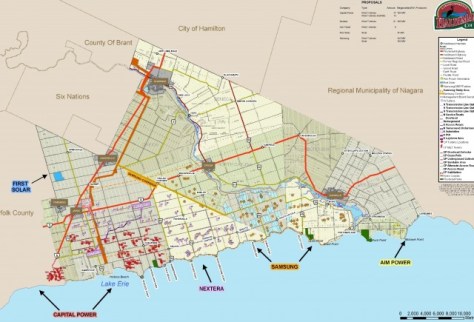
turbine-map-haldimand-proposed1Haldimand County Council  has betrayed residents impacted adversely by wind power complexes by welcoming additional proposals for increased development within its boundaries’.  Samsung Energy Inc. presented its pitch for municipality participation on August 4, 2016 for even more wind turbines along the shores of Lake Erie (see pages 13-19) with an anticipated notification date of selected proponents in 2018 in the LRP 2 (large renewable projects).  The massive Grand Renewable Wind and Solar complex was completed in 2015,  http://www.samsungrenewableenergy.ca/haldimand
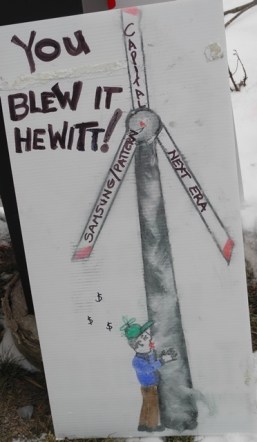
“Samsung More Turbines” resolution can be read here:

samsung-more-turbines-resolution-2016-20160913-council-in-committee-1

It was just a few short years ago- 2013 to be exact- that Haldimand declared itself an unwilling host due to pressure from its constituent. The resolution can be read here;

wind-turbines-resolution-february-2013-1

Mayor Hewitt’s motion endorsing the partnership with Samsung Renewable Energy Inc.  in some sort of equity form and to apply for a PPA (purchase power agreement) contract in anticipation of the next round of large renewable energy projects states:

WHEREAS the province has taken a clear direction to move ahead with more green renewable energy projects;

AND WHEREAS the transmission lines and area around them are fundamental for new applications;

NOW THEREFORE BE IT RESOLVED THAT Haldimand County consider a request made by Samsung Renewable Energy Inc. to partner in some equity form and apply for P.P.A. contract in the next round of applications.

Lessons learned  as taken from the Samsung presentation:

  • Community Support is critical in winning the bid (Municipal Resolution, First Nation  Participation, Adjacent landowner consent)
  • Transmission Capacity Availability needs to be deeply considered

Mayor Hewitt has consistently supported Samsung and its partners such as starring in commercials still featured on their website:

Samsung feels it has experience with the local community and Haldimand is the right place for more wind projects.

Since the County is openly on board, Six Nations Band Council is already a part equity owner of Grand Renewable, and HDI accepted payments- it only leaves out those who are considered “non-participating” receptors.

Wind turbines make lousy neighbours but nobody wants to ask those who live in the flickering shadows of Haldimand’s horizons against consent.

Haldimand Press writes about the latest events in its September 15, 2016 edition (subscription): http://www.haldimandpress.com/samsung-seeks-support-for-more-windmills?id=858


dscn1859

Protect Our Children

School and Cement Plant are a bad mix

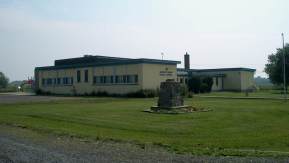
amherst-island-public-school
Amherst Public School

“The Green Energy Act allows the wind industry to trump every provincial regulation and municipal by-law designed to protect children. A cement plant near the Amherst Island Elementary School was approved by the Ministry of Environment and Climate Change as ” equipment necessary for the Project”, the construction of 26 wind turbines on Amherst Island. No alternative location was required, no mitigation measure deemed necessary. In dismissing an appeal from the Association to Protect Amherst Island, the Environmental Review Tribunal concluded that the arguments “have not established that the operation of the concrete batch plant as part of the Project and in accordance with the Renewable Energy Approval (REA) will cause serious harm to the human health.”

Protect our children:

https://www.facebook.com/bruce.sudds/videos/10157523546600061/


Please support the fight on Amherst Island and consider a monetary donation for the ongoing legal battle: http://www.protectamherstisland.ca/school-cement-plant-bad-mix/


Tradegy & Farce of Ontario’s Energy

wind-refugeeKarl Marx said that history repeats: first as tragedy, then as farce. In Ontario, the history of failed energy policy repeats – first as farce, and then as more farce.

Premier Kathleen Wynne faces an election in a little over a year and a half, and one of the main issues dogging the Liberal government is the price of electricity. Thanks to policy choices that the government itself seems incapable of unwinding, electricity bills have been on an upward tear for a decade. Many voters are furious. And so the Wynne government devoted the heart of its Throne Speech this week to a plan to lower the price of electricity. Not the cost of electricity, however. Just the sticker price.

Taxpayers of Ontario, you will now be paying for more of your electricity through your taxes, or through future taxes funded by deficit financing, and less through your electricity bill. Yes, that’s the new plan. It looks a lot like the old plan.

Nearly six years ago, Ms. Wynne’s predecessor, Dalton McGuinty, was facing an election. He was, like the current premier, spooked by rapidly rising electricity prices. These spiking prices, note well, had been engineered by the Liberal government’s mishandled Green Energy policy. To win back voters, Mr. McGuinty decided to give consumers a break. The tool: the so-called Ontario Clean Energy Benefit, which ran from the start of 2011 to the end of 2015….

Editorial published in Globe & Mail on September 13, 2016

READ MORE: http://www.theglobeandmail.com/opinion/editorials/ontarios-new-electricity-policy-history-repeats-as-farce/article31862790/

Green Energy & Energy Poverty

heat or eat

“Going green is fine. But not at any price! And right now Ontario is in the midst of a growing electricity crisis. We have the power, that’s not the issue. The problem is the soaring cost of delivering electricity to customers, especially those who are unfortunate enough to live in lightly populated, rural areas.”

Soaring hydro costs driving families into poverty

Carleton Place Almonte Canadian Gazette

When people ask if you are “into green energy” it is nice to be able to hold up your hand.

I have no issues with working to eliminate coal-fired electrical generation or reducing our dependency on nuclear energy which, despite a record of success, still scares many of us.

Going green is fine. But not at any price! And right now Ontario is in the midst of a growing electricity crisis. We have the power, that’s not the issue. The problem is the soaring cost of delivering electricity to customers, especially those who are unfortunate enough to live in lightly populated, rural areas.

The Liberal government of Premier Kathleen Wynne refuses to term the current situation “a crisis.” But for thousands of rural Ontarians who are struggling to pay their electricity bills it is a catastrophe.

Some of the tales of woe we’re hearing on a daily basis are truly pitiable.

Three weeks ago I read about a man in Bruce County, near Lake Huron, who after suffering a serious heart attack told family and friends it would be better if he died instead of surviving.

His reasoning is that the medical equipment he is now required to use regularly runs on electricity. It is driving up his family’s already ridiculous hydro bill.

READ MORE: http://www.insideottawavalley.com/opinion-story/6844567-soaring-hydro-costs-driving-families-into-poverty/


Time to step up & face the issues

“The Huron County Board of Health has voted in favour of partnering with the University of Waterloo and Wind Concerns Ontario on a study of the health impacts of wind turbines in Huron County.

It was made clear to board members the health unit’s commitment is limited to collecting date and analyzing that data, and nothing more than that, and it was also pointed out the participation of the health unit would not result in any additional costs.

Spokesperson for the Concerned Citizens of Huron Patti Kellar says she’s happy that the board has agreed to move ahead with the study, but maintains it should have happened six months ago. She believes there’s no doubt the study will find a relationship between proximity to turbines and health problems, because she experiences them herself. Kellar says she hopes that once that link has been established the wind energy companies will halt the operation of the turbines, and work with residents to address their concerns. She adds she would like to see them removed, but admits realistically that’s not likely to happen.patti-kellar_dvd_original

Kellar says not everyone feels the affects of the turbines, but maintains people with a health issue will find that aggravated by the turbines, and anyone who is predisposed with a health problem will find that problem will be triggered by the presence of wind turbines.”

READ AT: http://blackburnnews.com/midwestern-ontario/2016/09/01/huron-board-health-favour-wind-turbine-study/

One step closer to investigation

house and wind turbine

MOTION:

Moved by: Member Jewitt and Seconded by:  Member Steffler

THAT:

The Board of Health accepts the report of Jean-Guy Albert, Public Health Manager, dated September 1, 2016, entitled Proposed joint investigation to be conducted by Wind Concerns Ontario, University of Waterloo and Huron County Health Unit into wind turbines and reported associated human health effects, as presented for information;

AND FURTHER THAT:

The Board of Health agrees to the request made during its August 4, 2016 meeting for the Health Unit’s participation in the proposed investigation into wind turbines and reported associated human health effects, to be conducted in partnership with Wind Concerns Ontario and the University of Waterloo.

CARRIED

Susan Cronin

County Clerk

The Corporation of the County of Huron

1 Courthouse Square

Goderich ON N7A 1M2

519-524-8394 Ext 3257