Niagara Wind’s Enercon Industrial wind turbines & others from adjacent complexes disturbing human, plant and animal life in Lowbanks, Ontario.


Niagara Wind’s Enercon Industrial wind turbines & others from adjacent complexes disturbing human, plant and animal life in Lowbanks, Ontario.

Protesters blocked the entrances to three wind turbine construction sites near Chatham Thursday morning. Five families are now reporting dirty water in their wells after pile driving for the construction of industrial wind turbines began.
Source: Fight to save water wells
“At the press conference were the people whose wells have been affected in the North Kent Wind 1 project area – Theresa Pumphrey, Paul and Jessica Brooks, Valerie and Wayne Brooksbank, and a representative for Mark Moir (Countryview Line).
Visibly upset, the property owners talked about the impact on their families’ health and fear about the black shale that is visible in the water that is known to carry arsenic, mercury and other harmful chemicals in it.”

Aug 14 • Letters to the Editor •
Sir: Mayor Hope, you and Chatham-Kent council are playing a game. A very dangerous game that is affecting the life style as well as the very livelihood of some of your constituents.
Mayor Hope, you and most of your councillors do not know what is going on within Chatham-Kent, especially in regard to the wind farm sites in the former Dover and Chatham townships. This is proven by the fact that most of you have never visited any of the reported problem sites to see firsthand what the affected families are experiencing. You are making decisions based on what you hear from the wind companies, their associates and the Ministry of Environment and Climate Change – all of whom have biased opinions based on profits or their lack of willingness to admit that they made errors.
In addition, you as mayor and council, who have invested $8 million of the Chatham-Kent taxpayers’ reserve fund, are in conflict of interest with regards to any decision made on wind farms or any conflicts arising form them.
You, Mayor Hope, indicated that, “the group (WWF) had a chance to meet with the MOECC ‘and they turned it into a circus.’” You were not there!
Do you recall that the MOECC, having been given a list of questions over one month before the meeting and not answering one of them being a circus? Do you consider the MOECC not giving WWF a promised copy of the minutes of the meeting that they promised part of the circus? Would those minutes have exposed their incompetence?
You indicate that you do not release all of your correspondence to the public. Perhaps you should. How many things are you hiding? Did you ever think that in the letter, received by Freedom of Information, that Mr. Murray’s reply might have been important information? In Mr. Murray’s reply letter it states, “The measurement of turbidity is a key test of water quality because it captures the potential impact that a vibration from a wind turbine could have on a water well. The ministry is aware that some residents are concerned that wind turbine vibration may shake sediment loose in a water well. These particles could have a chemical make-up of heavy metals that are naturally occurring in the area; however any existing heavy metals in the rock particles do not dissolve with vibration. Should a wind turbine vibration cause elevated turbidity in a water well, the wind farm company would be required to implement a contingency plan that is to include, as a minimum, remedial measures to be undertaken by the company, at the company’s expense, to resolve any impacts to wells or well water resulting from the construction, operation, or decommissioning of the facility.”
Mayor Hope, don’t you want your constituents to know that there can be heavy metals in their well water?
All of the affected wells in Dover were once clear water producers and now carry particles that the MOECC refuses to analyze for chemical content. Particles of 30 to 40 microns in size or larger can be seen by the human eye. Particle smaller than that cannot be seen.
In tests done to date by well owners in Dover Township, it indicates that almost half of the particles carried in the water are less than one micron in size. These particles can penetrate skin and walls of body organs. Approximately another 25 per cent of the particles are less than two microns in size.
These particles may carry the heavy metals, to which former Minister Murray refers, such as uranium, arsenic and lead. This is why, Mayor Hope, you should have released Minister Murray’s letter to the public, so the public could have been made aware.
According to the MOECC turbidity measurement, on which the MOECC hangs its hat, this water should be safe to consume. Why do they not take a total analysis and find out what is dissolved in the water and what are the particles carried by the water and if it is safe to drink.
I strongly suggest that the mayor and all of council visit one of the affected sites. If you find it too humbling to visit with one of your constituents, then go without using any of your water for drinking or cooking and think about what effect contaminated water could have on you when you bathe or wash your clothes. Perhaps all other people who are not sure of the effect of not having potable water should also try this for a period of time.
Water wells have gone for decades producing clean, clear water. Common sense would indicate that after the wind farms drove piles in Dover Township and ruined wells there, we would stop building wind farms. We now have piles being driven in Chatham Township and wells are now being ruined there as well. Obviously, there is a direct correlation between pile driving and a negative effect on water wells.
When will those with some authority ever wake up?
Is the solution bigger turbines in the Otter Creek Wind Farm? What would you expect to happen there?
Water security, Mayor Hope, is not a circus or a game. At the Windsor meeting with the MOECC, which you did not attend, it was the citizens of Chatham-Kent that were trying to protect the water security of the municipality, not you.
Mayor Hope, in the future when you receive information about public health, share the information with the public.
Peter J Hensel
Dover Centre
Published: The Chatham Voice.com

Words and their meanings have powers that can impact our very well- being. Judge Cornelius J. Moriarty II, of the Justice of the Superior Court ordered the cessation of the operations of the wind turbines in Falmouth, Massachusetts. In giving his judgement he discusses findings and reasons while interpreting and applying the meanings of the words injurious and nuisance.
“Despite the Town’s insistence that Barry Funfar is hypersensitive to sound, it is clear that he is no lone voice crying in the wilderness. Other residents of the neighbouring area have registered similar complaints which was the very reason the Town commissioned the HMMH study in the first place.”

The Falmouth Enterprise August 11, 2017
A neighbor of the town’s turbines e-mailed us last week to say that we have been misleading the public by stating in recent stories that Judge Moriarty ruled that the turbines were a nuisance to the Funfar property. A nuisance, he wrote, is generally thought of as a neighbor mowing the lawn on a Sunday morning, whereas Judge Moriarty defined nuisance not only as an inconvenience but also a danger. He attached a copy of the judge’s decision for our reference.
In fact, Judge Moriarty went into a good deal of detail in a five-page discussion of his findings and decision.
First, he pointed out that the Zoning Board of Appeals’ decision that the turbines constituted a nuisance could not be overturned, as the board would have had to have been unreasonable or on legally untenable grounds. The appeals board found that the turbines were a nuisance to the Funfars’ property because, based on a DEP sound study, they directly affected the health and well-being of the Funfars. “The decision here was hardly arbitraray and capricious,” Judge Moriarty wrote.
But the issue here, of course, is the definition of nuisance. Judge Moriarty pointed out that nuisance is difficult to define and, as much testimony as there was about sound levels, none of it applies to the definition because there are no numerical standards. “The issue is,” he wrote, “whether, on the facts found, the operation of the wind turbines was offensive because of injurious or obnoxious noise or vibration, a nuisance in violation of the by-law.”
He pointed out that, while the town argued that Mr. Funfar was hypersensitive to sound, “it is clear that he is no lone voice crying in the wilderness. Other residents of the neighboring area have registered similar complaints…”
The judge discussed the definition of “injurious,” at some length and concluded that “the physical effects of the turbine-generated sound upon Mr. Funfar have been certainly harmful and have tended to injure him.”
There should be no mistake among the residents of Falmouth; when the appeals board and Judge Moriarty called the town turbines a “nuisance,” they did not mean it in the way of ants at a picnic or a dog barking in the night.
Judgement Town of Falmouth vs Falmouth Zoning Board of Appeals et al


“The common enemy of humanity is man.
In searching for a new enemy to unite us, we came up
with the idea that pollution, the threat of global warming,
water shortages, famine and the like would fit the bill. All these
dangers are caused by human intervention, and it is only through
changed attitudes and behaviour that they can be overcome.
The real enemy then, is humanity itself.“
– Club of Rome; The First Global Revolution (page75)–
A North Kent Wind Project manager referred to a family’s water as “visually clear” in a press release, despite tests and photos that show otherwise.

Aecom, the engineering consultant behind the wind project, scheduled a site visit to sample the family’s water on Wednesday. According to Law, the tests show no issues.Senior Manager of Development Jody Law says the Ministry of Environment (MOE) notified him of Paul and Jessica Brooks’ complaint on Monday. Paul and Jessica Brooks live on Brook Line in North Kent and say they have been experiencing a plugged water pump from nearby wind tower pile driving.
“The sample was visually clear and colorless with no visible sediment. We have requested expedited analysis from the lab but, at this point, there is no empirical evidence of an issue,” says Law.
However, Water Wells First spokesperson Kevin Jakubec points out that a Ministry of Environment provincial officer made a visit to the home on Tuesday and found drastically different results.
According to Jakubec, the test results from the MOE show extremely high turbidity levels at 86.8 NTU. The Ontario Drinking Water Standard’s objective turbidity level is 5.0 NTU.
To meet conditions of the wind project’s permit, Pattern Development delivered a 2,000 gallon water tank from Ingersoll to the Brooks residence on Saturday.
“He said that there is no empirical evidence of an issue. I think the delivery of a water tank is recognition of an issue. Given that Mr. Law is the project manager, you’d hope he would know what is going on with this project,” says Jakubec.

Paul and Jessica Brooks demand that North Kent Wind executive Jody Law issues a full apology and retraction of his press release.Jakubec adds the project permit ensures that families, like the Brooks, who complain that their well has been affected by the turbines, do not have to pay for the costs of the investigation or water tanks……
READ ARTICLE: Blackburn News August 8, 2017
Pile driving for turbine foundation installations are again being associated to changes in a water well. Another day and another well impacted…


Eugene Clune who lives in Ballinvalley shared his family’s trauma and said that if he had the chance now he would approach things very differently.
‘My house is situated 800 metres from an industrial turbine and my four-year-old has slept, maybe two nights since last winter.
‘She would ask us why her granddad is outside on the digger in the middle of the night – because that is what it sounds like,’ he said.
Source: Crouck Substation Action Group
Published July 29, 2017: Independent IE
Friday, 14th July 2017 Wexford County, Ireland

On foot of a number of complaints from the public of noise nuisance from wind farms in north Wexford, Wexford Co Co commissioned RPS Engineering in early 2016 to carry out an in-depth, extensive noise survey of the sound emitting from adjacent wind farms and their wind turbines.
The wind farms included in the noise survey were;
1. Gibbet Hill, planning ref: 2009 0266 – view Gibbet report (PDF, 8.84MB)
2. Knocknalour, planning ref 2011 0504 – view Knocknalour report (PDF, 24.7MB)
3. Ballycadden, planning ref 2009 1730 – view Ballycadden report (PDF, 12.8MB)
4. Ballynancoran, planning ref 2003 3444 – view Ballynancoran report (PDF, 24.6MB)
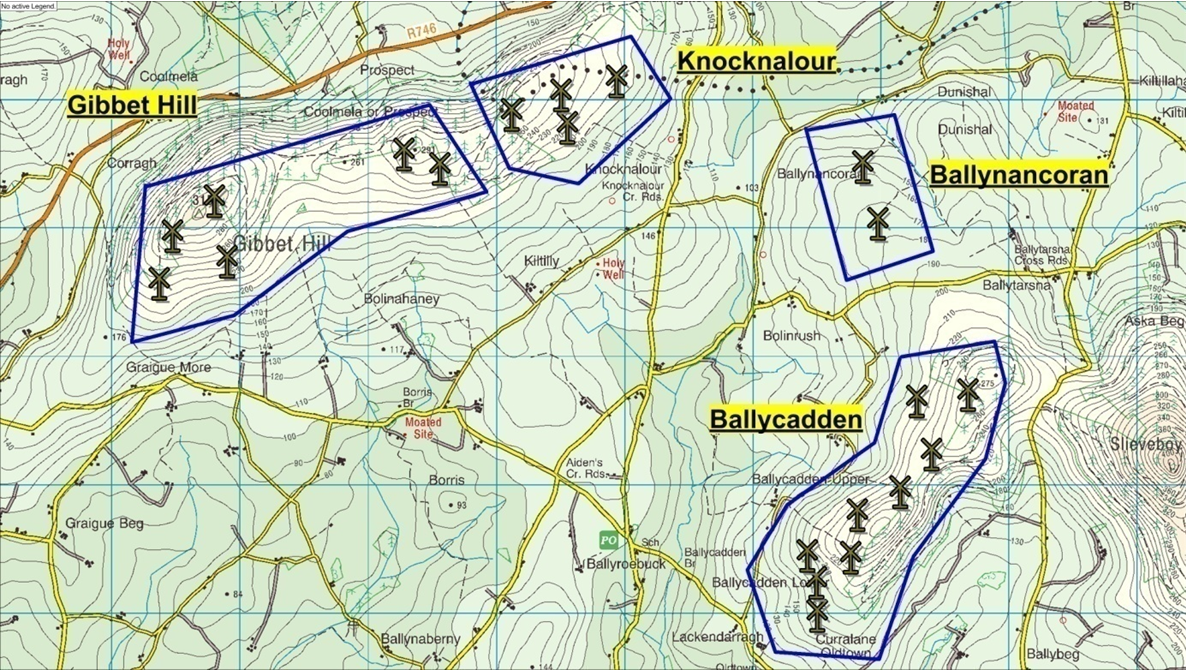
The scope of noise survey carried out, exceeded the requirements of the DEHLG noise guidance for wind farms and the requirements of most countries with well developed wind legislation. It involved inter-alia the continuous simultaneous acoustic monitoring at 4 wind farm sites, and eventually involved 13 noise meters being simultaneously deployed. In addition to noise meters a number of rain gauges and 10 metre high wind speed masts were also utilised to gather weather data.
The extended duration of this noise survey, 8 weeks at 8 sites and over 6 months at 3 sites, and the wide extent of noise parameter measurements and meteorological parameters carried out, ensured that account was made of practically all environmental and meteorological conditions experienced at the sites during the noise survey, such as differing wind speeds, directions, air temperature and particular meteorological conditions as experienced at the sites. This included the measurement of noise during periods of winter time cold temperatures with little or no wind (temperature inversions) so as to measure the noise impact during possible worst case scenarios.
The survey required the following measurements to be carried out at the 13 measurement sites,
Audio was also recorded at each site at a number of occasions at a sufficient sampling and bit rate to allow further analysis, eg FFT and amplitude modulation.
This study also includes an assessment report for each wind farm addressing their compliance regarding noise emissions under the following headings:
The survey was carried out in accordance with best international practice and in accordance with the most up to date Institute of Acoustics guidance for noise measurements of wind turbines/wind farms. This also included the anticipated recommendations of the Institute of Acoustics guidance document on Amplitude Modulation (IOA Noise Working Group (Wind Turbine Noise) Amplitude Modulation Working Group, Final Report, A Method for Rating Amplitude Modulation in Wind Turbine Noise), which was published in August 2016, during the noise survey, and included reference measurement methodologies, instrument placement, signal analysis, etc.
All of the raw the acoustic and audio data utilised in the analysis of these reports is available to the public on request. Due to the attendant problems the public may encounter with downloading online, very large data files associated with the raw data, Wexford County Council will be making the data available via portable hard drives. So as to protect both Wexford County Council and the end user from computer viruses etc, ensure IT security and to prevent corruption of the data, Wexford Co Co will copy the raw data from the Wexford County Councils master copy on to a new portable 250 GB hard drive, which will be supplied at the purchase cost of the hard drive.
The Software to access the raw data files is available to download from the following websites:
Raw Noise Data Files
Bruel & Kjaer Measurement Partner Suite
Raw Weather Data
NRG Systems Symphonie Data Retriever Software
Re-use of Public Sector Information Regulations 2005 (SI 279 of 2005)
All of the information featured on this website and the raw data is copyright of Wexford County Council unless otherwise indicated. Wexford County Council complies with the regulations on the Re-use of Public Sector Information, and we encourage the re-use of the information that we produce.
You may re-use the information on this website and the raw data free of charge in any format. Re-use includes copying, issuing copies to the public, publishing, broadcasting and translating into other languages. It also covers non-commercial research and study.
Re-use is subject to the following conditions:
• the source and copyright must be acknowledged in cases where the information is supplied to others
• the information must be reproduced accurately and fully
• the information must not be used in a misleading way
• the information must not be used for the principal purpose of advertising or promoting a particular product or service
• the information must not be used for, or in support of, illegal, immoral, fraudulent, or dishonest purposes
• the information must not be used in a manner that would imply endorsement by Wexford County Council or in a manner likely to mislead others
• any Wexford County Council crest, logo or mark must not be reproduced except where such crest, logo or mark forms an integral part of the document being re-used
• Wexford County Council is not liable for any loss or liability associated with the re-use of information and does not certify that the information is up-to-date or error free
• Wexford County Council does not authorise any user to have exclusive rights to the re-use of its information
For more details on information held on our website, please contact out FOI officer.
Copies of the reports have been sent to the complainants and the wind farm operators. Wexford County Council is currently assessing the contents of the reports and following evaluation of the results Wexford County Council will issue further updates in due course.
For further information please contact brendan.cooney@wexfordcoco.ie , Senior Executive Scientist.
Source: Wexford County Council
Author:
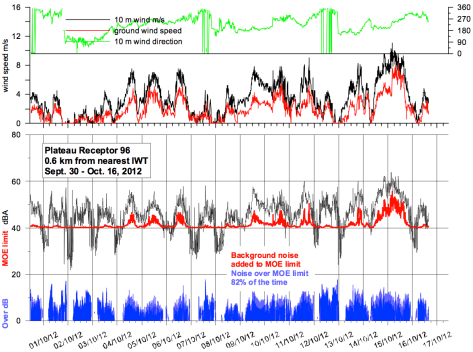
These are the results of nearly six months of continuous sound measurements away from and near industrial wind turbines (IWT’s) at five locations in Grey Highlands, ON, Canada. The measurement protocol was designed to allow for corrections to account for wind induced noise resulting in findings that are directly comparable to the MOE tables. The results indicate that for three IWT sites studied, the recorded sound pressure levels (SPL’s) exceeded MOE’s noise limits a majority of the time for non‐participating receptors outside the minimum distance of 550 m and outside the 40 dBA SPL contours calculated by consultants engaged by the wind developers. The other two sites were used to measure background noise levels.
Download original document: “Grey Highlands 2012 Wind Turbine Noise Survey”
Source: National Wind Watch
 Mothers Against Wind Turbines Inc.