“Ellen Andrew-Kasper says she struggles to stay awake when she drives because of lack of sleep; David Kennedy leaves home to avoid headaches caused by the flicker of light and shadow through his windows, and Valerie Vitali thought she was having neurological problems from the same light and shadow flicker.
The three South Shore residents have only one thing in common: they live within a mile of a wind turbine.”
…….
““I don’t want to be a warrior,” Vitali said. “I just want to be a person who has lived here for 37 years and has a right to some peace and quiet.”
In the article “Renewable Energy’s Dilemma” (CC Jan. 22), Candice Goodchild introduced the perspective of a grassroots group in Chatham-Kent, Ontario called Water Wells First. This group was formed to protect the sensitive aquifer in the area from vibration damage caused by the construction and operation of industrial wind turbines (IWT). I am a member of that group, and I would like to share my story with you.
My family and I live inside the footprint of the North Kent Wind 1 (NKW1) project, built in the northeast part of Chatham-Kent, Ontario. The wind farm is built and managed by Pattern Energy (out of Texas) and Samsung (out of Korea). We live on an acre of land, surrounded by farmland. We have enjoyed quiet country living that included an unlimited supply of good, clean water from our well. However, last summer, during the construction of the NKW1 project, our property was surrounded by three pile drivers. The particular style of construction for industrial wind turbines requires the use of piles to support the foundations. In this case, 18 to 24 piles are used for each of the 34 wind turbines in this project. Three turbines were erected within one kilometre of our house.
Pile driving began on July 27, 2017. The next day, while my husband was in the shower, the water stopped running. Upon investigation we found that the sediment traps we had installed on our water line were choked with thick, black sediment – something we had never seen before.
Chatham-Kent sits on a unique geological bedrock formation called Kettle Point Black Shale. The aquifer that feeds hundreds of wells in Chatham-Kent is shallow and quite fragile. It rests on that black shale, trapped in layers of glacial sediment. Black shale is known to naturally contain lead, mercury, arsenic and uranium.
In 2012, the East St. Clair wind project was constructed in northwest Chatham-Kent, which has the same black shale formation as other areas of the county. Many well owners in the area experienced the same black water we found in our well.
Health hazards
Investigation by private citizens and scientists hypothesized that the vibration from pile driving and the operation of wind turbines had disturbed the aquifer under the East St. Clair project, causing the release of sediments into the aquifer. As a result, the water turned black from the shale particles. When the NKW1 project was to begin, farmers and residents from the area mobilized to inform government officials about the potential danger to the aquifer from pile driving. This became the group Water Wells First. Our warnings and pleas were ignored, and construction began.
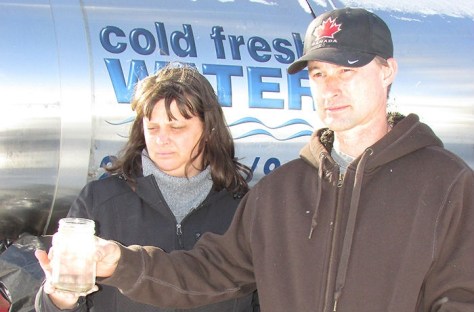
Today more than 20 wells within the footprint of the NKW1 project are experiencing black water. Many of these families had received water tanks from the wind company, which was required by the Renewable Energy Act permit – an alternative water supply in the case of any well issues during construction. Our family has had a tank on our property since the first weekend of August. It froze during the coldest winter days, and ran dry when there were delays in delivery, or when the hose leaked. At the time of writing, we have been informed that the tank will removed from our property by the end of March…
The people of Chatham-Kent aren’t stupid and it makes us a little angry when the powers that be assume we are.
The news this week about the EBS Geostructural Consultant blog that had a key phrase removed regarding the company’s advice to Hydro One about using micro-piling methods instead of deep piling to avoid “potential for driven pile installation to cause issues with nearby active water wells” is disturbing on so many levels.
First, the advice to Hydro One is proof at least one government agency used alternative methods of pile-driving to avoid disturbing area water wells, with the blessing of the Ministry of the Environment, as the blog states.
Second, it refutes the claims by the North Kent One wind farm that there couldn’t possibly be any connection between deep pile driving methods used to construct the turbine foundations and the complaints of sediment contamination in several water wells in the project area.
And finally, removing the line referring to water wells doesn’t make us “unsee” the information. We now know at least one government agency – Hydro One – sought advice on how to construct towers with the least impact to area wells and went with that advice, keeping in line with the company commitment to “identify and evaluate environmental risks to ensure that hazards are eliminated or controlled” as it states on its website.
So asking us to disregard what we read because it wasn’t being “used properly” and expecting us to believe this advice is not in any report to Hydro One is utterly ridiculous and, frankly, insulting.
If Samsung and Pattern are going to stick to their assertion their construction methods couldn’t possibly be the problem for well owners, and if the environment ministry and municipal officials are going to buy into that when other sources say otherwise, it is time for us all to demand better from our deciison makers.
The well owners have been dealing with dirty water for long enough. We need to start questioning why the environment ministry and the municipality are letting the turbine companies dictate what we consider unsafe for our rural residents, and why these well owners have to fund their own investigation into the potential carcinogenic sediment in the water the government insists is safe to drink.
And because our chief medical officer of health says so isn’t a good enough reason. Until the governments – local and provincial – step up and demand answers from an unbiased third party, we will continue to be treated as naïve sheep who need to be neither seen nor heard.
It’s been longer than I would have liked, to post another update. That’s the funny thing…as the information changes quickly, its hard to stay ahead of it.
I want to give a bit of a back story. We have been at this water protection thing for almost two years. But our lack of water started in July, 2017. In our case, pile driving for wind turbines near our house started on July 27, 2017. By the end of the next day the water quit coming into the house in the middle of someone’s shower.
We found that the sediment traps we had installed to monitor our water quality ahead of the construction were clogged with sediment. We had never seen this before…..
A new blog coming from Ontario detailing the serious changes to daily life as a family struggles every day with the loss of clean water that occured after the wind turbines were built. It highlights the lack of meaningful resolution not only by the wind industry and project operators but also the failures of the government to be protective and serve the people.
March 15, 2018
Today is day number 4 that the NRWF project which became operational on November 1, 2016 has been shut down at the request of Hydro One for work at their substation in Hamilton.
This has given me an excellent opportunity to assess the gradual symptoms or lack thereof that I have been experiencing.
I had waded into the pool of depression gradually without identifying it as such. There were frequent days when I did not have to put my P J’s on because I was still in them in the evening. I vaguely recognized the person staring back at me in the mirror. I had no interest in my appearance nor my attire. I no longer wanted to play cards with the seniors and enjoy their camaraderie and competitiveness.
My head ached from internal pressure. I couldn’t focus on simple math. It was too challenging. Some days I abandoned reading articles. I wasn’t able to focus nor concentrate on them where before I relished reading them especially wind turbine related ones since I live in the epicentre of the turbines in our community.
Delayed Perception. Now that is an interesting term. Have you ever driven in the evening at night and seen what appeared to be huge red taillights ahead of you?
I wondered why the red taillights I was seeing were so large only to discover moments later that they were the red traffic lights at the next intersection. This should have been an automatic observation. I am having moments of delayed perception in other instances as well. I found myself making silly mistakes and then wondering why I had done that. I am struggling through the brain fog.
I have a frequent companion named Dizziness. Some days are worse than others. I now always hit the pause button before I take the first step from a rising position and I am especially careful in rising from a prone position. This dizziness I first began to experience last summer.
On day number 3 of the shut down of the project I noticed that my depression had lifted. I felt energetic and did some household chores which had been neglected for quite some time. I did not have the energy nor the motivation to do them before.
I had a feeling of enthusiasm and normalcy that had become a stranger to me in the past months.
The brain fog has lifted and I am able to concentrate at the moment. The dizziness has abated and I do not have to hit the pause button before rising.
Some verbs I’ve used in the past tense knowing full well that all the symptoms will revisit me once again when the project becomes operational again.
It is my wish that relating my experiences will perhaps help someone else identify their symptoms if they are living amidst turbines but not making the connection. Symptoms will vary from person to person and the listing of health impacts is more comprehensive so please do the research if you suspect that your symptoms could be turbine related.
With the NRWF project down for days, our community is reminded of the pure, nature’s darkness of our night skies.
The stars are bright and the neighbourhood is silent.
(Transformer 2 of Niagara Region wind was being worked on while the shut down had been at the request of Hydro One for work on another transformer station in Hamilton.)
“I took pictures on my way home tonight and fought tears as I recall how much I loved my home and quiet remote community.
I quickly turned those tears into motivation; we will get our health, skies and communities restored.
Normally red flashing lights! But no power to the turbines so the aviation lights are dying and dead!”
“I wonder whether anyone is noticing changes in their health status now that the turbines have not been operational since early Monday and making the connection? What an opportunity to self assess the symptoms that are not present.
I now recognize that depression has been one of my symptoms. Today for the first time in months I have felt motivated. My frequent companion dizziness has decreased so much. I have not felt the achy head pressure and my concentration is back once more.
Two more days of reprieve.”
“The heavy blanket has been lifted. You know those blankets we wear at x-ray time to protect our thyroid etc? That’s how I feel I am each day – everything is a chore.
The haze – the dense cloud I have been living in is gone. The clarity present yesterday and today is remarkable.
I had a herbal tea on the deck at 10pm, wrapped in a blanket and just soaked in my natural environment. It was quiet, the sky was dark and a great reminder of what we fight so hard for. Glorious!”
“Delayed Perception. Now that is an interesting term. Have you ever driven in the evening at night and seen what appeared to be huge red taillights ahead of you? I wondered why the red taillights I was seeing were so large only to discover moments later that they were the red traffic lights at the next intersection. This should have been an automatic observation. I am having moments of delayed perception in other instances as well. I found myself making silly mistakes and then wondering why I had done that. I am struggling through the brain fog.
I have a frequent companion named Dizziness. Some days are worse than others. I now always hit the pause button before I take the first step from a rising position and I am especially careful in rising from a prone position. This dizziness I first began to experience last summer.
On day number 3 of the shut down of the project I noticed that my depression had lifted. I felt energetic and did some household chores which had been neglected for quite some time. I did not have the energy nor the motivation to do them before. I had a feeling of enthusiasm and normalcy that had become a stranger to me in the past months.
The brain fog has lifted and I am able to concentrate at the moment. The dizziness has abated and I do not have to hit the pause button before rising.
Some verbs I’ve used in the past tense knowing full well that all the symptoms will revisit me once again when the project becomes operational again.
It is my wish that relating my experiences will perhaps help someone else identify their symptoms if they are living amidst turbines but not making the connection. Symptoms will vary from person to person and the listing of health impacts is more comprehensive so please do the research if you suspect that your symptoms could be turbine related.”
“Darn it!!! It’s so quiet and the night sky is completely dark. I will enjoy it for one more night I guess.”
“Two families are taking legal action related to a plume of construction dust from a Niagara Region Wind Farm construction site in 2015 that they say has left them with physical and mental health issues, as well as property damage and monetary losses.”
Dust spreading from the construction site in 2015 of one of the 77 Enercon wind turbines that make up the Niagara Region Wind Farm. Photo: Stefanos Karatopis
Local families take legal action after turbine construction incident
Claims relate to construction dust in summer of 2015
Two families are taking legal action related to a plume of construction dust from a Niagara Region Wind Farm construction site in 2015 that they say has left them with physical and mental health issues, as well as property damage and monetary losses.
Raymond Sherman and Alexandra Karatopis Sherman, along with their three children, and Stefanos Karatopis — the brother of Alexandra — are named as plaintiffs in court documents that were originally filed last summer, about two years after the July 23, 2015 incident. A list of 25 defendants, including 10 individuals whose identities are unknown, are named in the notice, ranging from stakeholders in the Niagara Region Wind Farm, to construction companies and employees to the Township of West Lincoln and Region of Niagara.
In court documents, the plaintiffs allege workers at the wind farm on Regional Road 20 in West Lincoln were discharging a construction dust which made its way into the house. While the parents were not home, the Sherman children were and the documents allege they had difficulty breathing and their eyes were burning.
Update on Huron County Wind Turbine Study about Noise, Vibration and Light Recruitment continues for the Huron County Wind Turbine Study about Noise, Vibration, and Light.
Launched in October of 2017, recruitment for participants will continue until the end of October 2018.
Interested Huron County residents, who live within 10 km of a wind turbine, can find all the materials needed to participate in the study at any branch of the Huron County library. Library branches can also return participants’ completed materials to the Health Unit.
Huron County residents who live within 10 km of a wind turbine are eligible to participate. The Health Unit wants to hear from those who do and do not have difficulties with wind turbines so we can look at differences between the two groups.
Participation involves returning a completed consent form, doing the Registration Survey, and completing the Observation Diary. We are asking participants to complete the Observation Diary at least one week every month during the 12-month data collection period. A map showing what households are eligible can be found at any branch of the Huron County Library and on the Huron County Health Unit website.
For more information, please visit huronhealthunit.ca or contact the Huron County Health Unit at 519-482-3416 or 1-877-837-6143.
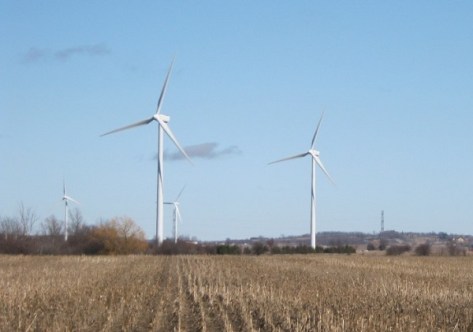
Wind turbines have made home a place of unrelenting torment for many non- consenting residents. The above photos are of Enercon wind turbines in the Niagara Wind project, located in Southern Ontario.
Emissions such as noise, light, vibrations, and even contaminated water wells are linked to the growing numbers of reported adverse effects to quality of life and human health across multiple wind projects. MOECC (Ministry of Environment and Climate Change) continues to approve new projects while failing to act and provide meaningful remedy for the existing 1000s of complaints arising from the operations and construction of wind complexes across Ontario.

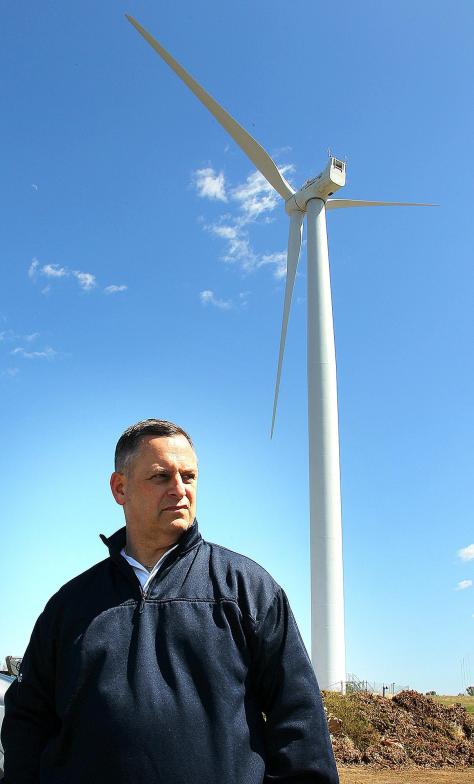 Living near municipal wind turbines has residents on guard

 Where We’ve Been, Where We’re Going
 March 15, 2018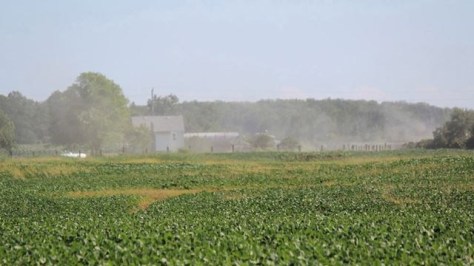


 Mothers Against Wind Turbines Inc.