Corresponding Author: Arline L. Bronzoft, GrowNYC, New York, NY. USA
Albtor@aol.com
Bio:
Arline L. Bronzaft, PhD is a Professor Emerita of Lehman College, City University of New York.
She serves on the Mayor’s GrowNYC, having been named to this organization by three previous
Mayors as well. Dr. Bronzaft is the author of landmark research on the effects of elevated train noise on children’s classroom learning; has examined the impacts of airport-related noise on quality of life; and has published articles on noise in environmental books, academic journals and the more popular press. In 2007, she assisted in the updating of the New York City Noise
Declaration of Conflicting Interests: The author declared no potential conflicts of interest with respect to the research, authorship, and/or publication of this article.
Funding: The author received no financial support for the research, authorship, and/or publication of this article.
Abstract
Research linking loud sounds to hearing loss in youngsters is now widespread, resulting in the issuance of warnings to protect children’s hearing. However, studies attesting to the adverse effects of intrusive sounds and noise on children’s overall mental and physical health and well-being have not received similar attention. This, despite the fact that many studies have demonstrated that intrusive noises such as those from passing road traffic, nearby rail systems, and overhead aircraft can adversely affect children’s cardiovascular system, memory, language development and learning acquisition. While some schools in the United States have received funds to abate intrusive aircraft noise, for example, many schools still expose children to noises from passing traffic and overhead aircraft. Discussion focuses on the harmful effects of noise on children, what has to be done to remedy the situation, and the need for action to lessen the impacts of noise from all sources. Furthermore, based on our knowledge of the harmful effects of noise on children’s health and the growing body of evidence to suggest the potential harmful effects of industrial wind turbine noise, it is strongly urged that further studies be conducted on the impacts of industrial wind turbines on their health, as well as the health of their parents, before forging ahead in siting industrial wind turbines.
The first public meeting to describe the proposal for a 75 MW wind energy generating system on Amherst Island, dated December 2011, put forward a single document to address the potential adverse health impacts, a pape by Knopper and Oilson (2011)Health effects and wind turbines: A review of the literature Other references have been added to the company website but no further document has been prepared in advance of the second public meetings to be held on March 5th and 6th, 2013. Drs. Knopper and Ollson have been retained as consultants by Algonquin Power Co.
The purpose of this commentary is to evaluate the Knopper and Ollson (2011) paper on its own merits, including strengths and weaknesses, errors of commission and omission (Part 1)as well the existing state of knowledge as of January 2013 18 months after Knopper and Ollson’s (2011) publication (Part B). A considerable amount of new information continues to evolve (Part B and Appendix C) which appears to have been passed over by Algonquin Power Co
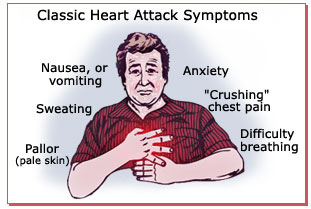
editors note: there are those who would suggest that because the symptoms ofWind Turbine Syndrome are being brought to the attention of the public, that the public will be more prone to experience them.
We are told how to watch for symptoms of Stroke, of Heart Attacks, of Diabetes etc. Because the public is aware of what to look for DOES NOT mean that they will have a Heart Attack, Stroke or develop Diabetes. The same stands true for Wind Turbine Syndrome.
Being aware of the symptoms of Wind Turbine Syndrome is the first step in recognizing them in yourself, your family, your children, your neighbours.Not everyone is affected, but those that are can not be ignored and may require medical assistance. Thank you.
Please note the following information.
It is also important that you share this information with your neighbours who could be affected by the turbines but have no idea that its the turbines that are causing the anxiety, or discomfort,headaches, chest pains etc.
Even if you are not yet living in a “Industrial wind farm”, be prepared.
KEEP THE ATTACHED NUMBERS BY YOUR PHONE!
The 5 IPC turbines are spinning and “the sky did not fall down”.
Many residents seem rather complacent about them because they have not effected their lives drastically and they are content to live the turbines . However, many of those people are experiencing the effects of the turbines alreadyeven though they do not realize it– things like pressure on the chest, head aches and a poor nights sleepare easily confused with normal situations.
Situations with livestock and wildlife, will not show up right away either.
We ask that you speak with your neighbours and friends and inform them of these complications from the turbines and ask them to report them immediately.
We are sending the contact numbers for complaints to you again. Keep them handy and should you experience anything, including the noise from the turbines,call the numbers given.
This is not only for families living very close to the turbines – we have already received notice of a family 4 kms from the site where family members are experiencing headaches and annoyance from noise.
An information sheet with the numbers for reporting complaints for Vineland Power and NRWC is attached to this email . Please keep these numbers handy and use them if and when you find a need to use them.
We hope that the contact numbers for NRWC will not be necessary for some time yet. But the NRWC project can be approved any day and construction can begin immediately after approval. Contact the company with any and all problems that you notice with the construction of the project, and also report all complaints to the township as well, whether that be Wainfleet, or West Lincoln or Haldimand.
Document all the calls you make and keep records of not only the calls but also the response that you receive. ‘ WLGWAG/MAWT
People who live near wind turbines complain of symptoms that include some combination of the following: difficulty sleeping, fatigue, depression, irritability, aggressiveness, cognitive dysfunction, chest pain/pressure, headaches, joint pain, skin irritations, nausea, dizziness, tinnitus, and stress. These symptoms have been attributed to the pressure (sound) waves that wind turbines generate in the form of noise and infrasound. However, wind turbines also generate electromagnetic waves in the form of poor power quality (dirty electricity) and ground current, and these can adversely affect those who are electrically hypersensitive. Indeed, the symptoms mentioned above are consistent with electrohypersensitivity. Sensitivity to both sound and electromagnetic waves differs among individuals and may explain why not everyone in the same home experiences similar effects. Ways to mitigate the adverse health effects of wind turbines are presented.
Introduction
With growing concern about climate change, the carbon budget, depletion of fossil fuels, air pollution from dirty coal, radiation from nuclear power plants, and the need for a secure energy supply, more attention and funding are being diverted to renewable energy. Among the various types of renewable energy, wind has received a lot of attention due, in part, to opposition from communities earmarked for wind turbines and from communities that have experienced wind turbines firsthand.
Some people who live near wind turbines report difficulty sleeping and various symptoms of ill health and attribute these problems to noise and shadow flicker—two elements they can perceive. Indeed the U.S. National Research Council (Risser et al., 2007) identify noise and shadow flicker as the two key impacts of wind turbines on human health and well-being.
Not all health agencies, however, recognize that sound waves from wind turbines may cause adverse health effects. Following a review of the literature, the Chief Medical Officer of Health for Ontario (2010), concluded
that while some people living near wind turbines report symptoms such as dizziness, headaches, and sleep disturbance, the scientific evidence available to date does not demonstrate a direct causal link between wind turbine noise and adverse health effects. the sound level sound level from wind turbines at common residential setbacks is not sufficient to cause hearing impairment or other direct health effects, although some people may find it annoying.
Low frequency sound and infrasound from current generation upwind model turbines are well below the pressure sound levels at which known health effects occur. Further, there is no scientific evidence to date that vibration from low frequency wind turbine noise causes adverse health effects.
Editor’s note: Rick James is, without doubt, one of North America’s premier experts on wind turbine noise. Unlike the great majority of noise engineers who have sold their souls and ethics to the wind energy industry, Mr. James can’t be “bought.” Together with Rob Rand and Steve Ambrose, Rick has exposed the deceit and mendacity of wind company acoustic consultants — as in their fraudulent use of A-weighted noise measurements, for instance.
We all owe these three gentlemen a huge debt of gratitude.
— Richard James, Noise Engineer (7/8/14). Click for PDF, with all graphs included.
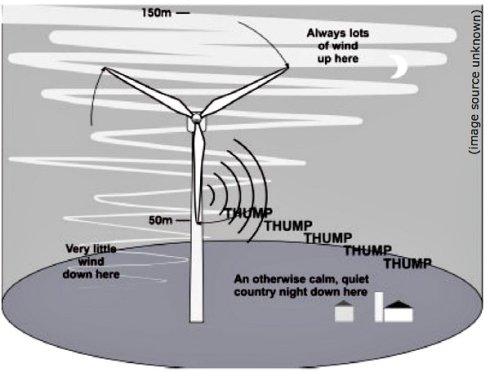
As the blade passes the tower, the low frequency noise and infrasound is generated at a frequency related to the hub’s rotation and number of blades. These pressure pulsations appear as tones during analysis, but are not heard as tones by most people. Instead, they may feel the pressure changes as pulsations, internal organ vibrations, or as a pain (like ear aches or migraines).
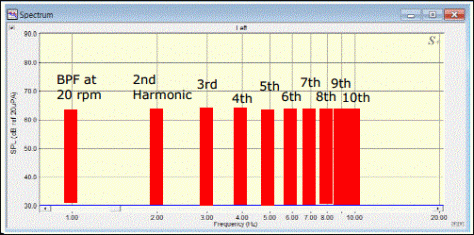
This frequency is called the Blade Pass Frequency, often abbreviated as BPF.
For modern utility-scale wind turbines, this frequency is at 1Hz or lower. A three-bladed wind turbine with a hub rotation of 20 revolutions per minute (rpm) has a BPF of 1Hz. This means there is a pressure pulsation emitted into the community once every second. At 15 rpm the BPF is 0.75 Hz; and at 10 rpm, 0.5 Hz.
When wind turbine blades rotate past the tower, a short pressure pulse occurs, producing a burst of infrasound. When analyzed, the result is a well-defined array of tonal harmonics below 10 Hz.
For impulsive sound of this type, the harmonics are all “phase-correlated.” This means the peaks of each occur at the same time. Thus, the peaks add together in a linear fashion, with their individual maximum sound pressures all coinciding.
Thus, for an impulse having 4 equal amplitude harmonics (BPF, 2nd, 3rd and 4th) each of the same amplitude, the peak level is +12 dB. Ten equal harmonics would produce a peak level of +20 dB.
In West Lincoln we will be keeping a close eye on the complaints coming out of Brinston. They are the un-lucky FIRST Residents in Ontario to have to live among the 3MW Capacity Turbines. The SAME size that the NRWC propose for West Lincoln.
Brinston residents: call toll-free number to complain about turbine noise
The South Branch wind “farm” has only been in operation for two and a half months, but already people are talking about the noise and vibration from the turbines. Last week’s super-windy days were especially troublesome. The turbines are 3-megawatt capacity, the first of the powerful turbines to be operational in Ontario … for now.
This very useful reference from a New Zealand group who have worked in this area for 8 years including Bruce Rapley, Bob Thorne, Huub Bakker and Philip Dickinson with an assortment of peer reviewed papers by various people is now available.
Product Description
Sound, Noise, Flicker and the Human Perception of Wind Farm Activity
This book is a review of how wind farms affect people through the sound and flicker that they produce. It covers topics in health, noise assessment, noise prediction, economics and noise management.
The format of this review is a series of papers that have been accepted from experts in different fields and peer-reviewed for this work. The intent is to make this material accessible to the layman, so many of the papers have extended introductions to the subject areas.
The explosion of wind farms worldwide has brought with it a rising tide of resistance from residents near them. Complaints about noise and flicker, as well as health problems such as sleep disturbance, headaches, dizziness, anxiety and depression, are all strikingly similar. Developers are advised by experts that the noise levels are virtually undetectable and so low that sound cannot directly cause these symptoms and that these people are naturally anxious.
Why is there such a disparity between the perception of the issue from the two groups? Part of the problem is that the physics of sound and the human perception of noise are still not well understood by many. There is a great difference between being able to measure something and a person’s perception of it and the variation between individuals is never well accounted for by a statistical mean. This can split communities into the affected and the unaffected, the latter group who, due to no fault of their own, cannot understand the views of those who complain. Yet, for those adversely affected by the wind farm placement, there is no doubt about the intrusion into their lives.
This Review brings together the many threads that are needed to explain these issues as a series of Papers from experts dealing with issues of human perception of wind farm noise and flicker. The intent is to make this material accessible to the layman, so many of the papers have extended introductions to the subject areas.
Please spread the word around – the information is readily accessible.
The parents of autistic children have particular fears about the effects turbines and high voltage pylons may have on their quality of life.
Fears: Neil van Dokkum and his son Ian moved to Kilmacthomas, Co Waterford, in search of a peaceful environment Photo: Patrick Browne
Protest: Jenny Spittle wants to protect daughter Billie. Pic: James Flynn
Whenever Jenny Spittle’s children visit their grandad in England, 12-year-old Billie comes home tired, complaining of headaches, earache, dizziness and hearing buzzing noises. Billie has autism and her mother is convinced her symptoms are brought on by the towering pylons and wind turbines located near her grandfather’s house. Now Jenny lies awake at night worrying about plans to build a wind farm close to her home in Co Westmeath.
“I see what she’s like after a week with her grandfather and wonder how she’ll cope if we have these things on our doorstep,” she says.
Like many autistic children, Billie is hyper-sensitive to sound and light. She hears sounds at frequencies that are inaudible to most people, and Jenny is afraid she will find the sound of wind turbines close to home intolerable.
“It’s not easy raising an autistic child, yet while I’m busy trying to organise psychotherapy, speech and language, occupational therapy and all the other kinds of supports she needs to help her cope with everyday life, I also have to make time to protest against pylons and wind turbines,” she says. “I can’t afford to wait until they’ve been built to voice my objections. I have to protect my child.”
Thirteen years ago, university lecturer Neil van Dokkum and his wife Fiona moved from South Africa to an idyllic part of Waterford with their two sons. Their youngest, Ian, had been diagnosed with autism and part of the reason for choosing to make their home in such a remote location was to give Ian the peaceful environment they felt he needed in which to thrive. Then, six months ago, Neil heard about the proposed construction of pylons in the area from a neighbour. The news set off alarm bells for him and his family.
“Ian is incredibly sensitive to electric noise and certain types of light,” he says. “He will start crying and become very agitated. It is a source of emotional trauma for him. My wife and I discovered the extent of this sensitivity when we installed energy-saving light bulbs in our kitchen. When Ian walked in, he put his fingers into his ears, screwed his face up tight and said: ‘Blue light off, please Daddy. Blue light off!’ I was sitting directly under the light and had not noticed anything. Ian was standing at the door, about four metres away, and he couldn’t bear it. Can you imagine how he will be affected by pylons carrying 400kV power lines? Like many other parents of autistic kids and indeed children with other intellectual disabilities, we deliberately moved to the country so as to be away from the city with its high levels of ambient noise, including electrical noise, and disturbance. At night, it can be so quiet here that I can hear the cows crunching grass in the field opposite. Can you imagine how that silence will be shattered by clanking pylons? More specifically, how my son’s silence will be shattered by the electrical noise coming from those cables? How will he be able to sleep with that noise? And how will the rest of my family sleep as Ian becomes highly agitated when awakened by this distressing noise?
“The other concern I have is flight risk. Ian, like many autistic children, has no sense of danger and will run away and on to the road at any opportunity. He is not running away from anything, but sometimes seems to feel the need to rush into an open space. Again, the countryside, with its minimal traffic and quieter roads, is far safer than a city with all those vehicles. Even so, my property is fenced and gated, not to keep people out, but rather to keep my son in and safe.
My deepest fear now is that the electrical noise coming off cables and pylons will disturb him so much that he will attempt to run from it. And if he can’t get out, he will bang his head against the wall out of sheer frustration. The potential consequences are too painful to even contemplate, and if the proposed construction of pylons across the countryside goes ahead, selling our house would be impossible, so we are effectively trapped.
“If the Government were to abandon its slavish adulation of the wind industry and pursue the biomass option, converting Moneypoint power station to biomass boilers, it could save over three billion euro. Imagine how many state-of-the-art facilities for people with intellectual disabilities could be built with that sort of money.”
A Department of Health spokesperson says: “According to international literature, no direct health effects have been demonstrated in persons living in close proximity to wind turbines. However, it is agreed that there is a need for additional, well-designed studies in this area. The Department of Health advises that anyone who believes they are experiencing any health problems should consult their GP promptly.”
In its draft development plan, Westmeath County Council required any new wind farm development to implement a setback distance of 10 times the height of the turbine from residential dwellings, but the Department of the Environment intervened. Under Objective PWin6 of the plan, a turbine measuring 180m, for instance, would be sited at least 1.8km away from any house, while according to the Department’s wind energy guidelines, a distance of 500m is deemed sufficient. Minister of State for Planning Jan O’Sullivan wrote to the council instructing it to re-examine the setback distance.
“We received over 5,600 submissions from constituents who supported PWin6, which would have kept the setback distance in place,” says Westmeath County Council chairman Peter Burke. “We informed the Minister of State that we felt the Department’s guidelines were not adequate and she appointed an inspector to carry out an independent review.”
Last month, that inspector’s report recommended against the inclusion of the PWin6 objective on the grounds that it “would be contrary to section 28 of the Planning and Development Act 2000.”
At the time of writing, the Department’s final decision on the matter is pending.
Safety first: Are turbines and pylons dangerous?
Now that Ireland’s plan to export wind energy to Britain has been scrapped, the public has been left a little breathing space to focus on a simple question: Are wind farms and their related pylons and overhead power lines safe or not?
The Department of Health’s Deputy Chief Medical Officer, Dr Colette Bonner, has said that older people, people who suffer from migraine, and others with a sensitivity to low-frequency vibration, are some of those who can be at risk of ‘wind turbine syndrome’.
“These people must be treated appropriately and sensitively as these symptoms can be very debilitating,” she commented in a report to the Department of the Environment last year. We asked Dr Bonner for clarification.
“Presently the World Health Organisation does not classify Wind Turbine Syndrome as a disease under the WHO international classification of diseases,” she said. “Current research in the area suggests that there are no direct health effects of wind turbines. However, there are methodological limitations of many of the studies in this area and more high quality research is recommended.”
Side by side with the controversy over wind farms comes concern over the high voltage pylons which distribute the electricity generated by the wind turbines to the national grid. Chief Medical Officer in the Deptartment of Health, Dr Tony Holohan, has stated that he does not think there is a health risk associated with people living in vicinity of pylons.
But not everybody agrees; according to British physicist Denis Henshaw, people have every reason to be concerned. Emeritus professor of human radiation effects at Bristol University and scientific director of the charity Children with Cancer UK, he recently told a public health meeting in Trim, Co Meath, that high voltage power cables are linked “beyond reasonable doubt” to childhood leukaemia and other diseases.
“It has been shown again and again that there is a definite risk of childhood leukaemia and other diseases near these lines,” he says. “The link is so strong that when a childhood leukaemia occurs near these lines there is a greater than 50pc chance that the leukaemia is due to the line. This raises the prospect of legal action for corporate manslaughter against those involved in putting the line there. The Irish government and EirGrid need to take care of their citizens and acknowledge the known health risks in people near these lines.”
A spokesman for EirGrid says: “We’re not doctors, but having taken advice from experts at the World Health Organisation, along with the chief science adviser and the chief medical officer, it is clear to us that there is no evidence to link overhead lines with adverse health effects.”
The Government report ‘Health Effects of Electromagnetic Fields’ 2007 says: “Given that there is still uncertainty about whether long-term exposure to extremely low frequency magnetic fields could cause childhood leukaemia, use of precautionary measures to lower people’s exposure would therefore appear to be warranted.
“As a precautionary measure, future power lines and power installations should be sited away from heavily populated areas to keep exposures to people low.”
Go to the original article and vote on the Poll!!!
After studying two Lake Erie communities, Western University researchers are calling on governments and wind farm developers to avoid feeding the war of words that has broken out between supporters and opponents of wind turbines.
In a study published in the journal Environment and Planning, the Western geography department researchers found people who have raised health concerns and other objections to wind turbines are denigrated, dismissed and ostracized by supporters of the developments in their communities.
They also endure shots by senior politicians, such as former premier Dalton McGuinty, who dismissed health concerns as “unreal.”
The treatment only makes the situation worse for individuals with concerns, said associate geography professor Jamie Baxter, one of the study’s authors.
“If you get right down to the micro level of the community, life is not good for these people,” Baxter said Wednesday.
It was in face-to-face interviews researchers heard supporters of the turbines making light of the problems of those opposed, with comments such as “A lot of people live to be annoyed” and “Well, you know, I guess if you stood here long enough you’d get dizzy looking at them . . . watching those blades go around.”
Health concerns reported by opponents included pain, dizziness, sleep deprivation and loss of balance.
The study found the majority of people in both communities supported the existing wind farm projects within the communities — 80% in Port Burwell and a statistically significant lower 63% in nearby Clear Creek.
But the researchers said the support was more “pragmatic” than “enthusiastic.” Most in favour said it was simply a “better alternative” than other energy choices. Those opposed were quite emotional, expressing anger, disappointment and frustration.
In addition to lowering the rhetoric, the researchers suggested the developers of wind farms could improve support for their projects if the financial benefits of wind farms were shared among households in the vicinity of turbines, not just the landowners with the turbines on their property.
In their study, the Western researchers looked at Port Burwell in Elgin County, home to 66 industrial wind turbines, and the Clear Creek area in Norfolk County, about 20 kilometres east, home to 18 turbines.
In addition to 152 responses to a questionnaire, the researchers gleaned information from 26 face-to-face interviews.
The questionnaires were distributed to people living within two kilometres of a wind turbine, while the face-to-face interviews were with participants within a two-kilometre radius.
What wind energy opponents say:
“I would say that’s not really a surprise,” said Jane Wilson, president of Wind Concerns Ontario, of the study’s findings. Wilson said the dismissive attitude toward opponents of wind farms were set almost at the instant former Ontario premier Dalton McGuinty introduced the Green Energy Act. She said those who have concerns have even had their grip on reality questioned.



 When wind turbine blades rotate past the tower, a short pressure pulse occurs, producing a burst of infrasound. When analyzed, the result is a well-defined array of tonal harmonics below 10 Hz.
 The South Branch wind “farm” has only been in operation for two and a half months, but already people are talking about the noise and vibration from the turbines. Last week’s super-windy days were especially troublesome. The turbines are 3-megawatt capacity, the first of the powerful turbines to be operational in Ontario … for now.
 The explosion of wind farms worldwide has brought with it a rising tide of resistance from residents near them. Complaints about noise and flicker, as well as health problems such as sleep disturbance, headaches, dizziness, anxiety and depression, are all strikingly similar. Developers are advised by experts that the noise levels are virtually undetectable and so low that sound cannot directly cause these symptoms and that these people are naturally anxious.


 Mothers Against Wind Turbines Inc.