Category Archives: Green Energy

Turbine Collapses when is it too close?

PointTupper_Canada_Enercon-20160822111754578

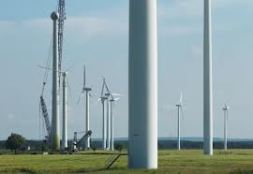
August 17, 2016 in Nova Scotia an Enercon turbine collapsed. The technician working in the turbine was able to exit the turbine safely.

Source: http://www.windpowermonthly.com/article/1406395/enercon-investigating-turbine-incident-Canada

“Enercon has launched an investigation into the collapse of a turbine at the 23.3MW Point Tupper wind farm located close to Port Hawkesbury in Nova Scotia, Canada.

The German turbine manufacturer said the incident, which occurred during a component exchange last Wednesday, triggered an evacuation alarm before the turbine collapsed and that nobody was injured.

The wind farm was developed by a joint venture between Canada’s Renewable Energy Services, which is the controlling shareholder, and Nova Scotia Power.

It uses Enercon E-82 and Enercon E-48 turbines, although Enercon did not specify which model was involved in the collapse.

“With close to 1000 wind turbines installed in Canada over the course of the last 15 years, this is the first time that such an event has occurred,” Enercon said in a statement.

A technical team is probing the incident, which did not occur during regular operations and is “undoubtedly an isolated one”, Enercon said…”

READ MORE: http://renews.biz/103859/enercon-probes-canadian-collapse/#.V7srAMS-P6U.twitter

A dramatic multiple turbine collapse event involving 8 Enercon turbines occurred in Brazil during an extreme weather event in 2014.

Source: http://www.portal-energia.com/forte-tempestade-derruba-8-aerogeradores-em-parque-eolico-no-rs-brasil/

The issue of turbine failures,setbacks to homes and safety was heard at the tribunal appeal hearing challenging the renewable energy approval granted for the Niagara Wind project.  The community was assured by their experts that catastrophic turbine failures and component liberation are rare events and the setbacks in the project are adequate.

The chart below is taken from the closing written reply of Mothers Against Wind Turbines and gives the reader an idea of how close the 3MW Enercon 101 turbines of 124m in height are placed to homes in the Niagara Wind project.

Ontario’s 550 metre setback and noise limits are waived if you agree to host a turbine on your land.  Something to ponder in light of the recent “isolated” event.

155. Participating receptors predicted noise exposure levels as extracted from the Niagara Region Wind Farm Noise Assessment Report, September 30, 2014   often exceed the 40 dBA worst case sound power level thresholds detailed in the chart below:

“P” stands for participating


Receptor Number


Sound Limit in dBA


Distance to Closet Turbine


Closet Turbine


Page of Noise Assessment Report

P1191 40.6 529 m T75 Pg.40 of 291
P1235 41.3 451m T75 40
P1562 41.5 370m T36 40
P1610 42.7 429m T36 40
P1666 46 253m T65 40
P1688 40.6 612m T01 40
P1703 41.7 488m T65 40
P1711 40.3 702m T01 40
P1765 41.4 590m T76 40
P1846 41 629m T76 40
P1848 41.5 427m T55 40
P1872 41 593m T76 40
P191 43.4 336m T88 40
P1981 40.2 671m T76 40
P2293 40.2 573m T31 40
P2529 40.5 446m T56 40
P2548 40.9 632m T33 40
P2550 40.9 693m T34 40
P2579 43.8 380m T33 40
P2590 45.4 280m T35 40
P2614 41.4 693m T02 40
P2636 40.6 506m T35 40
P2640 41.1 510m T23 40
P3160 40.4 564m T18 40
P3171 40.3 574m T60 40
P3893 41.7 425m T24 41
P3897 42.1 398m T04 41
P411 40.4 563m T51 41
P439 40.3 546m T39 41
P580 40.1 537m T90 41
P595 44.7 299m T94 41
P689 44 289m T07 41

Fighting Back

Tiny the Turbine helps fight back the wind industry propaganda allowed into our schools

Tiny the Turbine is a moral tale that tells the truth about the impacts of industrial wind development in a way children can understand. It has been written by a Highland anti wind campaigner, illustrated by a supporting Cartoonist and published online today.

Tiny the turbineSome time ago it was discovered that not only were multinational wind developers welcomed into our schools, they come bearing gifts and speak to pupils regarding only the ‘benefits’ of wind development.

Children are asked to name turbines and design logos. They are taken to visit wind farms. The message is clear. Build wind farms – or else the planet will suffer and the polar bears and penguins will die!

The other side of the story has never been told as far as we are aware.

There is no hard evidence that building wind farms will do anything to combat climate change. Many things like grid connection (no matter how many miles), foreign parts and workers, pollution caused in China mining and processing necessary rare earth minerals and decommissioning are not included in any CO2 savings calculations, making emission claims a farce.

Not only do wind developers go into schools, they produce child friendly stories about turbines. Tommy the Turbine, Timmy the Turbine, Lofty etc. All designed to put a positive spin on a controversial industry and keep profits flowing from the next generation.

Lyndsey Ward wrote Subsidy Sam, illustrated by Josh, in retaliation to this shameless indoctrination earlier in the year. It was a satirical story and really meant for adults.

Subsidy Sam went global and following requests to write a real children’s story Lyndsey came up with Tiny the Turbine and Josh agreed to illustrate it.

Children should never be exposed to indoctrination by multinational companies with a product to sell with no access to the opposing argument. It is happening again and again. Fast food and fizzy drink giants were allowed into schools years ago – we now have a child obesity epidemic.

Tiny the turbine2This wee story is moral. It smashes the myths of clean and green and environmentally friendly wind energy. Yet it does so in a way that is reasoned and sensible and so obvious to those who know the other side of the industry, and in a way that children will understand.

Importantly it is written and illustrated by people who are not paid by big industries with the deep pockets of the multinationals. People who care passionately for the environment and also that children are not indoctrinated by an industry determined to keep its shareholders happy. It is an honest reflection of what we see is happening – the other side. The side children are never told.

This tale, although written in Scotland, can be told in any country where there is industrial wind development and we hope it gets used around the world and translated into other languages.

thrasherIt comes with a foreword from Sarah Laurie, CEO of the Waubra Foundation in Australia which promotes health research and regulation of environmental noise pollution.

The message in this story to all governments supporting industrial wind is:

Stop access to school children by multinationals which are promoting their wares and are driven by their shareholders and profit margins

Stop allowing communities to be ransacked by wind developers against their will. Give communities a wind veto and the final say on the developments that they are forced to live with.

Stop enriching the already wealthy developers and landowners to the detriment of your own people.

Stop denying the health impacts suffered by humans and by animals.

Stop ignoring pollution concerns regarding drinking water and the environment.

Stop dismissing the deaths of protected birds and bats by turbine blades as numbers are reaching catastrophic proportions across the world.

Speak and act for the people you are paid to serve and not the rich multinationals.

The hands of the wind industry and supporting politicians are stained by the tears of the unwilling communities they have exploited and continue to exploit.

For further details contact:

Lyndsey Ward
subsidy.sam@btinternet.com


Pilot Killed Hit Turbine Monitoring Tower

“After the plane struck the wire, the cable wrapped around power lines, prompting Xcel to temporarily shut off power to the wind turbines.  While crews repair the damage, federal investigators will work to piece together what led up to the crash that claimed the life of a veteran pilot, once honored by the FAA for his safe flying record.”

met tower crash


Near Ruthton, MN USA

A crop-spraying job ended in tragedy amid wind turbine country in southwest Minnesota.   

The plane nose-dived into a soybean field west of Ruthton Friday morning after striking a cable.   Investigators say the pilot, 68-year-old James Arnt of Worthington, died instantly.  

A bent electrical tower high above this bean field is a telltale sign of tragedy in southwest Minnesota.

READ MORE: http://www.keloland.com/news/article/news/pilot-killed-while-spraying-crops-in-southwest-Minnesota

Our thoughts and prayers are with the pilot’s family and friends.

The Great Noise Debate

towers of turbinesAudiologist’s are among allied health care providers that are seeing increasing numbers of patients seeking assessment for a range of symptoms that can include migraines, vertigo, tinnitus,and sleep deprivation in response to exposure of wind turbine sound.   The following article while slanted in favour of wind energy also demonstrates the widening cracks in the veneer of the wind industry’s posturing that all is well for the health of those who live near the turbines.

Articles about Visceral Vibratory Vestibular Disturbance (WVD), Vibroacoustic Disease, and Wind Turbine Syndrome are appearing in books, newspapers, and on websites with increasing frequency. While the effects of intense noise in the range that we can hear are becoming more widely recognized and publicized, physicians and researchers are now concerned that infrasound – sounds that are in the frequency range too low for the human ear to hear – are the cause of these symptoms. They theorize that the low-frequency sounds and vibrations emitted by wind turbines may interfere with the ear’s vestibular system, which controls our sense of balance, or may affect heart and lung tissues.

By Andrea Graham
Audiologist, M.Sc. (C) Reg. CASLPO
Heritage Hearing Care

READ ARTICLE: http://www.lifestylehearing.ca/2013/02/great-windmill/

Don’t Shove Wind Turbines Down Our Throats!

prince edward county farmThe Mayor of Prince Edward County is going to this week’s conference of the Association of Municipalities of Ontario with a focus that won’t be surprising to those who follow the goings on in The County.

Robert Quaiff says a group of communities, including Prince Edward County, will again be telling the
provincial government that regulations must change with regards to big industrial wind turbines.

READ AT: http://www.quintenews.com/2016/08/dont-shove-turbines-throats/123657/

Unmanageable

green windWhere does the money go? Global News has presented a series of stories over the past few weeks painting a troubling picture of rural Ontario residents struggling to pay soaring electricity bills. In a particularly telling interview, Ontario’s new Energy Minister, Glenn Thibault, was forced to admit he didn’t know how many residents have had their electricity disconnected because they couldn’t pay— nor was he aware if anyone in his department was keeping track of this information.
Thibault’s suggestion? Residents should conserve electricity. Besides, his government has a new support program designed specifically to help low-income Ontario residents pay their electricity bills. Relief of sorts perhaps, but more along the lines of putting one’s thumb in a dike, rather than addressing the bigger issue.

All it really does is transfer these costs to the taxpayer.

So where is the money going? Many millions, indeed billions, of dollars are being extracted from customers and taxpayers to fund rising electricity costs. Is it paying for research and development into electricity storage so that perhaps one day, intermittent generating sources (i.e. wind and solar) might serve a useful purpose? Is it being used to offset the hardship faced by low income Ontarians? Is it funding Ontario infrastructure development or green transit plans? No, no and no.

Maybe it is funding a network of charging stations across the province, including one planned for the King Street parking lot in Picton? No. Perhaps it is helping to pay the $14,000 subsidy Ontario pays purchasers of electric cars? No.

As it turns out, much of this money is going into the pockets of a few developers, investors, pension funds and corporations. It’s called profit—and a handful of companies are profiting handsomely from your electricity bills.

Scott Luft has been poring over the mounds of data produced by the Independent Electricity System Operator (IESO) and other sources for the past six years. Luft’s research and analysis, compiled on his website coldair.luftonline.net, is an important resource for anyone interested in understanding what has gone so terribly wrong with Ontario’s electricity market. Luft has methodically revealed, and laid bare, the destructive politically driven management of Ontario’s electricity system and shows why residents will be paying for these decisions for decades to come.

According to Luft’s analysis, Ontario electricity customers have subsidized wind and solar energy producers by $6.4 billion over the past decade. Worse, the rate of subsidization is climbing rapidly. We are on track in Ontario to subsidize wind and solar producers by more than $2 billion in 2016 alone.

This is money going directly from consumers into the bank accounts of producers. This doesn’t include the many millions of dollars Ontario spends, or forgoes, each year offloading excess electricity to New York or Michigan from intermittent wind and solar generators it can’t control. Or the amount we pay smelters and mineral processors to spare them the high cost of Ontario electricity.

How did we get here?

Through the 1990s, Ontario dabbled in renewable energy but couldn’t persuade investors and the capital markets to participate with them. They increased incentives and tax breaks but investors stayed on the sidelines.

Dalton McGuinty’s Liberals came to power in 2003 promising to close Ontario’s coal-fired generating facilities and replace this capacity with electricity generated from renewable sources, including wind and solar. While he successfully closed coal-fired plants, it was gas and nuclear-powered generation, not wind and solar, that filled the gap. (Luft’s charting, based on IESO data, illustrates this clearly).

Still, investors remained stubbornly on the sidelines. So McGuinty doubled down and doubled down again. Eventually, he would agree to pay wind and solar producers as much as 25 times the market price for electricity for up to 20 years—if it appeared to be green. That did the trick. Now, long queues form seeking to join the gravy train each time the wicket opens for the province to buy more power.

Despite a decade of rapid and ill-planned expansion of industrial wind and solar facilities across the province, these generators produce a paltry portion of the province’s electricity—at an extraordinarily high cost. They did, however, provide one important advantage for McGuinty and, later, Kathleen Wynne. The massive turbines and acres of solar panels have proved to be helpful political emblems signalling to urban voters their government is green.

It has won this praise at a very high cost. Sadly, it is Ontario’s rural poor who are paying it.

rick@wellingtontimes.ca

READ AT: http://wellingtontimes.ca/unmanageable/

Its Official Wind Projects Cancelled

Ontario has officially terminated the Ostrander Point wind project.

Ostrander-Tree

Trout Creek and Clarington projects are also cancelled by IESO.

READ: http://fit.powerauthority.on.ca/program-updates/program-reports

Wind Turbines Killing thousands of birds and bats

By John Miner, The London Free Press

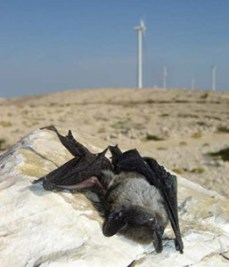
Wind turbines are killing bats, including ones on the endangered species list, at nearly double the rate set as acceptable by the Ontario government, the latest monitoring report indicates.bat-killed-by-wind-turbine-blades

Bats are being killed in Ontario at the rate of 18.5 per turbine, resulting in an estimated 42,656 bat fatalities in Ontario between May 1 and October 31, 2015, according to the report released by Bird Studies Canada, a bird conservation organization.

Ontario’s Ministry of Natural Resources has set 10 bat deaths per turbine as the threshold at which the mortalities are considered significant and warrant action.

The bats being killed by turbines in Ontario include the little brown bat, tri-coloured bat, eastern small footed bat, and northern long-eared bat, all on the endangered species list.

The Birds Studies Canada report draws its information from a database that is a joint initiative of the Canadian Wind Energy Association, Canadian Wildlife Service, Ontario Ministry of Natural Resources and Bird Studies Canada.

Brock Fenton, an expert in the behaviour and ecology of bats and professor in Western University’s department of biology, said the bat deaths are a concern.

Bat populations across North America have been plunging with the emergence of a fungal disease called white nose syndrome.

Birds are taking less of a hit from wind turbines, according to the report, with an estimated 14,144 non-raptors killed by wind turbines and 462 raptor fatalities between May 1 and October 31 in 2015.

The report noted that some wind farms have moved to reduce bat mortalities by cutting their turbine speeds from dawn to dusk in the late summer and early fall.

A spokesperson for the Canadian Wind Energy Association said the association is concerned about reports that are based on limited data that have the effect of boosting estimates.

In response, CanWea is developing its own system that will be released this fall that is designed to improve existing and proposed bat regulations, said Brandy Giannetta, CanWea’s Ontario regional director.

“It aims to achieve this in part by enhancing knowledge of the existing data in order to drive science-based policy decisions and also by providing avoidance, minimization, and mitigation options that we hope operators and regulators alike will find useful in conservation efforts,” Giannetta said in an email.

Wind Concerns Ontario, a coalition of provincial groups opposed to wind farm development, said it is concerned that birds and, significantly, bats are being killed in numbers that were not forecast by either the Ontario government or the wind power developers.

“The population of the Little Brown Bat in particular is now at 5-10 per cent of its historical levels, so, as the Environmental Review Tribunal stated in the White Pines decision in Prince Edward County, even a few deaths will have a serious impact on the species as a whole. And we know for a certainty that bats are killed by wind turbines,” Jane Wilson, president of Wind Concerns Ontario, said.

It is critical to understand that wind power projects shouldn’t be approved without a full and objective assessment of all factors in any given location. The government’s push for wind power has to be balanced with the continuing need to protect the natural environment, Wilson said….

READ MORE:  http://www.lfpress.com/2016/07/20/wind-turbines-killing-tens-of-thousands-of-bats-including-many-on-the-endangered-species-list

A Populist Revolt Against Wind? It’s Happening

“With each oversized, out-of-scale, in-your-face wind project presented, scores of people join the not-so-quiet ‘war on wind’ raging nationwide…. While Big Media and Big Wind are busy forcing the vision they want, communities are taking aggressive action to limit wind’s negative impacts and will ultimately lead to far fewer projects being built.”

Lisa Linowes – June 27, 2016

A journalist recently contacted windaction.org with questions about Colorado’s latest wind project sponsored by utility giant, Xcel Energy. The 600 MW, 300 turbine, $1.04 billion Rush Creek wind ‘farm’, if built, will span 150 square miles of Colorado’s sensitive eastern grasslands. To deliver the energy to market, Xcel must also construct a 90-mile 345 kv transmission line along a 150-foot wide right-of-way. The project is massive by any measure and the largest considered by the state. Yet, according to the reporter, no one local has raised any concerns which explains the call. Even the reporter — a freelancer from New Jersey where just five turbines (9 MW) spin — admitted having no idea wind had issues.

And why would anyone …?

Big media coverage is dominated by feel-good stories of cheap renewables (and now, apparently, cheap storage) overtaking coal and nuclear. The press, prodded by industry mouthpieces, never misses an opportunity to advocate for federal and state subsidies and their sister mandates that spur green ‘investment’ and leave the public believing that a world of all renewables, all the time is almost here. 

Nice vision, but far from real. In fact, with each oversized, out-of-scale, in-your-face wind project presented, scores of people join the not-so-quiet “war on wind” raging nationwide. For proof, just look at a few of the news stories from the last 45 days:

1)    In Indiana, a judge ruled Rush County’s decision to impose larger safety setback distances on the Flat Rock wind facility (180 MW) was reasonable to protect health and preserve property values. The decision is likely to end the project. Another suit pending in Fayette Circuit Court against a NextEra project argues the decommissioning plan violates county regulations. And in Henry County, the Planning Commission denied two applications to erect meteorological towers used for measuring wind speed and direction. The towers are the first step in siting a wind project. Each vote to deny was met with applause and a standing ovation from the public.

2)    Blowback over wind turbines impairing military operations prompted the North Carolina state senate to pass a bill restricting turbine sites. State leaders recognized the importance of protecting the economic benefits derived from hosting military bases, including thousands of jobs. Local benefits delivered by wind pale in comparison. Similar concerns are being raised in New York and Texas, where the Texas legislature is also considering a bill to protect military base missions.

3)    A proposal to erect 2-dozen turbines standing up to 660-feet tall in Cumberland County, Tennessee has outraged residents and caught the attention of Senator Lamar Alexander, Congresswoman Diane Black, State Senator Paul Bailey (R-Sparta) and Representative Cameron Sexton (R-Crossville), all of whom are united in their opposition to the project. Senator Bailey highlighted one of the many failings of the proposal when he wrote “The wind turbine project proposed for Cumberland County would take us in the wrong direction for economic development in the Upper Cumberland. Tourism is over a $17 billion industry in Tennessee and it would be a step backwards to mar our scenic beauty with unsightly turbines.”

4)    Wyoming’s Joint Revenue Committee has asked its staff to draft two bills that would increase taxes on wind, including one that would require wind developers to transfer a portion of the federal wind production tax credit to state coffers. When Converse County commissioner, Jim Willox, insisted the severance tax on oil and gas can’t be compared to a tax on wind since the fossil industry removes (severs) non-renewable products from the ground and are forever lost, State Senator Cale Case snapped back that wind turbines destroyed viewsheds. “With wind, that viewshed is lost forever. It is severed,” he said. Talk of taxing wind has delayed the outlandish 1,000 turbine, 3,000 MW Chokecherry Sierra Madre. [1]

5)    In Vermont, the electorate is inflamed over the visual, environmental and health impacts of the spinning towers. Governor Peter Shumlin has been described as one who “loves wind turbines and hates the people who live next to them.” He is leaving office this year to the delight of many. At least three of the candidates vying for his seat – Bruce Lisman, Peter Galbraith, Brooke Paige  – are openly running on a ‘NO Wind’ platform.

We could go on describing the intense fights now happening in New York, Missouri, Pennsylvania, Wisconsin, Michigan, New Hampshire, Maine, Oklahoma, Ohio, Oregon, Massachusetts … you get the picture. But don’t expect big media to notice. After all, these fights don’t fit the national narrative honed by the wind industry that up-plays the image of turbines operating in concert with man and nature and downplays, or flatly denies the harms. While big media and big wind are busy forcing the vision they want, communities are taking aggressive action to limit wind’s negative impacts and will ultimately lead to far fewer projects being built.

[1] The State of Wyoming is the only state that imposes a wind energy tax which equates to $1 per MWh.


Letters to Premier Wynne

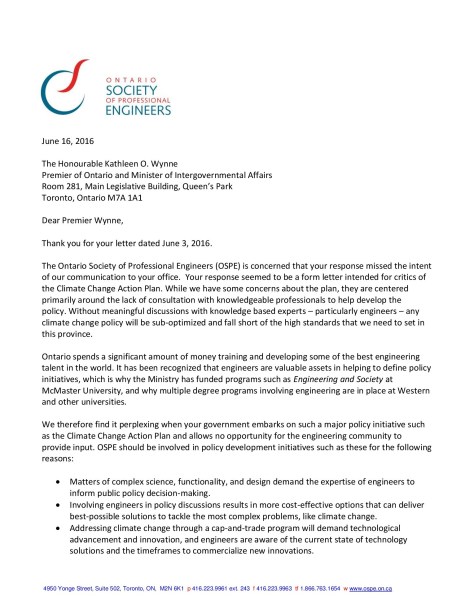
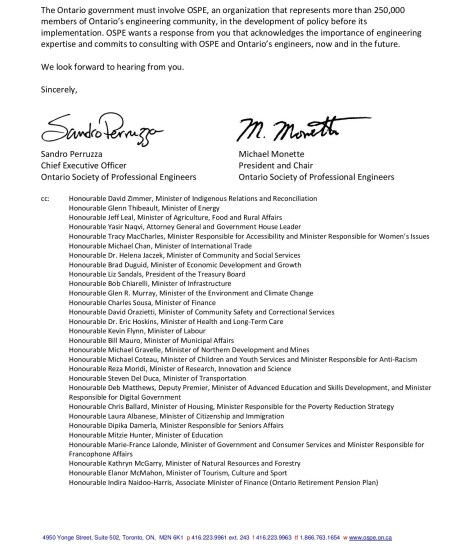
On June 1, OSPE sent a letter to Premier Wynne imploring the government to consult with engineers before implementing its cap-and-trade program. On June 14, OSPE received a response from the Premier that appeared to be a form letter intended for critics of the Climate Change Action Plan. The Premier’s response did not address OSPE’s main concern that the government does not consult with engineers before implementing policy.

So yesterday, OSPE sent a second letter to Kathleen Wynne:

Reply-1.jpgReply-2-crop

READ AT:  https://blog.ospe.on.ca/advocacy/letters-premier-wynne/