Category Archives: Destruction from turbines

Ocotillo Wind Turbine 126 Collapse

November 21, 2016  turbine 126 suffered a catastrophic structural collapse as documented in photos shared on Facebook. Ocotillo Wind Energy consists of 112- 2.37 MW Siemens  wind turbines. The project was built on California public lands by Pattern Energy and began commercial operations in 2013.  It is now 3 years and the project continues to demonstrate ongoing structural and operational issues for this ill conceived facility.

The project responded with the following statement:

“Ocotillo Wind

On November 21, 2016, one of the turbines at the Ocotillo Wind facility fell within the designated setback zone surrounding the turbine’s base. No one was injured in the incident. We are working closely with the turbine manufacturer, Siemens, to identify the root cause of the failure and a full investigation is currently underway. Relevant authorities have also been notified.

Our first priority is the safety of our employees, contractors, neighbors and the environment. We are taking this issue very seriously and will communicate more information as it becomes available.

Pattern Energy is proud to be part of the Imperial Valley. Our Ocotillo Wind facility is an investment in the region that is creating many economic benefits, including jobs and substantial growth in the property tax base.

The facility supports local initiatives through the Ocotillo Wind Community Benefits Program, which established the Ocotillo Wind Community Fund, Ocotillo Wind Education Fund and Ocotillo Wind Imperial Valley Fund, and is administered by the Imperial Valley Community Foundation. Sign up here to receive updates about the community benefits program and facility news.

Pattern Energy is focused on being a responsible community partner by respecting the land, its resources and the people of the Imperial Valley. The Ocotillo Wind facility is located on public lands administered by the BLM, with a small portion on lands under the jurisdiction of Imperial County. The permanent footprint is approximately 120 acres, which is less than 1% of the total project area, allowing the overwhelming majority of the project land to be preserved in its natural state and allowing the project infrastructure to be sited in areas that do not directly impact cultural resources.”

READ AT: http://www.ocotillowind.com/
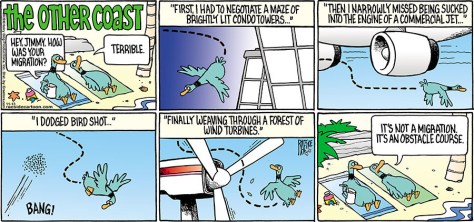
It’s not a migration it’s an obstacle course

not-a-migration

The work of cartoonist Adrian Raeside illustrates some of the cumulative harmful impacts from human activities to migrating avian species that use the global flyways.  Habitat loss, avoidance and mortalities are direct adverse impacts arising from the installation of wind power generating facilities.  Killing the natural world one spin at a time.

Enjoy his work at:

https://www.creators.com/read/the-other-coast/11/16/188957


Eagle Kills & Wind Projects

“How do you report that birds are taken, are you counting them, and are they reporting them?” Kasperik asked.

“The short answer is, no,” Abbott said.

“Pretty much with all the projects out there, unless the company that is running that operation is going out there and conducting surveys of their own, there are no data being collected in terms of the number of migratory birds being taken.”

d958faf2-0e59-46f3-881d-6d1823c8c7df
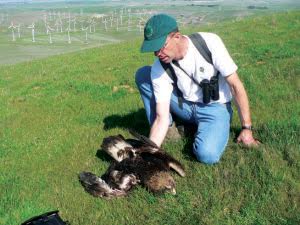
Doug Bell of the East Bay Regional Park District, in a 2007 photo with a golden eagle found near turbines in California’s Altamont Pass Wind Resource Area. The raptor, which had a compound wing fracture, later was euthanized. Janice Gan/Courtesy East Bay Regional Park District

Eagle Take Permit Considered at Hearing

A new federal regulation that would give the wind industry 30-year permits for unintentional eagle deaths was the topic of a recent legislative committee hearing in Casper.

The issue centers on a 2013 U.S. Fish and Wildlife decision that increased the length of eagle take permits from the current five years to 30, but only for wind energy projects and related infrastructure, such as transmission facilities.

A federal judge in California struck down the rule in 2014, shortly after it was issued, after conservation groups challenged it on environmental grounds. This past February the federal government decided it was not going to appeal the court’s decision.

Tyler Abbott, a deputy field supervisor for the U.S. Fish and Wildlife Service, Wyoming Ecological Services, told the Select Federal Natural Resources Management Committee that a new rule was emerging as a result of those actions.

“The Fish and Wildlife Service … is in the process of developing some definitions, some draft regulations and an environmental impact statement that could potentially lead to the authorization of an incidental take permit in the future, but right now it’s in development, and it’s not active legally,” Abbott said.

The proposed new rule would continue to allow 30-year permits for wind energy, but it now also includes a review every five years, bringing it somewhat in line with present permit length. The rule also has stipulations that companies seeking eagle take permits work collaboratively with Fish and Wildlife on a bird protection plan.

READ MORE:  http://casperjournal.com/news/local/casper/article_6c745815-e428-56e1-a79d-7c8883380802.html

Water Wells Useless by nearby Turbines

turbines & water

Water wells made useless by nearby turbines

We found the opinion expressed by letter writer Dean de Jong in the July 22 edition of the Sarnia Observer both hurtful and inaccurate.

With research Mr. de Jong would have realized he has misconstrued the situation. There is a problem in Dover Township and a pending problem anywhere in the area where wind turbines are constructed in this manner in this soil and rock composition.

Mr. de Jong did get one thing right; the situation is about water quality. Had the Ministry of Environment and Climate Change listened to the people of Dover and reacted to their complaints, along with writing meaningful precautions into the Renewable Energy Approval for North Kent Wind 1, this situation could be reported differently and there would have been no need to push to an Environmental Tribunal.

The ministry’s approach of “let them eat cake” or in this case providing farmers with livestock “bottled water” is insulting. We’re afraid it shows there is more than one person out of touch with what is at stake here.

Furthermore Mr. de Jong, we assure you the Health Unit would not test this water, as you cannot see through it. It looks rather like chocolate milk but with a lot of grit. Perhaps Mr. de Jong has the time to invent a way to have a shower, do the laundry or run the dishwasher with “bottled water”.

There is no hidden agenda here. Water Wells First has been abundantly clear that it’s not against the wind turbines, or any other type of renewable energy. What Water Wells First is against is having water wells that have been used for generations made useless by wind developers. The blind compliance to renewable energy demonstrated by the performance of the ministry confirms direction from a Toronto-centric ideology and no concept of what goes on in rural Ontario. Not all water comes out a tap fed by a lake, you know.

Perhaps if Mr. de Jong could see past the anti-wind energy neo-Luddites, as he describes them, he might see the countryside where people have sourced clean natural ground water for generations (why would they stay if they couldn’t?) and understand the irony, in that the majority of these folks’ ancestors used wind energy (wind mills) to pump their water for all those generations.

Seismic coupling – no one is making this up! People, especially rural people, have far more to do than fight to protect their wells from the government they pay for.

K.C. Craig Stainton, executive director

Ontario Ground Water Associaton

and Kevin Jakubec, executive director

Water Wells First

Published July 26, 2016 The Observer: http://www.theobserver.ca/2016/07/26/3500-tags-for-not-an-igloo-project

Pierced

Ostrander Point Tribunal drags scrutiny of wind and solar projects out into the open

Ostrander-Tree

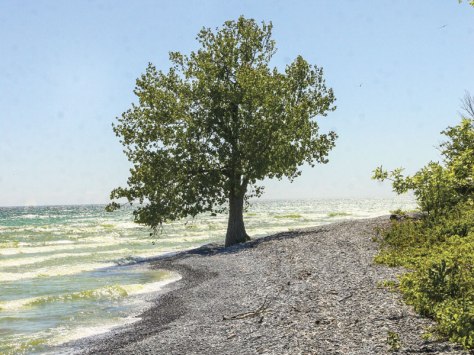
Only when time has passed and the memories of the years long struggle begin to fade, will we know that industrial wind turbines have been banished from Ostrander Point for good. But for now, the creatures who occupy or pass through this bit of land on Prince Edward County’s south shore may do so without the threat of bulldozers rolling across the terrain or 50-story machines whirring overhead. Maybe forever.

The Ostrander Point wind project has been stopped. Its appeal period has expired. There remain scenarios in which the project could be revived, but that likelihood is now remote, according to the lawyer acting for the Prince Edward County Field Naturalists (PECFN).

“There is rarely a final chapter written in these types of sagas,” said Eric Gillespie. “It is fair to say, however, that the odds of this going further are extremely low. To the best of our understanding, the Gilead Power permit is revoked. That decision is not being appealed. The file has concluded.”

The volunteers who form PECFN allowed themselves to exhale on Thursday evening—after the developer’s appeal period had expired.

“It is particularly wonderful to finally realize that the battle is over,” said Cheryl Anderson of PECFN.

WHAT IT MEANS
The decision by the Environmental Review Tribunal—written by Heather Gibbs and Robert Wright—fundamentally alters the future for Ostrander Point, and has the potential to disrupt other projects involving land where Blanding’s turtles are known to nest, including White Pines and Amherst Island. But it has the potential to reach much further. Indeed, it has the potential to shake the very foundations of the Green Energy Act (GEA).

In 2009, the provincial government, led by Dalton McGuinty, was unsatisfied with the pace of wind and solar energy development in the province. Deadline after deadline had passed and his targets for renewable energy had gone unmet. A panel of experts had reported a year earlier that the regulatory process— the safeguards that protect human health, the environment and even the electrical grid itself—were causing the delays to wind and solar development across the province.

The GEA set out to remove these hurdles—eliminating safeguards in the Ministry of the Environment, Ministry of Natural Resources and Forestry, Ministry of Energy and the Ontario Energy Board, among others.

Since the GEA was enacted, industrial wind and solar projects have been reviewed and approved behind closed doors in a mostly tightly controlled process. The only nod to public transparency and accountability was a single Environmental Review Tribunal…..

Published Wellington Times July 15, 2016

READ MORE: http://wellingtontimes.ca/developmentApril16/pierced/

Loretta Sheild’s Testimony at the NRWC Environmental Appeal – Wainfleet

MAWT Inc. would like to thank Loretta for all the hard work she has put into this fight.  She truly is an advocate and a voice for the natural beauty, ecosystems and wildlife of West Lincoln and area that is being threatened by the NRWC Project.  She has most definitely done her homework and if there was anyone in that room today that was an “expert” on the topic it was her, regardless of what the proponents lawyers say.  🙂  

Hi everyone,

I testified at the ERT today in Wainfleet.  My presentation is attached if you are interested in the details.  There are 4 sub issues.  These include concerns for migratory butterfly stopover areas, encroachment on provincially significant wetlands, inadequate mitigation measures for woodlands and red mulberry.  There are so many other issues. For example, there is no evidence to show that winter raptor transects were conducted within the interior of the woodlands.  62 permits are required by the Niagara Peninsula Conservation Authority.  These are still pending.   There are 20 industrial wind turbines proposed in Blanding’s turtle habitat in Lowbanks, all on private property.  There are many properties within this habitat where ‘alternative investigations – ie roadside surveys” were allowed.  The MNR is allowing this to proceed. If anyone would like more information, please feel free to contact me.

I want to thank you all for helping me learn about the many birds and raptors during the past few years.  If there is a silver lining here, it is the wonderful people I have met, and the greater appreciation I have for the beautiful world we live in.
Have a wonderful week everyone!
Loretta Shield’s

Barn owl halts turbine project | Simcoe Reformer

barn owl

By Daniel R. Pearce

The barn owl has done what no anti-wind turbine protester in Port Ryerse has been able to do to date: halt construction of a green energy project in their village.

A woman walking her dog this summer spotted one of the birds — they are on the endangered species list in Ontario — flying into a barn.

An investigation ensued, photographs of the owl perched on a woodpile were taken, and the sighting was confirmed. The evidence was then presented to an environmental review tribunal hearing, which last week slapped a five-month moratorium on the project.

Boralex, the company that wants to construct a four-turbine 10-megawatt wind farm next to Lake Erie, must now apply to the Ontario government for what’s known as an “overall benefit permit” if it wants to continue with the project.

It must submit an amended plan showing how the wind farm will avoid having a negative impact on the owls and that it has explored alternative sites. It must also show it will do something to help the birds, such as creating new habitat.

The tribunal hearing has been adjourned until March 31.

The Port Ryerse case is the first time a project in Ontario has been ordered back to the drawing board due to the presence of barn owls.

As a result, “there are a number of unknowns right now that will take some work and some time to bring to a conclusion,” Sylvia Davis, legal counsel for the Ontario Ministry of the Environment and Climate Change, wrote in an email to the parties to the hearing.

The barn owl is so rare there have only been four confirmed nesting sites in the province in the past decade and maybe a dozen or more confirmed sightings, said Bernie Solymar, a member of the Ontario Barn Owl Recovery Team who happens to live in Port Ryerse.

Read rest of article here.

And this related article as well.                                                          Barn owl killed by wind turbine-they said such a thing could not happen.

Wind Turbines “Good For Making Toast”


Today – Sept 26, 2014 at 10:00 AM

According to the IESO the total energy demand for the province of Ontario was 17,690 MW

The contribution of the industrial wind turbines was 63 MW. That right folks, 63 MW of the total 17,690 MW required to keep the lights on in this province.

63 MW is .00356 % of the energy required. So if 2000 plus Industrial Wind turbines can only produce .00356% of the energy required, can you calculate how many IWT’s would be required to make a meaningful contribution?

What a sham. This is what happens when you engage in a billion dollar industry without due diligence and a business plan. STOP the madness.

Will the last person out, please turn off the lights.

Catherine

“Absolute Corruption”

ENVIRONMENTAL RESEARCHER: WIND INDUSTRY RIDDLED WITH ‘ABSOLUTE CORRUPTION’

Written by James Delingpole, breitbart.com

A Mexican ecologist has blown the whistle on the corruption, lies and incompetence of the wind industry – and on the massive environmental damage it causes in the name of saving the planet. wind turbines

Patricia Mora, a research professor in coastal ecology and fisheries science at the National Institute of Technology in Mexico, has been studying the impact of wind turbines in the Tehuantepec Isthmus in southern Mexico, an environmentally sensitive region which has the highest concentration of wind farms in Latin America.

When a project is installed, the first step is to “dismantle” the area, a process through which all surrounding vegetation is eliminated. This means the destruction of plants and sessilities – organisms that do not have stems or supporting mechanisms – and the slow displacement over time of reptiles, mammals, birds, amphibians, insects, arachnids, fungi, etc. Generally we perceive the macro scale only, that is to say, the large animals, without considering the small and even microscopic organisms…

….After the construction is finalized, the indirect impact continues in the sense that ecosystems are altered and fragmented. As a result, there is a larger probability of their disappearance, due to changes in the climate and the use of soil.

The turbines, she says in an interview with Truthout, have had a disastrous effect on local flora and fauna.          Read more.

Debate Continues Over Wind Energy

CHCH News

Wind is fairly new and controversial in this province with some saying it’s a much needed clean source of energy, while others — many of them in communities around Lake Ontario and Lake Erie — are saying ‘not in my backyard’. Considerations with wind turbines include the environmental mark they make and the environmental benefits they offer, as well as the financial implications.

There are five wind turbines in West Lincoln now but there will be many, many more as soon as they pass environmental approvals. Ontario Power Authority says wind is an important part of its energy portfolio — it’s expanding infrastructure for all the power Ontario produces and the province wants a mix of sources so they balance each other out — especially now that they’ve phased out coal. But in West Lincoln, people say their rural way of life is being destroyed, and there’s nothing they can do to stop it.

The wind turbines in West Lincoln don’t seem to make noise, but Zlata Zoretic has lived in their flickering shadow since they went up a year ago: “Just whomp, whomp all day. It’s terrible.”

The sound is on YouTube. People living near wind turbines complain of headaches, inability to sleep, ear ringing and diminished property values. Nellie Dehaans is terrified of this. For decades, she’s lived on the other side of Smithville: “It’s going to look much different. I’ve got turbines coming that way, that way, that way. West Lincoln’s getting 44, the whole project is 77 plus three extras in case.”

The wind farms are expected to stretch from Smithville to Wainfleet. And the turbines will be much bigger — the size of a 60 storey building.

Wind power can cost almost twice as much per kilowatt hour as gas or nuclear energy. But there’s no power when there’s no wind — like in a muggy summer heat wave.

Wendy Veldman lives next to a turbine: “They produce it when we need it the least. They are not reliable. The wind is blowing today. But, there are some days when they sit still. What are we going to do when that’s happening. But, there always has to be backup power.”

If there is too much wind, the power has to be sold off at a loss, or the companies are paid not to produce. But, we don’t pay when there’s no wind.  Read rest of article here.

Watch local windwarriors being interviewed here. http://www.chch.com/wp-content/plugins/projekktorvm/embed.php?id=15253&poster=http://www.chch.com/wp-content/uploads/2014/09/2014-0924-WindEnergyEN6.jpg&long=&noad=false#rdzutabx