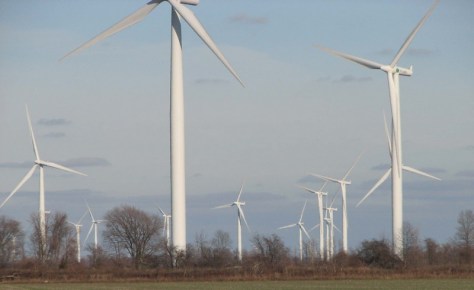
Ryerson University has decided to decommission all 6 wind turbines in its Wind Tech research project. In 2009 the project was awarded 729, 771 from the Canada Foundation for Innovation. The rest of the 1.8 million in project funding coming from the Ontario Ministry of Research and Innovation, Ryerson and the Canadian industry.
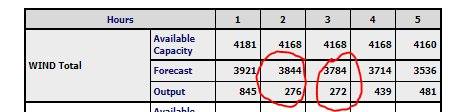
“Wind power is associated with three difficult problems: wind is unpredictable, inconsistent and the energy it produces cannot be dispatched on demand.”
Bhanu Opathella, Ryerson researcher
I have heard the stock statement answers from the premier, MOECC minister, his staff, Chatham-Kent mayor and council, municipal administration and the main owners of the North Kent wind farm that it is making me sick.
These stock answers are:
–We take the concerns about ground water seriously.
–We take a very cautious, scientifically-based approach when setting standards for renewable energy projects to protect the health of the Ontario people.
–Pile driving vibrations do not affect water wells.
–Our Government is committed to clean energy.
The concerns of residents in some of the affected areas in the former Dover Township have been made aware to the Ministry in 2012. The problem arose in the former Chatham Township shortly after pile driving started in June of this year, just as was predicted by Water Wells First, based on what had happened in Dover which has the same Kettle Point Black Shale in the aquifer. MOECC’s solution was to take turbidity tests which represents the clarity of water and not the heavy metals that are being carried in the water, some visible and some only visible under a microscope.
Dr. Colby states that the lead, arsenic mercury and uranium carried in the particles in the water will not render it unsafe. At the same time, he refuses to touch or have it tested and certainly would not drink it.
Scientific based approaches are as effective as is intended by those doing the testing.
I saw a vibration monitor on the Centre Side Road that was affixed to a well casing, which is not in contact with the bedrock, with a hose clamp that was not tightened to hold it tightly against the casing to pick up vibration. In addition, it was less then 100 meters from the road and at least 550 meters from the pile driving site. Does it seem reasonable to have a busy road between the site monitored and the sensor? Does it seem reasonable that no analysis is being done on the black matter suddenly appearing in wells that have been pristine for decades? Is that what a scientifically based cautious approach is all about?
So, computer models and engineer’s theory say that pile driving does not affect water wells! No one has heard of a major water well problem for years, yet within two or three months of pile driving at least 16 water wells have been adversely affected. Engineer’s theory also said that the Titanic was unsinkable. Engineer’s theory and model said that the O ring in the Challenger space shuttle was adequate, but its failure caused an explosion and a major crisis in the USA space program. There is precedence for engineer’s theories and models for being wrong. Could this be another? Does actual observation not have preference over theory?
Our government is committed to clean energy apparently at the cost of water wells. Perhaps if the following questions were answered, it would shed some light on why they have this commitment.
How much money was paid by the wind industry to individuals, political parties and the Ontario government for the privilege of building turbines in Ontario without interference?
How much money was paid by the wind industry to individuals and the municipality to become friendly hosts for turbine construction?
How much money would it take to stop construction and stop operation of turbines until their negative impact on environment issues, especially water, are properly assessed by an independent party, since our politicians, local and provincially, obviously had not done “due diligence” prior to signing the agreements?
Are the citizens of this province being used as pawns in a system that is broken? Are some ministries, such as MOECC, actually company self-monitoring agencies that are incorrectly being paid by our tax dollars rather then the companies that they refuse to police. How do we change things? Is common sense dead?
Former Minister of Energy & Infrastructure Georger Smitherman- 2008
The date is September 28, 2008 newly minted Ontario Minister of Energy and Infrastructure George Smitherman gushes over a vision of the future for green-energy in Ontario. In 2009 the Green Energy Act passes and is rapidly followed by 1 000s upon 1000s of industrial wind turbines erected. Ontario bowed to political push back by pausing installation of wind turbines in the Great Lakes. Today an offshore demonstration project looms with a build date of 2018. The project proposed in Lake Erie off Ohio’s shores.
From visions of green energy to build out of wind projects. What do you see?
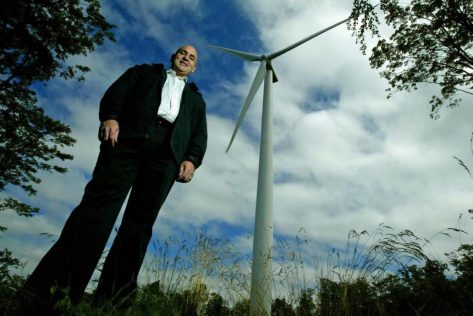
The wind at his back
By TYLER HAMILTONClimate and Economy Reporter
Sat., Sept. 27, 2008
NIAGARA FALLS–In just nine weeks George Smitherman has likely learned more about the green-energy industry than any energy minister before him, and then some.
Sitting in a meeting room at the Sheraton Fallsview Hotel in Niagara Falls, just minutes after giving his first major speech since being appointed energy and infrastructure minister in June, Smitherman enthuses like a kid who has just returned from Euro Disney.
He recounts his visit to a small community in Denmark that powers and heats itself with straw, municipal waste and geothermal energy. Then there was the neighbourhood in Freiburg, Germany, powered by rooftop solar panels atop high-efficiency homes. In Spain, he saw how the local electricity operator manages the country’s 15,000 megawatts of wind turbines and a world-class stable of solar farms.
His travels also took him to California, where he learned how the world’s fifth-largest economy used innovative conservation programs and energy-efficiency mandates to keep per-capita electricity consumption flat for the last three decades.
“Imagine a world where we could emulate their success?” asks an animated Smitherman, 44, who later turns to Amy Tang, an adviser sitting across the table. “Sorry, now I’m getting all worked up. Am I frothing at the mouth?”
The trips didn’t end there. On his home turf, he has already visited the massive Prince Wind Farm in Sault St. Marie, the Atikokan coal-fired generating station near Thunder Bay, the province’s three nuclear power stations, the massive Nanticoke coal-fired station, Hydro One’s grid control centre in Barrie, and has been inside the Niagara Falls water tunnel currently being excavated by Big Becky.
“I call it sponging. I just went out there to try and learn as much as I possibly could,” he says. “Everything I do, I learn something that’s one more piece of, let’s face it, a complex puzzle.”
Smitherman says he’s “jazzed” about his new job, a fresh change after five years as health minister. Premier Dalton McGuinty made it a promotion, insiders say, by merging the energy and infrastructure portfolios into a super-ministry.
ANNUAL GENERAL MEETING Wednesday, November 29, 2017 Silverdale Community Hall, 4610 Sixteen Rd. St. Ann’s, ON
Members Election of Board 7:00 pm • Program Start 7:30 pm
• Current Situation, Locally, Provincially & World Wide • Legal actions in Ontario
• What are our Activities? Health study for those thinking of moving.
• Long term exposure and VAD • The Risks – Infra Sound – Stray Current-Water Wells
• 2500 Homes in rural in West Lincoln exposed to IWT’s • Your Questions Answered
When Premier Kathleen Wynne announced 14 months ago that her government was suspending Ontario’s renewable energy procurement process, she and her Liberal colleagues were caught in the middle of a public backlash against skyrocketing electricity bills. Halting a costly plan that promoted wind turbine farms was a quick, convenient response. Indeed, Wynne’s own energy minister admitted Ontario didn’t need the electricity that would be produced by new turbines.
But there was a problem. Six months earlier, several wind turbine projects had been approved, and the September announcement didn’t mean they would be cancelled. The contracts would be honoured. Ontario would be allowing the development of wind turbines to produce electricity that wasn’t needed.
Among those projects are two in Chatham-Kent and another in Elgin County. One has become an enormous public relations problem for the Wynne government, while the other two have the potential to become the same.
The first project is almost complete; but the others should be halted before they begin.
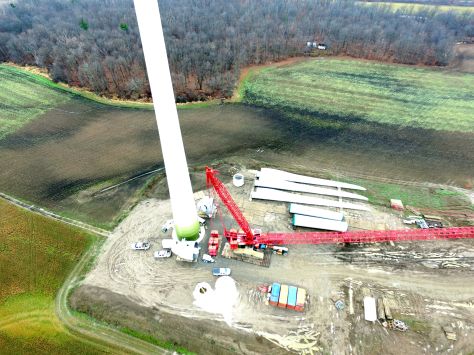
The North Kent 1 wind project was mired in controversy even before Wynne announced suspension of the renewable program. Construction activity is believed to have fouled or clogged at least 16 water wells because of interference to the area’s unique geology. Residents with damaged wells have made arrangements to have clean water trucked to their property.
The problems at the North Kent 1 project have stirred up fears a few kilometres away, at the Otter Creek project. Work has yet to begin, but residents are worried the same problems will affect their water. They’re also worried proposed turbine towers, the tallest in Canada, will be erected in an important migratory bird flight path.
Local MPP Monte McNaughton (PC — Lambton-Kent-Middleses) wants Otter Creek halted.
“These turbines are being built to generate electricity we don’t need, and they’re only going to contribute to driving hydro prices even higher,” he said.
In Elgin County, meanwhile, residents in Dutton Dunwich continue to campaign against a wind farm that has yet to be built.
Kathleen Wynne may have hoped rural Ontario’s long-held discontent with the Green Energy Plan would be forgotten by the June 2018 provincial election. But that’s not about to happen as the remnants of that multibillion-dollar campaign, and its varied controversies, continue to be revealed.
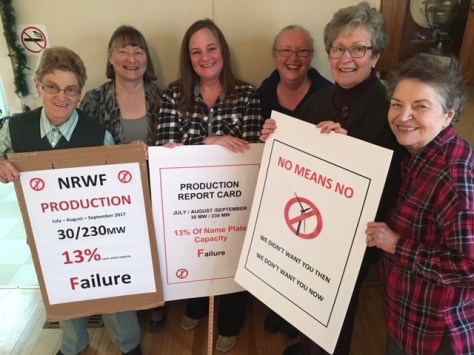
The production for the West Lincoln NRWF Industrial Wind Turbine project for the first year of production (2017), can now be calculated using the information provided by the IESO.
(The IESO publishes the hourly output of each wind generator in Ontario, from March 1, 2006 to the present in a spreadsheet on their website Hourly Wind Generator Output, 2006-present(1)
The production for West Lincoln NRWF is in column AN
The production from Nov. 2, 2016 to Nov. 2, 2017 was 492,051 MW
To calculate the hourly production divide 492,051 by 8760 hours in a year = 56.17 MW/hr.
The production for the first year of operation for the West Lincoln NRWF is 56.17/230 (name plate capacity) = 24.42%
So the over build for industrial wind turbines as an energy generator is 400%. In other words you either accept that the production is ¼ of the nameplate capacity or you need 4 times the number of industrial wind turbines. You still have an intermittent energy source that will only produce energy when the wind blows and frequently produces energy out of sync with demand.
A key question for the decision makers becomes – are industrial wind turbines financial viable at 25%? When you consider that we have already down loaded 330 billion dollars of debt on our children and grandchildren in Ontario.
We recently drove from London to St. Louis, Mo. On our drive to Windsor we saw many wind turbines. After crossing the border and driving through Michigan, Illinois, Indiana and Missouri, we saw no wind turbines.
I guess they do not need any, since we sell our electricity to them cheaper than it costs us to produce it.
“The biggest recipient of taxpayer cash on ACENY’s roster is the world’s biggest and most-litigious wind-energy producer: NextEra Energy …NextEra is using some of that taxpayer cash to sue small towns including Hinton, Okla., and Almer and Ellington in Michigan. What did those tiny towns do to irritate the energy giant, which has a market capitalization of $73 billion? They prohibited installation of wind turbines, the latest models of which now stand about 800 feet high.”
Last month, Anne Reynolds, executive director of the Alliance for Clean Energy New York, complained that the state is a “tough place to develop” big renewable-energy projects due to a “spirited tradition of home rule.” This came after her group and the Nature Conservancy released a report lamenting the fact that siting new renewable-energy projects is often “lengthy, uncertain and sometimes unsatisfactory for both developers and communities.”
It should be. With good reason, numerous upstate towns are actively fighting the encroachment of Big Wind. To cite just one recent example: Last month, the Watertown City Council unanimously approved a resolution opposing the development of eight industrial wind-turbine projects totaling 1,000 megawatts of capacity, because the projects could impair military training capabilities near Fort Drum.
Over the past decade or so, members of Reynolds’ group — some of America’s biggest subsidy miners — have collected $18.7 billion in federal and state subsidies. The burgeoning backlash against Big Wind means a growing group of rebellious New York towns stand between Reynolds’ members and even more taxpayer gravy.
The $18.7 billion sum was obtained by matching ACENY’s membership roster with data from Subsidy Tracker, a program run by Good Jobs First, a Washington-based government-accountability organization. That $18.7 billion includes all federal grants, tax credits, loans, loan guarantees and state subsidies.
The subsidies are corrosive. They encourage wind-energy companies to use legal action to bully rural landowners and small towns. They also induce the wind industry to kill more wildlife, including bats and birds.
The biggest recipient of taxpayer cash on ACENY’s roster is the world’s biggest and most-litigious wind-energy producer: NextEra Energy, which has collected nearly $5.5 billion in federal and state subsidies. NextEra is using some of that taxpayer cash to sue small towns including Hinton, Okla., and Almer and Ellington in Michigan. What did those tiny towns do to irritate the energy giant, which has a market capitalization of $73 billion? They prohibited installation of wind turbines, the latest models of which now stand about 800 feet high.
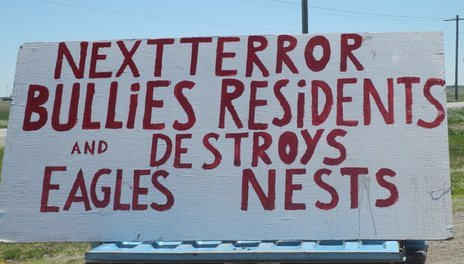
Speaking of bullying, NextEra also has a pending defamation lawsuit against Esther Wrightman, a Canadian activist who had the temerity to call the company “NextError and “NexTerror” on her Web site.
Another ACENY member: Spanish energy company Iberdrola (the parent company of its US subsidiary, Avangrid), which has collected $2.2 billion in subsidies. In 2012, shortly after Iberdrola began operating its Hardscrabble wind project, several dozen residents of Herkimer County filed a lawsuit against the company due to the nuisance, noise and sleep disturbance caused by Iberdrola’s turbines. That case, which now has 68 plaintiffs, is still pending.
Last year, after the New York town of Clayton imposed a six-month moratorium on applications for new wind-energy projects, Iberdrola sued the town, claiming the moratorium was illegal. But a state court sided with Clayton. And last November, citizens from two Vermont towns, Grafton and Windham, voted overwhelmingly to reject a proposed Iberdrola wind project.
Multibillion-dollar subsidies for Big Wind are also fueling widespread destruction of American wildlife. While the deadly effect that wind turbines have on birds, in particular eagles and other birds of prey, has been well documented, Big Wind is also killing hundreds of thousands of bats per year.
A paper published last year in Mammal Review found that wind turbines are now the largest single cause of bat mortality. A report by the conservation group Bird Studies Canada found that “across Canada, bat fatalities were reported more often than birds, accounting for 75 percent of all carcasses found.” To be sure, bats don’t get as much good press as eagles and hawks, but they are critical pollinators and insectivores.
In short, while Reynolds and other members of ACENY claim their push for renewable energy is about climate change, the numbers from Good Jobs First show that what they really want is more corporate welfare. And more corporate welfare for the group’s members means bad news for America’s small towns and even worse news for our wildlife.
Robert Bryce is a senior fellow at the Manhattan Institute.
Participants at the Goal Setting Retreat November 4th 2017, Silverdale Hall- West Lincoln, Ontario
A successful goal setting retreat was recently hosted by Mothers Against Wind Turbines (MAWT) and West Lincoln Glanbrook Wind Action Group (WLGWAG). Participants came from wind action groups,area residents and other interested stakeholders. Under the skilled guidance of Facilitator: Georgina Richardson a meeting of the minds occurred. Helping those of us negatively impacted by industrial wind turbine sort through chaos, set mutual goals and put into place action plans on how to move forward and what to leave behind.

 Ryerson University has decided to decommission all 6 wind turbines in its Wind Tech research project. In 2009 the project was awarded 729, 771 from the Canada Foundation for Innovation. The rest of the 1.8 million in project funding coming from the Ontario Ministry of Research and Innovation, Ryerson and the Canadian industry.
 ANNUAL GENERAL MEETING
 Mothers Against Wind Turbines Inc.