Category Archives: Canada Wind

Enercon done major contract in Canada and brings out new , high-wind turbines. 

POSTER’S NOTE: THIS ARTICLE IS ORIGINALLY IN GERMAN AND HAS BEEN TRANSLATED USING GOOGLE TRANSLATE. FOR ORIGINAL ARTICLE, PLEASE CLICK HERE: http://www.iwr.de/windenergie/wind-news.php?id=26054

April 11, 2014

Aurich – The wind turbine manufacturer Enercon has built on a major project in Canada within 30 months of 126 wind turbine generators (WTG ) . The manufacturer also based in Aurich, wants to expand its range of wind turbines for strong-wind locations .

Both the system of type E – 82 and E -101 of the type it should in future be in an additional version with wind class – I- interpretation according to the manufacturer . The E-82 for strong-wind sites is at 2.35 megawatts ( MW) offered nominal power. The corresponding E -101 with 3.05 MW plant is about the same power rating as the wind have Class II turbine of this platform.

New turbines with different tower , foundation and grid connection variants
The message for the expansion of the turbine Enercon has to offer Hannover Messe issued , which ends on Friday . Enercon explained now to optimize the basic machine types E -82 and E -101 for the construction of wind Class I locations. Both series Enercon guarantees in connection with relevant agreements in relation to the so-called Enercon Partner concept technical availability of 97 percent. In addition to various towers and foundations variants both strong wind series will be available with four different power supply configurations for the different target markets.

” Enercon reacts with the new high-wind versions to customer needs in international target markets . We want to offer our customers for their wind energy projects always the optimal Enercon technology, “said Enercon sales manager Stefan Luetkemeyer . The strong winds versions of the E- 82 and E -101 are primarily intended for export markets and are expected to be available in early 2015 and in early 2016 series .

Logistical challenges of large projects in Quebec
In the Canadian province of Quebec Enercon has built in just 30 months for customers Boralex and Gaz Métro total of 126 wind turbines and put into operation. The wind farm Beaupré am so far the world’s largest built by Enercon wind farms. The installed capacity is 272 MW. Machines from the E -70 and E-82 with 64 , 85 and 98 meter hub height have been installed there. A further 38 machines (91 MW) will soon follow in another two phases. The site of the first phases of construction includes about 100 square kilometers. Around 150 kilometers of roads were built for the project, also moved massive amounts earth , blasted rock and built numerous bridges .

Up to 36 large cranes were from 2012, while construction of the tower and installing the system, simultaneously cutting and added a further auxiliary cranes that were ready to unload the heavy transports . This heavy transports were carried out with special heavy-duty trucks, the so-called “Army Trucks” . Elizabeth Fennell, General Project Manager at Beaupré Project declared proudly: ” implement Deliveries within the schedule , led many successes – with on-time project delivery as the crowning glory . ”


FOR ORIGINAL ARTICLE, PLEASE CLICK HERE: http://www.iwr.de/windenergie/wind-news.php?id=26054

Wind power approvals pushing Ontario hydro bills up

February 11, 2014
Wind Power Project Approvals Driving Up Cost of Ontario’s Electricity
By Parker Gallant
The provincial government would have us believe it is taking steps to manage rapidly rising electricity costs. Meanwhile, in the background, they are pushing 55 wind turbine projects through the Renewable Energy Approval process, projects  that will add $1.1 billion per year to Ontario’s electricity costs.  The impact of these turbine projects is 20 times the cost of the gas plant relocations.
The 230-megawatt  (MW) Niagara Region Wind Project proposed for West Lincoln and Wainfleet in the Niagara Region alone will add $78 million annually to Ontario’s electricity costs when approved.  The cost over its 20-year contract is $1.6 Billion.  Rather than declining or delaying these 55 projects, the provincial government continues to issue approvals and increasing electricity costs to levels that Ontario household and business users cannot afford.
In fact, wind power projects continue to be approved almost weekly despite Ontario’s current surplus of electricity.  Some operators of existing wind power generation facilities are actually being paid not to produce electricity, and neighbouring jurisdictions like New York and Michigan are being paid to take Ontario’s surplus power, which they in turn use to attract jobs away from Ontario with cheap electricity.  To create capacity on the grid for the expensive power generated by wind turbines, Ontario is also idling the Niagara hydro plants which in the past have powered Ontario’s economy by supplying cheap clean electricity.
The truth is that wind is not a reliable source of electric power.  In Ontario, wind turbines generate most of their electricity at night, and in the fall and winter months—exactly when we don’t need it. To provide the electricity needed by the province during the day, and in the hot summers, Ontario has had to supplement wind turbines with gas plants to provide electricity when the wind is not blowing.  This means that the average Ontario electricity user will not only pay about $220 annually for the cost of the wind turbine contracts but also another $200 annually to pay for the base costs of the gas plants needed to back them up.  Ontario electricity ratepayers could do a lot with that $420.
While the government argues that it has no option but to proceed with these projects, Ontario court have confirmed that the Feed-in-Tariff contracts issued for these projects only allow the proponent to enter a “complex regulatory process that might have led to approvals” and that the Environmental Project Act gives the Ministry of the Environment Director “broad powers to issue, reject, or amend Renewable Energy Approvals.”  The known impacts of existing wind power projects on communities in rural Ontario give the Ministry of the Environment Director a basis for rejecting or delaying these projects.  The Ontario government is pursuing wind power without a proper cost-benefit analysis, as was pointed out by the Auditor-General in 2011; no analysis was done before launching into the wind power program, or since. Citing benefits to the environment, is not an appropriate rationale:  with the coal plants closed, there is no need for concern about pollution from them, and there are also valid concerns about environmental damage and harm to wildlife from wind power plants.
For example, the government’s own Environmental Review Tribunal revoked approval to construct the Ostrander Point project last July because the project would cause “serious and irreversible harm” to the endangered Blanding’s turtles native to the area.  Rather than accepting that decision, however, the Ministry of the Environment partnered with the wind industry in January to appeal this ruling in the Ontario Superior Court of Justice in Toronto; the Ministry is trying to overturn the decision to protect the turtles.  Similarly, the Ministry continues to support the Wainfleet Wind Energy project, despite the obvious dangers presented to users of the nearby Skydive Burnaby facility.
Electricity costs in Ontario are now among the highest in North America. Ontario households and businesses have reached the limit of their capacity to pay for this Green Energy experiment. It is time for the Ontario government to stop approving more wind turbine projects, like the Niagara Region Wind Project, that will drive up the cost of electricity in the province for the next 20 years while generating electricity we do not need.
Parker Gallant is a former vice-president with the TD Bank, a former director with Energy Probe, and currently an energy analyst and commentator. He is vice-president of Wind Concerns Ontario.

New plan; same old hydro hikes

December 6, 2013 – The Windsor Star

Pic of Chiarelli

Based on what the Liberals have done to hydro bills over the past decade, there’s good reason to worry about what they are now proposing as part of an “updated long-term energy plan.”

In fact, the update comes after hydro costs have increased nearly 50 per cent under the Liberal government’s watch. The reasons are myriad: The Green Energy Act — the centrepiece of the old long-term energy plan — has proven to be overly expensive and controversial. Each year about $1 billion is spent to pay for the stranded debt that was left over after the breakup and restructuring of Ontario Hydro. According to the auditor general, the province sells electricity exports for less than they’re worth. Between 2005 and 2011 the loss was $1.8 billion.

And then there’s the more than $1 billion the government needlessly spent to move two gas plants for no other reason that to save Liberal seats in the last election.

At best, the Liberals’ energy policy is a mess. It has failed to deliver affordable hydro rates that are fair to families and an incentive for businesses investment.

Thanks to the new long-term energy plan, it’s only going to get worse. Ontarians can count on their electricity rates going up 33 per cent over the next three years. And within five years, the average monthly bill of $125 will rise to $178 — a 42 per cent increase.

However, this is all good news, according to Energy Minister Bob Chiarelli. That’s because after the initial hikes, Ontarians will actually be paying $100 a year less than they would have under the old long-term strategy. That’s because the government decided to scrap plans to build two new nuclear reactors, renegotiated the Green Energy deal with Samsung and cut payments to small solar producers and wind farms.

“We are saving ratepayers money,” is how the energy minister characterized the coming hit to electricity bills. Just forget about the inflationary increases that are coming.

As far as Chiarelli is concerned the high rates are “just a fact of life.”

Another fact of life is that the Liberals have mishandled the energy file and they have no intention of addressing high rates, or even stabilizing them.

But since there’s an election coming up, possibly this spring, the Liberals are holding out hope to hard-pressed energy users that they’ll be offering some help “to better control their consumption.”

The government says the program will provide “on-bill financing for energy efficiency retrofits” starting in 2015, which would provide loans for home renovations that would be paid back through electricity bills.

“We haven’t put the details together,” admitted Chiarelli. “The cost of financing over time will be paid for by savings.” And considering the rate hikes ahead, that could be a very long time.

For now, the Liberals’ energy strategy seems to be focused on creating the impression that everything is under control as the province heads toward an election. But the bottom line is that Ontario’s hydro rates are among the highest in North America, and there’s no end in sight to the increases.

The coming election will provide Ontarians with the opportunity to send a simple message to all the parties — it’s time for an affordable energy plan.

See original article here: http://blogs.windsorstar.com/2013/12/06/the-stars-view-new-plan-same-old-hydro-hikes/

20131019-151831.jpg

Form of Child Abuse & Neglect? Protecting Children less than 550m

Did you write to Andrea about how the Hydro Increases are Affecting You?

Dear Andrea Horwath and Peter Tabuns;


Thanks you for your consideration and approach to finding out about concerns from Ontarians with regards how rising electricity rates are affecting families. This subject is one that is dear to my heart as I have spend the last 12 months researching the topic extensively. Almost 2 weeks ago, I also found out that the factory I work at which employed 60 people in Caledonia (Just outside of your consituency), will be “Idling” in the first quarter of 2014….so that the corporation can put the jobs back into the US.  Energy costs for Large Consumers – aka manufacturing –  has risen in Ontario on average 30% since 2008. (Fraser Institue Report Here) My colleagues and I will now be looking for work in an economy where manufacturing has been leaving in astronomical numbers, along with the middle class. The Fraser institute report shows how in New York state, their large consumer electricity rates have actually dropped over 20% from 2008 rates…That is a 50% difference for companies who are manufacturing goods from Ontario to NY State. We sell our excess electricity at a loss, and have paid Quebec and New York state at times to even take our electricity! We paid them!!!


Never before have I been so interested in Ontario’s energy policies, especially after reviewing the Auditor Generals report from 2011. I am extremely worried about Ontario’s current path related to energy policies as I know that my children and their children will be suffering the consequences of the current LIberal governments mismanagement. As a child, the Hydro One debt was tacked onto my parents electricity bills, and to this day my generation of ratepayers continue to pay for a debt that the Liberals contnue to extend final payment to, almost unquestioned. The Green Energy Act and FIT contracts are blatantely killing the economy. The numbers are there for all to see, if anyone would actually take a look at the output capability reports from IESO which on any given day would show you that Wind power is supplying less than 1% of our daily demand….after spending billions on subsidies and infrastructure.


On Page 89 of the Auditor Generals report, it states that The Ministry of Energy at the time (George Smitherman) claimed that the Green Energy Act would lead to “modest incremental increases in electricity bills of about 1% annually” yet in November 2010 the Ministry forecast concluded that a typical residential electricity bill would rise about 7.9% annually over the next 5 years, with 56% of the increase due to investments in renewable energy.” It also states that “wind and solar renewable power will add significant additional costs to ratepayers’ electricity bills.”  Electricity is a necessity in Ontario, how many households can afford this?


We are being asked to pay for a second energy system – wind – while we underutilize hydro and gas. According to IESO the Energy Output  by Fuel Type for 2012 has nuclear at 56.4%, hydro at 22.3%, gas at 14.6% coal at 2.8% and wind at 3%.


On Page 90 it shows the Minister of Energy replaced the RESOP (Renewable Energy Standard Offer Program ) with the FIT (Feed in Tariff) program providing renewable energy generators with significantly more attractive contract prices adding $4.4 billion in costs over the 20 years.” If the government’s  goal of 10,700 MW of renewable energy by 2018 (p. 89) is realized the FIT subsidy will be closer to $2.6 billion per year or $52 billion in costs over the 20 years  just for the FIT subsidy.

(The Formula to calculate the Feed in Tariff Subsidy is:


Mega Watt

X

Operating efficiency

X

Hours per year

X

Cost


10,700 MW X .28 efficiency X 8760 hours per year X $103.50 = $2,624,496,000 FIT subsidy per year!


According to page 111 of the Auditor General’s Report the operating efficiency of industrial wind turbines is 28%. The cost per MW is based on the FIT guaranteed price of $0.135 per kw minus hourly Ontario Energy price estimated at $0.0315 per kw = $0.1035 per kw making it $103.50 per MW.  So 10,700 MW X .28 efficiency X 8760 hours per year X $103.50 = $2,624,496,000 FIT subsidy per year! )


Just in Fit Subsidies, we are being asked to pay over $2.6 BILLION per year for only 3% of Ontario’s energy output. This is while we spill, “clean hydro energy” over Niagara Falls, in order to take WIND that we do not need.


Those on fixed pension incomes, contract workers, and those earning minimum wage will be most affected by these energy policies. In the United Kingdom, fuel poverty, which now affects 5.5 million households, has become a household term, largely because of electricity policies similar to those that are being pursued in Ontario. In Germany, every year over 600,000 Households are disconnected annually for not being able to pay their electricity bills. Ontario is now being boasted about Internationally as having an energy policy “Worse than California”.

The contract that Energy Minister Smitherman entered into with the Korean Consortium has not been disclosed. The contract has not been published so it is not available for the public to examine, criticize, evaluate, etc. Is this deal being covered up with the expectation that in time citizens will forget?  Who is responsible for protecting the interests of the citizens of Ontario?

The question is not about “renewables or not”, the quesitons are:


1) Why are we even investing in any additoinal energy sources, a 2nd system, when we have “enough energy” in Ontairo as per the Ministry of Energy office. $2.6BILLION/YEAR for subsidies on Energy we don’t need!!!!!!!!


2) Why does the government ignore the over 75 Municipalities in Ontario who have asked to “Not be a Willing Host” to wind turibnes? Why doesn’t your party support these Ontarians in ever growing numbers?


3) Why is it ok for the Liberals to let manufacturing jobs in Ontario leave?


4) When will my insurance rates go down? I have actually got notices about rising rates, not decreasing….


Those on fixed pension incomes, contract workers, and those earning minimum wage will be most affected by these energy policies. In the United Kingdom, fuel poverty, which now affects 5.5 million households, has become a household term, largely because of electricity policies similar to those that are being pursued in Ontario.

The contract that Energy Minister Smitherman entered into with the Korean Consortium has not been disclosed. The contract has not been published so it is not available for the public to examine, criticize, evaluate, etc. Is this deal being covered up with the expectation that in time citizens will forget?  Who is responsible for protecting the interests of the citizens of Ontario?


I hope that your party stops propping up the LIberals and takes a stand for Ontarians for once….if you don’t, our children and their children will be paying down the debt of this eras failed energy policies. I would like a response and look forward to it.


Respectfully Submitted


Haldimand Resident


In Memorium – Patricia Anne Vaughan

This morning, I lost a dearly loved friend,  and a staunch ally, in the war on the injustice of the greenscam.

   A stronger, more competent woman, I’ve never seen.  Tricia was an excellent mother, to her 12 year-old son, Marcus, and a hardworking member of the Fair Board.  She looked after her farm, tended to her cattle.  Made time to teach Marcus to be self-reliant, and responsible, and all the while, hold down a full time job.  While doing all of this, she also made time to help our community fight the threat of wind turbines, as well as being active in events at the Elcho Church.
               To say that Tricia will be missed, is an understatement.  She leaves behind her son, Marcus, her mom and dad, her sister and brother, many more members of her extended family, as well as many, many friends.  Needless to say, we are all heartbroken.
         I was told by Tricia’s Dad, that there will be visitation, on Sunday, and Monday, at the Merritt Funeral Home, in Smithville.  Hours are from 2-4, and 7-9pm.  The funeral is at the Elcho Church, in Wellandport, at 11:00 pm, and Tricia will be laid to rest, beside the church.
     Rest well, my friend, we will soon meet again.
Shellie Correia
VAUGHAN, PATRICIA ANNE:  May 6, 1972 – November 8, 2013 – Peacefully at West Lincoln Memorial Hospital.  Dearly loved mother of Marcus Tuck, she is also survived by parents Norman and Catharine Vaughan, and siblings Douglas Vaughan of Fergus, Caroline Robins (Ross) of Smithville, and Jonathan Vaughan of Waterloo.  Loving aunt to Alanna Vaughan, Owen Vaughan and Aiden Robins.  Survived by many aunts, uncles and cousins.  Patricia was very active in 4H first as a member and then as a Leader.  Also involved in Junior Farmers, West Niagara Agricultural Society and many other community organizations.  Visitation Sunday, November 10 and Monday, November 11 both days from 2-4 and 7-9 pm at Merritt Funeral Home, 287 Station Street, Smithville.  The funeral service will be held on Tuesday, November 12 at 11 am at Elcho Church, 6432 Elcho Road West, Wellandport (corner Port Davidson Road) with interment at Elcho Cemetery.  If desired, memorial donations to Elcho Church, the Canadian Cancer Society or West Lincoln Memorial Auxiliary would be appreciated and can be made through the funeral home.

Turbines affect you, too

Amanda Moore – Nov 8, 2013 – Grimsby Lincoln News

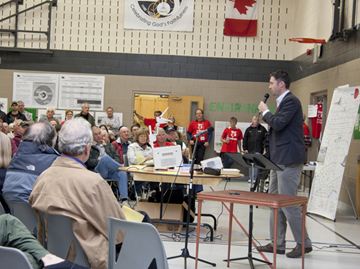
Industrial wind turbines affects everyone in Ontario. That is the key message a citizen’s group delivered to roughly 300 people in attendance at Smithville Covenant Christian School Thursday night.

“Just because you don’t live in West Lincoln, doesn’t mean it won’t affect you,” said Deb Murphy, a Dunnville resident who is vice president of the West Lincoln Glanbrook Wind Action Group. “There is a misconception that if you don’t live near them, they won’t affect you. It doesn’t matter if you live 550 metres from one or 550 miles. If you live in Ontario, they do so affect you.”

The information meeting held by WLGWAG was meant to target those living at a distance from the existing and proposed industrial wind turbines in West Lincoln. The group had hoped to attract residents from nearby Grimsby and Lincoln.

“We can see the ones in Caistor from our place, and they are the small ones,” said Grassie resident Cindy Poziomka, whose children and grandchildren live in Smithville. “I’m worried about the affects of children. Some of them are so close to Leisureplex. How can they put them so close?”

Cindy said she has not been following the battle between local residents and the corporations erecting the 80- and 140-metre high turbines. Her husband Rick, however, has been. Thursday’s meeting was the second one he attended. He said though the turbines won’t affect him at home, they will affect him in his pocket book.

“They won’t go near where we live because of flight paths, but it just doesn’t make sense to put them up anyway,” said Rick. “I’m not in favour of them for many reasons. The main reason being the effect on real estate. Some people are making tonnes of money at the expense of their neigbhour.”

The Posiomkas say they have seen how the issue has divided the township.

“You have kids on hockey teams who are fighting because one of them is getting a wind turbine,” said Cindy. “It’s divided the town.”

Members of the wind action group spoke on the many ways industrial wind turbines affect more than those who live near them.

Catherine Mitchell was given the difficult task of demonstrating the “true cost of industrial wind turbines.” While some will be directly affected by a hit to their property value (according to Mitchell’s research, property values in the Huron area fell between 25 and 60 per cent with the onslaught of wind turbines), all of Ontario will pay for it through the province’s costly Feed-in-Tariff program.

“Installed or in the que to be approved are 6,736 wind turbines,” said Mitchell. “Ontario will look like a pin cushion and we will not be able to afford to keep the lights on.”

Using a calculation of megawatts x operating efficiency x hours per year x cost, Mitchell said industrial wind turbines will cost more than $58.7 million a year in subsidies in the Niagara region alone. Over the 20-year span of the provincial contracts, that number totals more than $1.17 billion, she said.

“Who do you think is going to pay that bill,” Mitchell said as a warning to those in attendance.

Eric Ames, communications director for the Family Coalition Party, said the question Ontarians, including those awarded FIT contracts, failed to ask in the early days of the Green Energy Act was where is the money coming from.

Corporations and individuals with FIT contracts are guaranteed a set rate per kilowatt hour.

“Where does that money come from? From you and me,” said Ames, who attended Thursday’s meeting not to sway voters but to help spread the message of how these turbines will affect everyone in Ontario. “They were given contracts with the expectation that taxpayers would pay for this.

“If we continue down this road, we will all lose,” he said. “It affects everyone in this province.”

Another hidden cost of the Green Energy Act, Mitchell explained, is lawsuits. Anne Fairfield and Ed Engel know all about that. The West Lincoln couple is fighting IPC Energy’s HAF Wind Project, even as all five turbines stand a short distance from their home.

“Just to get this far, our legal bill was over $25,000,” said Fairfield. “This was paid by donations. It is going to take all of this community’s financial contributions to fight this problem and have a successful end.”

Engel and Fairfield are waiting on the outcome of several Charter of Rights and Freedoms challenges being heard across the province. These cases challenge the constitutionality of the Green Energy Act and its siting of industrial wind turbines.

“Your health, your safety, your wealth, your environment and this community are worth protecting now,” she said. “Help us to do this job for you.”

The crowd also heard from Mothers Against Wind Turbines chair Marianne Kidd about the impacts of turbines on children, Loretta Shields on the impacts to environment, Mary Kovacs on the dangers of transmission lines and Sidney Thompson on the loss of democratic rights.

West Lincoln mayor Doug Joyner attended the meeting for more than a show of support to his constituents.

“I’ve always said, knowledge is power,” said Joyner. “I am here to support the residents of West Lincoln and Wainfleet, but the biggest reason I am here is to have better information on this.”

The mayor and council have heard from several of Thursday’s speakers in council chambers over the past three years.

Turbines affect you, too.