Category Archives: Adverse Health Effects

Prove Your Wind Turbines are Safe

Water droplet with the earth in it.Regarding the Courier Press story, Otter Creek says there’s no proof that wind turbines are responsible for dirty water.

The headline of that story captures the essence of what’s wrong with Ontario’s Green Energy Act. Rather than providing proof that their turbines won’t harm well water, the developers are quite content with casting doubt about harm because they know the government will approve their project if they can create the slightest hint of doubt… the precautionary principle be damned.

This is perhaps the biggest flaw in the Green Energy Act that wind developers are only too happy to exploit — the burden of proof for proving harm rests with the individual residents. 

This is an impossible barrier for individuals with limited resources. The onus rightfully belongs on the Otter Creek developers to prove their turbines will not cause harm to the wells, rather than engage a consultant to review another consultant’s report, which in turn was based on other reports from other consultants; none of whom have bothered to actually test the water in the Dover wells.

This statement by Otter Creek project manager Marc Weatherill is one example of wind developers attitude towards local residents when he stated: “A lot of the claims have been based on anecdotal evidence or experience.”

The “experience” of residents in Dover, after nearby turbines have been installed, has been turbid well water that reeks of hydrocarbons. Their experience has been that they must buy bottled water for drinking and cooking, and some make regular trips to laundromats to wash their clothing.

Their experience has been that their horses would rather drink water at roadside ditches instead of the well water.

Their experience has been that the filters provided to some have not been effective in providing them with clean water.

Perhaps Mr. Weatherill should visit some of the well owners in Dover and taste their water before he dismisses their claims as merely “anecdotal” and not worthy of further investigation.

Mr. Weatherill also claims that if the Water Wells First group provided scientific data that proves their claims, they would be grateful and happily review the information and details.

He also states that, “What we said to them is, look we want to understand your concern, we want to understand the issue but we need to see it laid out for us.”

Seriously, he wants the residents to do his work for him.

Otter Creek’s selected turbine model, the Enercon 141, with a nominal output of 4.2 MW, will be the largest deployed in Ontario with a nacelle height of 129 metres and a rotor diameter of 141 meters.  There’s enormous potential for vibration, and yet Adam Rosso, project development director for Boralex, said there are no plans on doing baseline testing on water wells in and around the Otter Creek Wind Farm area. And Mr. Weatherill added: “If that’s something that is required of us then we will, but as of right now we don’t have any plans to do that.”

I would point out that the Otter Creek developers hope to vacuum about $218 million directly out of the ratepayers’ pockets over the 20-year life of the contract. Since the Minister of Energy has acknowledged that Ontario has a “robust supply” of generating capacity for the next decade, we will pay the Otter Creek owners about $100 million over the next 10 years in exchange for exactly zero net benefit. The cost of baseline and ongoing water testing pales in comparison to the potential profit.

Confirming “there’s no proof that wind turbines are responsible for dirty water” is as simple as installing an in-line turbidity meter and data logger at several wells in key locations before construction and continuing past start-up. This would confirm the water quality throughout the entire process. If there was an increase in turbidity, the data logger would be able to pinpoint the exact time it occurred, which could then be compared with any activity such as pile driving for turbine bases or when the turbines are operating. If there’s no change in the water turbidity, it would be definitive proof that the turbines are not causing any problems with the wells.

This so obvious, that refusing to perform such simple and low-cost testing would result in the public perception that the developers are engaging in willful blindness, perhaps out of fear of the results.

Santo Giorno

Camlachie

Published: http://www.wallaceburgcourierpress.com/2017/02/03/letter-no-reason-why-otter-creek-cant-do-more-tests 


Is there a remedy to Industrial Wind Turbines?

Is there a Remedy for People Suffering, Health Issues, Financially, etc. from Industrial Wind Turbines in Ontario ?– approximately 7700 planned for Ontario.

shawn-tricia
Trish & Shawn Drennan

“Congratulations to Trish and Shawn Drennan!”

The Goderich Superior Court Room was filled to capacity when Shawn and Trish Drennan went to Court on January 19th to reverse the negative impact that the 140 Industrial Wind Turbine Project (K2), two transformer stations and several transmission lines have on their family, home and their Heritage Farm operation.

They put a compelling and sensible case together and spoke with passion and the strength of truth behind their words.  One comment was that some felt they were witnessing an important step in this fight.  I heard, from a lawyer,… “that a lawyer could not have done a better job in arguing the case”.  Most felt the judge really got it and it was in no small part because of the time, work, expense and personal sacrifice they both have given to their case to put the facts on the table.

shawn-drennan
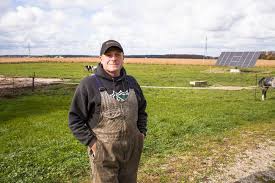
Shawn Drennan at home on his farm operation

Shawn, “presented himself”, and told the court that the government has created an impossible barrier when he has to prove “Serious Harm to human health” at an Environmental Review Tribunal (ERT), when the turbines have not been installed or in operation yet. The ERT appeals and Divisional Court Hearings occur prior to the IWTs becoming operational. The Divisional Court also confirmed that the ERT’s lack the jurisdiction to determine the validly of section 47.5 of the Environmental Protection Act (EPA) and its constitutionality. In addition, to date, there appears to be no definition for the term “Serious Harm” even after all the ERT’s, Judicial Reviews and Divisional Court cases here in Ontario.

Shawn declared that the many witnesses who have come forward to testify that they have been harmed by turbines all over this province have not been given the gravity and respect they deserve for putting their testimony forward.  Shawn told the hearing that the government and K2 knew the turbines will harm people even before wind project proposals and permits went ahead.  The Canadian Wind Energy Association (CanWEA) lobbied the government to remove Infra and Low Frequency Sound regulations and testing when the Green Energy Act was written and this requirement was subsequently removed. If Judge Raikes had asked, at least half or more of the people in the court room that day could have stood up and said, “ I am the evidence of harm from Industrial Wind Turbines (IWTs).”

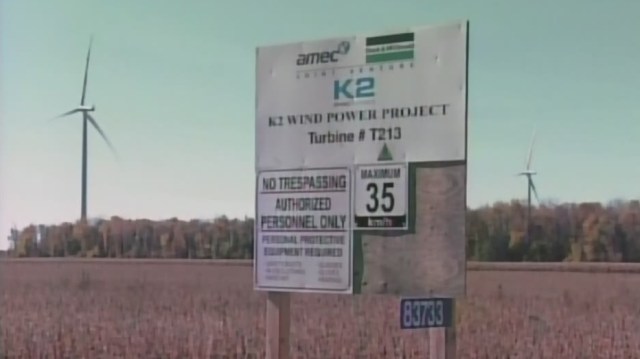
Shawn told the hearing that the difference between then, (ERT Hearings prior to operation) and now (May 29 2015), is that now the switch has been turned on, and the IWT’s are operational and we are being harmed.k2-wind-turbine

Judge Raikes challenged K2 and the MOE to tell him what remedy the Drennans have besides more time in court. We all watched them try to answer to no avail, because as was pointed out the only remedy right now is to move away. “Most people do not want to move away to begin with but do so to regain health.  They  are often penalized yet again when they have to lower the sales price to even get the home sold.

kingsbridge-120910
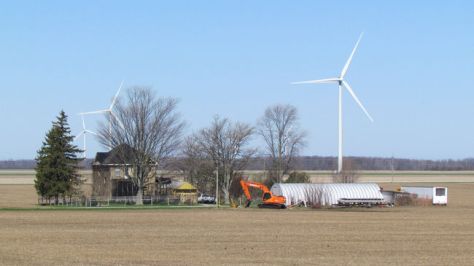
Home with a K2 industrial wind turbine just a few hundred metres away

When Judge Raikes looked at the K2 lawyer, Mr Bredt,  the judge tried to paraphrase what the lawyer had just said to him, “ So, the Drennans went to the ERT and Divisional Court, have complained to MOE, and still have no remedy, so it’s tough luck for them?  Bredt replied, “Yes.” which drew gasps of disbelief from the full gallery of people who attended.

When it came time to argue about who should be named as defendants in the Charter Challenge; K2 and /or govt., it was interesting to watch the judge see both parties try to throw each other under the bus.

Those in attendance are waiting to hear Judge Raikes decision and keep their fingers crossed that Shawn and Trish can move forward in finding a remedy for the harm they have experienced.  This hearing has implications for property owners and people living within at least a 10 km radius of a turbine project here in Ontario.

Thank you, on behalf of a whole lot of us in Ontario.

Dave Hemingway, Reporter, The Landowner

Kafkaesque world of windmill neighbors

despair-400.jpgThe definition of “Kafkaesque”: “Describing something that is horribly complicated for no reason, usually in reference to bureaucracy.” Neighbors of operating and proposed wind projects are watching in disbelief as they witness the Public Service Board (PSB) issue Orders affirming the rights of the wind industry while putting neighbors through expensive, time-consuming legal processes that tramples neighbors’ rights and provide no relief.

Paul Brouha of Sutton lives 6,385 feet from the nearest turbine in the Sheffield Wind plant. He filed his first noise complaint on Dec. 24, 2011, after the wind turbines began operating in October. The PSB dismissed his complaint.

Brouha hired a noise expert who conducted testing and found that instead of the 15 decibels (dBA) noise attenuation between outside and inside projected by wind company experts, the home attenuated 1 dBA.  The expert’s measurements showed “multiple and frequent violations of the CPG noise criteria.”  The PSB ordered the Department of Public Service (DPS) to investigate the complaint early in 2014. DPS hired a consultant who conducted the same test on July 1, 2014.

In January 2015, Brouha filed a nuisance lawsuit in Superior Court in Vermont.

In Sept. 2015, DPS reported to the PSB that Sheffield Wind exceeded interior noise standards 10-14% of the time.

At the end of 2015, the PSB opened an investigation. Sheffield Wind moved to stay Brouha’s nuisance lawsuit which they had moved from Superior to Federal Court.  The Federal judge approved the stay request until the PSB ruled on the complaint.

Brouha’s nuisance complaint has been held hostage by the PSB’s laborious investigation and enforcement process for a year, during which Sheffield Wind, DPS, and Brouha filed written arguments about whether or not a violation occurred.  Brouha argued that the project is in violation.  Sheffield Wind vigorously argued that new monitoring must take place.  The PSB Hearing Officer agreed.  Brouha filed a Motion to Reconsider six months ago.  The Hearing Officer has not ruled.

The parties agreed to have their noise experts meet to try to agree on a new monitoring plan.  They did not come to agreement.

On Jan. 25, 2017, the Hearing Officer held a daylong technical hearing in Brouha’s noise complaint case.  Each expert’s noise monitoring plan was presented.  Sheffield Wind wants an entirely new protocol.  DPS argues for a protocol that would change the noise standard.  Brouha asks to use the protocol originally approved by the PSB.  The hearing did not finish, so three PSB staff, five attorneys and their experts will return to the PSB for another hearing.

Brouha has spent nearly $350,000 so far attempting to get his noise complaint addressed.  No end is in sight.

Melodie and Scott McLane live 3800 feet from the Georgia Mountain Wind turbines. After they filed more than 30 noise complaints, the PSB opened an investigation in Nov. 2015.  In March 2016 the McLanes filed a complaint about the turbines operating under icing conditions.  The PSB opened another investigation.

Attorneys for GMW (same attorneys representing Sheffield Wind), DPS and the McLanes argued on paper about whether an attenuation test at the McLane home should be conducted, and whether the winter operating protocol required the turbines be curtailed under icing conditions.  GMW vigorously argued against testing at the McLane home.

The McLanes also filed a noise complaint along with the icing complaint, because they experienced the loudest noise for the longest period of time since the turbines began operating in 2013.  In every filing in the icing docket, the McLanes reminded the PSB that they also were filing a noise complaint.

Recently, the PSB issued an Order[1] finding GMW violated its CPG by operating its wind turbines under icing conditions in March 2016, and issued a negligible $2000 fine.  The same day, the PSB fined a solar company[2] $17,000 for failing to comply with a condition involving a fire lane.  No one was harmed by the failure of the solar company.  The McLanes sleep is regularly disrupted by the wind turbine noise.  The PSB declined to address the accompanying noise complaint.

In response to the McLane’s 2015 noise complaint, both the PSB Hearing Officer and DPS recommended testing to determine the attenuation of the noise from inside to outside. The Board denied[3] the testing but gave the McLanes and DPS ten days to file paperwork asking to engage in further discovery and cross-examination of GMW’s expert to decide if outside to inside testing should be done.

The McLanes also filed a Motion for Relief in Nov. 2015.  In denying that motion[4], the PSB said, “Nothing in our Order today prevents the McLanes from seeking any individual relief that may be available to them in a forum that has the requisite authority to review their personal circumstances and to take action as may be warranted.”  In other words, they can file a nuisance lawsuit in court and follow Paul Brouha down the path that leads back to – the PSB.

The legislature says it’s the PSB fault.  The PSB says it’s the legislatures fault.   Vermonters are victimized while the wind industry profits.

Annette Smith is Executive Director of Vermonters for a Clean Environment, Inc.  She is the Burlington Free Press’s 2016 Vermonter of the Year.

  1. 8167-memo-and-scoping-order
  2. 17000civilpenalty
  3. 26360527605365onbase-unity_96132205239795106026150
  4. 26365632768515onbase-unity_9630467781853243962494

Published: January 30, 2017  http://vermontbiz.com/news/january/annette-smith-kafkaesque-world-windmill-neighbors?utm_source=VBM+Mailing+List&utm_campaign=4405d9e165-Enews_2017_01_30&utm_medium=email&utm_term=0_85838110bc-4405d9e165-285543701 

Wind Turbines: Huge Profits at expense of residents and Nature

Too Much and Absurd.

Wind turbine battles are being fought globally.  In North America Germany’s use of renewable energy projects are often looked to as an ideal to strive for in power generation systems.  Wind turbines are facing increasingly stiff opposition from residents who had once strongly been in favour of wind power.  The following documentary explores how opinions change once the wind turbines go up and begin operations.  Ideals for a better future face a harsh and ugly reality.  The film was shown on the German television channel ARD – Das Erste  on August 1, 2016.   Original is in German but video has English subtitles.

People vs Wind Turbines

vive-a-la-resistance-2Ontario Superior Court- Goderich  January 19, 2017

Congratulations to Trish and Shawn Drennan!

You put a compelling and sensible case together and spoke with passion and the strength of truth behind your words today.  One comment was that some felt they were witnessing an important step in this fight.  I heard, from a lawyer, that a lawyer couldn’t have done a better job in arguing the case.  Most felt the judge really got it and it was in no small part because of the time, work, expense and personal sacrifice you’ve both given to this to put the facts on the table. 

You told the court the govt has put up an impossible barrier when we have to prove at an ERT that a turbine installation that isn’t built yet, will seriously harm us and that the judicial review confirmed the ERT’s decision.

You declared that the many witnesses who have come forward to testify that they have been harmed by turbines all over this province have not been given the gravity and respect they deserve for putting their testimony forward.  You told them the govt and the wind company KNOWS it will harm people even as the proposals and permits go ahead.  And I note that if the judge had asked, at least half or more of the people in that room today could have stood up and said, I am the evidence of harm from turbines.”

You told them that the difference between then and now, is now the switch has been turned on, the turbines are running and you too are being harmed.

The judge challenged the wind company and the MOE to tell him what remedy the Drennins have besides more time in court and we all watched them try to answer to no avail, because as was pointed out the only remedy right now is to move away. 

When the judge looked at the wind company lawyer and tried to paraphrase what the lawyer had just said to him with, “ So, the Drennins went to the ERT and judicial review, have complained to MOE, and still have no remedy, so it’s tough luck for them?  The wind company lawyer replied, “Yes.” which drew gasps of disbelief from the full gallery of people who attended.  

When it came time to argue about who should be named as defendants; wind company and /or govt., it was interesting to watch the judge watch both try to throw each other under the bus.

I await to hear the decision and keep fingers crossed that you can move forward. 

Thank you on behalf of a whole lot of us.

Lorrie Gillis


Public makes noise on wind regulations; PSB hosts discussion of sound limits

sally
Sally Collopy attends 1st PSB meeting on IWT noise limits

Credit:  By Tom Benton, Messenger Staff Writer | St. Albans Messenger | Jan. 12, 2017 |

MONTPELIER – The Public Service Board (PSB) held its second workshop to gather information regarding industrial wind sound limits in Montpelier on Jan. 9. This time, members of the public dominated the proceeding.

The Vermont legislature has tasked the PSB with creating sound regulations for industrial wind facilities by July 1. The PSB held an initial information-gathering workshop on Dec. 2, at which government agencies, specifically the Department of Public Service, dominated the proceedings. Members of the public in attendance criticized the PSB for not allowing the public due time, so the board established a follow-up workshop session.

The last workshop took several hours, from mid-morning until the early evening. The second workshop took only two-and-a-half. There were just two presentations, by Les Blomberg, director of the Noise Pollution Clearinghouse, a Montpelier-based national non-profit devoted to combating “noise pollution,” and by Olivia Campbell Anderson, the executive director of Renewable Energy Vermont, another Montpelier-based nonprofit, in this case supporting industrial efforts to increase renewable energy.

It was an even split between those advocating for tighter restrictions on industrial wind, arguing higher wind sound levels damage human health, and those advocating for less-harsh regulation, arguing strict restrictions on wind projects damage the economic prospects for renewable energy in Vermont. But those tighter-regulation advocates dominated the floor, with almost a dozen members of the public present to support them and voice their own concerns, sitting around the small conference room adorned in their trademark lime-green reflective vests.

Blomberg listed frequently used international wind sound regulatory tools. He said 89 percent of wind sound ordinances are based on public nuisance reports, 82 percent specific to the time of day and 70 percent based on zoning regulations. Blomberg did not share specific citations during his presentation, and members of the PSB consistently pressed him for more specificity. Blomberg spoke in favor of constant, 24/7 monitoring of wind facilities’ sound output, prompting the board to ask how that could feasibly be accomplished, a question for which Blomberg did not have a specific response.

Blomberg’s presentation was most clear when it was most simple, never more so than when he presented a list of six problems with industrial wind noise and six ostensibly simple solutions. Blomberg’s list stated regulatory techniques for wind turbine sound are too complicated, and suggested using setbacks, a mandatory distance between any industrial wind project and a homeowner’s house or even property line, and metrics based on maximum sound outputs rather than average sound outputs. But as with the rest of his presentation, Blomberg struggled when pressed by members of the PSB for specifics.

Anderson’s presentation was a brief reiteration of statements made during the last workshop: a 45 decibel (dB) average-based monitoring model is sufficient to protect the public health. She referred to many of the reports cited by the public opposition as “outlier studies” too constraining for project feasibility, advocating for limits “beyond what’s necessary for public health.” She said long-term monitoring of industrial wind projects is “onerous,” and threatens the economics of the industry without any benefits to the public.

Annette Smith, the director of Vermonters for a Clean Environment, the state’s foremost industrial wind opposition group, pressed Anderson. “Are you a noise expert?” Smith asked.

“No. Are you, Annette?” Anderson retorted.

Anderson presented a vast and specific list of international wind sound limits. But when Smith asked if Anderson had investigated the success of those limits, a question members of the PSB echoed, Anderson said no. “We’d have to reach out to those jurisdictions,” she said.

Members of the public in attendance frequently raised questions or concerns throughout both presentations. Fairfield resident Sally Collopy summarized public disdain after Anderson’s presentation, in which Anderson, like state and industry representatives during the last workshop, used the term “in reality” to contest assertions made by members of the public.

“We keep hearing ‘in reality,’” Collopy said. “The ‘reality’ is the people living with it.” She said the board faced “complete disagreement” from each side of the argument on sound monitoring. “You’ll never get the answers you want – and it is desperately needed – unless you can secure an independent party,” Collopy said.

Republican House Representative Marianna Gamache represents the town of Swanton, the proposed site for the controversial Swanton Wind project. Gamache was a member of the House Energy Committee, where the bill requiring the PSB to create a sound rule began. She said the House bill set a Jan. 2018 deadline for the rule’s creation. The Senate changed the deadline to Sept. 2017, and the bill finally passed with its current July 2017 deadline.

Gamache suggested the PSB request an extension “given the amount of material you have to sort through.”

“There was a general agreement in our committee that if you needed more time, all you have to do is request ii,” Gamache told the board.

The PSB’s workshops were not official hearings. Those will follow the creation of a preliminary sound rule. However, anyone can submit comments regarding any potential wind sound regulation to the PSB at psb.clerk@vermont. gov.

READ AT: http://www.samessenger.com/public-makes-noise-wind-regulations/

Lambton County Accepts Wind Money

cedar-point-wind-1
Wind turbines in Cedar Point project

Lambton County, Ontario

On Dec. 7, Lambton County Coun. Bev MacDougall accepted a donation of $50,000/year for four years, on behalf of the county, for Lambton’s Creative County Fund, from the Cedar Point wind project, which is jointly owned by Suncor and Nextera.

To put the total donation of $200,000 into perspective, Suncor/Nextera will receive approximately $700 million from the Ontario government, through our electricity bills, over the life of the wind project contract.

The media announcement came as a surprise to some county councillors, including Lonny Napper, whose municipality was sued by Suncor over bylaws intended to protect its residents.

The historical actions of the county council give context to this issue. Council passed motions to support a moratorium on turbines and to declare itself an unwilling host to turbines. Most importantly, county council became an opposing party in Nextera’s Jericho Wind Project Environmental Review Tribunal (ERT), and in the Suncor Cedar Point Wind Project ERT.

During the Jericho and Cedar Point ERT hearings, David Cribbs, Lambton County’s counsel, argued that the siting of the massive galvanized transmission pylons close to traveled roadways posed a health and safety risk to motorists. Those appeals were rejected by the tribunal.

The county’s media release contained a photo of MacDougall accepting the donation from Suncor representative Jody Hood, who was a witness for Suncor in the ERT hearing against the county. Would that not be considered hypocritical?

One of the stated aims of the Creative County Committee is to improve the quality of life in Lambton County. At every government-mandated public meeting held by Suncor since the Cedar Point project became operational, nearby residents have spoken out about their diminished quality of life because of nearby wind projects. We have also heard from affected individuals outside of the public meetings, including a family that has moved from their family farm because of the impacts of the turbines.

But the greatest detrimental impact this industrial project has had involves the irreparable damage to relationships between family members, and neighbours, in our community. This donation will cause even more divisiveness between the dedicated groups receiving the funds and those suffering because of the project.

We don’t oppose the county funding worthy causes locally. But we do take issue with the warden and the councillor accepting what had to be known as a controversial donation from the wind developers, on behalf of all county councillors and its citizens without their knowledge and without debate.

Warden Bill Weber states that the donation comes “with very few strings attached”. We disagree.

Lambton County now has the dubious distinction of voting itself as an unwilling host to turbines, while taking money from the wind developers through the back door. Accepting the cash could be viewed as tacit support for wind projects. It has damaged the credibility of the county’s “Not a Willing Host” resolution. It has undermined the work done by the county to protect its residents to date, and it will make it awkward for council to voice opposition to further wind projects already planned for Lambton by Suncor, Nextera and others.

These are more than a few strings with predictable outcomes that would not have been lost on Suncor or Nextera.

Audrey Broer, Bob Broer, Mary-Lynn Cooper, Elizabeth Bellavance, Ingrid Willemsen, Louyse Larochelle, Pam Ernst, Floyd Maidment, Lois McKay, Santo Giorno, Kristen Rodrigues, Doug Smith, Ed Vanderaa, Yvonne Vanderbeld, Bill Yates, Sue Wright, Joe Zanyk

Lambton County residents

Published January 10, 2017:  http://www.theobserver.ca/2017/01/10/countys-acceptance-of-funding-awkward

Remedy hearing proceeds for wind turbines

z-windmillsBy    January 6, 2017

Wpd will be given an opportunity to provide remedial action after a tribunal ruled wind turbines to be located near two aerodromes in Clearview Township threaten the health and safety of pilots, and little brown bats.

The Environmental Review Tribunal heard from parties during conference calls in December on procedural issues regarding the form and scheduling of the remainder of the hearing. It was determined the remedy phase of the hearing to be held in Collingwood from Feb. 27 to March 1.

The decision is in response to a request by wpd Fairview Wind Incorporated to submit evidence and make submissions on appropriate remedies to address the Tribunal’s Oct. 7 finding that engaging in the project in question in accordance with the impugned renewable energy approval will cause serious and irreversible harm to animal life, plant life or the natural environment. None of the parties has requested an opportunity to produce evidence or make submissions on the Tribunal’s finding of serious harm to human health.

As one of the appellants, the Township of Clearview will play a peripheral role in the upcoming remedy hearing, the extent of which has yet to be determined, said township solicitor Harold Elston.

Why wpd would want to address the former while accepting the latter, Elston said, “that’s The $64,000 Question”. He said there is some speculation that it could affect some other project where bats are a factor.

READ MORE: http://creemore.com/remedy-hearing-proceeds-for-wind-turbines/

It’s Official- wind farms are a Damned Nuisance

lady-noiseThe link to the posting on The Law is My Oyster seems to be broken- so we have copied and pasted the posting.

The tort of Nuisance – basic principles

The law of (private) nuisance has been around for a long time but it has always been a poor neighbour to the more commonly litigated torts of negligence and trespass.

In a nutshell, a nuisance is “any continuous activity or state of affairs causing a substantial and unreasonable interference with a [claimant’s] land or his use or enjoyment of that land”(Bamford v Turnley [1860] 3 B&S 62).  Private nuisance is a tort or civil wrong, unlike public nuisance, which is a crime.

Something that farmers leasing their land to wind farms might not know is that a landlord can be liable where the lease is granted for a purpose which constitutes a nuisance, as in Tetley v Chitty [1986] 1 All ER 663.

For there to be a claim in private nuisance, the claimant must show that the defendant’s actions caused damage. This can be physical damage, or discomfort and inconvenience. The test for remoteness of damage in nuisance is reasonable foreseeability. In other words, was it foreseeable that a wind turbine will cause discomfort and inconvenience to nearby dwellings?  The test is an objective one: was the nuisance reasonably foreseeable? If it was, the defendant is expected to avoid it.

It is impossible to specifically define what is or what is not unreasonable but factors that are taken into account include the nature of the locality where the nuisance took place, the time and duration of the interference and the conduct of the defendant.

The plaintiff must show that the defendant’s actions have caused an interference with their use or enjoyment of their land or home/property. These interferences are indirect, and almost always the result of continuing events rather than a one-off incident. The courts have allowed cases where the interference causes emotional distress, like continuous noise / infrasound for example.

The granting of planning permission does not constitute immunity from a claim in nuisance.

The families of Shivnen, Whelan/Walsh, Sexton, Sheehan, Duggan, McSweeney and O’Connor, versus Enercon Wind Farm Services  Ireland Limited and Carraigcannon Wind Farm Limited

It was with considerable interest then that we waited for the outcome of the action in nuisance brought by the seven families from Cork who were impacted by noise pollution from a nearby Enercon wind farm. A number of the families had to abandon their homes because of the severity of the noise and some lived up to a full kilometre from the wind farm.

A judgment against the wind farm would have constituted a powerful precedent to be used against the wind industry given the multitude of examples of Irish families living in misery due to unwelcome turbine neighbours. It was for that reason that the defendant settled the matter (probably at the instance of, and financial assistance from, IWEA). Although settlements are always better for the parties concerned as it avoids the huge emotional and financial cost of litigation, it does mean that we do not have that precedent in Irish law (although there are a number of foreign precedents – see https://the-law-is-my-oyster.com/2014/11/16/are-windfarms-torture-farms/).

Although the defendant wind farm admitted liability (nuisance-order-dec-2016) the wind industry will seek to minimise this by arguing that this was a “one-off” situation for any fallacious reason that they can think of: “the unique terrain; the extraordinary sensitivity of the plaintiffs; etc etc.” Expect a carefully worded press release soon in your nearest rag.

There is still one more opportunity to achieve a damning precedent though. The case is listed for ten days in the High Court commencing 25th April 2017 to deal with damages and costs. If the High Court was to make a massive award of damages (i.e. in the millions of euros) that would send a very strong message to the wind industry that Ireland is simply not suitable to build wind farms, due to the scattered population leaving very little wide open spaces, and in they insist on building them next to people’s homes, they must be prepared to pay a lot of money, which is what the wind industry is all about anyway – money. Don’t believe all the “green” rhetoric – if you hit them hard in the pocket, they will leave, our subsidies notwithstanding.

It is for that reason that there will very likely be a financial settlement. Good news for the family involved – they can avoid the ten days of litigation and get on with their lives. Bad news for the Irish rural population, as again there will be no precedent and it is guaranteed that the settlement will come with a gag order that will prohibit any of the families disclosing the details of the financial settlement. One would almost pray for a wealthy benefactor to compensate the families up front so that the ten days’ litigation could continue (assuming that the notoriously conservative High Court would hand down a decent damages award in the millions). Any friendly millionaires out there willing to step up to the plate?

https://the-law-is-my-oyster.com/2017/01/07/its-official-wind-farms-are-a-damned-nuisance