Niagara Falls, Ontario, Canada: Horseshoe Falls and Canadian Niagara Power Generating Station – hydro-electric generating plant – photo by M.Torres
While preparing to make a presentation to Haldimand County Council against the Townsend Wind Farm, I was reviewing the Ontario Power Generation (OPG) annual reports for 2013 and 2014 and discovered a bombshell. Despite an availability rate of 91% at our hydroelectric generating facilities and multibillion dollar investments made to expand them, it is the first to go when facing a surplus baseload power situation (SBG). It is only getting worse as more wind turbines are deployed. The loss went from 1.7 TWh (Terawatt Hour) in 2013 to 3.2 TWh in 2014. To put it in perspective, the new tunnel at Niagara Falls that cost us $1.5 billion has the potential to increase production by 1.5 TWh, which is able to supply 150,000 homes per year. Continue reading Hydroelectric Power Sacrificed for Wind Power→
Complaints of illness from people living close to wind turbines mirror those who are driving SUV’s with vibration issues.
Complaints of GM owners are relating low pressure fluctuations to nausea, headaches and fatigue in new SUV’s with a buffeting problem. All of which directly supports all the existing evidence for Infrasound causing the problems that are experienced near wind power generation systems. It may be related and possibly cause other issues in highway driving such as fatigue and motion sickness in some people.
“The issues centers on wind noise and vibration. “Vehicle is creating a buffeting, pressure sound and sensation at low- to mid-range speeds,” writes the owner of a 2015 Suburban on the NHTSA complaint site. “Creating headache, dizziness and strain.”
As we close the 2015 year, this is to update you on Snowy Ridge and Settlers Landing wind project, both of which are still in various stages of the Appeal.
Snowy Ridge (near Highway 7a and 35) was recently dismissed by the Environmental Review Tribunal (ERT). They are now preparing for the next step of the Appeal process.
Please make cheques payable to:
SR Opposition Corp.
c/o 1063 Highway 7A
P.O. Box 142
Bethany, Ontario L0A 1A0
rawde@sympatico.ca
Settlers Landing (west side of Hwy 35 near Pontypool) won a partial victory with the ERT with a finding there was “serious and irreversible harm” due to two turbines and an access road and is now in the “remedy” stage.
In addition, there have been many calls about the replacement of hydro poles that have been taking place along highway 35 and 7A. Hydro One has advised that the wind companies are allowed to install the poles in advance of an approval, ERT Decision or an Appeal. If their project is not approved or overturned on Appeal, the wind company is responsible for covering the costs. So, while it seems premature to erect poles when a project has not been approved or is under Appeal, it is currently allowed and can proceed even while a wind project is under Appeal.
Snowy Ridge and Settlers Landing.
Both need your support to mount the final legs of the Appeal process. This is a very important step and assistance is much appreciated.
All the best for 2016!
Heather Stauble
Councillor
Ward 16
City of Kawartha Lakes
There is this thing that Facebook does: reposts a picture or comment from any number of years ago that was on your timeline, sporadically, and calls it a Memory. I believe you are supposed to cherish these posts and sigh with, “Time flies!” or “Isn’t that cute?!”
This morning the picture of the severed eagle nestwas there and Facebook said: “Esther, we care about you and the memories you share here. We thought you’d like to look back on this post from 3 years ago.” Ahem. Well now. Some people have sweeter memories than others apparently. I should like all the cute little pictures scattered around the gruesome one of the crane and nest – kittens, flowers, children – awww! But I hate to tell ya FB, that so called ‘memory’ still feels like yesterday, and not in a good way.
The night before the eagle nest was cut, my dad was dutifully browsing the “Friday evening approvals” by the Ontario government (you know, when the reporters have all gone home for the weekend and no news story can be made until Monday, when the lead has lost most of its heat), and he saw this permit issued to NextEra Energy to destroy an active bald eagle nest. Really. He called me up. We didn’t believe it. Read and reread it. No… they wouldn’t do that. I mean, even when the government would unthinkably hand you a permit to commit an act like this, you wouldn’t go and cut a rare (only forty-eight nests in SW Ontario), massive nest, that was currently home to two eagles, down… would you?
Oh but then we had to think, “What Would NextEra Do?” Well yes, they would cold bloodedly do this, they had an access road that had be plowed through to three of their proposed wind turbines (yet to be built) – and this road demanded that these trees (including one with the nest) be cut in order for the project to proceed. They like words like ‘proceed’, as in “Proceed as Planned”. They wouldn’t want to disrupt a Plan for a silly little (or big) nest.
I have to date written many many letters to this paper attempting to describe/tell/reveal the true nature of what the town’s municipal wind turbines have meant, how they have affected, and what I have learned from living obviously too close to these machines for now near six years. These years and this experience have given me quite an education.
#1. About the adverse consequences of living within 1,600 feet of industrial wind turbines,
#2. What one can realistically expect from one’s local and state government bodies and even one’s fellow citizens, and #3, how the laws of the land fail to protect us. Justice delayed is justice denied.
After years of protests and calls for action, there will finally be a meeting to discuss the controversial CAW wind turbine at the UNIFOR centre in Port Elgin.
Council approved a motion that would bring all parties involved together for the first time including officials from UNIFOR, the Ministry of the Environment, Saugeen Shores council and from Saugeen Shores Turbine Operation Policy or STOP who have been lobbying for changes to how the turbine operates for years.
Greg Schmalz spokesperson for STOP says they have a few important questions they want answered.
Earlier I told you about the changes to the way the funds we raise are being handled. This change was made at the request of our legal team. Essentially all funds raised by PECFN and APPEC are going into one pot. The money in this pot will be apportioned to legal expenses totally at the discretion of our lawyer, Eric Gillespie. As a result we established a new bank account called the South Shore Appeal Fund (SSAF). We are transitioning to allow direct deposit into this account online with paypal. Please make any cheques payable to South Shore Appeal Fund, and mail them to South Shore Appeal Fund, P.O. Box 173, Milford, ON K0K 2PO.
Another transition is taking place in our web presence. The url www.SaveOstranderPoint.org will be changed over the next little while to www.savethesouthshore.org. We thank Marilyn Sprissler for taking care of this for us. The web site will continue to have important information about appeals and fund raising for both the Ostrander Point and the White Pines cases.
There are important dates for you to know about in January. On January 15 the final oral presentations in the Ostrander Point ERT will be heard at 10:00am at Human Rights Tribunal Ontario (HRTO) Hearing Rooms, 14th Floor, 655 Bay Street, Toronto. Continue reading South Shore Update→
One chapter of the Shirley Wind Farm saga ended this past week, but the story needs to continue for the sake of the people living near the wind turbines — and those living near turbines elsewhere.
To recap, Brown County Health Director Chua Xiong, after deliberations that went on over months and were obviously agonizing, ruled that she lacked scientific evidence to link the illnesses of some people living near the eight-turbine wind farm in southern Brown County. Xiong’s opinion is not shared by Dr. Jay Tibbetts and others on the county Board of Health — who last year declared the turbines a human health hazard — but it’s what Xiong felt she had to do based on the evidence at hand.
It’s not an issue with easy answers. A Shirley-area mother I interviewed on her family’s farm several years ago told me how one of her children became quite ill after the turbines began operating, while another seemed barely affected.
But the story needs to continue because the ruling doesn’t make people’s symptoms go away. It doesn’t mean the affected people suddenly can sleep through the night, that some no longer experience nausea and vertigo, that none suffer other effects of what is being called Wind Turbine Syndrome.
In some people, the illnesses are still there.
The focus now needs not to be on assigning blame. It needs to be on helping the people who can’t shake their illnesses — and who in a number of cases are trapped because they can’t sell their homes and couldn’t afford two mortgages.
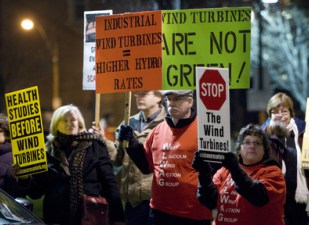
Hamilton, Ontario 29NOV10 _JLR1230.jpg Protesters against wind turbines and other causes carry signs outside Liuna Station Monday during the Liberal Trillium dinner. John Rennison, The Hamilton Spectator
Now that a second Auditor General’s Report has severely criticized Ontario’s electricity system, it is time to rethink a politically motivated energy policy. Action on climate change must not squander crucial time and resources on schemes that may be ineffective, economically unfeasible, or harm human health and the environment.
Why did the Government of Ontario choose to ignore the 2011 Auditor General’s Report that questioned the negligible ability of intermittent wind power to lower carbon emissions because natural gas-fuelled back up is required 24/7?
The Multi-municipal Wind Turbine Working Group, made up of councillors from jurisdictions where wind turbine development has been most intensive, is ideally positioned to observe first hand the effects of wind turbines on the local community. Adverse health effects are occurring to citizens exposed to wind turbines at approved setbacks. Noise and health complaints have been ignored by government officials. Restrictive Environmental Review Tribunal procedures under the Ontario Green Energy Act make residents’ participation meaningless. Biologists’ observations of degradation of significant habitat and loss of biodiversity near wind turbines have been disregarded.
Because of wind power’s difficulty in matching production with demand, a substantial amount of the emission-free electricity from hydro and nuclear plants is being dumped (in order to stabilize the grid) because the Government’s energy policy gives priority to nominally “green” wind energy. This results in throwing away a large portion of the “base load” electricity already paid for by consumers.
Our technical consultant, William Palmer, using IESO (Independent Electricity Supply Operator) data, found that in 2014 hydraulic generating stations (water power) were reduced by 3.2 TWh (Terra Watt Hours) due to surplus base load generation. Bruce Power nuclear units were reduced 588 times, each occurrence resulting in bypassing some 300 MW of electrical equivalent of high pressure steam directly to the turbine generator condensers [Read William Palmer’s report here] . These transient adjustments result in accelerated wear on the condensers.
At the same time, much of the excess wind energy has to be sold outside the province at below production cost. This drives down the market price for electricity and means that Ontario is often forced to dump surplus electricity to our neighbours in New York and Michigan at negative prices – paying them to take it, further penalizing Ontario consumers.
The Auditor General’s 2015 report discloses that
excess payments to generators over the market price have cost consumers $37 billion between 2006 and 2014
are projected to cost another $133 billion from 2015 to 2032
electricity consumers will eventually pay a total of $9.2 billion more for renewables under the Ministry’s guaranteed-price renewable program
we are paying double the U.S. average to generators of wind power
the electricity portion of hydro bills has risen by 70%.








 Mothers Against Wind Turbines Inc.