All posts by pbiljan

I do not like green blades with spans. I do not like them, mad I am


geah7


I do not like green blades with spans
I do not like them, mad I am

I do not like them on the roads
I do not like them in the rows

I do not like them standing tall
I do not like them, not at all

I do not like them killing birds
I do not like them killing bats

I do not like them causing harm
I do not like them on a farm

I do not like them — Do No Harm
I do not like them false green farms

I do not like the spinning blades, noise, flicker, insane rage
I do not like them on this page

I do not like these giant fans 
I do not like them on the lands

I do not like those men in ties
I do not like those telling lies

I do not like them on the ground 
I do not like them dead birds found

I do not like those concrete holes
Where toxic water then must flow

I do not like them in the sun
I do not like them in the rain

I do not like them in the snow
I do not like them, they must go!

I do not like them any day 
They harm us all in every way

I do not like them in the north
I do not like them in the south

I do not like them east or west
I do not like them, Can you guess?

I do not like green blades with spans
with giant sweeps upon our lands

In Germany Australia Netherlands Canada USA or UK
Take your fans and blow away!

I do not like green blades with spans
I do not like them, Mad I Am

Wind Turbine Syndrome, July 14 2014


What Wynne’s win means

“I’m still not sure how Ontario’s Liberal Premier Kathleen Wynne won a majority (Interview, July 7), but now we are subjected to four more years of monumental mismanagement.  Urban voters opted to “forget” about the costly scandals and investigations in our bankrupt, have- not  province and ask for more, especially when the most costly and deceitful scandal still flourishes: the Green Energy and Green Economy Act, dominated by the wind-turbine debacle, which has hog-tied rural municipalities and residents alike.  Wynne speaks about her progressive vision for Ontario, but those living outside her golden zone know it doesn’t include them as fundamental health and environmental protections and precautions have vaporized.

 Barbara Ashbee, Mulmur, Ont.”

 Published under Letters section page 6 Macleans July 7 2014

Raise Your hand if you are a “supporter of wind”. This letter is for you.

Windfarm risks acceptable?

To the named supporters of the windfarm,

guilty_raised_handI would ask, since we know that the mining of rare earth minerals in China is poisoning the land, lakes and people, how can they equate this with nice green energy? These rare minerals are components modern turbines depend upon.

Supporters must believe this wretched toxicity is acceptable.

These named supporters are aware that children in the windfarm areas will be exposed to infrasound. So after their bedtime story these little children can cuddle their pillows and receive maximum auditory stimulation. The pillow will block audible sound but not infrasound.

Supporters have found this to be acceptable.

The named supporters obviously have no concerns for the physical and psychological ill health that the windfarm occupants will be subjected to when the turbines become operational. Clearly the supporters have a better understanding of the detrimental health effects than Dr Sarah Taylor whose report supports the evidence that individuals living on windfarms will be affected.

The windfarm supporters find this acceptable.

I will not insult the windfarm supporters intelligence by suggesting that they were perhaps unaware of the above. Thankfully there are still many decent people who do not find these facts at all acceptable.

I have only touched on some of the reasons why I will never support this development.

Surprisingly no one in the above supporters group will have to live in the windfarm.

Evelyn Morrison
Setter,
Weisdale.

source : 13/07/2014, by Shetland Times, in Readers’ Views

Wind turbines face Charter suit: Ontario Farmer

Three citizen groups have been allowed to appeal wind farm projects in court

France Anderson, Ontario Farmer, July 2014

Three West Coast citizens’ wind groups have gotten leave to jointly appeal wind turbine projects under the Charter of Rights and Freedoms.

The three Ontario groups—SWEAR (Safe Wind Energy for All Residents), HEAT (Huron East Against Turbines), and HALT (Huron-Kinloss Against Lakeside Turbines)—which oppose wind farms near Goderich, St. Columban and Kincardine respectively, will be able to jointly appeal the projects by the Ontario Ministry of the Environment.*

They will be represented by Falconers LLP, and the appeal to the Divisional Court of Ontario is to be heard November 17, 18 and 19, 2014.

charteThe Canadian Charter of Rights and Freedoms is the government’s promise to every man, woman and child in Canada that they will have security to conduct their affairs and lives in relative peace.


Falconers, which specializes in human rights and constitutional law firm [sic], is arguing that the provincial government did not exercise due diligence with regard to human health when it crafted the Green Energy and Economy Act.

“The government says that massive industrial wind turbine developments are safe. We, the people, are holding them accountable,” explains Dave Hemingway, the president of SWEAR.

“If this Charter challenge is successful, it will set a precedent and will assist all appeals and legal challenges going forward,” says Gerry Ryan, the president of HEAT.

“This action has the potential to shift the burden of proof from the need to prove direct and serious harm to human health to the need to prove the possibility of harm,” which is “a lower and more reasonable threshold,” says Kevin McKee, the president of HALT.

Falconers is also seeking a conjoined stay of proceedings to halt progress of K2, St. Columban and Armow projects until the appeal is heard.

Hemingway said they hope to know the date for the hearing regarding the stay “relatively soon.”

Meanwhile, the commissioning of the Varna Wind LP Farm by NextEra Energy Canada** is underway. This project comprises 37 GE model turbines that stand 80 meters high and support blades 50.5 meters across. The project on private lands was of Highway 21 along the Lake Huron Shoreline, in the Municipalities of Bluewater and Huron East, has 60 MW total capacity.

unnamed (14)*Editor’s note: Of course, the projects are approved by the Ministry of the Environment. The developers, however, for the projects are: Capital Power/Samsung/Pattern; Veresen; and Samsung/Pattern, respectively.
**NextEra Canada is not a Canadian company; neither is Samsung, Pattern, and Veresen.

For more information on the Charter challenge and to donate funds, please go to SWEAR’s website.

It even is against your own policy. Or it is a great lie.

Below are your statements copied from your company website: BORALEX / Under Sustainable Developement

“To grow while respecting our communities and the environment.Wind Power: The Ultimate in Clean Energy.. almost complete absence of environmental, visual and noise impacts makes wind power a source of green energy that is respectful of the environment and communities. Boralex operates and is building wind farms in France and Canada. For each of its sites, Boralex places great importance on working with the communities involved.” How can you justify these claims regarding your project in Port Ryerse!? ptryerse button dec 08There are over 400 “receptors” in this project, mostly opposed, who since the inception of this project have been fighting it, declaring themselves an unwilling host. This is a beautiful, recognized historic village in one of Ontarios most picturesque heritage landscapes, rich in diversity, ptryerseroadwebrecreational opportunities and with great pride of ownership, reflecting itself in the many beautiful properties, most within the unacceptable 550 m to 850 m range of the project. For most of these residents, the last couple of years have been a wrenching struggle to fight for their beloved homes against the multiple assaults and destruction this project would bring. ptryersechannelwebWe are aware you are proceeding on the “invitation” by this government’s heavy-handed policy, which denies the affected citizens any say in the matter and their democratic rights, and the hosting owners, who obviously do not care for their neighbours. Do you really want to be part of this injustice? This is a small project for you and surely not worth the great hardship and ill will it would bring to this beautiful hamlet. Has anybody of your company even been around here to have a look at it outside the 550 m setback!? Would anybody of your company want to buy a home here now!? ptryersebeach1webWe are not per se against green windpower (I drive a Prius), but please let us not destroy our finest landscapes and places of living with their industrial monstrosity. I urge you to abandon this project. It even is against your own policy. Or it is a great lie. Margrit Kapler Port Ryerse Toronto

Kingston Independence turbine exceeds state’s noise threshold during study

The Kingston Independence wind turbine violated the state’s noise policy two of the nights sound samples were taken as part of an acoustical monitoring study, according to an interim report.

Page 2 of 2 – According to Fine’s letter, “MassDEP’s determination of exceedences is based on a comparison of the L90 background sound including the sound of traffic from Route 3 compared to the LMax sound levels excluding any source of interference sound (traffic).”
The consulting firm Harris, Miller, Miller, and Hanson Inc. (HMMH) performed the study for the Massachusetts Clean Energy Center and DEP.

Doreen and Sean Reilly live close to the Independence turbine, and their property was a sampling site. They are not only interested in the results released to date. They are interested in seeing the full report.
Sean Reilly said they don’t understand how the turbine can be out of compliance 100 feet away on Schofield Road and not at their property.

With the turbine out of compliance, they are calling for the town and the state to do something to fix it and help their and other families.
“The Independence wind turbine was permitted and constructed with no flicker study and inadequate sound studies,” Doreen Reilly said. “It is becoming clear that this was a mistake from the beginning that the town of Kingston and the state of Massachusetts is allowing to continue to diminish the quality of our lives at our home and on our property.”

Fine said the final report will be released to the public once it has been received by DEP and undergone quality assurance and review in the coming weeks. He said the interim report was released because there were times when the regulation was exceeded. He said HMMH and Mass CEC have assured the state that the regulation was not exceeded during the other sampling dates.

According to the Fine letter, DEP does not plan to request additional sound sampling. The interim report was based on monitoring events October through April before the study was suspended.

“As you know, the full study has taken longer to complete than anticipated due to persistent weather challenges, turbine operational issues and problems with background noise contamination,” Fine wrote. “Now that the winter sampling season has ended, the time identified in the scope as appropriate for monitoring worst case scenario sound impacts has also ended.”

To view the interim report, go to  https://mothersagainstturbines.com/wp-content/uploads/2014/07/kwicvletinterimreport0714.pdf

Kathryn Gallerani, Kingston Reporter

Ontario’s Power Trip: Bring in ‘da Noise, Bring in ‘da Facts

Wind power generates noise at levels that Ontario says must meet enforceable standards—but it has no enforceable standards. The long shabby story of wind noise from the province’s wind energy regime: Misguided Direction or Failure to Communicate?

The issue of noise from Ontario’s wind farms deserves a full public review. Instead, people are getting a run around from bureaucrats and politicians. Standards don’t exist, yet approvals are being issued without regard to consequences or the impact on people of noise levels.

Donna Cansfield, in November 2005, as Ontario Minister of Energy issued a “Direction” to the Ontario Power Authority instructing it to enter into contracts for up to 1000 MW of new electricity supply from renewable energy. Most were wind turbines. The health and other effects of wind turbines wasn’t actively studied before the contracts were signed. Noise, building codes, environmental standards etc. existed and were adapted tofit. No real review was undertaken.

To cite an example, the Amaranth wind contract used Stantec Consulting Ltd. of Guelph, Ontario to complete an Environmental Screening Report in February. They used Helimax Energie Inc. for the “noise” sector portion of that report. Three and a half years later Helimax presented a paper at the June 2008, World Wind Energy Conference which stated: “no recognized standard exists for measuring the noise impact of an operational wind farm.”

So the “noise” information used for Amaranth in the Environmental Screening Report in 2005 to secure the licence from the Environment Ministry was done without a “recognized standard”.

A leaked paper from the Guelph district office of the Ontario Ministry of the Environment stated the local authority “knowingly issued a series of Certificates of Approval (AIR) that are unenforceable.”

Sound measurement reports from the Ministry of the Environment exceeded the approved 40 decibel limit by almost 30%. The Ministry notes that allowances are related to wind speed and will allow 51 decibels based on higher wind speeds. This is almost 30% greater than those “experienced in a quiet office”. Research indicates a “clearly notable change” occurs with only a 5dB change and a 10dB increase is roughly equivalent to being a doubling in the perceived sound level as noise is measured on a logarithmic scale similar to earthquakes.

Noise produced by wind turbines is defined as “tonal” (eg: sirens, saws, etc.) and intrusive. Normally a 5dB penalty is applied for tonal noise, including that emanating from wind turbines. It is not clear that this penalty is applied by the Ontario regulators.

Dr. Arlene King, Ontario’s Chief Medical Health Officer, has accepted the findings of others in the May 2010 review endorsing setbacks established by the Ontario Ministry of the Environment so that noise levels that do not exceed 40 decibels at the nearest residence. However, health complaints by residents are generally ignored and end up tangled in provincial bureaucracy. A recent story indicates the MOE received 750 complaints in two years.

Most complaints about how people have suffered wind turbine related health effects remain unresolved, but over 25 families (five in Amaranth alone) have publicly disclosed their problems. Families have abandoned their homes and others have had their homes purchased by the developers and signed “gag” orders. Despite all of this, the various Ministries have not altered or changed their outright denial that there are any health effects.

We don’t really know what the health and quality of life issues are related to wind farms, but the evidence so far seems at odds with the basic premise that politicians are elected to execute the “will of the people.” We clearly need a full open factual review of the wind/noise issue. We have the noise, what we don’t is sold review of the facts on the impact on citizens who have to live with it.

to read a more complete version of my comments and report on this subject. click here

Financial Post, Parker Gallant, July 8 2011


WHY IS WIND TURBINE NOISE POORLY MASKED BY ROAD TRAFFIC NOISE?

Eja Pedersen
Frits van den Berg

Halmstad University and University of Gothenburg
{eja.pedersen@hh.se}  2GGD Amsterdam
{fvdberg@ggd.amsterdam.nl}

TurbineNoiseandTrafficNoise (1) Capture

Abstract

The possibility of road traffic noise masking noise from wind turbines was explored among  residents living close to wind turbines in the Netherlands (n = 725) with different levels of  road traffic noise present. No general masking effect was found, except when levels of wind  turbine sound were moderate (35 – 40 dB(A) Lden) and road traffic sound level exceeded  that level with at least 20 dB(A). This low masking capacity may be due to the different time  patterns of these noise sources, both on a small time scale (car passages/regular blade passing) and a larger time scale (diurnal and weekly patterns). Also, wind turbine sound is relatively easy audible and may be heard upwind more often than road traffic.

Introduction

Suitable sites for wind turbines can be difficult to find due to conflicting requirements.  Placing wind farms close to the electric grid and existing roads (both are usually better  available in populated areas) is favourable for investment costs, but it may increase the
possibility that neighbours may be visually and aurally disturbed. It is therefore not uncommon that wind turbines are planned to be erected at distances from dwellings that are unacceptable by the local residents.

The individual appraisal of wind turbines planned close to one’s home is not irrational but based on considerations such as the evaluation of the wind turbines’ impact (scenic and otherwise) and feelings of equity and fairness [1]. The apprehension that for example the noise will be disturbing in an otherwise comparable quiet area has been confirmed by research: wind turbine noise may be louder and is apparently more annoying than was assumed before the growth in wind turbine numbers and power in the ‘90s [2, 3]. The recommended noise limits (different in different countries), and consequently a minimum distance depending on the number of wind turbines and their sound power levels, should therefore be kept or should even be more rigorous if the original level of noise protection is to
be maintained.

Follow to Read more of the  report:  https://mothersagainstturbines.com/wp-content/uploads/2014/07/turbinenoiseandtrafficnoise-1.pdf

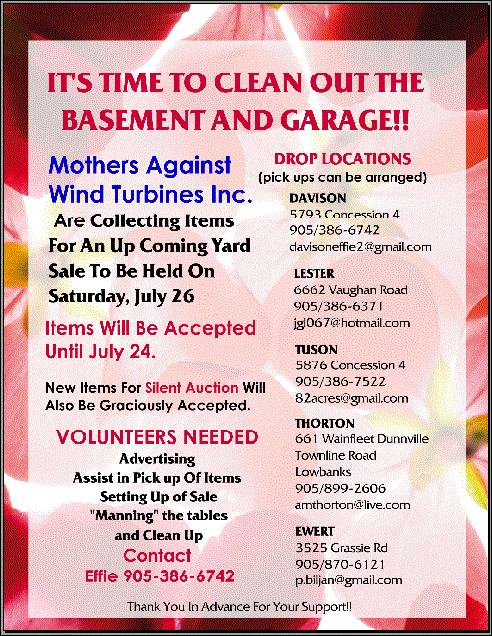
You Won’t Want To Miss the “MOTHER” of ALL Yard Sales This Summer!!

MAWT Inc.  would like to extend an invitation to West Lincoln and Surrounding Communities to join us for a day of Fun and Comradery.

PLEASE SHARE This Post With  ALL Family, Friends & Neighbours.  

We NEED “STUFF”, so PLEASE help by Collecting Items from your Garage, Basement, Yard,  Closets, Cupboards, Kids Rooms etc. that are no longer needed or used.  

You Can Choose a Drop Location Nearest You or Arrange for Pick UP of Items.   

Items for Silent Auction Also Welcome.

Volunteers Needed!

Proceeds from the sale will be used in our continued fight to keep Wind Turbines out of our Communities. 

mother of all yard salesCapture


“There is a pressure pulsation emitted into the community once every second”

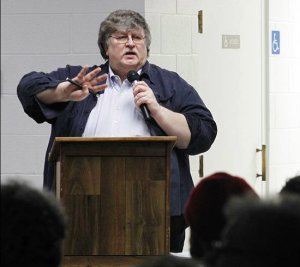
Editor’s note:  Rick James is, without doubt, one of North America’s premier experts on wind turbine noise.  Unlike the great majority of noise engineers who have sold their souls and ethics to the wind energy industry, Mr. James can’t be “bought.”  Together with Rob Rand and Steve AmbroseRick has exposed the deceit and mendacity of wind company acoustic consultants — as in their fraudulent use of A-weighted noise measurements, for instance.

We all owe these three gentlemen a huge debt of gratitude.

thump2

— Richard James, Noise Engineer (7/8/14).  Click for PDF, with all graphs included.

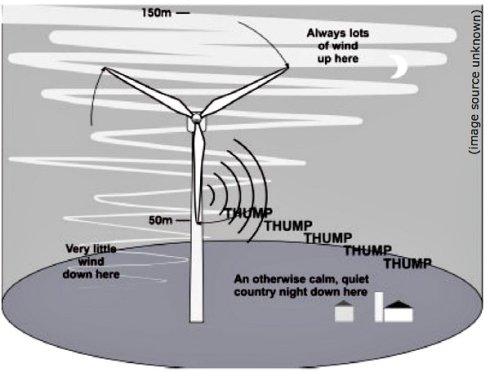
As the blade passes the tower, the low frequency noise and infrasound is generated at a frequency related to the hub’s rotation and number of blades. These pressure pulsations appear as tones during analysis, but are not heard as tones by most people. Instead, they may feel the pressure changes as pulsations, internal organ vibrations, or as a pain (like ear aches or migraines).

This frequency is called the Blade Pass Frequency, often abbreviated as BPF.

For modern utility-scale wind turbines, this frequency is at 1Hz or lower.  A three-bladed wind turbine with a hub rotation of 20 revolutions per minute (rpm) has a BPF of 1Hz. This means there is a pressure pulsation emitted into the community once every second.  At 15 rpm the BPF is 0.75 Hz; and at 10 rpm, 0.5 Hz.

rick-jamesWhen wind turbine blades rotate past the tower, a short pressure pulse occurs, producing a burst of infrasound.  When analyzed, the result is a well-defined array of tonal harmonics below 10 Hz.
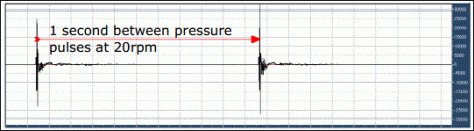
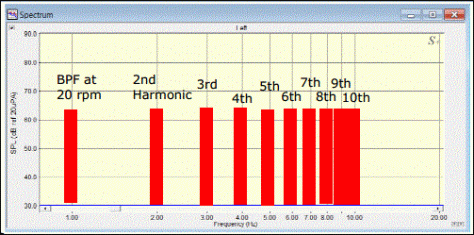
For impulsive sound of this type, the harmonics are all “phase-correlated.” This means the peaks of each occur at the same time. Thus, the peaks add together in a linear fashion, with their individual maximum sound pressures all coinciding.

Thus, for an impulse having 4 equal amplitude harmonics (BPF, 2nd, 3rd and 4th) each of the same amplitude, the peak level is +12 dB.  Ten equal harmonics would produce a peak level of +20 dB.

Wind Turbine Syndrome, July 8 2014

Capture

Capture