All posts by pbiljan

A Short Essay on Misguided Environmentalism, Bullies and Losing One’s Home

June 9, 2015  by Barb Ashbee

You were able to move. Now you have to forgive and carry on. Move on with your life and find the path back to happiness you enjoyed before it all happened.

This is what my mind tells my heart. That is what some of my friends are thinking, I can feel it. A gentle sort of ‘get over it’. And some days I feel like that is what I need to do.

But the heart still feels the pain. The heart feels the injustice for an event that wasn’t an accident, or being in the wrong place at the wrong time, or brought on by our own actions, or a natural disaster or single tragedy that all our families suffer throughout our lives. No, this tragedy has been intense, life changing; trust destroying, personality maiming and spirit crushing because it simply did not have to happen.

Why am I still angry?

I am angry that our perfectly healthy bodies were pummeled into illness by infrasound and relentless noise. That we were no longer allowed the right to get sleep in our home. That with thumping noise on too many nights over 60 decibels at times and a house that vibrated almost every day we were unable to thrive. Headaches, heart palpitations, chest pressure, sleep deprivation, and eventually hyper- thyroidism, nosebleeds requiring treatment, anxiety in pets with some crying and vomiting at the same time we felt the worst effects. I am angry that our government leaders knew all this from our very first letter asking for help and they lied to us, let us continue on for months and months until we just couldn’t take it anymore and hired a lawyer with money we really didn’t have to spare. And I am really angry that our awful experience was not enough, piled on top of all of the others we found out about, not enough to make it stop.

Instead new projects forged ahead and more families are sick.

And what of the non- physical impacts?

My husband fretted because there was one last piece of board that needed to go on to finish the inside of the dream shop he had just built and he didn’t have the energy or desire to do it. The perfect shop to house his classic car, with the fully insulated walls, painted floor and housing his collection of car memorabilia was barely used when he had to give it up.

He stressed over our future.

We lived in uncertainty, wondering how we were going to be able to stay there yet knowing we could never sell and if we did we could never pass this on to some innocent family. I thank the stars that we had even bought the house so that the previous family who had 6 children didn’t have this set upon them. What would they have done?

While most friends and family are sympathetic others ask why we are complaining so much when obviously, according to government research, there are no ties between the turbines and what has happened to us. How do we explain these erroneous and deceitful government statements on a complicated issue in a sentence or two without sounding nuts?

I want people to be angry; I want them to write letters to our leaders asking how they can treat people so bad but would I do that if I were on the periphery? I’m not so sure. In fact, when I first heard about the earliest families in phase one having problems, I felt sure they would be resolved. After all, is that not the role of government? To put the citizens foremost, to protect our health and home and look after people in harm? That’s what I thought.

People not connected to this issue are not sure. It’s hard to explain the impacts when you don’t have anything more to show but exhausted faces that can be caused by anything. The rest is hidden. The headaches are hidden, the sleep deprivation is debilitating but you can’t see it. The heart palpitations, head and chest pressure, incredible frustration trying to sleep in a vibrating home is hidden.

What do you do when you do get up the courage to speak with your doctor about it and they stare stone faced with no comment, so unworthy are you that they don’t even bother to note the symptoms in your records. Or when they do finally speak they offer a condescending comment that leaves you in tears? Nobody sees that either.

I could go on and on about the injustice and the long term effects but until this government takes a stand to stop this industry and turns their help to those suffering instead of funding the perpetrators then I am severely overpowered. If only people knew the real story.

There are

those who are involved in perpetrating and covering up the harm;

those who know and are fighting with every breath, some loudly, some quietly;

those who know but don’t know what to do;

those who know but don’t care;

and thanks to an impressive 5 star cover-up,

those who don’t know and will never know.

Unfortunately for all, the last two hold the majority of the population.


And so it continues….

Niagara Wind Project Ownership changes blowing in the wind.

Boralex acquires an option for a 25% interest in a wind power project in Ontario

unnamedMONTRÉAL, June 8, 2015 /PRNewswire/ – Boralex Inc. (“Boralex” or the “Corporation”) (TSX: BLX) announced the signature of a conditional buy/sell option for a 25% economic interest in the 230 MW Niagara Region Wind Farm project in which Enercon is the majority owner (the “Option”). The total investment planned for this major undertaking is between $900 million and $950 million and Boralex will immediately begin coordination of the project construction phase in partnership with Enercon.

Extending across the Regional Municipality of Niagara, the Township of West Lincoln, the Town of Wainfleet and Haldimand County inOntario, the Niagara Region Wind Farm project will comprise 77 3 MW Enercon turbines and construction will begin in June.

Boralex will have the obligation to exercise the Option if certain financial conditions are met at the time of signature of a project financing agreement. If unexercised at that time, Boralex will be entitled to exercise the Option at its discretion following commercial commissioning of the project. The Corporation expects that $60 million in equity will be needed to exercise the Option. Boralex will be the project operator following exercise of the Option. The initial consideration paid by Boralex in connection with the acquisition of this Option will be approximately $5 million, which will primarily consist of a deposit payable to Enercon.

More Turbines Threaten Haldimand Horizons

download (1)Haldimand county states it is an unwilling host but like a bad and unwanted smell even more wind projects keep blowing back in.  The current project- Townsend Wind, failed as a co -operative venture but is back as a new proposal and seeking endorsement.  The public “we tell you” meeting is scheduled for June 23, 2015 7-9 pm at the Jarvis Lions Club, 118 James St, in Jarvis.

Haldimand County states it is a non-willing host but has 205 industrial wind turbines and counting located within its boundaries.

“NOW THEREFORE be it resolved that Haldimand County Council will not be providing local municipal support to any application that will construct industrial wind turbines in Haldimand County.”

Haldimand- February 14, 2013

Time will tell if the tidal wave of invasive turbines has ebbed.

Townsend Wind Farm:

http://www.swebdevelopment.ca/

Are wind farms really noisy? What does a wind farm sound like?

The Listening Room Experience

What is the Listening Room Experience?

Are wind farms really noisy?  What does a wind farm sound like?

The primary aim of the exercise is to broaden understanding of wind farm noise. Whilst the issues surrounding wind farm noise are greatly discussed and debated, it has been experienced by relatively few in the profession or by those responsible for influencing the decision of whether nearby residents will experience this noise and if so to what extent.

The listening room experience aims to replicate listening to wind farm noise, particularly AM (Amplitude Modulation), in a home situation. Clips of wind farm noise are taken from MAS Environmental’s own measurements in the field and within dwellings where complaints of wind farm noise have been made.

MAS feel that there is a specific need to hear and experience wind farm noise and amplitude modulation not necessarily because of the decibel level of the noise, but largely due to the character of the noise – the changing frequency content and its context within what is usually a very quiet rural environment.

read more: http://www.masenv.co.uk/listening_room#item159

‘We are not activists’

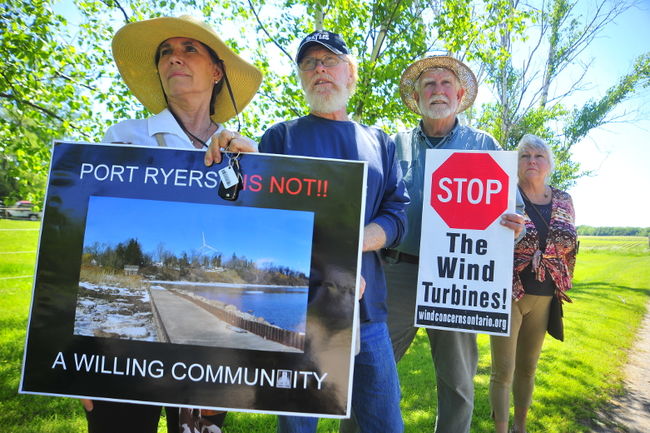
PORT RYERSE – Port Ryerse residents fighting against wind turbines slated to go up beside their village are protesting because of the certainty the project will harm them, an environmental tribunal hearing heard.


Port Ryerse residents protested as members of an environmental tribunal hearing into the case of wind turbines proposed for a field next to their village visited the site on Wednesday, June 3, 2015. From left to right are: Mary Goodlet, Bill Irvin, Stew Smith, and Shana Greatrix. (DANIEL R. PEARCE Simcoe Reformer)

Sleeplessness, sickness, loss of birds, and falling real estate values have hit every community that has ever hosted turbines, Port Ryerse resident Heather Walters testified.

“These are not guesses,” she said. “It is 100% predictable.”

Walters said she is not normally an outspoken advocate for causes and only took up the case against wind power once she heard about the project and started researching it.

“We are not activists,” she said. “I’ve never been involved in anything like this.”

Wednesday’s hearing was held in the council chambers at town hall in Simcoe in front of lawyers representing residents and the project.

The two-person panel hearing the case has the right to put a halt to the project. Last fall, construction was pushed back after a barn owl, an endangered species, was spotted next to the site.

The hearing also heard from Cayuga resident Grant Church, who cited a number of international studies that suggested wind turbines cause illnesses in people, even well beyond the 550 metre setback the Ontario government has set.

A tool and die maker by trade, Church said there are numerous examples of people being made sick by infrasound created by turbines, sometimes from as far away as 2.2 kilometres.

read more: Daniel R. Pearce, Simcoe Reformer Wednesday, June 3, 2015

Port Ryerse – A Funny thing happened on the way to the ERT

Credit:  photos courtesy of Larry Monczka

Port Ryerse, Ontario

Boralex Wind Project http://www.boralex.com/projects/portryerse

 A Funny thing happen this morning at the Environmental Tribunal Hearing. Biddle v. Ontario, 14-063 (Environmental Appeal)

It was another town and was supposed to be just another hearing against a wind  turbine project in southern Ontario.  The day was cool and the sun shone bright. The sky was clear blue and shimmered as the first blush of summer touched the landscape.  Port Ryerse  is a beautiful small village located on the shores of Lake Erie.  The peace and tranquility of  village life is threatened by a wind project that would see industrial wind turbines installed and not all of the people are welcoming the development.  It is land use that they have no planning veto over.   There are to be two appeals filed against the project.  The health and environmental hearings are planned to be held at separated  times and today’s hearing was the in person start to the health section of the legal wrangling.

Wednesday June 3, 2015 the task for the morning was a site visit.  All were to meet in the municipal Council Chambers of Norfolk in the town of Simcoe and start the  frantic speed style administrative steps, filings, counter motions and move on to what is now a predetermined outcome.   Wind takes and those who oppose lose.  This particular project has hit some speed bumps on its way as this is the wind project that has been halted by the presence of  a pair of rare nesting barn owls. The Ontario Ministry of Natural Resources and Forestry is now  scrambling to come up with a way  to be consistent and not to say no to this  particular renewable energy development.  It needs to create a new exemption that does not favour habitat or individuals from a species at risk.  Inconvenient for a wind developer and MNRF as that those darn those barn owls do exist and these birds are a nesting pair of less than 20 known adult individuals in the wild in Ontario.  The exemption  permit is necessary in order to side step species at risk legislation and to allow the wind project to proceed unimpeded.  Renewable energy is Ontario’s unflinching policy of the day.   That said on this day things didn’t go as it was supposed to.  On that day a funny thing happened at the Tribunal.  The citizens  didn’t play their expected roles.  That day as the hearing got under way it was a thumb down to Ontario and was about the residents taking back control of a process that guarantees they lose.   It was a small thing but it was the whisper of the people who have been shouting to be heard.

Early in the schedule of the day things went as expected as the Tribunal panel  members arrived and  lawyers began to gather for and against the project. After settling in, papers shuffled, microphones checked and the court reporter plugged in and  all was ready to proceed it was  becoming apparent something expected was missing.    Where were the people?

Not a single member of the public was present. Not a single witness present to hear the matters of the Tribunal.  Not a single member of the residents who had filed the appeal.  No one, not one person.  Lawyers, Tribunal panel members were confused and perplexed, even the appellant lawyer did not have knowledge or an explanation.  Despite the lack of an apparent audience things needed to get under way and a lack of members of the public must not slow down the process and the site visit was to occur.  Everyone headed out to the project site to meet up as prearranged for the tour.  This is the place where the barn owls live and the known nest of the local Bald Eagles is near. The Eagles had successfully fledged their eaglets in the previous season.

Unknown to all of the  lawyers  the people of Port Ryerse had other plans and had met each other on the shoulders of the dead end road that leads to where the turbines are supposed to be built.   Visiting and bird watching on such a beautiful day.  The people chose to speak by not sitting in a dry,  bland judicial process and used action as a protest to signal a way to bear witness to the invasion of their homes and community by unwanted industrial structures powered by the wind.  Today the voice of the people spoke well.

This slideshow requires JavaScript.


Deliberate Harm to the Health of Rural Australians, via the RET, Enabled by the CER, via Parliament

OPEN LETTER

Dear Parliamentarian,

Tomorrow, the Bill to change the Renewable Energy Target (RET) will be debated in the Federal Parliament.

Consequences

If you vote for the Bill as currently proposed by Minister Hunt, you will be allowing continuation and expansion of serious harm to the health of Australian rural residents, from unmeasured and unregulated infrasound and low frequency noise (ILFN) from large industrial wind turbines.  This health harm includes turbine hosts, and results from ILFN from 600kW and larger turbines, extending out to at least 10km1

The two inevitable long-term consequences of the failure to measure and regulate ILFN are health damage to many more families, including children, with a risk of permanent health damage and lifelong sensitization to ILFN, regardless of the ILFN source which will restrict where some can work, live and sleep; and the creation of acoustically toxic homes that are valueless and uninhabitable, leading to the creation of rural ghettos.

Wind turbine noise is not the only source of industrial ILFN urgently requiring safer regulation – but the subject matter of this particular Bill will not result in harm to human health from industrial noise and vibration from coal and gas fired power stations, coal mines or CSG field compressors2.  These sources also cause similar serious harm to physical and mental health, well known to the Federal Department of Resources & Energy3. Continue reading Deliberate Harm to the Health of Rural Australians, via the RET, Enabled by the CER, via Parliament

Turbines or turtles: Hudak to natural resources minister

MPP says province should protect endangered species

Hamilton, june 25, 2009 -- The Blanding's turtle, (like this captive turtle named Bea,) that live in Burlington's Royal Botanical Gardens should benifit from  Minister of Natural Resources  announcement of $700,000 in grant money for species at risk stewardship projects. The RBG will use it's $60,000 in grant money to gather population data and restore six species including the Blanding's, (pictured) Northern Map and Eastern Spiny Softshell turtles. Glenn Lowson photo for The Toronto Star
Hamilton, june 25, 2009 — The Blanding’s turtle, (like this captive turtle named Bea,) that live in Burlington’s Royal Botanical Gardens should benifit from Minister of Natural Resources announcement of $700,000 in grant money for species at risk stewardship projects. The RBG will use it’s $60,000 in grant money to gather population data and restore six species including the Blanding’s, (pictured) Northern Map and Eastern Spiny Softshell turtles. Glenn Lowson photo for The Toronto Star

QUEEN’S PARK — Tim Hudak says the minister of natural resources must decide which is more important to Ontario: industrial wind turbines or endangered turtles.

Hudak called on MNR Minister Bill Mauro last week in legislature “to do the right thing” and protect Blanding’s turtles whose habitat is threatened by the onslaught of industrial wind turbines. The Blanding’s turtle is listed as a threatened species under the Endangered Species Act.

The most significant threat to this reptile are loss or fragmenting of habitat, motor vehicles, racoons and foxes. Another threat is poaching for the black market.

Hudak said a provincially-approved wind development in his riding puts the turtle at greater risk.

The 40 trucks loads of cement and 540 metres of steel required for each of the 77 wind turbines Niagara Region Wind Corp. has been approved to build puts the Blanding’s turtle in jeopardy. Twenty of the project’s turbines are slated to be built in known Blanding’s habitats.

Grimsby Lincoln News By Amanda Moore May 31 2015

HIGHEST COURT IN ONTARIO DECLINES TO HEAR WIND APPEAL

For Immediate Release 

unnamed (4)HIGHEST COURT IN ONTARIO DECLINES TO HEAR WIND APPEAL

FARM FAMILIES DISAPPOINTED

May 29, 2015

On May 28, 2015, the Court of Appeal for Ontario denied leave to appeal to the Drennans, Dixons, Ryans, and the Kroeplins, in respect of their Charter Challenge to the current legislation for the approval of wind turbine projects.

These farm families had been seeking the opportunity to argue that the Environmental Protection Act provisions approving renewable energy projects exposes them to a reasonable prospect of serious harm to their health and therefore does not comply with the Canadian Charter of Rights and Freedoms.

The Health Canada Study Summary Results released on November 6, 2014, showed an association between wind turbine noise and annoyance, and an association between wind turbine noise annoyance and sleep disturbances, migraines, tinnitus, dizziness, and measured blood pressure and hair cortisol.

Shawn Drennan commented on the Court of Appeal’s decision: “We are disappointed with the Court’s decision not to hear our case. No one has been able to tell us that the turbines are safe.  We are being told that we have to wait to be harmed before we can do anything to stop them. The Court has given us two choices: leave the land my family has farmed for three generations, or be a guinea pig for the government and the wind companies.”

Lawyer for the farm families, Julian N. Falconer commented: “This decision will leave people like my clients, who face massive wind development projects across this Province, in an impossible position. The Health Canada Study has already shown an association between the turbines and serious health effects. My clients and other families in rural Ontario will now have to suffer these adverse health effects before they can seek any relief from our court system. It won’t surprise anyone that my clients are frustrated with a process that seems to be stacked against them.”

While this decision may restrict these farm families from pursuing Charter remedies for these harms, they are committed to exploring the other legal options available to them and to holding both the government and the wind turbine companies accountable for the failure to protect their health.

Concerned citizen groups throughout the Province remain committed to seeking justice for those in rural communities affected by industrial wind projects.

For further information, please contact Odi Dashsambuu of Falconers LLP at

416-964-0495, extension 248

Suncor Energy recently filed a court application to quash Plympton-Wyoming’s legislation

PLYMPTON-WYOMING – A legal challenge from Suncor Energy has prompted town council to back away from a noise bylaw the municipality enacted last year to limit local wind farm development.

Construction of Suncor and NextEra's 46-turbine Cedar Point wind energy project is underway in Lambton County. A crew works on a turbine foundation next to Hillsboro Road in Plympton-Wyoming on Thursday May 28, 2015 near Sarnia, Ont. (Paul Morden/Sarnia Observer/Postmedia Network)
Construction of Suncor and NextEra’s 46-turbine Cedar Point wind energy project is underway in Lambton County. A crew works on a turbine foundation next to Hillsboro Road in Plympton-Wyoming on Thursday May 28, 2015 near Sarnia, Ont. (Paul Morden/Sarnia Observer/Postmedia Network)

Suncor, a developer behind the 46-turbine Cedar Point wind project under construction in Lambton Shores, Plympton-Wyoming and Warwick Township, recently filed a court application to quash Plympton-Wyoming’s bylaw, said town clerk Brianna Coughlin.

The municipal legislation sought, among other things, to limit wind turbine-produced noise lower than 20 hertz — infrasound: the normal limit of human hearing. Wind turbine opponents argue exposure can negatively impact people’s health.

Complying with the bylaw would have made it impossible to operate the 100-MW wind farm, expected to be operational by late 2015, Suncor spokesperson Jason Vaillant said Thursday.

“We are committed to complying with and operating within the limits that are set out for us by the province,” he said, noting noise limits for wind farms are provincial territory. “And we felt that the municipality just didn’t have jurisdiction on this particular matter.”

Based on legal advice that the town’s bylaw would likely not survive a court challenge, council decided Wednesday to repeal it, Coughlin said.

Suncor, Vaillant said, is pleased with the decision and will withdraw its legal challenge.

“Certainly the relationship with the community is important to us,” he said. “We know that this project will be part of the community for 20 years or more, so we want to ensure that we develop and operate the project in a way that addresses the needs and concerns of Plympton-Wyoming.”

read more: By Tyler Kula, Sarnia Observer Thursday, May 28, 2015