All posts by mum4kids

Who Owns the Wind?

dscn1776

You can’t eat money.

Credit:  Emmetsburg News | September 20, 2016 & September 22, 2016 | www.emmetsburgnews.com | emmetsburgnews.com

“So, how much dough will I make on this wind farm deal?” That question remains utmost in the minds of farmers interested in squeezing every drop of income from their operation. As a native Iowa farm boy, I understand “the bottom line is the bottom line.”

Drought, hail storms, and low commodity prices sometimes made profit margins tight on our 160 acres. But growing up on that farm also taught me priceless values that sustained our family farming operation through thick and thin. A strong work ethic, resilient attitude, spirit of fair play, watching out for your neighbor, caring for the wildlife that shares our land, and being a good steward of the soil shaped this rural legacy of values passed on to me from my ancestors to whom I am forever indebted. Wind farms threaten this legacy.

At first glance, it seems like a good deal. A “windfall” of cash. “Free money” for the taking. A winning night at Vegas! After all, the wind is “free” isn’t it? Well not exactly. I recall wise farmers in our community who lived by the credo, “Free money never comes without strings attached.” And those “strings” are front and center of the wind farm debate, driving to the more important question, “Who owns the wind?”

Winning over the farmers

Wind farm corporations know this and work hard to incentivize farmers with promises of “free money,” avoiding the “Who owns the wind” question until it’s time to sign the contract. In the words of a fellow Iowan and respected writer, “They act as though eminent domain extends to the sky.” They control the script. They control the outcome. They control the strings. That’s why the “promise” of free money dominates the debate, overshadowing other urgent concerns. Who owns the soundscape we all listen to? Who owns the horizon we peer into day and night? Who owns the wildlife that depend on unobstructed flyways and migratory routes of our beautiful Iowa skies?

Wind farm planners minimize these concerns, seeking to control the debate with promises of quick and easy money-another source of “low-hanging” tax revenue for the county and a way of reducing our dependence on foreign oil. What happens when this “free money” wins out over responsible stewardship of wind, land and wildlife?

Delivering on the promise

Unfortunately, wind power can’t deliver on its promises. Carbon footprints remain unchanged because wind power is too unreliable to permanently replace existing power generating sources. Denmark is the latest nation to scrap plans for building more wind farms. The Danish government says wind power has become too expensive. (Matzen, Erik and Boyle, Jon; “Danish Government Says Wind Power Became Too Expensive.” Reuters Daily Mail Wires 13 May 2016 at dailymail.co.uk/wires/reuters /article-3589130/Danish-government-says-wind-power-too-expensive.html #ixzz4BHeWSohs)

Sprawling wind farms indelibly scar the rural landscape with giant towers that cast moving shadows during the day and a sea of blinking red lights at night. Residents living near wind farms report chronic health problems and we see mounting evidence wind farms kill our most treasured bird species (Cohen, Bonner R. “Minnesota Wind Farm Seeks Permit to Kill Bald Eagles.” Heartlander Magazine March 8, 2013 at news.heartland.org/newspaper-article/2013/03/08/minnesota-wind-farm-seeks-permit-kill-bald-eagles)

This is an enormous price to pay for economic gain enjoyed by only a handful of farmers, while their neighbors are doomed to live in the shadow of these hulking, blinking skyscrapers literally “scraping” the beautiful Iowa horizon with turning blades, hundreds of feet long. That “free money” carries a huge price tag.

Despite these undesirable consequences, some farmers “bend with the wind” toward the foreign wind farm corporations, enticed by their offers. The promise of “free money” becomes irresistible. And when we give in, we have just answered the question, “Who Owns the Wind?” They do. Until that point in time, no individual owned the wind. Wind was a shared resource that benefited all. No one could claim an exclusive right to it. But now the wind farm corporation has us “all turbined up.” They own the wind.

Tragically, they own more than the wind. They own the farmer who has surrendered control of the land. They own the “future” of that land destined to become a gravel road, tons of buried concrete, and towering steel monstrosities held together by nothing more than a “promise” to pay. The farmer has abdicated total control of that piece of land with no reasonable recourse to reclaim it, if and when the “promise” is broken.

The wind farm companies did it without Firing a shot. They took control. They expropriated our shared resource that benefited all. Most of us get nothing but a landscape littered with moving, blinking, noisy machines. Gone is our wildlife, gone our rural quiet, gone our peaceful evenings sitting on the deck, gone our unrestricted views of red/orange Iowa sunsets. Gone is our spectacular, unimpeded view of the Milky Way, and our community spirit of solidarity built by generations of farm families; while city dwellers thousands of miles away get cheap electricity without sacri?cing anything.

Giving up our freedom

But this isn’t just about giving in to a foreign occupation that has decimated our land, wildlife, skies, horizons and our rural way of life. Perhaps most importantgone is the freedom that comes with full ownership of the land. Gone is the legacy of unencumbered land handed down to us from our ancestors. Gone is the promise of passing this unencumbered land to our children and grandchildren, free and clear. For we now share air space with foreign entities unconcerned with preserving our way of life, which we have just traded for tons of steel, concrete, asphalt, and gravel covering our rich Iowa dirt.

This is a tragic irony

“So, how much dough am I going to make on this wind farm deal?” Ironically, our life is diminished in proportion to the lease payment. The greater the payment, the more restricted and smaller our life becomes. The greater the payment, the more power we have ceded to these invaders. The irony of all this centers on power. The farmer loses power, loses the ability to shape the destiny of their farm-to a wind farm corporation. The farmer gives away the power of ownership of land, their birthright.

How much is that power worth, the power the farmer just gave away? Can we put a price on it? Is getting “all turbines up” worth it when we abdicate our responsibility to protect a family birthright: the land? Do we really want to give that away? Who owns the wind? Now, they do. And the land. And the farmer. And the close-knit community that raised me. Our tragic loss is their “wind-fall” gain. Their Vegas win.

Is this the legacy we farmers want to pass on to the next generation? How much is that “promise” piece of paper called a lease really worth? Our land? Our wildlife? Our dignity? Our legacy? Now, all of this is “gone with the wind.”

(signed) Wayne R. Knutson, Jr.

former Palo Alto County resident, from San Antonio, TX

Knutson, raised on the family farm in NW Iowa, is a Colonel in the U.S. Air Force. His mother lives on the farm and is involved in managing the operation. His commentary was first published in Wallaces Farmer, August 2016.


Guardrails for Niagara Wind- What the hay?


This slideshow requires JavaScript.

Are Niagara Wind’s guardrails being installed for safety of people or just for the protection of wind facility infrastructure?

The intrusive and extensive kilometers of guardrails for Niagara Wind now found along West Lincoln’s and Regional roads were a subject of discussion on September 19, 2016.  Blocked access to heritage cemeteries, narrowed driveway entrances,  visual clutter for home frontages, maintenance issues, and snow removal were among the issues discussed.  The random pattern of installations are  generating a lot of blow back from the residents who have been calling into West Lincoln County for answers.  (Start at the 13 minute mark of the video).

Have Questions about Niagara Wind’s Guardrails?

Contact West Lincoln public works with inquiries and anticipate the opportunity to be “educated” – Expected timeline for a response to be within 24 hours.

Council members (20 minute mark of video) discuss the realities for large modern day farm equipment travelling the roads and increased barriers faced by guardrails narrowing the road width.  The suggestion is brought forth that perhaps the Engineers signing off on the plans attend Council and they be reminded to take into account the traffic found in an active agricultural community.

Niagara Wind is certainly a moving target.

The Reality of Wind Power Contracts

turbine-and-tractor

“Should the client sign the documents, in effect, he or she is affecting the use and viability of the property and any family plans for it for a minimum of 20 and perhaps as much as 40 years. From the Ontario experience, we know that neighbours are rarely appreciative and old friendships often suffer.”  

Law Times.  Speakers Corner: The Reality of Wind Power Contracts

Monday, 19 September 2016 09:00 | Written By Garth Manning

Rural landowners who are approached to permit a wind turbine or turbines or associated equipment on their acreage badly need sophisticated legal advice on these complex agreements.

What happens too often, however, is that landowners simply tick the box in the documents presented to them that says they waive independent legal advice.

As a public service, lawyers should change this practice, and soon.

Wind power projects are part of a policy for renewable sources of power within Canada. In Ontario, many projects are already operating in rural parts of the province with an additional 600 megawatts scheduled to be added in 2017. More are planned for several other provinces, including Alberta and Saskatchewan.

Lawyers advising rural landowner clients considering such agreements should be aware of the characteristics of these leases in order to advise clients appropriately. Often clients focus on the dollar amount offered by the developer without considering other important impacts of the agreement.

Typically, the wind power proponent incorporates a subsidiary for each individual project. Its agents obtain turbine sites from farmers who have limited understanding of what they’re being asked to do, which is to sign an Option to Lease many pages long; in this option may be a “further assurances” clause that obligates them, if the option is exercised, to sign a form of lease.

That document, many more pages long, is by far the most lessee-friendly imaginable to any real property lawyer, experienced or otherwise.

Those farmers badly need legal advice; local law associations should emphasize this to their members.

READ MORE: http://www.lawtimesnews.com/201609195645/commentary/speaker-s-corner-the-reality-of-wind-power-contracts

Turbulence in West Lincoln

13241387_952879334831276_3080059692547901511_n

Tempers flared in West Lincoln County chambers over a report on Industrial Wind Turbines.

A local resident spoke earlier to the members that her water well had stopped flowing after drilling occurred several hundred feet away for the installation of a Niagara Wind electrical pole (her deputation starts at around 6 minute mark of the video).

View Council meeting on video:

Niagara This Week  published the following article:

By: Amanda Moore

A newly formed public advisory committee knows it can’t go back in time and change decisions regarding industrial wind turbines. But the West Lincoln Industrial Wind Turbine Advisory Committee is hoping lessons learned can make an impact on future projects in Ontario.

However, councillors on the planning, building, environmental committee think the WTAC’s recommendations need to be cleared up before they can be endorsed.

There was much debate at this week’s planning, building, environmental committee over a set of recommendations from the advisory committee. The recommendations involve reaching out to other municipalities living with wind turbines, joining two organizations and re-emphasizing the township’s status as an unwilling host. Coun. Dave Bylsma, who chairs the committee, said the eight recommendations are the “absolute least” the township can do. He said not approving the committee’s recommendations sends the wrong message to residents.

“If we’re not willing and ready to do those eight, then I honestly don’t think this council cares anymore about the turbine issue,” said Bylsma, after members around the horseshoe debated the motion. “There is nothing offensive in here. It’s about getting information and networking. It commits us to continue working, to continue to network.”

READ MORE: http://www.niagarathisweek.com/news-story/6859535-turbulence-in-west-lincoln-council-chambers/

Eight Requests of the Industrial Wind Turbine Public Advisory Committee that were debated:

(c) ITEM P86-16 Director of Planning & Building (Brian Treble) Re: Report No. PD-113-16 – Recommendation Report – Update and Recommended Actions of West Lincoln Industrial Wind Turbine Advisory Committee RECOMMENDATION:

  1. (1) That, Report PD-113-16, regarding “Update and Recommended Actions of West Lincoln Industrial Wind Turbine Advisory Committee”, dated March 14, 2016, be RECEIVED; and,

  2. (2) That, the Chair of the Wind Turbine Advisory Committee and Township staff arrange a meeting or teleconference with representatives of the Municipality of Grey Highlands to obtain information about the Terms of Reference for their Noise Study (Attachment No. 1 to this report) and an understanding of the benefits and future uses for such a study/report; and,

  3. (3) That, the Wind Turbine Advisory Committee be permitted to continue to fact find the best available methods by which to protect our citizens from the harmful effects of industrial wind turbines and to report back on findings, recommendations and possible costs. This is likely to include the preparation of a business case for a sound, infrasound and tonality study such as the one completed in Grey Highlands, at the appropriate time; and,

  4. (4) That, Township staff obtain the final noise assessment reports as submitted to the Ministry of the Environment-Renewable Energy Approvals Office for the approval of both the HAF and NRWC (now FWRN LP) projects; and,

  5. (5) That, the HAF noise assessment report that was to be completed after 18 months of operation of the HAF wind turbine project be obtained by Township staff; and,

  6. (6) That, Township Staff and Council reemphasize that West Lincoln is an unwilling host for industrial wind turbine projects and obtain Provincial recognition of our position; and,

  7. (7) That, West Lincoln hereby agrees to pay membership fees to become a member of the Multi-Municipal Working Group (approximately $700.00/year) and Wind Concerns Ontario (approximately $100.00/year); and,

  8. (8) That, the Advisory Committee continues to meet and discuss/explore recommended actions for the 24 items as identified in this report; and to continue to report to the Planning/Building/Environmental Committee on a quarterly basis, or more frequently, as required.

Samsung More Turbines

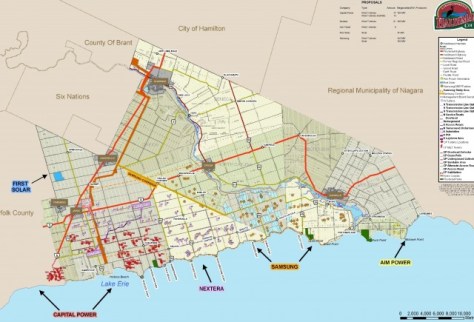
turbine-map-haldimand-proposed1Haldimand County Council  has betrayed residents impacted adversely by wind power complexes by welcoming additional proposals for increased development within its boundaries’.  Samsung Energy Inc. presented its pitch for municipality participation on August 4, 2016 for even more wind turbines along the shores of Lake Erie (see pages 13-19) with an anticipated notification date of selected proponents in 2018 in the LRP 2 (large renewable projects).  The massive Grand Renewable Wind and Solar complex was completed in 2015,  http://www.samsungrenewableenergy.ca/haldimand
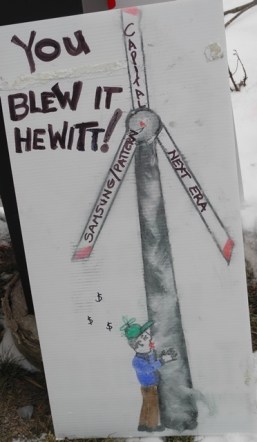
“Samsung More Turbines” resolution can be read here:

samsung-more-turbines-resolution-2016-20160913-council-in-committee-1

It was just a few short years ago- 2013 to be exact- that Haldimand declared itself an unwilling host due to pressure from its constituent. The resolution can be read here;

wind-turbines-resolution-february-2013-1

Mayor Hewitt’s motion endorsing the partnership with Samsung Renewable Energy Inc.  in some sort of equity form and to apply for a PPA (purchase power agreement) contract in anticipation of the next round of large renewable energy projects states:

WHEREAS the province has taken a clear direction to move ahead with more green renewable energy projects;

AND WHEREAS the transmission lines and area around them are fundamental for new applications;

NOW THEREFORE BE IT RESOLVED THAT Haldimand County consider a request made by Samsung Renewable Energy Inc. to partner in some equity form and apply for P.P.A. contract in the next round of applications.

Lessons learned  as taken from the Samsung presentation:

  • Community Support is critical in winning the bid (Municipal Resolution, First Nation  Participation, Adjacent landowner consent)
  • Transmission Capacity Availability needs to be deeply considered

Mayor Hewitt has consistently supported Samsung and its partners such as starring in commercials still featured on their website:

Samsung feels it has experience with the local community and Haldimand is the right place for more wind projects.

Since the County is openly on board, Six Nations Band Council is already a part equity owner of Grand Renewable, and HDI accepted payments- it only leaves out those who are considered “non-participating” receptors.

Wind turbines make lousy neighbours but nobody wants to ask those who live in the flickering shadows of Haldimand’s horizons against consent.

Haldimand Press writes about the latest events in its September 15, 2016 edition (subscription): http://www.haldimandpress.com/samsung-seeks-support-for-more-windmills?id=858


dscn1859

Protect Our Children

School and Cement Plant are a bad mix

amherst-island-public-school
Amherst Public School

“The Green Energy Act allows the wind industry to trump every provincial regulation and municipal by-law designed to protect children. A cement plant near the Amherst Island Elementary School was approved by the Ministry of Environment and Climate Change as ” equipment necessary for the Project”, the construction of 26 wind turbines on Amherst Island. No alternative location was required, no mitigation measure deemed necessary. In dismissing an appeal from the Association to Protect Amherst Island, the Environmental Review Tribunal concluded that the arguments “have not established that the operation of the concrete batch plant as part of the Project and in accordance with the Renewable Energy Approval (REA) will cause serious harm to the human health.”

Protect our children:

https://www.facebook.com/bruce.sudds/videos/10157523546600061/


Please support the fight on Amherst Island and consider a monetary donation for the ongoing legal battle: http://www.protectamherstisland.ca/school-cement-plant-bad-mix/


Tradegy & Farce of Ontario’s Energy

wind-refugeeKarl Marx said that history repeats: first as tragedy, then as farce. In Ontario, the history of failed energy policy repeats – first as farce, and then as more farce.

Premier Kathleen Wynne faces an election in a little over a year and a half, and one of the main issues dogging the Liberal government is the price of electricity. Thanks to policy choices that the government itself seems incapable of unwinding, electricity bills have been on an upward tear for a decade. Many voters are furious. And so the Wynne government devoted the heart of its Throne Speech this week to a plan to lower the price of electricity. Not the cost of electricity, however. Just the sticker price.

Taxpayers of Ontario, you will now be paying for more of your electricity through your taxes, or through future taxes funded by deficit financing, and less through your electricity bill. Yes, that’s the new plan. It looks a lot like the old plan.

Nearly six years ago, Ms. Wynne’s predecessor, Dalton McGuinty, was facing an election. He was, like the current premier, spooked by rapidly rising electricity prices. These spiking prices, note well, had been engineered by the Liberal government’s mishandled Green Energy policy. To win back voters, Mr. McGuinty decided to give consumers a break. The tool: the so-called Ontario Clean Energy Benefit, which ran from the start of 2011 to the end of 2015….

Editorial published in Globe & Mail on September 13, 2016

READ MORE: http://www.theglobeandmail.com/opinion/editorials/ontarios-new-electricity-policy-history-repeats-as-farce/article31862790/

Public Health on Wind in Poland

Position of the National Institute of Public Health – National Institute of Hygiene on wind farms

Position of the National Institute of Public Health – National Institute of Hygiene on wind farms

The National Institute of Public Health – National Institute of Hygiene is of the opinion that wind farms situated too close to buildings intended for permanent human occupation may have a negative impact on the well-being and health of the people living in their proximity.

The human health risk factors that the Institute has taken into consideration in its position are as follows:

  • the emitted noise level and its dependence on the technical specifications of turbines, wind speed as well as the topography and land use around the wind farm,
  • aerodynamic noise level including infrasound emissions and low-frequency noise components,
  • the nature of the noise emitted, taking into account its modulation/impulsive/tonal characteristics and the possibility of interference of waves emitted from multiple turbines,
  • the risk of ice being flung from rotors,
  • the risk of turbine failure with a rotor blade or its part falling,
  • the shadow flicker effect,
  • the electromagnetic radiation level (in the immediate vicinity of turbines),
  • the probability of sleep disruptions and noise propagation at night,
  • the level of nuisance and probability of stress and depression symptoms occurring (in consequence of long exposure), related both to noise emissions and to non-acceptance of the noise source.

In the Institute’s opinion, the laws and regulations currently in force in Poland (regarding risk factors which, in practice, include only the noise level) are not only inadequate to facilities such noise source as wind turbines, but they also fail to guarantee a sufficient degree of public health protection. The methodology currently used for environmental impact assessment of wind farms (including human health) is not applicable to wind speeds exceeding 5 m/s. In addition, it does not take into account the full frequency range (in particular, low frequency) and the nuisance level.

In the Institute’s view, owing to the current lack of a comprehensive regulatory framework governing the assessment of health risks related to the operation of wind farms in Poland, an urgent need arises to develop and implement a comprehensive methodology according to which the sufficient distance of wind turbines from human habitation would be determined. The methodology should take into account all the above-mentioned potential risk factors, and its result should reflect the least favourable situation. In addition to landform (natural topography) and land use characteristics, the methodology should also take into consideration the category, type, height and number of turbines at a specific farm, and the location of other wind farms in the vicinity. Similar legislative arrangements aimed to provide for multi-criteria assessment, based on complex numerical algorithms, are currently used in the world.

The Institute is aware of the fact that owing to the diversity of factors and the complicated nature of such an algorithm, its development within a short time period may prove very difficult. Therefore, what seems to be an effective and simpler solution is the prescription of a minimum distance of wind turbines from buildings intended for permanent human occupation. The setback criteria are also a common standard-setting arrangement.

Having regard to the above, until a comprehensive methodology is developed for the assessment of the impact of industrial wind farms on human health, the Institute recommends 2 km as the minimum distance of wind farms from buildings. The recommended value results from a critical assessment of research results published in reviewed scientific periodicals with regard to all potential risk factors for average distance usually specified within the following limits:

  • 0.5-0.7 km, often obtained as a result of calculations, where the noise level (dBA) meets the currently acceptable values (without taking into account adjustments for the impulse/tonal/modulation features of the nose emitted),
  • 1.5-3.0 km, resulting from the noise level, taking into account modulation, low frequencies and infrasound levels,
  • 0.5-1.4 km, related to the risk of turbine failure with a broken rotor blade or its part falling (depending on the size of the piece and its flight profile, rotor speed and turbine type),
  • 0.5-0.8 km, where there is a risk of ice being flung from rotors (depending on the shape and mass of ice, rotor speed and turbine type),
  • 1.0-1.6 km, taking into account the noise nuisance level (between 4% and 35% of the population at 30-45 dBA) for people living in the vicinity of wind farms,
  • the distance of 1.4-2.5 km, related to the probability of sleep disruptions (on average, between 4% and 5% of the population at 30-45 dBA),
  • 2,0 km, related to the occurrence of potential psychological effects resulting from substantial landscape changes (based on the case where the wind turbine is a dominant landscape feature and the rotor movement is clearly visible and noticeable to people from any location),
  • 1.2-2.1 km, for the shadow flicker effect (for the average wind turbine height in Poland, including the rotor from 120 to 210 m).

In its opinions. the Institute has also considered the recommended distances of wind farms from buildings, as specified by experts, scientists, as well as central and local government bodies around the world (in most cases recommended from 1.0 to 5.0 km).

READ AT: http://www.pzh.gov.pl/en/position-of-the-national-institute-of-public-health-national-institute-of-hygiene-on-wind-farms/

Scrap Green Energy Act

field-and-turbinesTORONTO – If the Ontario government wants to make a dent in soaring hydro rates it should scrap its controversial Green Energy Act.

That according to Christine Van Geyn, the Ontario director of the Canadian Taxpayers Federation. She says Premier Kathleen Wynne’s acknowledgement Wednesday that her government needs to move to address the high cost of electricity is coming far too late for many Ontarians.

“Call me a cynic, but if it takes losing a byelection of a Liberal stronghold for this to become an urgent issue maybe you don’t actually care about it,” she said of last week’s vote in Scarborough-Rouge River.

Progressive Conservative candidate Raymond Cho beat Liberal Piragal Thiru by 2,000 votes, snatching the long-held riding from the government.

“It’s been an issue for people in this province for years,” Van Geyn said of the soaring rates. “It takes losing for her to listen.”

Wynne said Wednesday that her newly minted energy minister, Glenn Thibeault, will look into the problem. But the message sent by Scarborough voters — and people around the province — hasn’t been lost on her.

“It’s not something that is isolated in one riding in Toronto,” Wynne said. “This is a concern across the province and I recognize that.”

Van Geyn said that if the government were to dismantle the Green Energy Act that would help rein in rates.

“It’s the whole reason we’re in this mess,” she said of the act. “The auditor general found that as a result of these Green Energy Act contracts for wind and solar power, where we pay between two and three and a half times above market rate, we overpaid for power by about $37 billion.”

READ MORE:  http://www.torontosun.com/2016/09/08/scrap-green-energy-act-to-help-hydro-mess-tax-watchdog-says?token=60776aed1cc5e2dd0f1293b7b3451832

Green Energy & Energy Poverty

heat or eat

“Going green is fine. But not at any price! And right now Ontario is in the midst of a growing electricity crisis. We have the power, that’s not the issue. The problem is the soaring cost of delivering electricity to customers, especially those who are unfortunate enough to live in lightly populated, rural areas.”

Soaring hydro costs driving families into poverty

Carleton Place Almonte Canadian Gazette

When people ask if you are “into green energy” it is nice to be able to hold up your hand.

I have no issues with working to eliminate coal-fired electrical generation or reducing our dependency on nuclear energy which, despite a record of success, still scares many of us.

Going green is fine. But not at any price! And right now Ontario is in the midst of a growing electricity crisis. We have the power, that’s not the issue. The problem is the soaring cost of delivering electricity to customers, especially those who are unfortunate enough to live in lightly populated, rural areas.

The Liberal government of Premier Kathleen Wynne refuses to term the current situation “a crisis.” But for thousands of rural Ontarians who are struggling to pay their electricity bills it is a catastrophe.

Some of the tales of woe we’re hearing on a daily basis are truly pitiable.

Three weeks ago I read about a man in Bruce County, near Lake Huron, who after suffering a serious heart attack told family and friends it would be better if he died instead of surviving.

His reasoning is that the medical equipment he is now required to use regularly runs on electricity. It is driving up his family’s already ridiculous hydro bill.

READ MORE: http://www.insideottawavalley.com/opinion-story/6844567-soaring-hydro-costs-driving-families-into-poverty/