All posts by Marianne Kidd

Moving out: Anti-wind activist leaves Ontario worried for family’s health

April 25, 2014 – The Independent – Serving Petrolia & Central Lambton

Esther Wrightman feels like she is being evicted from her own home.

The woman who has been at the forefront of the anti-industrial wind turbine movement in Middlesex and Lambton County is moving to New Brunswick.

Wrightman, who heads up the Middlesex-Lambton Wind Concerns group and runs the Ontario Wind Resistance website, put up the for sale sign on her home Tuesday as workers from NextEra continue to put up wind turbines around her home just outside of Warwick. She says it was one of the toughest things she’s ever done. “You feel like you’ve been evicted,” says Wrightman who fears for the health of her family.

“I don’t think we had much of a choice here,” she says. “When you have people in your family with (pre-existing) health problems…you can’t risk it to stay…you have to leave.”

Wrightman has be in the forefront of the fight against a number of projects, including the Bornish and Adelaide projects by NextEra Energy which are right in her backyard. She went to the Ontario Energy Board to try to stop the company from building its transmission wires down the roads in her community, but lost. Now, crews are busy in the neighbourhood putting up one turbine after another.

“It really does make you want to throw up,” she says as she watches the turbines go up in the places which used to be dots on maps in NextEra’s plans. “I know these dots on these maps in my head now, after so many years now – where they are and who they effect …And then you see the dots ripped in the ground…yeah this is exactly what I had imagined. Somewhere in my mind there was a chance it wouldn’t happen…but now it’s holes and concrete… “This is what I thought would happen, but now its worse because it has happened.

“These companies have come in, they won’t be staying as people they’ll be staying as machines but you have to stay and suffer or you have to leave…That does make me angry.”

Wrightman says some of that anger has worn off as she plans to move her family to New Brunswick with her parents. New Brunswick isn’t pursuing wind energy so the family will take its nursery business to the province this summer and start again. The activist may have to return to Ontario. NextEra is suing Wrightman for libel after labeling the company as Next-Terror on line and on placards during some of the dozens of demonstrations she’s been part of. She’s not ready to walk away from that fight.

“They’ve taken my place, taken my home that I was so attached to, and five years of my life fighting,” she says. “I’m determined that they won’t take my right to speak out as a person. I’m determined they won’t take my happiness and they won’t take my health and the health of my family.”

But she admits they have taken away some very precious things – her sense of being rooted in a community and her faith in the political system. “I cannot put any faith in politicians at all…It’s a game and your pawns in their game,” says Wrightman who won’t stay in Ontario to see if an anticipated provincial election will change the situation.

Wrightman says she is concerned for the neighbours she leaves behind and the impression she may leave with others who are still fight projects in their neighbourhoods. “It does look somewhat that I’m pulling up stakes, leaving retreating. I don’t like how it looks. I’m sure the wind companies like it, “ she says. “Some people may say ‘you need to stay you have to stay and help,’ As much as I would like to stay and fight I can’t do that to my family.”

In the end, she says it is a personal choice to leave the province to protect the health of her family. “I’m a voice I’m a single person…this is what happens. We fought, we pushed them back,” she says adding she doesn’t know what to say to others continuing the fight. “When they ask, what could I do, I don’t even know what to tell them – fight government? Fight wind companies? I don’t know. Now, when the wind turbines are up its even harder – it’s almost impossible. They’re not coming down. “It’s a hard pill to swallow.”

See original article here: http://petrolialambtonindependent.ca/2014/04/25/moving-out-anti-wind-activist-leaves-ontario-worried-for-familys-health/

Turtles vs. turbines

WindResistanceofMelancthon's avatarWind Resistance of Melancthon

Turtles2-336x252
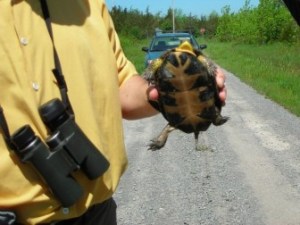
A Blanding’s turtle roadside at Ostrander Point. Photo from Prince Edward County Field Naturalists.

The Ontario Divisional Court has ruled in favor of a wind turbine project that put groups with environmental interests at odds with each other.

On one side is an alternative energy project. On the other is protection of a threatened turtle species and fragile soil.

Prince Edward County Field Naturalists (PECFN) took Ostrander Point Gilead Power Inc. to court to challenge the Ontario Ministry of the Environment’s “renewable energy approval” to build nine wind turbines near Lake Ontario in Prince Edward County.

The court decision – now on hold pending a further appeal — would allow Ostrander to start construction after the Environmental Review Tribunal revoked the Ministry’s approval.

PECFN relied on the Endangered Species Act to halt the project. The act requires proof of harm to human health, or serious and irreversible harm to plant…

View original post 670 more words

Health authorities admit ‘wind turbine syndrome’ is real

March 6, 2014 – Natural News – J.D Heyes

(NaturalNews) An Irish health official has warned that people who live near massive wind turbines of the sort used to generate electricity run the risk of having their physical and psychological health compromised.

According to a report in the Irish Examiner newspaper, the official — Dr. Colette Bonner — says further that people who are at risk of the controversial wind turbine syndrome need to be treated “appropriately and sensitively as these symptoms can be debilitating.”

As the paper reported:

Following a review of international research on the health effects of wind turbine noise, the Department of Health’s deputy chief medical officer concluded that wind turbines are not a threat to public health, but “there is a consistent cluster of symptoms related to wind turbine syndrome which occurs in a number of people in the vicinity of industrial wind turbines”.

What is wind turbine syndrome?

It is supposedly a condition suffered by people living within earshot of the noise made by wind turbine blades as they spin round. The blades are known to make infrasounds, vibrations that we cannot consciously “hear” but still have an effect on the inner ear, Breitbart News reported. Symptoms include fatigue, dizziness, headache, difficulty concentrating and insomnia.

Irish official first ranking expert to give ‘syndrome’ legitimacy

A letter that reporters and editors of the paper claim to have seen tells how, in a review sent by Bonner to the country’s Department of Environment in November, “there are specific risk factors for this syndrome and people with these risk factors experience symptoms.”

“These people must be treated appropriately and sensitively as these symptoms can be very debilitating,” she added, according to the Irish daily.

Experts have disagreed on whether wind turbine syndrome is real or if it is merely a psychological concoction in response to anguish over not wanting to live near a turbine wind farm.

Bonner “has been quoted in a variety of policy proposals related to noise and set back distance, advising Minister Jan O’Sullivan regarding revisions to 2006 standards that ‘there is a consistent cluster of symptoms related to wind turbine syndrome which occurs in a number of people in the vicinity of industrial wind turbines,'” writes Hank Campbell at Science 2.0. “Well, that’s epidemiology right there. You can find almost anything if you try. We have had similar claims in the US, about self-reported mental health issues after wind turbines went up, especially among people who were against the turbines in the first place.”

Following her review, the Irish Department of Health’s Food and Environmental Health Unit wrote a letter to the Department of the Environment asking officials there to consider hiring more experts to further study the health effects of wind turbine syndrome.

The Department of the Environment, however, has dismissed Bonner’s literature review as “preliminary,” adding that it was “not a recommendation of the Department of Health.”

Not everyone is signing on just yet

The Department of Environment is currently conducting a review of the 2006 Wind Energy Development Guidelines, the Irish Examiner reported.

Meanwhile, the Department of Health has said that the deputy CMO’s comments “did not constitute expert advice” but rather were “a general overview of the literature in this area.”

The department went on to confirm that a “range of symptoms have been described by people living close to wind turbines mainly related to general environmental noise exposure.”

“These symptoms include headache, irritability, difficulty concentrating, fatigue, dizziness, anxiety and sleep disturbance, and are often described in relation to annoyance,” a spokesman, who was note named, told the paper.

“Anyone who experiences such symptoms should seek medical advice from their family doctor, who may be able to prescribe suitable medication,” the spokesman continued.

Campbell added sardonically: “They may not be great for people but they sure are terrible for bats and birds. But they can’t hire paid lobbyists, so I bet wind turbines are here to stay.”

See original. Article here: http://www.naturalnews.com/044196_wind_turbine_syndrome_health_authorities_mysterious_illness.html##ixzz2ziHykukD

Julian Falconer to speak at wind energy town hall

Paul Morden – Sarnia Observer – April 22, 2014

Noted Canadian lawyer Julian Falconer is set to speak at a May 5 town hall meeting a Plympton-Wyoming citizens group is organizing to rally support for its fight against Suncor Energy’s proposed 46-turbine Cedar Point Wind Power Project.

Falconer, known for his human rights advocacy and involvement in high profile cases like the Ipperwash Inquiry, along with lawyer Asha James from Falconer’s firm, are set to speak at the meeting about Charter of Rights and Freedom challenges of wind energy projects.

“He knows how to make things happen and has quite a reputation,” said Ingrid Willemsen, with the group We’re Against Industrial Turbines – Plympton-Wyoming.

“We’re quite excited he’ll be there.”

The meeting is set for 7 p.m. to 9 p.m. at the Camlachie Community Centre. Willemsen said group members hope to fill the hall and attract more residents to their cause.

“I think it’s about the only thing the community has left to hope for,” she said.

Suncor has a contract to sell power from its Cedar Point project to Ontario’s electricity grid, and has submitted an application for provincial environmental approval for turbines it plans to build in Plympton-Wyoming, Lambton Shores and Warwick Township.

Also scheduled to address the town hall meeting are Ben Lansink, a real estate appraiser and consultant, who will speak about the impact of turbines on property values, and Carmen Krogh, one of the authors of an article published in the Canadian Journal of Rural Medicine on the health impacts of wind farms.

Willemsen said the view of turbines going up along Highway 402, just east of Lambton County, is showing local residents what’s on the way to their communities, and may spur more opposition to wind projects.

“A lot of people have not involved themselves because they don’t know how it’s going to affect them,” she said. “They haven’t seen them, right close.”

As well as awaiting provincial environmental approval for its Cedar Point project, Suncor has taken the Town of Plympton-Wyoming to court over several of its bylaws aimed at wind turbines.

Earlier this month, Suncor officials met with town council after the judge hearing the case asked the two sides to explore the possibility of a settlement.

Mayor Lonny Napper said Tuesday councillors were still waiting to hear back from the town’s lawyer before responding to Suncor.

Willemsen said she remains hopeful Suncor’s wind project can be stopped.

“They need to jump through the hoops, just like any other project, and the longer it’s delayed, the better our chances,” she said.

See original article here: http://www.theobserver.ca/2014/04/22/julian-falconer-to-speak-at-wind-energy-town-hall

MONOPOLY: Ontario Liberal Party Version

Donna Quixote's avatarQuixotes Last Stand

With more and more families in Ontario entering Energy Poverty, thanks to the insane policies of the Liberal Party, families are now finding themselves sitting in the dark at night.  This has spawned a resurgence in board games and the newest rage in board games is the Ontario Liberal Party version of Monopoly.

Click on game to enlarge slightly then use your browser button to zoom in to be able to see squares clearly.

Ontario Liberal Monopoly game1

View original post

MPAC Wind Turbine Property Assessment Study – Stand by for Peer Reviewed Assessments

First look at the MPAC study which is way OVERDUE! Stand by for reviews from the field. Houses that haven’t sold were not included in the study.

See original study link here which includes a link to all Appendices – http://www.mpac.ca/property_owners/IndustrialWindTurbines.asp

Feds List New Bird Species As Threatened – Should Wind Developers Be Worried?

Richard H. Podolsky Tuesday April 08,  2014 – North American Wind Power

Bird Picture

In response to a precipitous decline of the lesser prairie-chicken (LPC), the U.S. Fish and Wildlife Service (FWS) announced on March 27 that it is listing the species as threatened under the Endangered Species Act (ESA). Under the ESA, a “threatened” designation means the species is likely to become in danger of extinction within the foreseeable future. Threatened-species status represents a step below “endangered” and, as such, carries fewer restrictions.

Nevertheless, the listing of any species under the ESA has immediate and long-term implications for both energy and agriculture interests. And because the LPC resides in the wind-rich lands of Colorado, Kansas, New Mexico, Oklahoma and Texas, rest assured that listing will impact wind developers now and until the species recovers and is de-listed or it goes extinct.

Why the fuss?
According to FWS Director Dan Ashe, “The lesser prairie-chicken is in dire straits.” Last year, the range-wide population declined to a record low of 17,616 birds, an almost 50% reduction from the 2012 population estimate. This once-abundant relative of the greater prairie-chicken, greater sage-grouse (GHG) and other “prairie grouse” species has been reduced by an estimated 84-90% from its historical levels as a result of the human-induced degradation of its preferred habitat. And with land-use pressure from energy development, and agriculture and urbanization on the increase in the West, the prognosis for LPC remains bleak.

Historically, LPC were common in sand sagebrush-bluestem and within shinnery oak-bluestem vegetation types. Currently, LPC are most common in dwarf shrub and mixed grasses on sandy soils, as well as in short-grass or mixed-grass habitats on loamy or clayey soils. In Colorado and Kansas, LPC are typically restricted to sand sagebrush communities dominated by sand dropseed, side oats grama and blue grama. Recently in the northern fringe of its range, LPC have moved into mixed-grass prairie and Conservation Reserve Program (CRP) fields. And although all these vegetation elements are important to LPC, the thing they need more of than almost anything else is what is increasingly in short supply – large and contiguous expanses of undisturbed habitat. In order for LPC to sustain viable populations, it is estimated they need contiguous units of their preferred habitat that are a minimum of 25,000-50,000 acres in area, or coincidentally, about the size of an average wind farm in the Great Plains. A century ago, the heath hen, a New England relative of the LPC, went extinct due to similar cumulative impacts resulting from destruction of its preferred habitat.

As early as next year, this same ESA-listing scenario may play out with another increasingly rare western bird, the greater sage-grouse (GSG). However, the impact of that listing will be even more far reaching because GSG will be listed as an endangered species, as opposed to threatened species for LPC. Also, GSG and their preferred habitats are found in 11 states, as opposed to five states for LPC.

Death from above

While habitat quality and habitat size are critical, LPC live in such mortal fear of being preyed upon by hawks and eagles that they will abandon otherwise-suitable habitat simply because it contains an elevated perch that a bird of prey may someday land on and hunt from. This means that vertical structures of almost any kind, be it a wind turbine or telecommunication tower, will render otherwise-suitable habitat unusable by LPC. Studies have indicated that LPC habitat is also degraded by proximity to roadways, buildings, and oil and gas fields.

The upshot of these ecological proclivities is that, according to the FWS’ LPC Conservation Plan, once a site has been designated as LPC habitat, it is recommended that “avoidance buffers” be established between such sites and the following human impacts: 300 feet to the nearest gravel road; 600 feet to the nearest distribution line or residential building; 900 feet to the nearest oil or gas pad; 1,800 feet to the nearest transmission line; 2,250 feet to the nearest paved road; and 3,000 feet to the nearest wind farm, commercial building or tall telecommunication tower.

These large buffers were derived from careful scientific study of the observed responses of LPC to these various land-use features. The proposed buffers are particularly large for wind farms and telecommunication towers because studies showed that LPC were particularly sensitive to them. These 3,000-foot buffers will invariably result in fewer turbines and tall towers in areas that also host LPC populations or their preferred habitat.

Reducing the impact to wind developers 

Due to a special deal struck in 2013 (under section 4(d) of the ESA), the regulatory impact to wind power companies from formal ESA listing will be somewhat less than it would have been otherwise. Yet, by no means will it be “business as usual” for wind power in any of the states that host remaining populations of LPC. Specifically, the special 4(d) rule will allow the five states to continue to manage conservation efforts for the species under the Western Association of Fish and Wildlife Agencies’ (WAFWA) range-wide conservation plan.  

The WAFWA conservation plan was developed by a consortium of experts from all five states and with input from a wide range of stakeholders. Regarding the special 4(d) WAFWA deal, Ashe said, “Working through the WAFWA range-wide conservation plan, the states remain in the driver’s seat for managing the species – more than has ever been done before – and participating landowners and developers are not impacted with additional regulatory requirements. We expect these plans to work for business, landowners and the conservation of prairie-chickens.”

Credits for the good, debits for the bad

Under the WAFWA Mitigation Framework, a metric system of debits and credits has been established whereby land-use actions that result in an impact to LPC and their habitats will generate debits, whereas land-use practices that result in impact avoidance or improvements to LPC habitat will generate WAFWA credits. In doing so, WAFWA is providing opportunities for both the exchange and conservation banking of debits and credits. 

The bottom line

The listing of the LPC as a threatened species is the inevitable result of a century or more of cumulative human impacts. Therefore, wind companies considering developing or investing in any project site that may support LPC or LPC-preferred habitat are advised to conduct all requested pre-construction site assessments, perform all post-construction monitoring, report any bird fatalities to FWS as required by law, and proactively engage in the WAFWA Mitigation Framework. It is particularly vital to hire certified ecologists who know LPC ecology, have worked in the states where LPC reside, and are intimately familiar with endangered species biology, WAFWA and the ESA. 

Dr. Richard H. Podolsky is a certified senior ecologist who specializes in endangered species biology and is CEO of Avian Systems, a biological consulting firm that conducts bird and bat surveys. Podolsky can be reached at podolsky©att.net or (207) 475-5555.

Photo credit: U.S. Department of Agriculture

Original Article Here: http://nawindpower.com/e107_plugins/content/content.php?content.12826


Naturalists to pay Gilead $40,000, reduced from $120,000 demand

April 14, 2014 – http://www.countylive.ca

DSCN1679Prince Edward County’s Field Naturalists will pay $40,000 in legal costs instead of $120,000 demanded by Gilead Power.

The Divisional Court has found turbine project developer Gilead Power’s demand for $120,000 in legal costs from the Prince Edward County Field Naturalists “was too high and lowered it to $40,000,” said Myrna Wood, PECFN president. “More importantly, the reason given is that “clearly the case is of important public interest. It is significant that two judges have based decisions on the importance of the case to the public interest. We see this as a positive indicator that permission to appeal will be given. We will also be able to use this argument for an appeal against paying any legal costs to Gilead or the Ministry.”

The naturalists group has filed its submission to the Court of Appeal asking for leave to appeal the Divisional Court reversal of the decision of the Environmental Review Tribunal.

Last July, the Tribunal revoked the approval of a Gilead Power wind turbine project at Ostrander Point Crown Land Block in the centre of the Prince Edward County’s South Shore Important Bird Area. There have been more than 20 appeals of Renewable Energy Approvals since the Green Energy Act came into effect in 2009. All but the PECFN appeal resulted in dismissals.

“In allowing PECFN’s appeal, the Tribunal rendered a landmark and precedent-setting decision,” said Wood.

Soon after the Divisional Court decision, Gilead Power announced its intention to start construction in April.  PECFN brought an urgent motion for a Stay of construction and leave to appeal the Divisional Court decision to the Court of Appeal.

In his decision submitted on March 25, Judge Blair of the Appeal Court held that he had “no hesitation in granting the Stay” because the issues raised on the proposed appeal are of “broad public implication in the field of environmental law”.  Further, he found that the irreparable harm criterion had been satisfied on the basis that “once a habitat is destroyed, it is destroyed – for at least short-term purposes, in any event – and the species sought to be protected here is a vulnerable and endangered species.”

“The notice of intention to seek leave to appeal has attracted increasing expressions of support for PECFN’s opposition to industrialization of the South Shore IBA,” said Wood. “We believe that this important test of Ontario environmental law encourages other environmental and legal organizations to apply to intervene in the appeal.”

The struggle to save Ostrander Point has gained a broader dimension since two other wind turbine projects in the area have been submitted to the government Registry (EBR) for public comment, she said.

The White Pines proposal includes 29 turbines spread across private lands within the IBA surrounding Ostrander Point.  Windlectric Inc. proposes 36 turbines spread across the Amherst Island’s natural areas.  Residents of Amherst Island have applied to the Superior Court of Justice in Toronto for a judicial review of the Ministry of Environment’s approval of the application.  They challenge the company’s claims that their plan has mitigated any harmful effects to wildlife and people prior to construction.

“The cumulative effect of proposed turbine projects surrounding eastern Lake Ontario creating a barrier across the eastern flyway of migrating birds and bats is a concern for all naturalists,” said Wood. “If approved, these projects will displace wildlife from shorelines, the most important staging and resting habitats for many species.  Renewable energy will not be ‘green’ if it destroys significant wildlife habitats.  Recognition of this fact is demonstrated by two recent project cancellations. British Petroleum has cancelled a project on Cape Vincent across from Wolfe Island.  On the Lake Erie Pelee flyway two proposed projects in Ohio have been cancelled due to the threat of a lawsuit by Black Swamp Bird Observatory and the American Bird Conservancy.”

The Appeal Court’s decision on the request to appeal may not be made until June.

“In May, everyone will be enjoying one more spring migration and searching for emerging Blanding’s turtles along the South Shore firmly resolved to continue in the struggle to Save Ostrander Point,” said Wood.

More at www.saveostranderpoint.org

Original Article Reference here: http://countylive.ca

Wind Concerns asks Ombudsman to investigate wind power approvals

NEWS RELEASE

April 14, 2014

Wind Concerns asks Ombudsman to investigate wind power approvals

Wind Concerns Ontario, the coalition of individuals and community groups concerned about the impact of large-scale wind power projects, sent a letter to Ombudsman of Ontario, requesting an investigation of aspects of the approval process for wind power projects.

“Our members, and Ontario municipalities, are very concerned about the lack of transparency that appears to be the hallmark of the approval of these power projects,” says Jane Wilson, president, Wind Concerns Ontario.

“For example, the Ministry of the Environment has ‘deemed complete’ documentation for some projects when in fact environmental studies and assessments for emergency response and aviation safety are not complete and in some cases absent entirely,” Wilson says. “This is not acceptable, and not the ‘fair’ and ‘transparent’ process the government claims it fosters.”

At least one Ontario community has already taken legal action based on the fact it believes documentation to be incomplete: the citizens’ group in Amherst Island filed for a judicial review in March, citing numerous flaws and deficiencies in the wind power developer’s application.

Wind Concerns Ontario also asked about the appropriateness of large wind power developers offering money to municipalities in return for an expression of municipal support, referring to Samsung’s recent offer to the community of Southgate, which was eventually refused by the local government.

“This looks  like Ontario’s small towns are literally up for sale to huge power developers,” Wilson explains.

Ontario municipalities are being allowed to have more input into decisions about large-scale wind power generation facilities, but still do not have a “veto” according to the Minister of Energy, despite community concerns.

View the letter to the Ombudsman here:

April 2014 Ombudsman Letter

windconcerns@gmail.com

Original Article Here: http://www.windconcernsontario.ca/wind-concerns-ontario-asks-ombudsman-to-investigate/