Overview of Problems and Solutions in Fire Protection Engineering of Wind Turbines

SOLOMON UADIALE (1) , ÉVI URBÁN (1) RICKY CARVEL(1) DAVID LANGE (2), and GUILLERMO REIN (3)

  • (1 )School of Engineering University of Edinburgh, UK
  • (2) SP Technical Research Institute of Sweden, Sweden
  • (3) Department of Mechanical Engineering Imperial College London, UK

ABSTRACT

The wind energy industry is one of today’s leading industries in the renewable energy sector, providing an affordable and sustainable energy solution. However, the wind industry faces a number of challenges, one of which is fire and that can cast a shadow on its green credentials. The three elements of the fire triangle, fuel (oil and polymers), oxygen (wind) and ignition (electric, mechanical and lighting) are represent and  confined to the small and closed compartment of the turbine nacelle. Moreover, once ignition occurs in a turbine, the chances of externally fighting the fire are very slim due to the height of the nacelle and the often remote location of the wind farm.  Instances of reports about fires in wind farms are increasing, yet the true extent of the impact of fires on the energy industry on a global scale is impossible to assess. Sources of
information are incomplete, biased, or contain non-publically available data. The poor statistical records of wind turbine fires are a main cause of concern and hinder any research effort in this field. This paper aims to summarise the current state of knowledge in this area by presenting a review of the few sources which are available, in order to quantify and understand the fire problem in wind energy. We have found that fire is the second leading cause of catastrophic accidents in wind turbines (after blade failure) and accounts for 10 to 30% of the reported turbine accidents of any year since 1980’s. In 90% of the cases, the fire leads to a total loss of the wind turbine, or at least a downtime that results in the accumulation of economic losses.

The main causes of fire ignition in wind turbines are  (in decreasing order of importance)  lighting strike, electrical malfunction, mechanical malfunction  and maintenance.  Due to the many flammable materials used in a wind turbine  ( eg. fiberglass reinforced polymers, foam insulation, cables )  and the large oil storage used for lubrication of mechanical components, the fuel load in a turbine nacelle is commonly very large. The paper finishes with an overview of the passive and active protection options and the economics (costs, revenue and insurance) of wind turbines to put in context the value of a loss turbine compared to the cost and options of fire protection. We hope that this paper will encourage the scientific community to pursue a proper understanding of the problem and its scale, allowing the development of the most appropriate fire protection engineering solutions.

Read Full Report Here

Now Greenpeace is against Lego?

It’s hard to tell the Good Guys From the Bad Guys These Days.

unnamed (19)Greenpeace Spends Thousands on Lego Kits to Make This Video and then Pours Oil Over it to make a statement?  Did they then clean the Lego’s off and give the sets to kids,  hopefully, some who can’t afford them, or did they….add them to the landfill?

One wonders  if they were also aware that Lego has Spent over 500 Million on “Renewable Wind Power“.  While learning that  does not truly impress those of us fighting Wind, one would think Greenpeace would of approved. Yet not one “Industrial Wind Turbine” Lego kit was used in the making of this video….hmmm?

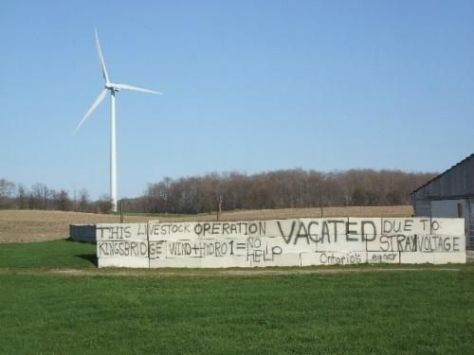
Vacated Due to Stray Voltage

unnamed (18)

canwea FACT Sheet:  

ABOUT STRAY VOLTAGE

WHAT IS STRAY VOLTAGE?

Stray – or ‘tingle’ voltage – is a low-level electrical current or shock (typically under 10 volts) that results primarily from an improperly grounded or, in some cases an ungrounded, electrical distribution system.

Stray voltage can be found in any electrical system and is strictly a power distribution issue – improper grounding causes low voltage current to travel along a neutral wire.  An electrical wiring system is
grounded in order to keep voltage potential differences between the neutral wire and the ground, below levels that could be considered harmful.

While potential exists for stray voltage in residential areas, it is most commonly found at agricultural operations and is often attributed to poor grounding of the neutral wiring system in an environment where the presence of water increases conductivity between points of contact.

Stray voltage is unwanted electricity that in some cases can pose a safety risk to animals – and to lesser degree, humans – that come in contact with it

. Farming operations are especially susceptible to incidences of stray voltage for two key reasons:

  1.  Many working farms have electrical systems and wiring that have not been fully updated to current electrical codes and standards
  2.  Farms have a higher number of potential contact points (e.g., metal), water and wet conditions,  i.e. feed bowls and wet concrete floors

WHAT’S IN A TERM?

The term ‘stray voltage’ is often misused due to poor understanding of its cause.

Stray voltage has incorrectly been called ‘dirty electricity’, implying that some forms of electricity are better or cleaner than others. Electricity from all sources is equally ‘clean’. Stray voltage has also been confused with electricomagnetic fields (EMF), grounding systems or even naturally-occurring currentfound in the earth.

ANIMAL REACTION TO STRAY VOLTAGE

Stray voltage may affect farm animals through nerve stimulation, causing a ‘tingling’ effect. This so-called ‘tingle’ can occur when the animal comes in contact with two points that have a voltage
potential – such as a metal dish filled with water and a wet concrete floor – creating a path for current (electricity) to flow through the animal.
This nerve stimulation may have an effect on an animal’s behaviour directly – in the form of involuntary muscle contractions and/or pain; or indirectly in the form of behavioral responses such as reduced food
and water intake, or proving difficult to handle.

All electrical current must be respected as potentially harmful and stray voltage, although present in low amounts, is no different. Based on research, levels below 1 V are considered to be inconsequential, and generally not believed to cause behavioral changes in farm animals.

DETECTING AND REPAIRING INCIDENCES OF STRAY VOLTAGE

In most cases the source of stray voltage can be identified, allowing it to be either mitigated or eliminated.

Suspected cases of stray voltage should be investigated by an inspector from a local utility operator such as Hydro One, Toronto Hydro, etc., as it is a common distribution issue for farm operators as a result of inconsistent wiring quality. A utility inspector will investigate the farm’s existing wiring system to ensure
proper installation, wire condition and code compliance. An inspector will seek to isolate the source of neutral-to-earth (ground) voltage through measurement of voltage at various points within the electrical system. This helps to determine whether the issue is related to on-farm wiring and distribution or whether the issue is related to the electrical distribution system off the farm.

COUNTERING INCIDENCES OF STRAY VOLTAGE IN ONTARIO

In 2007, the province of Ontario began an extensive research and consultation process into the phenomenon of stray voltage and its effects on the farm sector. In 2009, the Ontario Energy Board
(OEB) enacted code amendments detailing procedures and methodology for dealing with incidences of  stray voltage

As part of its two-year research and consultation process, the OEB employed Dr. Douglas J. Reinemann, a Professor of Biological Systems Engineering and a leading authority on stray voltage to review studies and literature on the subject.

Recognizing stray voltage’s connection to farming operations, Dr. Reinemann sought to further clarify the term ‘stray voltage’ by further defining it as “…a low-level electrical shock that can produce
sensation or annoyance in farm animals”. He also further specifies the term as “a special case of voltage developed on the grounded neutral system of a farm”.

STRAY VOLTAGE AND WIND ENERGY

There has been much confusion on the topic of stray voltage, and wind turbines have at times been inappropriately linked as direct sources of stray voltage.

Stray voltage is a potential symptom in any system of electrical distribution, regardless of source and is especially prevalent on working farms. Wind turbines are often located in agricultural areas, connecting to the provincial electricity grid with farm operators leasing the land on which the turbines sit. Through improved regulation and electrical code enforcement, incidences of stray voltage will be increasingly detected and eliminated.

https://mothersagainstturbines.com/wp-content/uploads/2014/07/strayvoltagefactsheet-1.pdf

Uncontrolled electricity awareness on farms (2014)

By Brent Royce, Director, Ontario Federation of Agriculture

Experiencing production challenges or caring for livestock with health problems is never easy on the farm. It’s even more difficult when farmers and veterinarians struggle to identify the source of the problem.

800px-Gladys_christmas_2006Now, more Ontario farmers are becoming aware of an environmental challenge that has a significant impact on animal health – the issue of  Also called “ground current” or “stray voltage,”Uncontrolled Electricity  occurs when there is a constant underground electrical current flowing in the ground or barn. Animals can be exposed to shocks transmitted through barn floors, milking equipment and water bowls. Livestock exposed to uncontrolled electricity may have lower production, stop eating or drinking, or exhibit other odd behavior. Some cases even result in death.

It’s important that Ontario farmers educate themselves on how to recognize the signs of ground current challenges on the farm. That’s why the Ontario Federation of Agriculture (OFA) is helping to raise awareness about uncontrolled electricity. We belong to a working group of agricultural organizations in Ontario that is looking to identify the severity of the problem, and work with utility companies to address the issue.

The OFA has also launched a series of online videos to help raise awareness about issues such as uncontrolled electricity. OFA’s most recent video, Understanding Uncontrolled Electricity on the Farm, provides background information on the issue, and explains important steps farmers need to take to identify and fix the on-farm problem and where to find help.

For farmers who suspect uncontrolled electricity is at play on their farm, their first phone call needs to be to a licensed electrician. The electrician should visit the farm to test for ground current, and work with the farmer to fix any problems that are within the farm’s electrical system.

Uncontrolled electricity can also come from off–farm sources beyond a farmer’s control, such as the farm’s electricity carrier. If the licensed electrician discovers the problem is from an off-farm source, he or she will work with the farmer to contact the local utility to file a report. A utility representative needs to visit the farm to test for ground current. It is important that farmers document all reports of uncontrolled electricity, so that all parties are aware of the extent of the problem.

The OFA is working with other agricultural organizations and Hydro One to address ground current challenges on Ontario farms. Gaining more control over this and other issues will go a long way in helping to enabling prosperous and sustainable farms.

For more information check out our video on uncontrolled electricity – on our You tube Channel, OntarioFarms, or visit http://www.ofa.on.ca/ to learn more about this serious concern.

For more information, contact:
Brent Royce
Director
Ontario Federation of Agriculture
519-291-8279
Neil Currie
General Manager
Ontario Federation of Agriculture
519-821-8883

Wind Turbines Make Waves: Why Some Residents Near Wind Turbines Become Ill

Magda Havas and David Colling

Abstract

People who live near wind turbines complain of symptoms that include some combination of the following: difficulty sleeping, fatigue, depression, irritability, aggressiveness, cognitive dysfunction, chest pain/pressure, headaches, joint pain, skin irritations, nausea, dizziness, tinnitus, and stress. These symptoms have been attributed to the pressure (sound) waves that wind turbines generate in the form of noise and infrasound. However, wind turbines also generate electromagnetic waves in the form of poor power quality (dirty electricity) and ground current, and these can adversely affect those who are electrically hypersensitive. Indeed, the symptoms mentioned above are consistent  with electrohypersensitivity.  Sensitivity to both sound and electromagnetic waves differs among individuals and may explain why not everyone in the same home experiences similar effects. Ways to mitigate the adverse health effects of wind turbines are presented.

Introduction

With growing concern about climate change, the carbon budget, depletion of fossil fuels, air pollution from dirty coal, radiation from nuclear power plants, and the need for a secure energy supply, more attention and funding are being diverted to renewable energy. Among the various types of renewable energy, wind has received a lot of attention due, in part, to opposition from communities earmarked for wind turbines and from communities that have experienced wind turbines firsthand.

Some people who live near wind turbines report difficulty sleeping and various symptoms of ill health and attribute these problems to noise and shadow flicker—two elements they can perceive. Indeed the U.S. National Research Council (Risser et al., 2007) identify noise and shadow flicker as the two key impacts of wind turbines on human health and well-being.

Not all health agencies, however, recognize that sound waves from wind turbines may cause adverse health effects. Following a review of the literature, the Chief Medical Officer of Health for Ontario (2010), concluded

that while some people living near wind turbines report symptoms such as dizziness, headaches, and sleep disturbance, the scientific evidence available to date does not demonstrate a direct causal link between wind turbine noise and adverse health effects.  the sound level sound level from wind turbines at common residential setbacks is not sufficient to cause hearing impairment or other direct health effects, although some people may find it annoying.

Low frequency sound and infrasound from current  generation upwind model turbines are well below the pressure sound levels at which known health effects occur. Further, there is no scientific evidence to date that vibration from low frequency wind turbine noise causes adverse health effects.

follow link to read full report:   Bulletin of Science, Technology & Society

Wind Turbines: A Different Breed of Noise?

images (8)“Much of what scientists can conclude today about the health effects of noise in general draws upon studies of transportation noise in urban areas conducted over the past four decades. Among the first to suggest a link between noise and learning impairment was a 1975 study by environmental psychologist Arline Bronzaft.21 In a New York City elementary school adjacent to an elevated train track, Bronzaft compared the reading scores of children in classrooms facing the tracks to those of children in classrooms on the other side of the building. She discovered that children on the noisy side were nearly one year behind their peers in reading. After two years, once noise-abatement measures had been completed—and other classroom variables held constant—Bronzaft returned to the school and found reading scores on both sides of the building to be at the same grade level.22
follow link to read artice: Environmental Health Perspectives, CEHN July 2014 Article of the Month

I do not like green blades with spans. I do not like them, mad I am


geah7


I do not like green blades with spans
I do not like them, mad I am

I do not like them on the roads
I do not like them in the rows

I do not like them standing tall
I do not like them, not at all

I do not like them killing birds
I do not like them killing bats

I do not like them causing harm
I do not like them on a farm

I do not like them — Do No Harm
I do not like them false green farms

I do not like the spinning blades, noise, flicker, insane rage
I do not like them on this page

I do not like these giant fans 
I do not like them on the lands

I do not like those men in ties
I do not like those telling lies

I do not like them on the ground 
I do not like them dead birds found

I do not like those concrete holes
Where toxic water then must flow

I do not like them in the sun
I do not like them in the rain

I do not like them in the snow
I do not like them, they must go!

I do not like them any day 
They harm us all in every way

I do not like them in the north
I do not like them in the south

I do not like them east or west
I do not like them, Can you guess?

I do not like green blades with spans
with giant sweeps upon our lands

In Germany Australia Netherlands Canada USA or UK
Take your fans and blow away!

I do not like green blades with spans
I do not like them, Mad I Am

Wind Turbine Syndrome, July 14 2014


What Wynne’s win means

“I’m still not sure how Ontario’s Liberal Premier Kathleen Wynne won a majority (Interview, July 7), but now we are subjected to four more years of monumental mismanagement.  Urban voters opted to “forget” about the costly scandals and investigations in our bankrupt, have- not  province and ask for more, especially when the most costly and deceitful scandal still flourishes: the Green Energy and Green Economy Act, dominated by the wind-turbine debacle, which has hog-tied rural municipalities and residents alike.  Wynne speaks about her progressive vision for Ontario, but those living outside her golden zone know it doesn’t include them as fundamental health and environmental protections and precautions have vaporized.

 Barbara Ashbee, Mulmur, Ont.”

 Published under Letters section page 6 Macleans July 7 2014

Raise Your hand if you are a “supporter of wind”. This letter is for you.

Windfarm risks acceptable?

To the named supporters of the windfarm,

guilty_raised_handI would ask, since we know that the mining of rare earth minerals in China is poisoning the land, lakes and people, how can they equate this with nice green energy? These rare minerals are components modern turbines depend upon.


Supporters must believe this wretched toxicity is acceptable.

These named supporters are aware that children in the windfarm areas will be exposed to infrasound. So after their bedtime story these little children can cuddle their pillows and receive maximum auditory stimulation. The pillow will block audible sound but not infrasound.

Supporters have found this to be acceptable.

The named supporters obviously have no concerns for the physical and psychological ill health that the windfarm occupants will be subjected to when the turbines become operational. Clearly the supporters have a better understanding of the detrimental health effects than Dr Sarah Taylor whose report supports the evidence that individuals living on windfarms will be affected.

The windfarm supporters find this acceptable.

I will not insult the windfarm supporters intelligence by suggesting that they were perhaps unaware of the above. Thankfully there are still many decent people who do not find these facts at all acceptable.

I have only touched on some of the reasons why I will never support this development.

Surprisingly no one in the above supporters group will have to live in the windfarm.

Evelyn Morrison
Setter,
Weisdale.

source : 13/07/2014, by Shetland Times, in Readers’ Views

Wind turbines face Charter suit: Ontario Farmer

Three citizen groups have been allowed to appeal wind farm projects in court

France Anderson, Ontario Farmer, July 2014

Three West Coast citizens’ wind groups have gotten leave to jointly appeal wind turbine projects under the Charter of Rights and Freedoms.

The three Ontario groups—SWEAR (Safe Wind Energy for All Residents), HEAT (Huron East Against Turbines), and HALT (Huron-Kinloss Against Lakeside Turbines)—which oppose wind farms near Goderich, St. Columban and Kincardine respectively, will be able to jointly appeal the projects by the Ontario Ministry of the Environment.*

They will be represented by Falconers LLP, and the appeal to the Divisional Court of Ontario is to be heard November 17, 18 and 19, 2014.

charteThe Canadian Charter of Rights and Freedoms is the government’s promise to every man, woman and child in Canada that they will have security to conduct their affairs and lives in relative peace.


Falconers, which specializes in human rights and constitutional law firm [sic], is arguing that the provincial government did not exercise due diligence with regard to human health when it crafted the Green Energy and Economy Act.

“The government says that massive industrial wind turbine developments are safe. We, the people, are holding them accountable,” explains Dave Hemingway, the president of SWEAR.

“If this Charter challenge is successful, it will set a precedent and will assist all appeals and legal challenges going forward,” says Gerry Ryan, the president of HEAT.

“This action has the potential to shift the burden of proof from the need to prove direct and serious harm to human health to the need to prove the possibility of harm,” which is “a lower and more reasonable threshold,” says Kevin McKee, the president of HALT.

Falconers is also seeking a conjoined stay of proceedings to halt progress of K2, St. Columban and Armow projects until the appeal is heard.

Hemingway said they hope to know the date for the hearing regarding the stay “relatively soon.”

Meanwhile, the commissioning of the Varna Wind LP Farm by NextEra Energy Canada** is underway. This project comprises 37 GE model turbines that stand 80 meters high and support blades 50.5 meters across. The project on private lands was of Highway 21 along the Lake Huron Shoreline, in the Municipalities of Bluewater and Huron East, has 60 MW total capacity.

unnamed (14)*Editor’s note: Of course, the projects are approved by the Ministry of the Environment. The developers, however, for the projects are: Capital Power/Samsung/Pattern; Veresen; and Samsung/Pattern, respectively.
**NextEra Canada is not a Canadian company; neither is Samsung, Pattern, and Veresen.

For more information on the Charter challenge and to donate funds, please go to SWEAR’s website.

Protecting our children from Industrial Wind Power Emissions is our first priority!