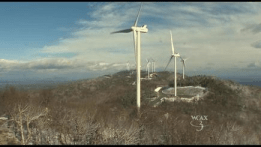
Not what you want in your backyard. Niagara Wind’s 3MW turbines and its cluster of 8 of 77 turbines now crowd the cottages and homes located in the picturesque community of Lowbank in southern Ontario. Lake Erie’s shoreline and its horizon are dominated by towering turbines of multiple wind projects visible from all views. Continued impacts to residents and migrating butterflies, birds and bats await the turning blades with the project’s anticipated start up date of fall 2016.
Category Archives: Property Rights
What side of the fence do you live on?
The discord of wind facilities hits home and personal for those who have had the projects forced onto their communities. In southern Ontario the construction frenzy of the Niagara Wind project consisting of 77 3MW wind turbines continues to defy logic and common decency.
The latest in your face example being the installation of the guard rails that were installed along the narrow rural road edges needed to protect the massive transmission poles for the project.
It has been well over a week since the heritage site of the West Lincoln cemetery was trespassed by the installation of the infrastructure associated with the Niagara Wind project which blocks access. No word as to when this will be fixed. Utter disrespect for those who have loved ones buried there.
No thought has been given to the impacts to the home owners whose front yards are now visually reminiscence of the QEW highway . The guardrails are also creating direct barriers of access for agricultural operations with farm lane entrances narrowed. Moving large slow moving farm equipment onto the public roads will become even more difficult as the option of moving over to allow oncoming traffic to pass has been removed.
Snow removal in the winter months will also be directly impacted by the endless miles of hydro pole bases and the guardrails.
Industrialization of our rural homes.
(Photos courtesy of Smithville Turbine Opposition Party)https://www.facebook.com/Smithville.Turbine.Oppositon.Party/
Legislators, please put people over profits
Recently the Vermont Senate voted against protecting Vermonters who live near industrial wind turbines.


The Senate voted against requiring sound monitoring to ensure compliance with noise pollution standards. Green Mountain Power’s lobbyist Todd Bailey, of KSE Partners, told senators that GMP could not afford to pay an unsubstantiated cost of $264,000 for sound monitoring for its industrial wind project in Lowell. As reported in Seven Days, “they (the army of energy lobbyists) got their message to Senator Bray and other senators in a hurry. The Senate voted 18-8 to strike sound monitoring from the bill.”
It is enlightening to understand GMP’s opposition to the cost of sound monitoring at industrial wind projects in comparison to other costs at Green Mountain Power. For instance, annual sound monitoring costs, estimated by ethical experts to be $50,000 to $75,000, pale in comparison to the annual compensation for company CEO Mary Powell.
According to the Valener Energy Company Management Proxy Circular, included with the March 22, 2016, stockholders’ meeting notice, total annual compensation to Powell for the fiscal year ending September 2015 was $1.9 million. Her total compensation for 2013, 2014 and 2015 was over $5 million. Her total compensation consists of base salary, annual and long-term incentive plan (bonus pay), current pension value and other compensation. Her current retirement benefit is $3.3 million.
Gaz Metro owns GMP and has determined that Powell’s long-term incentive compensation will be based on a program that “takes into account cash flow, asset base growth, and achievement of Merger savings.”
“Asset base growth” occurs whenever GMP completes a new energy project. Utilities make money by earning a return on the equity portion of their assets, called asset base in the proxy report or, more commonly, “rate base.” Rate base increases whenever a utility builds anything. Intermittent (renewable) generation assets such as wind and solar projects are extremely capital-intensive. It makes sense that GMP’s parent corporation would want to increase asset base, because it increases corporate income. The more projects GMP builds, the more money Powell makes.
The problem is these industrial wind projects are located close to Vermont families who feel their negative impacts. People who live near an industrial wind project, according to the Vermont Public Service Department, will experience “a significant impairment of quality of life,” and unlike the CEO of GMP will not be compensated by a higher bonus in their paycheck. Instead, Vermonters who live near industrial wind projects will see their quality of life deteriorate and their home values decrease. I have met with Vermonters who have abandoned their homes, are sleep deprived, get headaches, have been hospitalized, are awakened in the middle of the night with their heart racing due to a panic attack, get dizzy and nauseous or have sold homes at a loss, all because of the impact of unregulated industrial wind turbine noise pollution.
The GMP financial incentive to increase rate base resulted in a provision added to the proposed 30 megawatt Deerfield Wind power purchase agreement. GMP negotiated the power contract with Iberdrola, the entity that would develop and own the wind power project on U.S. Forest Service land that is poised to destroy critical bear habitat and the high elevation headwaters of Wilmington. It is no wonder that this agreement includes a provision that allows GMP to buy the project for $50 million in 10 years. After GMP’s long and ugly battle to build its Lowell industrial wind project, it may have found a new way to own wind projects without all the problems of building them. It contracts with a developer to build wind projects and buys the projects later, which adds assets and increases compensation for CEO Powell. Neighbors get the noise pollution and significantly impaired quality of life.
The opposition to continuous sound monitoring at Vermont industrial wind projects is also not consistent with established utility practice. The McNeil wood chip generating plant, part of which is owned by GMP, is required to maintain a Continuous Emissions Monitoring System. The CEMS equipment provides hourly data. The McNeil plant is smaller than the Lowell industrial wind project. Despite the wind industry’s well-funded denials to the contrary, it has been proven that industrial wind projects emit harmful sound emissions.
Sound generated by a wind turbine is directly related to its power output. More power output equals more sound. The real cost of continuous monitoring to the wind companies is that they would have to shut down when they are out of compliance, which would mean that the developer would make less money.
The Legislature must act to require third-party continuous sound monitoring to ensure compliance for all industrial wind projects. Legislators, please put people over profits.
READ ARTICLE: http://www.rutlandherald.com/article/20160424/OPINION06/160429743
MPAC and Wolfe Island, again.
INTRO
Several months ago Stewart Fast, a new professor at Queens University in Kingston, Ontario, undertook a study of why southern Ontario was such a hotbed of anti wind energy sentiments. His conclusions were interesting, and I’ll be having more to say about them in a future posting. As part of his study he looked at property values and in particular he looked at MPAC (the Ontario real estate assessors), Wolfe Island and the property assessment reductions thereon.
As it happens, I had also looked at MPAC and Wolfe Island and posted on it about 18 months ago. It seems that Fast and I used the same FOIA-obtained spreadsheet. My main conclusion was that there seemed to be a large number of large reductions on Wolfe Island, but there wasn’t enough of a pattern to convincingly tie the reductions to the 86 wind turbines on Wolfe’s west end.
I’ve also posted on MPAC and property assessments in a 4-part series. My main conclusion, contained in part 1′s section, was that MPAC seemed to be hiding the reductions by lowering the values in neighborhoods that just coincidentally happened to be around wind turbines, but not formally incorporating distance to a wind turbine into their regressions.
What Dr. Fast’s work added to mine was that (1) he was able to group MPAC’s reductions on Wolfe Island by their distance to the nearest wind turbine, and (2) he reminded me of how to usechi-square to test the differences between the bands for statistical significance. The quick summary is that MPAC has been providing reductions to properties close to wind turbines significantly more often that those further away. And I’m not using the word “significantly” in some fuzzy qualitative manner – I mean “significantly” in the hard statistical quantitative manner. In other words, the odds of the getting a wind-turbine-centered pattern just randomly are vanishingly small. Wolfe Island provides a good hard-to-refute example of how MPAC is finessing the numbers to deny the obvious. Continue reading MPAC and Wolfe Island, again.
Sixty Residents fighting for their Quality of Life.
This is a lawsuit to keep an eye on. It’s being heard in their State Supreme Court.
Sixty residents from Orangeville and Attica have filed lawsuits claiming that the Stony Creek Wind Farm is ruining their quality of life, destroyed property values, and is affecting their health because of noise and vibration.
Attorney Richard Lippes, who handled the Love Canal lawsuits, is representing the angry residents.
Lippes said the basis of the lawsuit claims the wind turbines were erected too close to residential homes and are now causing “adverse effects.”
The lawsuits were filed in State Supreme Court in Wyoming County and they also seek restrictions on operation of the wind turbines.
The Orangeville wind farm contains 58 wind turbines and was constructed in 2013 by Invenergy – which is the sole defendant in the lawsuits.
Invenergy issued the following statement in response:
About the Orangeville wind farm
As a clean energy leader, Invenergy is committed to successful, enduring partnerships with the communities in which our projects are located. We are grateful for the broad support we’ve received in Western New York and continue to receive from members of the community.
While support for renewable energy is strong across our country, we take seriously any concerns of those who live in a project host community. That is why we took great care in developing the Orangeville wind farm in accordance with all local, state, and federal laws and regulations. The lengthy authorization process was open and inclusive, allowing extensive opportunity for citizen input.
In addition, since the Orangeville wind farm commenced commercial operation, the facility has been operated and maintained in accordance with all applicable laws and regulations, including local zoning laws, relevant state agency directives, and Federal Aviation Administration (“FAA”) requirements.
About Wind Turbine Sound and Health
Numerous studies – conducted in countries all over the world – have found no evidence to support a link between sound emitted from wind turbines and adverse health effects.
About Wind Turbines and Property Values A 2013 comprehensive report by the U.S. Department of Energy’s Lawrence Berkeley National Laboratory studied wind turbines and home values. In analyzing more than 50,000 home sales near 67 wind farms in nine states, researchers were “unable to uncover any impacts to nearby home property values.”
About Petitioners’ Motions
The Orangeville wind farm will vigorously defend itself against the unfounded claims set forth in these complaints
MPAC Wind Turbine Property Assessment Study – Stand by for Peer Reviewed Assessments
First look at the MPAC study which is way OVERDUE! Stand by for reviews from the field. Houses that haven’t sold were not included in the study.
See original study link here which includes a link to all Appendices – http://www.mpac.ca/property_owners/IndustrialWindTurbines.asp
Presentation: “Harm from Wind Turbines: What Has Been Known for Decades”
Speaker: Carmen Krogh
Date: Wed 7 May 2014. 3:30pm.
Place: DC1302 (Davis Center), University of Waterloo
Abstract:
The topic of adverse health effects associated with wind facilities is globally debated. It is acknowledged that if placed too close to residents, industrial wind turbines can negatively affect the physical, mental and social well-being of some. In addition to the general population, at risk are the vulnerable such as fetuses, babies, children, elderly and those with pre-existing medical conditions. There is published research on the effects of Low Frequency/Infrasound (LFI) on people and animals dating back several decades. This presentation will provide some of the available evidence drawn from peer reviewed literature, authoritative references, and other sources. It is proposed that known risk of harm can be avoided by siting wind facilities a protective distance from residents.
Bio:
Carmen Krogh is published in peer-reviewed scientific and medical journals and has presented papers at scientific noise conferences. She is an independent, full time volunteer and for almost 6 years has researched health and other effects associated with industrial wind energy facilities and shares information with individuals, communities, authorities, wind energy developers, industry and others. Krogh’s background in health care, vigilance monitoring, editing and publishing helps inform her work. She held senior positions at a major teaching hospital; as a drug information researcher; a professional association and the Health Protection Branch of Health Canada (PMRA). She is a former Director of Publications and Editor-in-chief of the Compendium of Pharmaceuticals and Specialties (CPS), the book used by physicians, nurses, and health professionals for prescribing information on prescription medication in Canada. Her goal is evidence-based siting of IWTs that protects human health.
Bylaw sought for Noisy Turbines
NORFOLK – A movement is afoot that could ultimately force wind turbine companies to shut down some units after dark.
North Perth Coun. Warren Howard is touring Ontario building support for a common bylaw that would silence turbines after dark if they produce noise that is audible to residents nearby.
“The legal advice we have is we can enforce a `quiet night’ provision,” Howard told Norfolk council Tuesday. “Yes, we’ll be challenged. But the legal advice we have is we can win.”
The Liberals’ Green Energy Act stripped municipalities of planning authority in the area of renewable energy projects several years ago.
In a recent ruling, a court said that Wainfleet Township had over-stepped its authority by trying to establish a large setback for wind turbines. However, the judge also said municipalities have the right to pass bylaws on nuisance issues that affect residents’ quality of life. Read rest of article here.
In Ontario – Wind Energy Meeting Silences Public
Posted at No Frakking Consensus by Canadian author and journalist Donna Laframboise
http://nofrakkingconsensus.com/2014/02/07/wind-energy-meeting-silences-the-public/

Turbines Topple Property Prices
Dolan Nolan – January 22, 2014 – The Kerryman (North Kerry)
FINUGE HOMES LOSE VALUE… AND A SALE HAS COLLAPSED
PROPERTIES are already losing value in Finuge because of plans to locate ten massive turbines there, locals claimed at a protest meeting on Monday night.
One house sale collapsed at the last minute as buyers were about to sign on the dotted line immediately after controversy flared up over the plans by Stacks Mountain Windfarm Ltd.
Locals say they are in no doubt the sale of a house closed to the planned windfarm site collapsed because buyers didn’t want to own a home in an area that could be dominated by the massive generators.
Up to 200 people attended the public meeting in Finuge on Monday night at which anger over the plans was palpable. The vast majority of people living in the Ballyhorgan area of Finuge are fiercely opposed to the windfarm as they fear the planned 157-metre turbines would impact on their homes, cause noise and shadow flicker and affect health.
One Banemore woman who attended the meeting told how shadow flicker from a turbine behind her home is ‘constant’ and likened the noise from the turbine to a ‘plane’ in evidence that hit locals hard on Monday.
It’s expected that hundreds of individual objections to the plan will be lodged in the coming weeks as Finuge prepares for a fight locals believe will have lasting implications for all of north Kerry. HUNDREDS OF objections will be lodged by Finuge locals as part of the community’s first formal move in its fight against plans to erect giant wind turbines in the low-lying rural area.
Anger was palpable at a massive public meeting in Finuge on Monday night attended by up to 200 locals fiercely opposed to the plans which are currently before Kerry County Council.
Company Stacks Mountain Windfarm Ltd hopes to erect the ten tallest wind turbines ever seen in the State – at a height of 157 metres – in the heart of the farming community. The turbines, labelled ‘monstrosities’ by locals on Monday, would dwarf even the Great Pyramid in Egypt as well as Dublin’s Spire.
Locals say the visual impact of the turbines would utterly transform the attractive community – officially a heritage village – devalue homes, cause noise pollution and ‘shadow flicker’ and lead to a general deterioration of the quality of life in the community.
And many are now of the feeling that north Kerry is being ‘sacrificed’ by local government to supply the county’s windenergy requirements with large tracts of populated areas categorised as potential windfarm locations – from the Stacks Mountains over to Lerrig Lough in Kilmoyley.
“These things are going to be huge,” committee member Anne Quilter told Monday night’s public meeting at Dromclough National School. “Bird’s big wheel is forty metres tall, these will be four times the size of that going up here.”
Anger was also directed at the apparent downgrading of large parts of north Kerry, including Finuge, as being of ‘no scenic value’ under the new County Development Plan (CDP). “That makes me angry. I chose to come here and make my life in north Kerry,” Ms Quilter said.
“The CDP suggests that Kerry should produce one third of the nation’s renewable energy, to do that they are going to locate most of the windfarms in north Kerry…we have to fight this,” Ms Quilter said, also rejecting claims the development would result in jobs: “This is going to decimate our community.”
Clinics are to be held all week in Dromclough school where the windfarm committee will help people fill in objections. Chairman Gerry Doyle is urging locals to ring Kerry County Council planners to ensure the plan is validated as quickly as possible as no objections can be lodged before then.
The five week deadline for objections is meanwhile ticking down.
Among the most forceful evidence of windfarm impact heard on the night came from Banemore woman Shirley Thornton who said that shadow flicker and noise had reduced her quality of life. “I actually have these at the back of my house..the shadow flicker is constant coming in and the noise is like planes flying overhead.”
Locals in the Irremore side of Finuge said they can hear the Banemore windfarm – two-anda-half miles from their homes.
But the committee are optimistic at the outset of the fight. They are receiving guidance from a similar group that succeeded in blocking a wind development in Offaly.
The committee also revealed its plans to launch large balloons to the height of the turbines in an event designed to give people a real idea of the scale of the proposed development as well as to garner more publicity for their cause.
Visit Link to find original story:
http://kerryman.newspaperdirect.com/epaper/viewer.aspx