
On the shores of Lake Erie in Haldimand County- Ontario, Canada hundreds upon hundreds of industrial wind turbines intrude, harm, harass and trespass.
Category Archives: Ontario Wind
Bottom Line- We Don’t Believe You
MOECC failing as regulator: WCO
Wind Concerns Ontario president Jane Wilson says these remarks are either a sign of “stunning ignorance, or a calculated policy by the MOECC to ignore and even demean what is happening to people in Ontario.”
MOECC reps stun audience with views on wind turbine noise
Municipal officials told wind turbine noise no worse than barking dogs, no action planned

December 16, 2017
The Ontario Ministry of the Environment and Climate Change (MOECC) position on wind turbine noise is that they don’t pose a health problem.
That’s the conclusion from remarks made by Owen Sound District Manager Rick Chappell and District Supervisor Andrew Barton, speaking to the Multi-Municipal Wind Turbine Working Group in Chesley this past week.
The two MOECC managers said repeatedly indicated that they are just messengers: the MOECC’s Technical Assessment and Standards Branch is responsible for establishing the Ministry’s position on wind turbine noise and providing “advice” to local District staff when they respond to queries.
Bottom line: we don’t believe you
In their presentation and responding to questions from municipal officials in the Multi-Municipal working group, the MOECC officials outlined key elements of the MOECC position on wind turbine noise.
- They agree that wind turbines can cause annoyance. Contrary to medical literature, however, they do not use “annoyance” as a medical term denoting stress or distress. They actually compared annoyance caused by barking dogs to residents’ reactions to wind turbine noise. *
- The MOECC managers insisted the literature did not demonstrate any direct health effects from wind turbine noise, when asked about health studies and reviews on turbine noise. Despite evidence of indirect health effects raised, the staff comments repeatedly indicate the MOECC is narrowly focused on direct health effects.
- The MOECC takes a one-sided view of the Health Canada study which according to these officials only found that there was no link between wind turbine noise and health impacts. This statement ignores the second half of the findings which confirmed a link between reported health effects experienced over 12 months and wind turbine noise. They also do not seem to be aware of the findings released to WCO which indicated that annoyance starts at 35 dBA, not the 40 dBA used in Ontario.
- Their view of the Council of Canadian Academies report was similarly selective. They downplayed the key finding of this review which was that there is sufficient evidence to establish a causal relationship between exposure to wind turbine noise and annoyance in the medical sense. Also not mentioned were the issues highlighted about measurements of wind turbine noise using A-weighted tools which fail to capture low frequency components of wind turbine noise. The Council noted that averaging measurements over time does not convey changes in sound pressure levels occurring in short periods.
- In terms of low frequency noise and infrasound, the MOECC representatives relied on a statement from Health Canada that levels of these emissions were found to be below levels that would expect to result in harm to human health. When questioned, however, they were not able to quantify what the MOECC considered “safe” levels of infrasound, or when the MOECC would be acquiring equipment that is capable of measuring emissions at frequencies below 20 Hz.
- Members of the Working Group countered by referring to research that conflicted with the MOECC statements. The response from Chappell and Barton was that the Technical Assessment and Standards Development branch reviews emerging research, but limits its assessments to peer-reviewed articles in “respected” journals.
- In the MOECC presentation, staff said the 2016 Glasgow International Wind Turbine Noise Conference supported their position on infrasound and health effects. This prompted the Technical Advisor to the group — who actually attended the conference — to inform them that he sent 14 papers presented at this conference to the Ministry, because the conclusions do not support the Ministry’s position.
- Chappell and Barton did not seem to be aware of the work of Dr. Neil Kelly at NASA in the mid-1970s on low frequency noise and infrasound from wind turbines, even though it was published in respected peer-reviewed journals and presented at U.S. wind industry conferences.
- Residents affected by wind turbine noise were present in the audience. One from Grey Highlands asked when the Ministry was going to respond to the noise assessments at his home that had been provided to the Ministry. No response timeline was provided. Another asked for the position of the MOECC on people who had to move from their homes because of the impact of the noise from nearby wind turbines. The response was that the MOECC has no position except to repeat that there is no direct link between wind turbine noise and health issues.
Members of the Multi-Municipal Wind Turbine Working Group did not appear to be satisfied with the answers provided by the Ministry officials; several follow-up activities are planned.
MOECC failing as regulator: WCO
Wind Concerns Ontario president Jane Wilson says these remarks are either a sign of “stunning ignorance, or a calculated policy by the MOECC to ignore and even demean what is happening to people in Ontario.”
Wilson, a Registered Nurse, says there is a great deal of evidence in the health literature about the range of noise emissions produced by large-scale wind turbines, and growing international concern about adverse health effects.
“Of course there are health effects,” Wilson said. “That’s why we have setbacks between turbines and homes in the first place. This Ministry refuses to acknowledge it has a problem and take appropriate action — it is failing the people of Ontario as a regulator.”

*CanWEA in a 2011 news release acknowledged that a percentage of people can be annoyed by wind turbines, and the trade association said that when annoyance has a significant impact on quality of life, “it is important that they consult their doctor. The U.S. Environmental Protection Agency also describes noise-induced annoyance in legislation as a situation that “can have major consequences, primarily to one’s health.”
Source: Wind Concerns Ontario
Wind Turbine Poetry Throwdown at Queens Park

Question period saw a lively exchange of Christmas poetry with wind turbines issues being raised in Ontario’s Parliament:
WIND TURBINES
Ms. Lisa M. Thompson: My question is for the Premier:
Wind turbines still go up against a town’s will,
Just like the Grinch ignoring councils,
this gives Liberals a thrill,
They swear that the turbines are all science-based.
But will she admit real noise pollution proves
that’s just not the case?
Hon. Kathleen O. Wynne: Minister of Economic
Development and Growth.
Hon. Brad Duguid: ’Tis the session before Christmas
And I note with much joy,
The kids in our land
Will enjoy plenty a toy.
Our unemployment rate
Is the lowest in years.
This Christmas we may
Even enjoy a few beers—
from grocery stores, nonetheless.
And so we wish you all
The best of the season,
And hope that next year
The opposition will engage with more reason.
The Speaker (Hon. Dave Levac): Supplementary?
≈≈≈≈≈≈≈≈≈≈≈≈≈≈≈≈≈≈≈≈≈≈≈≈≈≈≈≈≈≈≈≈
Mr. Rick Nicholls: “Wind turbines must go,”
but the Liberals ignore
The demands of the people, as they loudly implore.
In the Alley of Carnage, the snow piles so high,
But the need for a barrier will they always deny?
Hon. Brad Duguid: It’s still the session
before Christmas
And it’s almost done.
It’s nice to spend time in this House
And even have fun.
We may be opposed to many an issue,
But when we leave this place
Rest assured,
We will miss you.
Let us focus this session
On those that are in need,
And let us work together
So Ontario can still lead.
Source: Hansard Ontario Dec.14.17
Ontario’s Opposition Party “Twas the last QP before Christmas Break”:
End of procurement of new contracts
“As a result of the province’s robust supply situation and flat yearly demand for electricity, the procurement phases of the IESO’s Feed-in-Tariff (FIT) and microFIT programs have come to an end. These programs have been instrumental in helping Ontario establish the clean energy supply mix it has today.”
IESO December 12th, 2017: Ontario’s electricity system ready for winter

Good riddance and don’t let the door hit you on your way out! Now to move onto the next order of business-canceling existing wind power contracts and halting construction of additional projects.
Ontarians taking it on the chin (& wallet)

Ontario Auditor zaps power firm charges
THE CANADIAN PRESS
Wednesday, December 6, 2017
Ryerson Wind Turbines Coming Down
Renewable Energy Approval Revoked:
EBR 013-1940
 Ryerson University has decided to decommission all 6 wind turbines in its Wind Tech research project. In 2009 the project was awarded 729, 771 from the Canada Foundation for Innovation. The rest of the 1.8 million in project funding coming from the Ontario Ministry of Research and Innovation, Ryerson and the Canadian industry.
“Wind power is associated with three difficult problems: wind is unpredictable, inconsistent and the energy it produces cannot be dispatched on demand.”
Bhanu Opathella, Ryerson researcher
The wind at his back
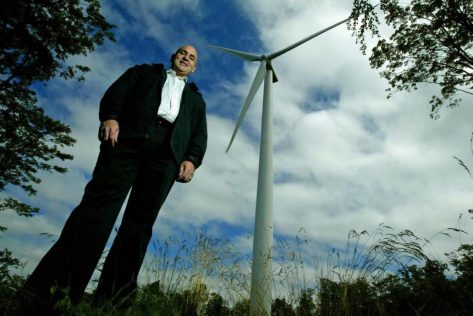
The date is September 28, 2008 newly minted Ontario Minister of Energy and Infrastructure George Smitherman gushes over a vision of the future for green-energy in Ontario. In 2009 the Green Energy Act passes and is rapidly followed by 1 000s upon 1000s of industrial wind turbines erected. Ontario bowed to political push back by pausing installation of wind turbines in the Great Lakes. Today an offshore demonstration project looms with a build date of 2018. The project proposed in Lake Erie off Ohio’s shores.
Fast forward to 2017. Minister of Energy Glenn Thibeault admits mistakes were made by government with its green energy plan. Ontario holds tight to its energy vision of a green energy industry. Wind projects are forced onto unwilling host communities. Resident’s voices of opposition muted under renewable energy legislation. At the Federal level the wind industry is championed by many, including Minister of the Environment Catherine Mckenna. The Minister recently declined to take up pleas to review cumulative wind energy projects along the Great Lakes
From visions of green energy to build out of wind projects. What do you see?
The wind at his back
By TYLER HAMILTONClimate and Economy Reporter
Sat., Sept. 27, 2008
NIAGARA FALLS–In just nine weeks George Smitherman has likely learned more about the green-energy industry than any energy minister before him, and then some.
Sitting in a meeting room at the Sheraton Fallsview Hotel in Niagara Falls, just minutes after giving his first major speech since being appointed energy and infrastructure minister in June, Smitherman enthuses like a kid who has just returned from Euro Disney.
He recounts his visit to a small community in Denmark that powers and heats itself with straw, municipal waste and geothermal energy. Then there was the neighbourhood in Freiburg, Germany, powered by rooftop solar panels atop high-efficiency homes. In Spain, he saw how the local electricity operator manages the country’s 15,000 megawatts of wind turbines and a world-class stable of solar farms.
His travels also took him to California, where he learned how the world’s fifth-largest economy used innovative conservation programs and energy-efficiency mandates to keep per-capita electricity consumption flat for the last three decades.
“Imagine a world where we could emulate their success?” asks an animated Smitherman, 44, who later turns to Amy Tang, an adviser sitting across the table. “Sorry, now I’m getting all worked up. Am I frothing at the mouth?”
The trips didn’t end there. On his home turf, he has already visited the massive Prince Wind Farm in Sault St. Marie, the Atikokan coal-fired generating station near Thunder Bay, the province’s three nuclear power stations, the massive Nanticoke coal-fired station, Hydro One’s grid control centre in Barrie, and has been inside the Niagara Falls water tunnel currently being excavated by Big Becky.
“I call it sponging. I just went out there to try and learn as much as I possibly could,” he says. “Everything I do, I learn something that’s one more piece of, let’s face it, a complex puzzle.”
Smitherman says he’s “jazzed” about his new job, a fresh change after five years as health minister. Premier Dalton McGuinty made it a promotion, insiders say, by merging the energy and infrastructure portfolios into a super-ministry.
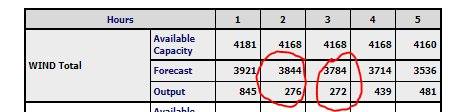
Record Curtailment of Wind Power?
WLGWAG Annual General Meeting
 ANNUAL GENERAL MEETING
Wednesday, November 29, 2017
Silverdale Community Hall, 4610 Sixteen Rd. St. Ann’s, ON
Members Election of Board 7:00 pm • Program Start 7:30 pm
• Current Situation, Locally, Provincially & World Wide • Legal actions in Ontario
• What are our Activities? Health study for those thinking of moving.
• Long term exposure and VAD • The Risks – Infra Sound – Stray Current-Water Wells
• 2500 Homes in rural in West Lincoln exposed to IWT’s • Your Questions Answered

WLGWAG • wlwag.com
Wind turbine woes won’t be forgotten
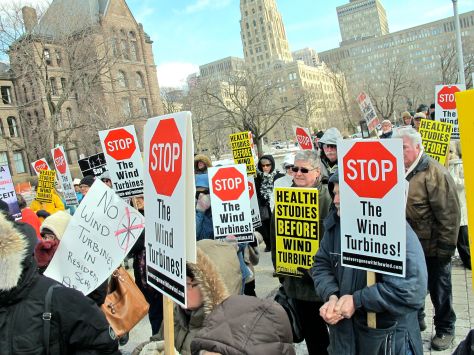
 Mothers Against Wind Turbines Inc.