Category Archives: Noise

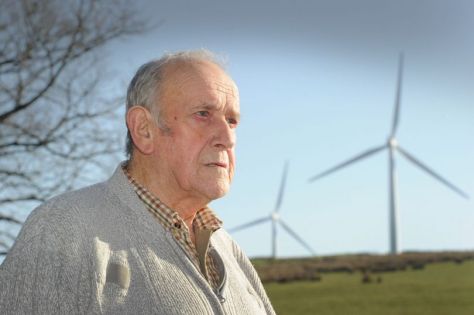
forced to give up his dog and home tormented by noise from wind project.

“Retired farmer Clifton Lockhart, 83, has lived in the house for 35 years but says the noise of the turbines has kept him wide awake.”

js111755327

Communities Quality of Life and Amenity

We will support proposals if: They do not have significant detrimental effect on the amenity of nearby residents, including from noise and shadow flicker.

The potential of wind turbines through noise, shadow flicker and visual effects to create significant long term impacts on the amenity of an area , well being and quality of life of people living or working near to them is of significant concern to local communities and residents within South Ayrshire…..

Supplementary Guidance:Wind Energy (South-Ayrshire, UK): http://www.south-ayrshire.gov.uk/documents/adopted%20wind%20energy-supplementary%20guidance.pdf

Carrick pensioner forced to give up dog and move to caravan after wind farm hell

A pensioner claims he has been forced to give up his dog and relocate to a caravan just to get a decent night’s sleep because he is tormented by the noise from a wind farm opposite his home.

Clifton Lockhart, 83, has lived in Tralodden Cottage near Old Dailly for the past 35 years, but says his golden years have been robbed from him since the turbines arrived 14 years ago and he has since been kept wide awake most nights.

The retired farmer, who is unable to read or write, told the Post he feels “pushed out of his own home” when the noise persists and now rents a caravan in Port William just to get a decent night’s sleep following a decade-long dispute with South Ayrshire Council and SSE wind farm bosses.

At his home, he said: “I have complained to South Ayrshire Council and SSE made a deal about switching the turbines off from 7pm to 10am every day, but that didn’t last long.

I then complained again to South Ayrshire Council that SSE had gone back on the deal, but I have been put through so many loops and the matter is still not resolved.

“For the past 10 years it has constantly bothered me and never gone away, it sounds like an aircraft landing when the wind picks up.

“I have had to leave my home on many occasions, people have been out to conduct their own tests but nothing has been done, I allowed them to put monitors in my house and garden but nothing changes.”

Clifton, who lives alone and uses a walking stick, now feels he will eventually be forced to move from the home he hoped to spend his final days in.

He added: “I had to give up my dog Otter a few years ago to a shelter which broke my heart. He would run off to the turbines and start barking when they were noisy, it was clear he was distressed by them and it just wasn’t fair to hold onto him any more.

“I have now came to terms with the fact this noise might not ever stop, I’ve already had to alter so much of my life quality because of these turbines, and I am concerned that I may have to pack up my life here and move.

“It has been so stressful and I feel I am being forced out of my own home.”

READ MORE: http://www.dailyrecord.co.uk/news/local-news/carrick-pensioner-forced-give-up-9859771


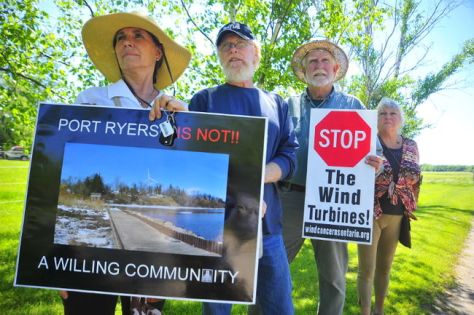
Boralex faces angry Port Ryerse residents

port-ryerse-protest
Residents protested long and hard to stop the wind turbines in Port Ryerse. The battle now is focused on the newly built and operational project. Disruptive noise and other complaints are being raised about the negative impacts to quality of life in the small tight- knit village. Boralex faces a chorus of similar complaints arising from its larger Niagara Wind project also located on the shores of Lake Erie, Ontario.

An Earful Over Wind Turbine Noise

Monte Sonnenberg.
Simcoe Reformer.
February 16, 2017

The company that brought a four-turbine wind farm to Port Ryerse last year got an earful about noise levels at a community meeting this week.

Boralex officials were on the hot seat Wednesday as 40 people from the Port Ryerse area had at them in a committee room at the Simcoe Recreation Centre.

The occasion was a bi-annual meeting Boralex has agreed to have with its neighbours. Also attending were members of the Port Ryerse Community Liaison Committee.

“It’s very loud and it’s very upsetting,” Port Ryerse resident Shana Greatrex told the gathering. “Our whole village has been affected. This is something we warned about a long time ago and no one did anything about it.”

Village residents were surprised when one of the property owners who agreed to host a turbine said his neighbours aren’t imagining things.

“I’m surprised I can hear them as loud as I do, and I wear an earpiece,” said Wally Faulkner. “They’re louder than I expected.”

Comments at this week’s meeting are consistent with complaints across the province that wind turbines are noisy, disruptive and interfere with the peaceful enjoyment of property.

In telling her story, Gail Lyons started off calm enough. However, the bitterness she feels came through loud and clear in her words.

Lyons told the gathering she lives across the road from “one of these pieces of crap that I hate” and that she is often awakened in the middle of the night because her bed is shaking.

“This is not about business or money,” Lyons said. “This is about people. Put your money where your mouth is. Perhaps you could turn them off at night so we can sleep and sit on our back decks in peace.”

Some Port Ryerse residents dread the arrival of the warm weather and the impact the turbines might have once they open their windows. They are especially upset because a community coalition warned for years that the turbines would have a negative impact on their quality of life.

The firm Aercoustics will conduct a first round of noise tests in the weeks ahead. The meeting heard it could take the better part of a year to arrive at a scientific conclusion about noise levels.

“People’s quality of life is being affected now,” said Port Ryerse resident Scott Pullen. “Why do we have to wait for months? It’s disgusting, and it’s criminal.”

Aercoustics representative Payam Ashtiani said the province doesn’t expect wind turbines to be noise-free. He added the Ministry of the Environment has concerns about ambient noise levels once they reach 40 decibels.

Boralex representative Adam Rosso was on the firing line for much of the two-hour meeting. Acting as a facilitator was Toronto moderator Karla Kolli. Kolli intervened on several occasions to keep the discussion moving in a constructive direction.

“It’s disappointing on my side,” Rosso said after the meeting adjourned. “As a good corporate citizen we’re trying to integrate these turbines into the community. There has been some positive feedback and that gives me comfort. No one would relish a conversation where there is an ideological difference with what we do. But we will continue striving to be good corporate citizens.”

Farmer Chris Van Paassen lives on Radical Road near the turbines. He’s a member of the community liaison committee.

Van Paassen places the blame for the anger in his neighbourhood on the Liberal government at Queen’s Park. The Liberals stripped municipalities of planning authority on green energy projects several years ago.

“One of the first smell tests you do with a development is ask whether it complements the atmosphere of the community,” Van Paassen said. “These turbines do not meet the smell test. You might add that the people in Toronto can’t smell it where they’re from. But that’s where these decisions are being made.”

MSonnenberg@postmedia.com

READ AT: http://www.simcoereformer.ca/2017/02/16/an-earful-over-turbine-noise

Port Ryerse Wind CLC #4 Meeting

Do you hear the wind turbine noise?

How are you affected by the noise?

Are you concerned about the noise in the summer months when our windows will be open?

Please come to the Community Meeting next Wednesday, February 15th.

We are looking for solutions to the noise levels.

We need “them” to understand that we are concerned so bodies are needed to support our concerns

If you have been filling out the Boralex Noise Complaint form please bring that along as well.

Hope to see you there!

snowy-owl
This is the project where the nesting Barn Owls (& Eagles) along with the human residents were denied protection.

Wednesday February 15th, 2017 | 6pm
Simcoe Recreation Centre (Norfolk Room) 182 South Drive, Simcoe, ON N3Y 1G5

The purpose of the CLC is to facilitate two-way communication between Boralex and CLC members with respect to issues relating to the construction, installation, use, operation, maintenance and retirement of the facility. All CLC meetings are open to the general public for observation. Questions can be submitted in advance up until February 8th to Karla Kolli, CLC Chair and Facilitator at kkolli@dillon.ca or by phone at 416-229-4647 ext. 2354. For more information about the project please visit the website at: http://www.boralex.com/projects/portryerse


Wind Power Peril- Part 2

scream-2

By Helen Schwiesow Parker — February 8, 2017

“Imagine fighting Goliath in compromised health: lives given over to complaint protocols, sound measurements, lawyers, delays, appeals, desperate pleas for relief. For some, it becomes a life of learned helplessness.”

“How have we been brought to such an extraordinary betrayal of basic human rights and social justice – a Kafkaesque world where corporate, local and state government personnel ignore and elude victims’ pleas? It is a tale of money and power shunting aside integrity and compassion, of well-intentioned individuals who don’t do their homework, of a new industrial health crisis shunned by news media who are supposed to educate, inform and protect.”

Nina Pierpont paved the way 

This is the Wind Turbine Syndrome (WTS), a constellation of symptoms first given a name by the brilliant young MD/PhD, Nina Pierpont. She followed up her astute and compassionate observations of turbine neighbors around the world with epidemiological research, using a robust case-crossover statistical design: subjects experienced symptoms that varied with proximity to the turbines. When the same subjects were placed some distance from the turbines, their symptoms abated; returning to the scene brought the symptoms back.

Pierpont found that the 1.5-3.0-MW industrial wind turbines she studied wreak these adverse health effects on about 10% of those living within 2km (1.25 miles) or more. Later studies place the percentage of people affected at 20-40% or more. Even at “just” the 10% level, this would never be tolerated by politicians or regulators with regard to peanuts, air emissions or water pollution.

As with seasickness, not everyone is similarly affected. But for many, the experience becomes literally intolerable.  Most vulnerable are the young, the old, and those who are especially sensitive to stimuli – including the autistic, those with a prior Post Traumatic Stress Disorder (PTSD), and some of us who have retreated to rural areas for just that reason.

I personally remember the mother of a young, blind autistic boy. Worried about how her son might respond to IWTs proposed for installation near their rural Indiana home, she decided to explore her question by driving with him toward one of the already up-and-running Big Wind “farms” some forty miles north. This “wind factory” had been inserted in an area that for generations had been a breathtakingly open sweep of endless farmland south and east of Chicago.

When mother and son were still miles away from the turbines, which of course she could see although her son could not, he began to whimper, holding both hands to his ears. Writhing with increasing discomfort, he eventually became distraught, in a panic, shouting in his own language and careening against the confines of the front seat, pleading with her to turn back, go home, get him out of there!! Which she did that day. But she was powerless to stop the Big Wind installation coming to their backyard – and into her young son’s already severely impacted life.

Michigan State University noise engineers explain that “Inaudible components can induce resonant vibration in liquids, gases and solids, including the ground…, building structures, spaces within those structures, and bodily tissues and cavities – potentially harmful to humans.”

Pierpont hypothesized that, in addition to these bodily sensations, a significant pathway from ILFN to symptoms includes disruption to the balance mechanisms located in the inner ear.

Research results – and Big Wind response

Audiological and acoustical consultants Jerry Punch and Richard James provide an excellent review of the recent research findings linking ILFN from IWTs with effects on health and quality of life.

In particular, Punch and James describe fascinating basic research conducted at the Washington University School of Medicine by Dr. Alec Salt, Otolaryngologist, which supports the biological plausibility of Pierpont’s hypothesis.

By focusing on distinctions of anatomy and function between the inner hair cells (IHCs) and outer hair cells (OHCs) of the inner ear, Salt and colleagues found that Infrasound and low-frequency noise signals reach the brain via OHC displacement, leading to unfamiliar and disturbing sensations outside the auditory realm paralleling Wind Turbine Syndrome victim complaints. As utility-scale wind turbines increase in size and power, the blade-pass frequency goes increasingly deeper into the nauseogenic zone.

Installed turbine size is indeed trending upward, with a lot of money riding on keeping the science under wraps or under the radar of public awareness, and regulations to a minimum.

When Denmark’s environmental protection agency proposed severely tightening turbine noise regulations to protect turbine neighbors from ILFN (May 2011), the Vestas CEO wrote the DEPA Minister: Turbines send out ILFN; the bigger they are the more intensely they do so.  It isn’t technically possible to curtail the ILFN output. Not only would your new standards serve as an unfortunate model which might be copied by other countries.

More simply, “Increased distance requirements cannot be met whilst maintaining a satisfactory business outcome for the investor.” DEPA folded, in fact turning instead to looser standards, “likely to be copied by other countries,” to the detriment of thousands of people.

The European Platform Against Windfarms (EPAW) and the North-American Platform Against Windpower (NA-PAW) – representing a total of nearly 600 associations from 26 countries – then put out a press release citing the exchange and criticizing DEPA’s manipulation of noise measurements to advance wind industry interests, to the detriment of people’s health. 

But the potentially increased endangerment of tens of thousands of turbine victims around the world was somehow deemed unworthy of widespread media attention, and Big Wind’s central players ramped up their game plan undeterred.

Shadow Flicker

While turbine health impacts due to ILFN radiation may be the least intuitively obvious, another frequently disturbing and often-minimized assailant is Turbine “Flicker” – a strobe-like effect caused by turbine blades alternately blocking and allowing sunlight to sweep the land after sunrise and before sunset. It can “pull your attention in the direction it’s moving, making you dizzy, even sick to your stomach.”

Environmental impact statements will tell you that “Shadow Flicker only impacts objects within 1400 meters of the turbine” – but 1400 meters is 0.87 mile, greater than 15 football fields placed end to end!

The common reassurance that “any issue pertaining to flicker is easily remedied” is at-best poorly thought out, at-worst deliberately false and misleading, and in any case dead wrong.

At a public forum in Fairhaven, MA, where an established neighborhood of some 6,000 people would soon host two 1.5 MW turbines, to be erected within ecologically sensitive salt marshes surrounding a quiet estuary, wind developer Sumul Shah brushed aside a question about Flicker saying: “Not to worry.  It occurs mostly before 7am.”

What!? “Shadow Strobing” results from rotating blades passing between the sun and any object which the sun would otherwise illuminate. When the sun is directly behind them, the blades of 40-story-tall wind turbines throw extensive shadows that skim rhythmically and repeatedly across buildings, trees, roadways, lawns, meadows, ponds – and people.

The direct impact extends to nearly a mile from the turbine – long after sunrise, and again long before sunset – during those magical early and late hours that photographers love, when low light washes the landscape. Jerking flashes ricochet yet further when the blade shadow strikes anywhere within view shed – strobing rock faces across the valley, lakes and ponds in between, or trees across the park.

Sleep disturbance and stress-related illness

Alongside the less familiar ILFN and landscape-strobing turbine assaults, sleep deprivation and stress-related symptoms are the most common health complaints of IWT neighbors. This is not due solely to the turbine sound volume (as some might expect), but also to its characteristics: constantly fluctuating with “swishing” or “thumping” sounds, akin to low-flying jets or the rumble of helicopters, “freakish, screeching sound sludge,” rhythmic, repetitive, throbbing and percussive. It is unnatural. People say the noise gets into your head, and you can’t get it out.

Sleep may be disturbed from yet another non-intuitive angle. In their “McPherson Study,” Ambrose and Rand note that the 22.9 Hz tone considered part of the signature IWT acoustic profile “lies in the brain’s ‘high Beta’ wave range (associated with alert state, anxiety, and ‘fight or flight’ stress reactions). The brain’s ‘frequency following response (FFR)’ could be involved in maintaining an alert state during sleeping hours….”

As enormous industrial wind turbines spread around the world, World Health Organization (WHO) 2009 Noise Guidelines emphasized that any investigation into health impacts must include the equally significant indirect effects. 

Advising the Falmouth, MA Board of Health, Dr. William Hallstein wrote: “All varieties of illnesses are destabilized secondary to inadequate sleep: diabetic blood sugars, cardiac rhythms, migraines, tissue healing. Psychiatric problems intensify… all in the ‘normal’ brain. Errors in judgment and accident rates increase.” 

Imagine bombarding a hypersensitive autistic child with strident, unpredictable, unnatural noise. Imagine our veterans struggling with PTSD, the throbbing drone of the turbines re-igniting anxiety and terror – endlessly through the years once they are back home. Imagine what happens when being “safely” back home instead predictably brings physiological destabilization: nausea, ringing in the ears, vertigo, panic attacks, memory and concentration loss, incapacity.

Imagine fighting Goliath in compromised health: lives given over to complaint protocols, sound measurements, lawyers, delays, appeals, desperate pleas for relief. At best, it becomes a challenge to re-frame every encounter, either to educate a potential ally, or to pretend this isn’t the center of your life.

For some, it becomes a life of learned helplessness: having accepted that nothing will bring relief, they give up trying. With nowhere to go, the dog sits back down on the tack. Other families and individuals … devastated, having lost their health, jobs or farms … return their keys to the bank, sell their homes at a fire-sale price, or simply pack up and flee.

How have we been brought to such an extraordinary betrayal of basic human rights and social justice – a Kafkaesque world where corporate, local and state government personnel ignore and elude victims’ pleas? It is a tale of money and power shunting aside integrity and compassion, of well-intentioned individuals who don’t do their homework, of a new industrial health crisis shunned by news media who are supposed to educate, inform and protect.

In November 2014, after a four-year investigation, the Brown County, Wisconsin board of health declared that the preponderance of evidence showed the Shirley Wind Project is a human health hazard. The news went worldwide, but the local Green Bay Press Gazette ignored it for almost two weeks.

Physician and BOH member Jay Tibbetts said, “I don’t think the average person in the United States hears anything about this issue. For some reason the news media doesn’t seem to want to cover it.

___________

Helen Schwiesow Parker, PhD, is a Licensed Clinical Psychologist and a Past Clinical Supervisory Faculty member at the University of Virginia Medical School.  Her career includes practical experience in the fields of autism, sensory perception, memory and learning, attention deficit and anxiety disorders, including panic disorder and PTSD. Part I of this three-post series was posted yesterday.

Wind Power Peril

wind-refugee

The Secret, Silent Wind Power Peril (Part I: The General Problem)

By Helen Schwiesow Parker — February 7, 2017

“From a distance, many view the massive turbines as majestic – as a clean, seemingly quiet and free source of endless energy. To numerous residents clustered within 2km (1.25 miles) or more of the pulsing machines, however, the Industrial-scale Wind Turbines (IWT) bring strangely debilitating illness – incapacitating for some, yet scoffed at by the Big Wind industry.”

“Common sense tells us that a forty-story-tall metal structure with blades as long as football fields moving at 180 mph at their tips would negatively impact quiet neighborhoods, pastoral and wilderness areas. But the extent and severity of the IWT’s effect on body, mind and spirit comes as a surprise to most people.”

Schools and airlines have become highly responsive to people with peanut sensitivities – going so far as to ban peanuts, peanut butter, peanut oil and related items. The U.S. Environmental Protection Agency and many state agencies have implemented regulations that set allowable power plant, factory, vehicle and other emissions as close to zero as possible, hoping to prevent any potential adverse effects on people thought to be the most sensitive to air and water pollutants.

But with wind power, nearly all federal, state and local authorities gloss over, ignore or bury increasing evidence that wind turbines affect numerous people living in proximity to them.

Legislators and regulators appear unwilling even to consider the possibility that some segments of our population might be extremely sensitive to infrasound, flicker, and other “emissions” from these turbines – and wind energy companies and advocates are working hard to ensure that this approach remains in effect.

Indeed, even those who seek increasing scrutiny of the wind industry generally speak of mandates, subsidies, bird and bat deaths, and impacts on wildlife habitats. Few pay attention to, or even acknowledge, the often devastating and long-lasting health impacts suffered by human wind turbine neighbors, even though clear evidence of the hazard has been available for decades.

Proper attention to this serious and widespread problem is long overdue. It is hoped that this review of available knowledge will accelerate that process.

Disregard for Turbine Health Impacts: A Longstanding Problem

Neil Kelley was principal scientist at the National Renewable Energy Laboratory Wind Technology Center from 1980 until 2011.  During the Windpower ’87 Conference, he presented one of many similar studies published in this decade by acousticians working under grants from the Department of Energy (DOE), Department of Defense (DOD), and National Aeronautics and Space Administration (NASA).

Their findings quickly became a hot topic. Infrasound (inaudible) and low-frequency (audible) noise (collectively referred to as ILFN) produced by Industrial-scale Wind Turbines (IWTs) directly causes adverse health effects, experts stated. The disturbance from the turbines is often worse indoors than outside. “Far from becoming inured to the disturbance, people become increasingly sensitive to it over time,” they noted.

The wind industry response was immediate. Any regulatory standards will reference only A-weighted measurements, they insisted, which exclude the ILFN that are known to cause problems. We will measure only outside, not inside dwellings, insist that neighbors “will get used to it,” and deny that the victims’ suffering has any basis in reality, let alone science.

NOTE: A-weighted noise measurements reflect the relative loudness perceived by the human ear, but drastically reduce sound-level readings in the lower frequencies: the slow periodic vibrations that were found to directly impact human health and wellbeing. Noise meters in common use can present measurements in both A- and C-weighted figures, using built-in electronic filters to adjust the way in which the instruments measure noise.  Clearly, the C-weighted measurement, which more fairly represents the low frequencies, must be included in any regulatory standards that address the impact of sound from wind turbines.

With billions of dollars at stake, the wind lobby overpowered any community or organization that tried to raise concerns or slow its advance. Big Wind expanded rapidly around the globe, devastating wilderness areas and agrarian and shoreside communities, while forming fraternities with other powerful interests to advance and protect its agenda.

From a distance, many view the massive turbines as majestic – as a clean, seemingly quiet and free source of endless energy. To numerous residents clustered within 2km (1.25 miles) or more of the pulsing machines, however, the IWTs bring strangely debilitating illness – incapacitating for some, yet scoffed at by the Big Wind industry.

When I’m at home I’m usually sick with headaches, nausea, vertigo, tinnitis, anxiety, hopelessness, depression. My ears pop a lot and I hardly ever sleep…. My husband and I are trying desperately to find a cheap little house we can afford away from here…. We own six acres and a beautiful home, but it’s now toxic and unsellable.… Suicide looks to be my only relief.  Land of the FREE Home of the BULLSHIT! … Million to one odds anybody contacts me back.”  

The Surprising Extent and Severity of Problems

Common sense tells us that a forty-story-tall metal structure with blades as long as football fields moving at 180 mph at their tips would negatively impact quiet neighborhoods, pastoral and wilderness areas. But the extent and severity of the IWT’s effect on body, mind and spirit comes as a surprise to most people:

“We reside in what used to be a wonderful home. After just two weeks of this machine running full tilt, I was a physical and emotional wreck!  So tired. Headaches that do not go away. Dizzy and nauseous.  Body functions go haywire – I start dropping things (can’t seem to make my hand close all the way) and fall down basement stairs. Heart palpitations. Go to ear specialist: along with Vertigo, Anger, Teeth grinding – break a tooth. Crying – no more sanctuary of home. Depression. Suicide plans. Call suicide hotline. How do you explain that you are being abused every day by a wind turbine!” 

The primary pathway of turbine assault on human health and wellbeing is no mystery. The Israeli army has used low-frequency sound pulse as high-tech crowd control for years. Low-frequency noise at high intensities creates discrepancies in the brain, producing disorientation in the body: “The knees buckle, the brain aches, the stomach turns. And suddenly, nobody feels like protesting anymore.… It has no adverse effects, unless someone is exposed to the sound for hours and hours.”

But indeed, thousands of IWT neighbors around the world are subjected night and day, some now for decades, to these sub-audible (slowly vibrating) sound waves sent out as turbine blades spin past the shaft, setting up vibrations within body cavities: ears, eye sockets, skull, lungs, and belly.

People are made nauseous and confused, with blurred vision, vertigo, headaches, tachycardia, heightened blood pressure, pain and ringing in the ears, difficulties with memory and concentration, anxiety, depression, irritability, and panic attacks arising when awake or asleep.

The effects of the turbines run from annoyance with the audible sound and shadow flicker to downright anguish from panic attacks which can feel like a death/dying episode of extreme pain. These are brought on by first a bit of nausea and upset stomach, extreme light headedness, and then the bad part: constriction and wringing of my insides. Sometimes I try to hang by a doorframe, other times I just lie on the ground if I can’t make it to the house. It is truly an inner body disturbance.” 

___________

Helen Schwiesow Parker, PhD, is a Licensed Clinical Psychologist and a Past Clinical Supervisory Faculty member at the University of Virginia Medical School.  Her career includes practical experience in the fields of autism, sensory perception, memory and learning, attention deficit and anxiety disorders, including panic disorder and PTSD.

READ AT: https://www.masterresource.org/windpower-health-effects/secret-silent-wind-power-peril-1/

Enercon Admits Liability for Noise Pollution

13241387_952879334831276_3080059692547901511_n
Niagara Wind’s Enercon wind turbines in West Lincoln, Ontario

In Irish High Court Enercon admitted its liability for claims of noise pollution created by its wind turbines.  Several families in Cork sued the wind turbine manufacturer claiming the noise from its wind turbines were creating ill health that resulted in some of the families having to abandon their homes.  The decision is being watched closely worldwide. This  lawsuit has implications for Niagara Wind project in Ontario as some residents are already reporting ill health and negative symptoms since the installation was commissioned in late 2016.

Wind farm being sued by families admits its liability

Monday, February 06, 2017

By Claire O’Sullivan
Irish Examiner Reporter

The case is next listed for hearing on April 25, and will be closely observed by many of the families living in close proximity to wind farms and who claim that there should be a greater distance between homes and turbines.

The case against Enercon Windfarm Services Ireland Ltd and Carrigcannon Wind Farm Ltd was taken by the Shivnen family and another six households in Banteer including couples, families, and one single occupant.

The householders had claimed their health had been affected by the noise emanating from the turbines since they began operating in November 2011.

Planning regulation around wind turbines remain governed by 2006 guidelines which allow companies to build turbines within 500m of private dwellings.

Updated guidelines stipulating how far wind turbines should be set back from residential homes are three years overdue.

These guidelines will also deal with noise and ‘shadow flicker’ from the turning blades.

Up to 7,000 submissions were made in the public consultation process that followed the issuing of draft guidelines by the then minister for housing Jan O’Sullivan, which set down a mandatory minimum setback of 500m “for amenity considerations”.

The draft guidelines also set a maximum day and night noise limit of 40 decibels for future wind energy development, measured outdoors at the home nearest to the wind turbine.

The guidelines also stipulated that there should be no shadow flicker at home within 10 ‘rotor diameters’ of a turbine.

The Shivnen case appeared before Mr Justice Gilligan on December 6 where the Court recorded that liability had been admitted by the defendants.

A spokesman for Enercon was unavailable for comment.

A spokesman for the Department of Housing, Planning Community, and Local Government said that, due to the programme for government, ongoing policy, and legal developments, the Department is continuing “to advance work on the guidelines and related matters in conjunction with the Department of Communications, Climate Action and the Environment, in order to bring the various issues to a conclusion as early as possible”.

“It is expected that a statement on the matter will be made in the coming weeks, outlining the timelines for implementation of the various elements,” said the spokesman.

READ AT: http://www.irishexaminer.com/ireland/wind-farm-being-sued-by-families-admits-its-liability-442172.html 

Kafkaesque world of windmill neighbors

despair-400.jpgThe definition of “Kafkaesque”: “Describing something that is horribly complicated for no reason, usually in reference to bureaucracy.” Neighbors of operating and proposed wind projects are watching in disbelief as they witness the Public Service Board (PSB) issue Orders affirming the rights of the wind industry while putting neighbors through expensive, time-consuming legal processes that tramples neighbors’ rights and provide no relief.



Paul Brouha of Sutton lives 6,385 feet from the nearest turbine in the Sheffield Wind plant. He filed his first noise complaint on Dec. 24, 2011, after the wind turbines began operating in October. The PSB dismissed his complaint.

Brouha hired a noise expert who conducted testing and found that instead of the 15 decibels (dBA) noise attenuation between outside and inside projected by wind company experts, the home attenuated 1 dBA.  The expert’s measurements showed “multiple and frequent violations of the CPG noise criteria.”  The PSB ordered the Department of Public Service (DPS) to investigate the complaint early in 2014. DPS hired a consultant who conducted the same test on July 1, 2014.

In January 2015, Brouha filed a nuisance lawsuit in Superior Court in Vermont.

In Sept. 2015, DPS reported to the PSB that Sheffield Wind exceeded interior noise standards 10-14% of the time.

At the end of 2015, the PSB opened an investigation. Sheffield Wind moved to stay Brouha’s nuisance lawsuit which they had moved from Superior to Federal Court.  The Federal judge approved the stay request until the PSB ruled on the complaint.

Brouha’s nuisance complaint has been held hostage by the PSB’s laborious investigation and enforcement process for a year, during which Sheffield Wind, DPS, and Brouha filed written arguments about whether or not a violation occurred.  Brouha argued that the project is in violation.  Sheffield Wind vigorously argued that new monitoring must take place.  The PSB Hearing Officer agreed.  Brouha filed a Motion to Reconsider six months ago.  The Hearing Officer has not ruled.

The parties agreed to have their noise experts meet to try to agree on a new monitoring plan.  They did not come to agreement.

On Jan. 25, 2017, the Hearing Officer held a daylong technical hearing in Brouha’s noise complaint case.  Each expert’s noise monitoring plan was presented.  Sheffield Wind wants an entirely new protocol.  DPS argues for a protocol that would change the noise standard.  Brouha asks to use the protocol originally approved by the PSB.  The hearing did not finish, so three PSB staff, five attorneys and their experts will return to the PSB for another hearing.

Brouha has spent nearly $350,000 so far attempting to get his noise complaint addressed.  No end is in sight.

Melodie and Scott McLane live 3800 feet from the Georgia Mountain Wind turbines. After they filed more than 30 noise complaints, the PSB opened an investigation in Nov. 2015.  In March 2016 the McLanes filed a complaint about the turbines operating under icing conditions.  The PSB opened another investigation.

Attorneys for GMW (same attorneys representing Sheffield Wind), DPS and the McLanes argued on paper about whether an attenuation test at the McLane home should be conducted, and whether the winter operating protocol required the turbines be curtailed under icing conditions.  GMW vigorously argued against testing at the McLane home.

The McLanes also filed a noise complaint along with the icing complaint, because they experienced the loudest noise for the longest period of time since the turbines began operating in 2013.  In every filing in the icing docket, the McLanes reminded the PSB that they also were filing a noise complaint.

Recently, the PSB issued an Order[1] finding GMW violated its CPG by operating its wind turbines under icing conditions in March 2016, and issued a negligible $2000 fine.  The same day, the PSB fined a solar company[2] $17,000 for failing to comply with a condition involving a fire lane.  No one was harmed by the failure of the solar company.  The McLanes sleep is regularly disrupted by the wind turbine noise.  The PSB declined to address the accompanying noise complaint.

In response to the McLane’s 2015 noise complaint, both the PSB Hearing Officer and DPS recommended testing to determine the attenuation of the noise from inside to outside. The Board denied[3] the testing but gave the McLanes and DPS ten days to file paperwork asking to engage in further discovery and cross-examination of GMW’s expert to decide if outside to inside testing should be done.

The McLanes also filed a Motion for Relief in Nov. 2015.  In denying that motion[4], the PSB said, “Nothing in our Order today prevents the McLanes from seeking any individual relief that may be available to them in a forum that has the requisite authority to review their personal circumstances and to take action as may be warranted.”  In other words, they can file a nuisance lawsuit in court and follow Paul Brouha down the path that leads back to – the PSB.

The legislature says it’s the PSB fault.  The PSB says it’s the legislatures fault.   Vermonters are victimized while the wind industry profits.

Annette Smith is Executive Director of Vermonters for a Clean Environment, Inc.  She is the Burlington Free Press’s 2016 Vermonter of the Year.

  1. 8167-memo-and-scoping-order
  2. 17000civilpenalty
  3. 26360527605365onbase-unity_96132205239795106026150
  4. 26365632768515onbase-unity_9630467781853243962494

Published: January 30, 2017  http://vermontbiz.com/news/january/annette-smith-kafkaesque-world-windmill-neighbors?utm_source=VBM+Mailing+List&utm_campaign=4405d9e165-Enews_2017_01_30&utm_medium=email&utm_term=0_85838110bc-4405d9e165-285543701 

Public makes noise on wind regulations; PSB hosts discussion of sound limits

sally
Sally Collopy attends 1st PSB meeting on IWT noise limits

Credit:  By Tom Benton, Messenger Staff Writer | St. Albans Messenger | Jan. 12, 2017 |

MONTPELIER – The Public Service Board (PSB) held its second workshop to gather information regarding industrial wind sound limits in Montpelier on Jan. 9. This time, members of the public dominated the proceeding.

The Vermont legislature has tasked the PSB with creating sound regulations for industrial wind facilities by July 1. The PSB held an initial information-gathering workshop on Dec. 2, at which government agencies, specifically the Department of Public Service, dominated the proceedings. Members of the public in attendance criticized the PSB for not allowing the public due time, so the board established a follow-up workshop session.

The last workshop took several hours, from mid-morning until the early evening. The second workshop took only two-and-a-half. There were just two presentations, by Les Blomberg, director of the Noise Pollution Clearinghouse, a Montpelier-based national non-profit devoted to combating “noise pollution,” and by Olivia Campbell Anderson, the executive director of Renewable Energy Vermont, another Montpelier-based nonprofit, in this case supporting industrial efforts to increase renewable energy.

It was an even split between those advocating for tighter restrictions on industrial wind, arguing higher wind sound levels damage human health, and those advocating for less-harsh regulation, arguing strict restrictions on wind projects damage the economic prospects for renewable energy in Vermont. But those tighter-regulation advocates dominated the floor, with almost a dozen members of the public present to support them and voice their own concerns, sitting around the small conference room adorned in their trademark lime-green reflective vests.

Blomberg listed frequently used international wind sound regulatory tools. He said 89 percent of wind sound ordinances are based on public nuisance reports, 82 percent specific to the time of day and 70 percent based on zoning regulations. Blomberg did not share specific citations during his presentation, and members of the PSB consistently pressed him for more specificity. Blomberg spoke in favor of constant, 24/7 monitoring of wind facilities’ sound output, prompting the board to ask how that could feasibly be accomplished, a question for which Blomberg did not have a specific response.

Blomberg’s presentation was most clear when it was most simple, never more so than when he presented a list of six problems with industrial wind noise and six ostensibly simple solutions. Blomberg’s list stated regulatory techniques for wind turbine sound are too complicated, and suggested using setbacks, a mandatory distance between any industrial wind project and a homeowner’s house or even property line, and metrics based on maximum sound outputs rather than average sound outputs. But as with the rest of his presentation, Blomberg struggled when pressed by members of the PSB for specifics.

Anderson’s presentation was a brief reiteration of statements made during the last workshop: a 45 decibel (dB) average-based monitoring model is sufficient to protect the public health. She referred to many of the reports cited by the public opposition as “outlier studies” too constraining for project feasibility, advocating for limits “beyond what’s necessary for public health.” She said long-term monitoring of industrial wind projects is “onerous,” and threatens the economics of the industry without any benefits to the public.

Annette Smith, the director of Vermonters for a Clean Environment, the state’s foremost industrial wind opposition group, pressed Anderson. “Are you a noise expert?” Smith asked.

“No. Are you, Annette?” Anderson retorted.

Anderson presented a vast and specific list of international wind sound limits. But when Smith asked if Anderson had investigated the success of those limits, a question members of the PSB echoed, Anderson said no. “We’d have to reach out to those jurisdictions,” she said.

Members of the public in attendance frequently raised questions or concerns throughout both presentations. Fairfield resident Sally Collopy summarized public disdain after Anderson’s presentation, in which Anderson, like state and industry representatives during the last workshop, used the term “in reality” to contest assertions made by members of the public.

“We keep hearing ‘in reality,’” Collopy said. “The ‘reality’ is the people living with it.” She said the board faced “complete disagreement” from each side of the argument on sound monitoring. “You’ll never get the answers you want – and it is desperately needed – unless you can secure an independent party,” Collopy said.

Republican House Representative Marianna Gamache represents the town of Swanton, the proposed site for the controversial Swanton Wind project. Gamache was a member of the House Energy Committee, where the bill requiring the PSB to create a sound rule began. She said the House bill set a Jan. 2018 deadline for the rule’s creation. The Senate changed the deadline to Sept. 2017, and the bill finally passed with its current July 2017 deadline.

Gamache suggested the PSB request an extension “given the amount of material you have to sort through.”

“There was a general agreement in our committee that if you needed more time, all you have to do is request ii,” Gamache told the board.

The PSB’s workshops were not official hearings. Those will follow the creation of a preliminary sound rule. However, anyone can submit comments regarding any potential wind sound regulation to the PSB at psb.clerk@vermont. gov.

READ AT: http://www.samessenger.com/public-makes-noise-wind-regulations/

It’s Official- wind farms are a Damned Nuisance

lady-noiseThe link to the posting on The Law is My Oyster seems to be broken- so we have copied and pasted the posting.

The tort of Nuisance – basic principles

The law of (private) nuisance has been around for a long time but it has always been a poor neighbour to the more commonly litigated torts of negligence and trespass.

In a nutshell, a nuisance is “any continuous activity or state of affairs causing a substantial and unreasonable interference with a [claimant’s] land or his use or enjoyment of that land”(Bamford v Turnley [1860] 3 B&S 62).  Private nuisance is a tort or civil wrong, unlike public nuisance, which is a crime.

Something that farmers leasing their land to wind farms might not know is that a landlord can be liable where the lease is granted for a purpose which constitutes a nuisance, as in Tetley v Chitty [1986] 1 All ER 663.

For there to be a claim in private nuisance, the claimant must show that the defendant’s actions caused damage. This can be physical damage, or discomfort and inconvenience. The test for remoteness of damage in nuisance is reasonable foreseeability. In other words, was it foreseeable that a wind turbine will cause discomfort and inconvenience to nearby dwellings?  The test is an objective one: was the nuisance reasonably foreseeable? If it was, the defendant is expected to avoid it.

It is impossible to specifically define what is or what is not unreasonable but factors that are taken into account include the nature of the locality where the nuisance took place, the time and duration of the interference and the conduct of the defendant.

The plaintiff must show that the defendant’s actions have caused an interference with their use or enjoyment of their land or home/property. These interferences are indirect, and almost always the result of continuing events rather than a one-off incident. The courts have allowed cases where the interference causes emotional distress, like continuous noise / infrasound for example.

The granting of planning permission does not constitute immunity from a claim in nuisance.

The families of Shivnen, Whelan/Walsh, Sexton, Sheehan, Duggan, McSweeney and O’Connor, versus Enercon Wind Farm Services  Ireland Limited and Carraigcannon Wind Farm Limited

It was with considerable interest then that we waited for the outcome of the action in nuisance brought by the seven families from Cork who were impacted by noise pollution from a nearby Enercon wind farm. A number of the families had to abandon their homes because of the severity of the noise and some lived up to a full kilometre from the wind farm.

A judgment against the wind farm would have constituted a powerful precedent to be used against the wind industry given the multitude of examples of Irish families living in misery due to unwelcome turbine neighbours. It was for that reason that the defendant settled the matter (probably at the instance of, and financial assistance from, IWEA). Although settlements are always better for the parties concerned as it avoids the huge emotional and financial cost of litigation, it does mean that we do not have that precedent in Irish law (although there are a number of foreign precedents – see https://the-law-is-my-oyster.com/2014/11/16/are-windfarms-torture-farms/).

Although the defendant wind farm admitted liability (nuisance-order-dec-2016) the wind industry will seek to minimise this by arguing that this was a “one-off” situation for any fallacious reason that they can think of: “the unique terrain; the extraordinary sensitivity of the plaintiffs; etc etc.” Expect a carefully worded press release soon in your nearest rag.

There is still one more opportunity to achieve a damning precedent though. The case is listed for ten days in the High Court commencing 25th April 2017 to deal with damages and costs. If the High Court was to make a massive award of damages (i.e. in the millions of euros) that would send a very strong message to the wind industry that Ireland is simply not suitable to build wind farms, due to the scattered population leaving very little wide open spaces, and in they insist on building them next to people’s homes, they must be prepared to pay a lot of money, which is what the wind industry is all about anyway – money. Don’t believe all the “green” rhetoric – if you hit them hard in the pocket, they will leave, our subsidies notwithstanding.

It is for that reason that there will very likely be a financial settlement. Good news for the family involved – they can avoid the ten days of litigation and get on with their lives. Bad news for the Irish rural population, as again there will be no precedent and it is guaranteed that the settlement will come with a gag order that will prohibit any of the families disclosing the details of the financial settlement. One would almost pray for a wealthy benefactor to compensate the families up front so that the ten days’ litigation could continue (assuming that the notoriously conservative High Court would hand down a decent damages award in the millions). Any friendly millionaires out there willing to step up to the plate?

https://the-law-is-my-oyster.com/2017/01/07/its-official-wind-farms-are-a-damned-nuisance