Category Archives: Uncategorized

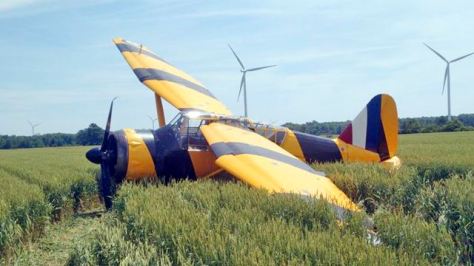
Emergency Landing in Haldimand Avoids Wind Turbines.

haldimand airplane crash

A Second World War plane successfully dodged the wind turbines and landed safely  after experiencing engine problems. The off airport landing was in a field outside of Cayuga and occurred on June 18, 2016 in Haldimand County.  The pilot and passenger were reported to be uninjured.

READ MORE: http://globalnews.ca/news/2771509/quick-thinking-pilot-lands-heritage-wwii-plane-in-ontario-field-after-engine-trouble/

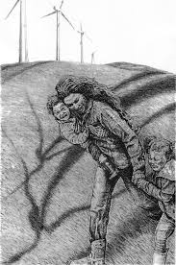
Clean Energy or Tax Burden for Our Children?

child-wind-turbine

By DONALD MORAN

For The Vista

I retired three years ago to Fairfield Glade, Crossville, Tennessee. I heard about the Crab Orchard Wind Farm in April of 2016, although wind speed studies and lease agreements with landowners was started in 2014 by Apex Clean Energy LLC.

My original opinion of wind farms was positive, if the right location was chosen.

Apex Clean Energy LLC held several open house meetings to discuss their project with residents of Crab Orchard and Fairfield Glade. I attended one of these meeting in Crab Orchard and one in Fairfield Glade.

I asked the following questions:

Me: What type of wind turbine will you use? Manufacturer, model, and size.

Apex: We have not decided.

Me:: Will the size of the electrical cables on TVA’s power grid need to be upgraded?

Apex: No.

Me: Who are the land owners that you lease from?

Apex: We can not release that information.

Me: What is cost to remove a wind turbine after it’s useful life is over or the wind farm closes?

Apex: We do not have that information.

Me: Will money be put aside to remove the wind turbines after their useful life or the wind farm closes?

Apex: Yes, we will put aside a bond fifteen years after the project is completed.

Me: Where can I get verification that this bond will be set aside?

Apex: It is in the lease agreement with the land owners.

Me: Can I get a copy of this land owner agreement?

Apex: No. It is private and proprietary.

Me: Which Federal subsidy will you chose the Production Tax Credit or the Investment Tax Credit?

Apex: Investment Tax Credit.

Me: Will Apex sell this wind farm after completion?

Apex:   We are not actively looking for a buyer. We might have the funds to own and operate, but most likely will only be the operator not the owner.

As you can see from Apex’s responses, there was nothing open about their open house.

Apex displayed before (no turbines) and after pictures (showing simulated pictures of turbines) from different locations in the area. Apex did a great job of making a 550’ to 650’ turbine look almost invisible in most of their after pictures. Apex also said property values of homes near wind farms will not be affected, and no health problems will be experienced. Based on these meetings I went to the internet to do my own research.

Apex’s president Mark Goodwin’s goal is to “sell projects as they come into operation”.

Does it really matter who owns Crab Orchard Wind Farm? Yes it does! Wind turbines have a useful life of 15:  25 years, and then must be removed. The cost to remove one turbine is about $100,000 dollars. This would be $2.3 million dollars for Apex’s

23 proposed turbines. Remember the bond put aside for turbine removal, that is in the lease agreement with the landowner, if Apex sells to someone else what will be in the new lease agreement? Who is responsible for this bond money to remove the turbines, Apex, new owner, landowner, or taxpayer? We are not allowed to read this lease agreement to determine if there really is a provision for bond money. The same problem exists if the wind farm closes.

Can wind farms survive without government subsidies? The U.S. Department of Energy offers two types of subsidies for wind farms to choose from. The first is the “Investment Tax Credit”, this is a one time payment equal to 30% value of the facility. The second choice is the “Production Tax Credit”, the government pays $0.023 per KWH produced for 10 years. Subsidies started in 1992, four times they were stopped and then restarted. The first time subsidies were stopped was 2000, and there was a 92% drop in installations, stopped again in 2002, and 76% drop in installations, stopped again in 2004, and 76% drop in installations, and finally in 2013 they stopped, and 92% drop in installations. President Obama has a 2016 energy proposal to make these subsidies permanent. WIND FARMS CAN NOT SURVIVE WITHOUT SUBSIDIES.

Warren Buffett” We get a tax credit if we build a lot of wind farms, that’s the only reason to build them.”……………

READ AT:   http://vistanewspaper.com/crab-orchard-wind-farm-clean-energy-for-our-children-or-taxpayer-burden-for-our-children/

“Road Warrior” Prints

road warrior

The Devil whispers “You can’t withstand the Storm”.
The Warrior replies “I am the Storm”.

Prints Now Available:

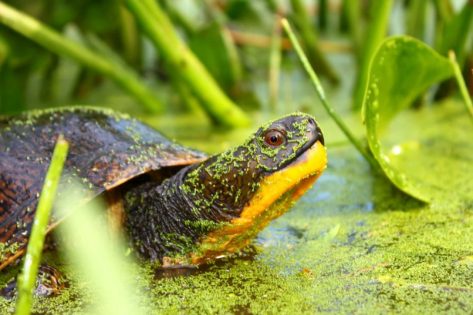
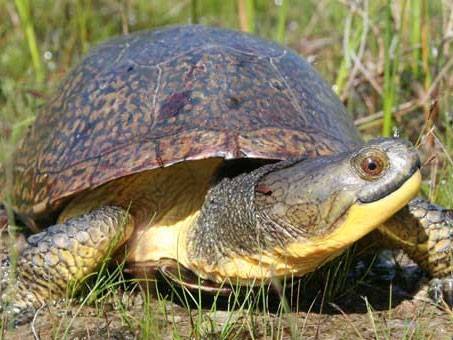
For Amherst Island and Prince Edward County, the Blanding’s Turtle symbolizes the need to protect Ontario’s sensitive environment.

“Road Warrior”, a limited edition print numbered and signed by esteemed artist Peter G. S. Large is now available. Only 50 hand-tinted, numbered prints have been created. Derived from an original drawing the prints are 19 X 13 inches printed on acid-free archival watercolour paper and are sold unframed and unmatted. The “Road Warrior” watermark does NOT appear on the print.

Peter G. S. Large is an award-winning Canadian artist. He is Past President of the Society of Canadian Artists, Member of the Ontario Society of Artists, Professional Member and Past-President of the Arts and Letters Club of Toronto.

The price is $200 with all proceeds generously donated by Peter to the Association to Protect Amherst Island.

Free delivery is available on Amherst Island, in Prince Edward County and in Kingston. Otherwise shipping is $25.

Please etransfer $200 to protectai@kos.net or make your cheque payable to APAI and send along with your contact information to Box 6 Stella ON K0H 2S0.

Contact protectai@kos.net to arrange to see the print or visit Peter in his studio on Saturday July 9 from 9 to 5 as part of the Amherst Island Art Tour. Start at the Neilson Store Museum and Cultural Centre 5220 Front Road Stella ON to obtain your map and directions.

Thank you for your support of the Association to Protect Amherst Island: http://www.protectamherstisland.ca/


20 Cures for Ontari0’s Green Energy Diaster

wind refugee

Jim McPherson, Special to the Toronto Sun

The Ontario government has massively subsidized with our money the creation of wind and solar factories across the province that are unhealthy and unsafe, both for human beings and the wildlife we claim to care about.

Wind factories are unsafe because they make many of their human neighbours sick.

They are proven killers of birds, bats and other wildlife.

Wind turbine noise causes community annoyance, as determined by a 2014 Health Canada study that was denied scientific peer review.

Health Canada has set no standards for potentially harmful acoustic radiations from industrial wind turbines, the largest radiating devices in rural communities.

An Ontario Environmental Review Tribunal confirmed last week that a wind turbine project would cause serious and irreversible harm to endangered Blanding’s turtles in Prince Edward County.

Wind and solar factories are inappropriate, giant megastructures that have been imposed on rural municipalities across Ontario, whose power to influence such decisions was taken away by the Green Energy Act of 2009…..

READ AT:  http://www.torontosun.com/2016/06/14/20-cures-for-ontarios-green-energy-disaster

Nation Under Siege

“The only thing we have left is the quiet,” he says. “Now they want to take that away.”

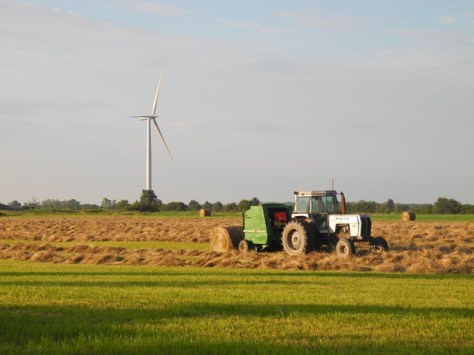
turbine and tractor

By Candice Vetter – AgriNews Staff Writer

ST. ISIDORE — André Castonguay’s dairy farm lies between Casselman and St. Isidore in The Nation Township, a few minutes north of Highway 417, where his family has farmed for four generations.

A tour of the area, going within 15-minute drives (or less) in different directions from his farm, reveals what appears to be disregard for the rich soil and long-established agricultural community there. The land is flat, very fertile, and lies lush between tributaries of the South Nation River, and it is well drained and dotted with farms and barns. It is also covered with unpleasant land uses, most of which surround Castonguay’s 200-cow operation and large farm…..

Almost home, he arrives at the place marking the latest intrusion into the community. It’s the meteorological tower which measures wind, and is one of the places where a wind turbine is proposed as part of a huge array of turbines that will spread across the landscape. The Parc eolien Gauthier project was recently given the green light by the province, even though the township declared itself “not a willing host” and its citizenry voted 80 per cent against allowing the large turbine project into the community. He stops and opens the truck windows. “What do you hear?” There is silence. “The only thing we have left is the quiet,” he says. “Now they want to take that away.”

READ AT:  http://www.agrinewsinteractive.com/fullstory.htm?ArticleID=15033&ShowSection=News

Mandatory Setbacks for Industrial Wind Turbines


stopwiatrakom_eu

A NATIONAL ONLINE PLATFORM FOR SAFE WIND TURBINE SETBACKS FROM HOMES

PRESS RELEASE, 10 June 2016
Polish Parliament adopts mandatory setback for industrial wind turbines (10 times turbine height)

On 9 June Polish Senate approved the bill providing for mandatory setbacks of new wind farm developments from residential housing, which had already been passed by the Lower House several weeks ago. To become law, the legislation must now be signed by Polish President Andrzej Duda and officially published. The law is expected to come into effect as from 1 July 2016.

This new regulation affects rural communities in a number of important ways:- future wind farms may be sited exclusively on the basis of local “spatial development” plans as adopted by municipality councils. Formerly wind farms could be approved individual decisions of local authorities (mayors); – the law provides for mandatory setbacks for industrial wind turbines of 10 times turbine height (total height of a wind turbine, including the blades) from residential housing and “valuable natural areas”, such as Natura 2000 and national parks. Formerly there have been no formal planning requirements in this respect;- it introduces a new definition of “building structure” into Polish law. The entire wind turbine is now defined as a “building structure”. Formerly the blades and the turbine were not treated as the structure’s components and as such not subject to any technical supervision; – the law transfers the authority to issue environmental permits from municipal authorities to regional government agencies specialising in environmental protection issues (Regional Environmental Protection Directors).

It needs to be noted that this legislation does not provide for the liquidation of any existing wind farms, does not affect in any way the current operation of these plants or the public subsidy system for industrial wind energy.

A recent report by the Polish National Auditor (NIK) analysed the failure to safeguard thepublic interest in local planning and approval processes for wind farms. Based on a multiyear inquiry covering 70 local and county level authorities, the report identified massive conflicts of interest (wind farms being sited on lands owned by local officials approving the projects), other widespread violation of local government laws, the lack of proper measurement of sound emissions from wind farms, and failures to properly consult with local communities about the projects.

The Polish Public Health Institute (PIZP-PZH) issued a recommendation that wind farms should be located at least 2 kilometres from people’s residences, citing a comprehensive review of current scientific publications (close to 500 items) and the precautionary principle that is part of the EU law.

Editors of stopwiatrakom.eu

stopwiatrakom sign.png

Celebrate

ostrander point shore

This changes everything. The decision by two Environmental Review Tribunal members to deny a developer from constructing nine industrial wind turbines on Ostrander Point, in Prince Edward County, this week restores limits to a bad law and puts boundaries between the Wynne government and the natural world—particularly endangered species. There is, once again in Ontario, meaningful protection for creatures that our government is willing to kill in the name of green energy.

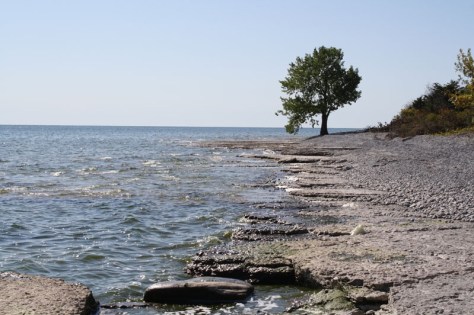
Ostrander Point was always a bit of an over-reach. There is scarcely a more rugged and undeveloped stretch of shoreland on Lake Ontario than what lies between Points Petre and Traverse. It is perched in the middle of perhaps the most important migratory bird pathway in North America. Jutting into Lake Ontario, Prince Edward County presents an important resting place for birds preparing for or completing  a lake crossing.

Its wild shores provide the essential ingredients of life for a surprisingly diverse range of animals, birds and plants. The alvar landscape defines a rare and special habitat that deserves protection.

We used to care about such things. It mattered that the frailest creatures around us might be teetering on extinction. We took steps to ensure we didn’t purposely and knowingly contribute to their demise. We believed that we shared this planet with other living things.

So we established rules, regulations and laws to safeguard the most vulnerable. We taught the importance of natural ecosystems in school. We illustrated the fragile bonds that link the amoeba to our food supply and the interconnectedness of the natural world.

We understood these things once.

But then we became frightened. We were told the end was coming. Human activity was over-heating the planet and threatening our species, and our beach houses. Now it was personal.

How quickly we chucked our pretense for caring for the natural world. In 2009, then- Premier Dalton McGuinty, driven by equal parts arrogance and fear, enacted the Green Energy Act—a vile and poisonous bit of legislation.

Its primary goal was to eliminate the barriers to industrial wind and solar energy in the province. Developers and others insisted that McGuinty eliminate safeguards and protection established over decades. There was simply no other way to scale up to the thousands and thousands of industrial wind turbines the Premier dreamed of erecting across Ontario.

The Green Energy Act removed decision-making for these projects from local government. It diminished the Ontario Energy Board’s ability to guide the development of the province’s electricity system. No ministry was untouched. Each was ordered to fall in line and get out of the way.

Nowhere was this edict imposed in a more Orwellian contortion of purpose than inside the Ministry of Environment and Climate Change and the Ministry of Natural Resources and Forestry. These folks know the consequences of their actions. They know that when they sign a permit that enables a developer to harm, harass and kill an endangered species, they are doing something very bad for the beasts they have been entrusted to protect. To care for.

The Prince Edward County Field Naturalists (PECFN) knew this too. So they have fought back. For four years, they have battled the province and its ministries in a series of hearings and court rooms. Arrayed against a phalanx of lawyers representing the government, the developers and the industrial wind energy sector, PECFN has argued for mercy for the most vulnerable in the natural world.

We don’t have to exterminate other species to salvage our own. We don’t have to ravage nature to protect our notion of the planet. We don’t have to diminish the well-being of our neighbours in our clumsy and ill-considered attempt to man-age the weather.

This week, Heather Gibbs and Robert Wright drew a line. A line that had nearly been erased by the McGuinty government and the Green Energy Act. The Tribunal adjudicators ruled that the development of renewable energy doesn’t override the environment. They have made it clear that endangered species are deserving of meaningful protection—that no government ambition, noble or otherwise, can obliterate that.

Further, the Gibbs-Wright decision injects some much-needed humility into the discussion of the natural world and our role in it. They acknowledge that our knowledge of the forces shaping nature is incomplete. Yet our government signs pieces of paper that give licence to kill an already-weakened species—a species we know to be vulnerable. This is shamefully reckless.

The Gibbs-Wright decision now instructs future Tribunals to consider the principle of precaution—to weigh the risks of development versus walking away—not with certainty, but with the understanding that we can’t know the full consequences of our actions.

“…[government] staff should exercise caution and special concern for natural values in the face of such uncertainty,” wrote Gibbs and Wright in their decision this week.

It took six months to write this decision. It still must be defended—and vigorously so. It restores, for the first time in seven dark years, basic protection for the creatures we would discard in the name of saving the planet.

It is a turning point. Not just for turtles, bats and whippoorwills but for communities in Prince Edward County, Amherst Island and elsewhere in rural Ontario. By enunciating these principles and establishing these precedents, Gibbs and Wright have restored some balance to the debate between those who seek to safe-guard nature and a powerful government that sees nature as expendable.

It is cause for celebration.

rick@wellingtontimes.ca

READ:  http://wellingtontimes.ca/celebrate-2/

Amherst Island ERT Wraps Up

“The project is putting children’s safety at risk and that is something that I don’t think we, as Ontarians, want to tolerate”

Kingston Heritage Published June 8, 2016   

By Mandy Marciniak

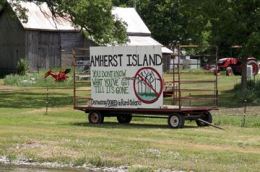
amherst Island haywagon

On June 7, members of the Association to Protect Amherst Island (APAI), along with many Island residents, gathered at St. Paul’s Presbyterian Church to hear the final submissions in their appeal against Windlectric Inc.

The submissions were the final part of the more than six month long Environmental Review Tribunal (ERT) that took place regarding the project, and members of APAI were feeling optimistic.

“It has been a long process and we are very proud of what we have accomplished and we are very confident,” said Michele Le Lay, a member of APAI before the final hearing. “We feel we had a fair hearing.”

The final instalment of the tribunal started with a statement from island resident and concerned parent Amy Caughey, who originally spoke to the tribunal in December. Caughey’s main concern is the proposed placement of a concrete batching plant and high-voltage substation directly next to the school on the island.

“It seems like all the industrial activity will be occurring next to the school and I think it is too close,” she said. “Also, the cumulative impacts of this project, especially on the school, have not been assessed. It seems that each component is looked at individually, but it is not looked at as a whole and I think that is a major problem.”

Caughey explained that after six months of hearings she still has numerous unanswered questions about the safety of the project, especially in relation to the school, and she worries that her children and others will be at risk.

“The project is putting children’s safety at risk and that is something that I don’t think we, as Ontarians, want to tolerate,” she said. “We don’t have enough information and if we just go ahead and do this, it is actually our children who become the test to see if the directive is right or wrong and I think that is entirely inappropriate in Canada in 2016.”

READ MORE:   http://www.kingstonregion.com/news-story/6712312-environmental-review-tribunal-wraps-up-on-amherst-island-results-expected-by-end-of-june/;send=false

Rare Blanding’s Turtle Scores Win against Wind

“Yippee! Hooray!” said Cheryl Anderson, a member and past president of the Prince Edward County Field Naturalists. “It’s been a long haul.”

blandings-turtle-wind-turbine_jpg_size_custom_crop_1086x724

The Blanding’s turtle, a sunny little reptile already prone to smiling, must be beaming this week like somebody who’d won a lottery the same day they were awarded the Nobel Prize.

For the third time in the past three years, a legal decision was handed down in favour of the endangered species, and against a proposed wind turbine development in Prince Edward County, east of Toronto, that threatened to cause the turtle “serious and irreversible harm.”

READ MORE:  https://www.thestar.com/news/canada/2016/06/07/blandings-turtle-protected-as-turbine-approval-revoked.html


Turtles Topple Turbines

12798837_1254759547870717_5530674074329556819_n

Country Live:  Posted June 6, 2016

The County’s Blandings turtles, and nature in general, are victorious in the Prince Edward County Field Naturalists’ more than six-year battle to protect the south shore of Prince Edward County.

The Environmental Review Tribunal in the Ostrander Point industrial wind turbine hearing has decided “remedies proposed by Gilead Power Corporation and the Director (MOEE) are not appropriate” and has revoked the Renewable Energy Approval for the nine turbine project.

“The tribunal decision says that no matter how important renewable energy is to our future it does not automatically override the public interest in protecting against other environmental harm such as the habitat of species at risk,” says Myrna Wood, president of the Prince Edward County Field Naturalists. “This was the basis of PECFN’s appeal. This decision not only protects the Blanding’s turtle but also the staging area for millions of migrating birds and bats and the Monarch butterflies.”

In their decision, ERT vice-chairs Heather Gibbs and Robert Wright state “The Tribunal finds that to proceed with the project, when it will cause serious and irreversible harm to animal life, a species at risk and its habitat, is not consistent with the general and renewable energy approval purposes of the Environmental Protection Act, protection and conservation of the natural environment and protection and conservation of the environment, nor does it serve the public interest.

“In this particular case, preventing such harm outweighs the policy of promoting renewable energy through this nine wind turbine project in this location.”

They also state the project would be located entirely within a Candidate Life Sciences Area of Natural and Scientific Interest (ANSI), which extends from Prince Edward Point to, approximately, Petticoat Point, and is roughly 2,000 hectares. “According to the Ministry of Natural Resources and Forestry, it is a “candidate” ANSI due to “the combination of size, extent of shoreline, known species diversity and special features that make this site unique in the site district.”

“The tribunal decision reminds the Ministry of Environment and Climate Change of its ‘Statement of Environmental Values’ that “As our understanding of the way the natural world works and how our actions affect it is often incomplete, [government] staff should exercise caution and special concern for natural values in the face of such uncertainty,” said Woods.

The Naturalists began their opposition in 2007 believing the south shore of the County “is the wrong place for wind turbines” – an important area to migrating birds, to bats and butterflies. It contains areas of natural and scientific interest, provincially significant wetlands, globally imperilled Alvar habitat and is the home and breeding grounds of avian, reptilian and amphibian species at risk.

“It’s been a long awaited decision and represents the efforts and determination of PECFN’s quest to protect the environment,” said Prince Edward County Mayor Robert Quaiff. “Congratulations to them. It further solidifies what everyone has been saying that the south shore of PEC is not a suitable location for industrial wind turbines.”

Todd Smith, Prince Edward Hastings MPP has also long campaigned that the south shore of Prince Edward County is the wrong place for wind turbines.

“It has taken a lot of time, money and effort to finally get to this point. My hope is that the Liberal government will actually listen to its own Environmental Review Tribunal that has ruled the south shore is a terrible location and that damage to the local environment outweighs any possible good that a wind turbine project could achieve,” said Smith. “Hopefully, this is the end of the Gilead proposal at Ostrander Point…Ultimately, this was not and is not, about the viability of wind power. This is about protecting the ecosystem of the South Shore of Prince Edward County. On that score, science and biodiversity won the day… The County is best served by being naturally green.”

Decisions with the White Pines project, also on the south shore, and the project at Amherst Island are still to be made.

READ AT: http://countylive.ca/blog/?p=60865

TRIBUNAL DECISION: http://www.ert.gov.on.ca/english/decisions/index.htm

Blandings-Turtle600