Category Archives: Health

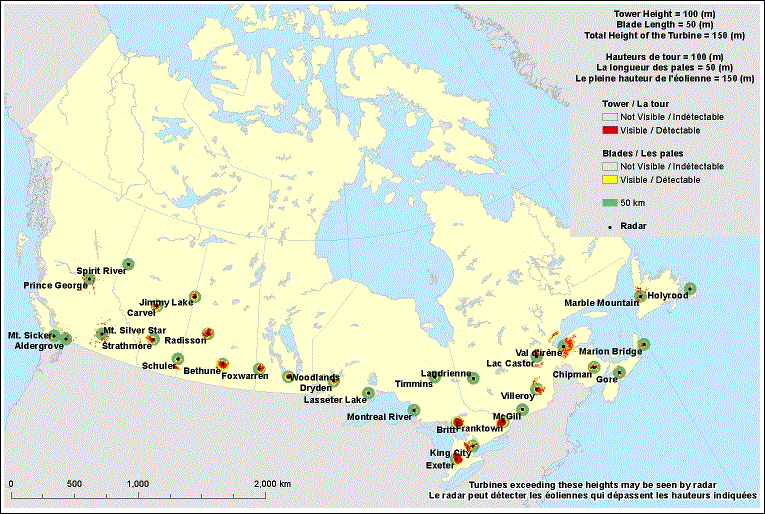
Radar Visibility Maps in Canada

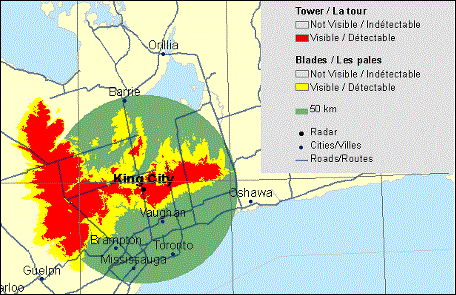
CapturePearson International (Toronto) seems to be surrounded by turbines.

King City Radar Visibility Map

HOW TO VIEW MAP

CaptureThe radar site locations are marked with a black dot. A green circle shows a 50 kilometre radius around the radar.  Inside this 50 kilometre ring, potential interference with the radar may exist and direct consultation is strongly suggested. Major roads and cities are indicated in dark blue.

The colour display surrounding the radar(s) represents whether wind turbine blades could be seen by the respective radar (in yellow) and if the wind turbine towers can be seen (in red). The visibility maps have been created for turbine models with turbine tower heights of 100 meters and blade lengths of 50 meters (for a total blade height of 150 meters). If any part of a turbine is visible to a weather radar, interference is expected, but if the turbine tower is visible (in red) more severe impacts may occur. Any region not covered by the colour display indicates that a wind turbine with a total height of 150 meters should not be visible to the radar. However, a turbine with a blade height greater than 150 meters may be seen and further analysis is necessary.

follow for interactive Map : Environment Canada

Meeting with “the people” must start somewhere

Bill Monture and Lester Green represented the interests of the Men’s Fire Council, appealing Next Era’s Summerhaven and Samsung Pattern Energy’s Grand Renewable Energy  at the ERT (dubbed Monture 1 & 2)  Attached below are the decisions.

unnamedSIX NATIONS – The main disconnect between western style corporations and most Indigenous societies is that one deals with governments put in place to act on behalf of their people, while most traditional indigenous societies work alongside with “the people”.

This is a paradigm one group of Six Nations residents hope to revive.

Bill Monture, a well-known local activist and traditionalist, built a meeting place on his Chiefswood Road property as a neutral space and has begun a process by which he hopes to find the future for Six Nations in the past.

Recently, he hosted a meeting at the converted barn, which was attended by a room full of unlikely participants, including Mark Clearwater and Randy Reed representing the provincial government, Haldimand County Mayor Ken Hewitt, and about 30 rank-and-file Six Nations citizens to openly and frankly discuss matters of interest to Six Nations as a people and the future of co-existence of the traditional wisdom of the ancestors and the reality of the 21st century, and to do so without the presence of the media.

He and the group known to the Six Nations community as the “Men’s Fire” are trying to refocus the attention of all parties currently vying for the power to speak on behalf of the people of Six Nations, and at the same time, educate settler governments and corporations on how to rightly deal with Six Nations.

read more: Two Row Times, Jim Windle lAugust 20, 2014

unnamed (1)unnamed (2)unnamed (3)Summerhaven Final Decision

Samsung ERT Desicion


Vampire Turbines In July

I recently read an entry on Wayne Gulden’s Wind Farm Realities website reviewing some figures for the Vestas V82 – 1.65MW capacity industrial wind turbine. The statement that stuck with me was:

… when the wind doesn’t get above 3.5 m/s – typically there’s a MINUS 50kw of production. This is power that must be supplied from the grid just to keep the turbine in business. And 50kw seems to be what the turbine uses to stay alive in good weather. In the winter it gets slightly higher – the highest negative numbers were in the 80 kw range.

I decided to investigate the performance of an industrial wind turbine project in Ontario comprised of 110 of the Vestas V82 turbines; Enbridge’s Underwood turbines in Bruce County.
110 turbines potentially each drawing 50kW means that at times when all Enbridge’s turbines are still, the draw would be ~5.5MW. In the parlance of the Ministry of Energy, and the renewables lobby, a draw of 5.5 MW is enough to prevent power being provided to over 4000 homes.

In Ontario, we know that wind is least productive in July – so the topic of how much “parasitic” load is present when turbines are unproductive is particularly relevant here.

The turbines’ manufacturer, Vestas, produced a Life cycle assessment of the V82-1.65 MW (the LCA) showing “energy balance” is achieved in 7.2 months of production. The “energy balance” is how long the turbine will take to generate the amount of energy consumed in production and disposal.

read more: Cold Air, Aug 2 2014

Another Wind Project Approved – Port Ryerse

AS of AUGUST 20, 2014 The Port Ryerse wind Farm has been approved. You can read the whole decision here.  The opportunity is  until Sept 5 to appeal.

http://www.ebr.gov.on.ca/ERS-WEB-External/displaynoticecontent.do?noticeId=MTIxMTM2&statusId=MTg0ODI5&language=en


Sixty Residents fighting for their Quality of Life.

This is a lawsuit to keep an eye on.  It’s being heard in their State Supreme Court.

Sixty residents from Orangeville and Attica have filed lawsuits claiming that the Stony Creek Wind Farm is ruining their quality of life, destroyed property values, and is affecting their health because of noise and vibration.
CaptureAttorney Richard Lippes, who handled the Love Canal lawsuits, is representing the angry residents.

Lippes said the basis of the lawsuit claims the wind turbines were erected too close to residential homes and are now causing “adverse effects.”

The lawsuits were filed in State Supreme Court in Wyoming County and they also seek restrictions on operation of the wind turbines.

The Orangeville wind farm contains 58 wind turbines and was constructed in 2013 by Invenergy – which is the sole defendant in the lawsuits.

Invenergy issued the following statement in response:

About the Orangeville wind farm

As a clean energy leader, Invenergy is committed to successful, enduring partnerships with the communities in which our projects are located. We are grateful for the broad support we’ve received in Western New York and continue to receive from members of the community.

While support for renewable energy is strong across our country, we take seriously any concerns of those who live in a project host community. That is why we took great care in developing the Orangeville wind farm in accordance with all local, state, and federal laws and regulations. The lengthy authorization process was open and inclusive, allowing extensive opportunity for citizen input.

In addition, since the Orangeville wind farm commenced commercial operation, the facility has been operated and maintained in accordance with all applicable laws and regulations, including local zoning laws, relevant state agency directives, and Federal Aviation Administration (“FAA”) requirements.

About Wind Turbine Sound and Health

Numerous studies – conducted in countries all over the world – have found no evidence to support a link between sound emitted from wind turbines and adverse health effects.

About Wind Turbines and Property Values A 2013 comprehensive report by the U.S. Department of Energy’s Lawrence Berkeley National Laboratory studied wind turbines and home values. In analyzing more than 50,000 home sales near 67 wind farms in nine states, researchers were “unable to uncover any impacts to nearby home property values.”

About Petitioners’ Motions

The Orangeville wind farm will vigorously defend itself against the unfounded claims set forth in these complaints

Follow to watch the accompanying News Report.

Turbines and the health risk

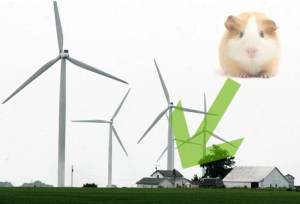
Guinea-pig-and-wind-farm-2-447x304I WAS interested in the Scottish Government’s response to the Winds for Justice concerns about the health implications of wind turbines on those living in close proximity to them (“Protesters fight wind farms on grounds of health”, The Herald, August 11) when it said there was “no clear evidence of a causal link between the operation of wind turbines and adverse health effects”.

In April, 2012, The British Medical Journal reviewed the consequences of wind turbine noise and available evidence and concluded at that stage that “wind turbine noise seems to affect health adversely and an independent review of evidence is needed”.

With the thousands of wind turbines already in operation in Scotland and many thousands more planned, the health implications should be of concern to the Scottish Government and at least until further studies and review of the evidence, as suggested by the British Medical Journal, no more should be constructed within two kilometres of homes.

The Scottish Government was made aware at the time of the BMJ article but chose not to take it on board.

Dr James Weir,

Glenlora Cottage,  Lochwinnoch.

Herald Scotland, Wednesday 13 August 2014

Industrial Wind Needs Blowback (Siemens ad campaign targeting U.S. taxpayers)

“Since Siemens’ tax-sheltering market is drying up in Europe, their marketing efforts in the U.S. are clearly geared towards increasing income for its investors via wind’s tax sheltering schemes here. Taxpayers, consumers take note!”

If you watch much mainstream TV, you’ve probably seen Siemens’ recent  multi-million-dollar advertising blitz  to sell the American public on industrial wind.

As it turns out, the wind business abroad has taken a huge hit of late. European countries have begun slashing renewable mandates due to the ever-broadening realization that renewables cost far more than industrial wind proponents have led everyone to believe — not only economically, but environmentally, technically, and civilly as well.

As reported in the article Siemens onshore, offshore pain: “Siemens’ energy business took a €48m hit in the second quarter related to a bearings issue with onshore turbines and a €23m charge due to ongoing offshore grid issues in Germany.”

Since Siemens’ tax-sheltering market is drying up in Europe, their marketing efforts in the U.S. are clearly geared towards increasing income for its investors via wind’s tax sheltering schemes here. Taxpayers, ratepayers beware!

As a company who stands to profit handsomely by it, Siemens ad campaign is obviously part of an overall pitch to urge Congress to extend the very lucrative wind Production Tax Credit (PTC), or more accurately, the “Pork-To-Cronies” bill.

As Warren Buffett recently admitted, “We get tax credits if we build lots of windfarms.  That’s the only reason to build them. They don’t make sense without the tax credit.”

read more : Master Resource,by Mary Kay Barton August 20, 2014

WELCOME TO OUR TREES NOT TURBINES INITIATIVE

“Trees Not Turbines” has a new Web Site up and running, with all the information and poster art, etc. that people may need to run their local campaign!

CaptureThere’s no question that over the past 2 decades, there’s been a heightened awareness for the environment. One of the more important areas is how we obtain electricity. One of the proposals has been in the form of Industrial wind turbines.

We feel there’s a better way to answer the question of how to retain a reasonable quality of life with a view to enhancing the environment that we could all mutually benefit. We feel trees are the answer and wherever you may reside, you can participate.

Here are some of the reasons trees are a superior way to enhance the environment over industrial wind turbines;

  • Trees absorb CO2 and release O2. An acre ( .405 hectares) of trees will absorb enough CO2 to offset a city driven car for a year, while producing enough O2 for 18 people per day. IWT’s can do neither.
  • IWT’s have a large initial carbon footprint before becoming operable. Trees start their work right away with no initial carbon footprint.
  • IWT’s have within their components, many detrimental compounds detrimental to the environment. Turbine blades contain bisphenol A, a known carcinogen and the hubs contain gear oil that has high levels of mercury. Trees, of course, are without these issues.
  • Trees are superior to IWT’s when it comes to preventing erosion, providing shade, providing habitat for birds and attracting many other forms of wildlife. IWT’s in fact enhance erosion, kill bats and birds and provide no attraction to wildlife.
  • IWT’s are infinitely more costly than trees, trees require no electricity to operate and are for the most part, maintenance free. Trees have proven to enhance property values and provide years of enjoyment no matter if you live in a rural or urban environment.
  • IWT’s require to work in tandem with other power generators. While we’ve essentially eliminated coal as a source of generation, gas plants have come on line to replace coal and to act to back-up wind generation. In order to do this, gas plants run in the most inefficient way possible and in the final tally don’t substantially reduce emissions at all. Trees of course require no gas plant backup and can help reduce heating and cooling costs.

We listed here just a few of the benefits of trees. We can replace IWT’s with trees and accomplish our goals for a better environment. This is the REAL green movement.

Trees Not Turbines.

Why Wind Energy is a Bad Idea

How many of you have found your self in the exact same position as described at the beginning of this article?  There is no way to “casually” explain why wind is bad.

In a casual conversation, I was asked why wind energy is a bad idea. Once again, I realized that a one or two-word answer could not convey a readily understandable and accurate picture of wind energy.

This article will try to provide such an answer in a few hundred words, where one or two won’t suffice.

There are essentially four reasons why wind energy is a bad idea.

  • It is unreliable
  • It is very, very expensive
  • It produces electricity when it isn’t needed
  • It has environmental issues

Wind can only produce electricity when the wind is blowing at between 6 mph and 55 mph. Above 6 mph, it gradually increases its output until it reaches a maximum output at around 35 mph. Above 55 mph, the wind turbine is shut down to prevent damage to the turbine.

The wind can stop blowing abruptly, so backup power generation must be immediately available to replace the wind generated electricity, or the grid could collapse causing blackouts.

Typically, gas turbine generators are kept running 24/7 so they are available to be rapidly brought online.

A sufficient number of gas turbine generators must kept running at all times to be ready for when the wind stops blowing. This varies by region and on the reliability of day-ahead weather forecasts.

The electricity generated by wind has an intrinsic cost, based on leveled cost of electricity (LCOE) of around 11 cents per kWh. This compares with around 5 cents per kWh for natural gas combined cycle (NGCC) power plants and around 6 cents for coal-fired power plants.

But there are other costs for wind energy that are seldom taken into consideration, and not included in LCOE calculations.

Continue reading here : Power for USA, Aug 12 2014,