Category Archives: Health

The High Church of Global Warming

U.S. Secretary of State John Kerry, right, walks with advisors at the Paris climate conference.As this edition of the Post hits the stands, the great Conclave of Catastrophists in Paris will have concluded. The last goose will gladly have surrendered its swollen liver — foie gras does not come without exertion — to the last epicure environmentalist. We have been told that the French did not stint on lending all the arts of its fabled cuisine to assist the Great Deliberators. State dinners took on something of the largesse and abundance last recorded by Gibbon in his descriptions of the Emperor Heliogabalus, who is reputed to have served up the tongues of hummingbirds, peacock brains and mice sauteed in honey, to the jaded appetites of his decadent court.

The reference here to far earlier times is not accidental or flip. Just as in the early centuries of Christianity, when the patristic Fathers struggled with various heresies and sought to stabilize the dogmas of the then-nascent Faith, held their great Councils to parse the finer points of esoteric doctrine, the Parisian analogue gave itself over to even more subtle ruminations: whether, for example, it was best to “commit” to ensuring the planet’s temperature doesn’t rise more than 1.5 degrees by the year 2100, or whether it was best merely to hold the thermometer to a more expansive two degrees.

How much mental energy must have been expanded over that winsome 0.5 degrees, 80 years down the road? The subtleties involved, the logical intricacies deployed, would have outpaced Aquinas and sent poor Augustine to bed early with a migraine. However, the modern monks of the High Church of Global Warming have resources that the early philosophers and theologians could not even dream of — they have computer models that dance in the direction wished of them.

And when what they deliciously refer to as the “settled science” does not serve their needs, they have always about them the ancient texts of Earth in the Balance by Reverend Al Gore, or the early press releases of the Dun Scotus of Global Warming, Cardinal Emeritus George Monbiot.

And where the scholiasts of old, wrestling with imperfect transcriptions and dubious translations of Holy Scripture had only prayer to guide them on the knotty questions of global warming — such as how many polar bears can dance on the edge of an ice floe — the priests of Climatology can always consult the Oracles of Greenpeace and the Sierra Club; or when in deeper need — say on the relationship between the decline of the coral reefs and bovine flatulence — refer to the obiter dicta of Bishops Tutu or Suzuki, on which matters such authorities speak with a Truth beside which that of Scripture is a mere contrail.

read more: National Post, Rex Murphy, Dec 11 2015

Day 18: Report on ERT on White Pines Wind Project

Report on Environmental Review Tribunal Hearing on White Pines Wind Project

December 7

by

Paula Peel, APPEC 
On Day 18 of the Environmental Review Tribunal (ERT), APPEC expert witness Dr. Daryl Cowell testified that there is substantial evidence of karst in the White Pines study area and that serious and irreversible impacts will occur if this project proceeds.   WPD witness Ronald Donaldson and Ministry of the Environment and Climate Change (MOECC) witness Mark Phillips disputed this.

Dr. Cowell told the ERT that he has appeared as a karst expert witness before eight Ontario Municipal Board hearings, done work for municipalities across Ontario, and authored or co-authored hundreds of technical documents, including peer-reviewed papers.  He has spent 40 years studying karst, with the past 20 years focused on hazard assessment.  Dr. Cowell was qualified as a professional geoscientist with expertise in karst. Continue reading Day 18: Report on ERT on White Pines Wind Project

Construction of more Industrial Wind Turbines will Increase CO2 emissions

Mr. Chiarelli and Ms. Wynne:

When the GEA was introduced in 2009, the intent was to reduce CO2 emissions as well as to create jobs in the renewable energies sector.

Figure 20 of the long term energy plan from 2013 states that over the next 10 years, CO2 emissions will increase.  A different document published by the PEO states that construction of more industrial wind turbines will increase CO2 emissions because of the gas backup that is required for the unreliable wind power.  Here are two documents (one of them is your own government document) stating the CO2emissions will increase.  Both documents are attached.

There have been recent closures of turbine tower manufacturing plants and turbine blade manufacturing plants across Ontario resulting in job losses in the industrial wind turbine sector.  There has been a net loss of manufacturing jobs in Ontario since the GEA was passed.  This was to be expected as the auditor general predicted job losses will increase because of renewable energies. This prediction is in the auditor general’s report of 2011.

The question needs to be asked – Since wind turbines increase CO2 emissions and decreases jobs, why is the Ontario government continuing down the path of renewables and specifically industrial wind turbines?  The electricity bills of the ratepayers continue to increase and this can be directly attributed to the rates and subsidies paid to the wind companies.  Some hydro rates have increased to the point that customers can no longer afford to have electricity delivered to their homes.  The recent auditor general’s report states that Ontario ratepayers have paid $37 billion extra for electricity from 2006 – 2014.  This is appalling!  When is the Ontario government going to realize that Industrial Wind Turbines are bad for the economy, bad for the environment, and bad for job creation?

Please respond to this concern.

Lois Johnson

Achieving Balance – Ontario’s Long-Term Energy Plan

2015_Presentation_Elec_Dilem_Page_15

Bill Gates sceptical of solar, wind power

Says unless clean energy is made cheaper, countries like India will be in an ‘impossible’ situation.

“I can’t comment on climate justice. I don’t know what the definition of that is,” says former Microsoft CEO Bill Gates.

Lauding India for doubling its funding for research and development of climate change technology, the former Microsoft CEO and co-founder of the world’s biggest charitable foundation, Bill Gates, says technological innovation is the only way to fight climate change. “If we are going to make the cost of clean energy as inexpensive as hydrocarbons, or coal energy today, which will need innovations. That will mean you won’t have to think about this huge trade-off between ‘Should I be clean’ or ‘Should I electrify’?” he told The Hindu in an exclusive interview.

Mr. Gates was in Paris for the COP21 summit, where he launched a multi-billion dollar 20-nation ‘Breakthrough Energy Coalition,’ and has met Prime Minister Narendra Modi twice this week, both in Paris and in Delhi on Friday.

Backing India’s stand on ‘climate justice’ or the need for the developing world to be financed for cutting emissions, Mr. Gates said that unless clean energy was made cheaper, it put countries like India in an “impossible” situation. “I can’t comment on climate justice, I don’t know what the definition of that is. I think while the premium cost of clean energy is very high, you force an almost impossible trade-off between two very important goals. My belief is that if you increase the R&D that will lower the price of energy,” he said.

read more: The Hindu, Dec 5 2015

Day 17 of the White Pines ERT

Report on the ERT Hearing on the White Pines Wind Project – Dec. 4, 2015

By Henri Garand, APPEC

On Day 17 the Environmental Review Tribunal (ERT) of the White Pines wind project heard the testimony of WPD witnesses Shawn Taylor and Dr. Paul Kerlinger.

Mr. Taylor was qualified by the Tribunal as “an ecological restoration and construction mitigation specialist.”  However, he testified at length about Blanding’s turtles because of his participation in a four-year study involving a Kanata road extension into their habitat.

After classifying the roads (paved, gravel, and access) required for White Pines, Taylor spoke about the risks from higher traffic, but he said these are minimal due to the “block-out period” on construction between April 15 and October 15, and the later infrequent maintenance visits.  Mitigations such as staff training and 15km speed limits will protect turtles. Continue reading Day 17 of the White Pines ERT

Exhausted

Tne Tribunal winds down, but the fight goes on

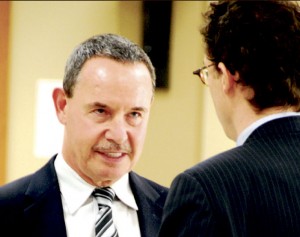
Eric Gillespie (with his back to the camera) address Tribunal members Heather Gibbs and Robert Wright in Demorestville.

Two exhaustive years, two tribunals and one appeal. The digging, the paperwork, the questions and revelations that just maybe the ministries involved aren’t as neutral as they should be, and it’s finally over. Well, for now.

The witness lists exhausted, the hearings for the second Environmental Review Tribunal for the Ostrander Point wind turbine project wrapped up last week, leaving Tribunal panelists Robert Wright and Heather Gibbs yet again with the task of deciding the fate of the County’s south shore and the species that inhabit it.

This time, Eric Gillespie, the lawyer for the appellant—the County group known as Prince Edward County Field Naturalists— fought yet again to prove that the project would indeed harm the population of endangered Blanding’s turtle inhabiting the delicate habitat on the County’s south shore

The biggest revelation came early on. It turned out even though the expert scientist employed by the Ministry of Natural Resources and Forestry warned against giving Gilead Power Company the go-ahead to develop the project, the ministry did not listen to his advice.

This led to delays, a torrent of paperwork, arguments over technical terms and fishing expeditions as the Tribunal demanded the ministry deliver documents that would show how thoroughly it processed its permit allowing Gilead to “kill, harm or harass” endangered species.

read more:  The Times, Dec 4 2015

Cramming

Industrial wind turbine hearings piling on top of each other

APPEC counsel Eric Gillespie discusses a scheduling proposal with James Wilson, counsel for the wind company, wpd Canada

Colliding schedules brought out a series of sharp exchanges at the appeal hearing of the White Pines industrial wind project on Friday. On Monday, in a dramatic twist, the appellant, the Alliance to Protect Prince Edward County (APPEC) asked the Tribunal members to step down from this hearing.

There had been a growing sense among observers that the adjudicators in this hearing appear to be driven more by meeting deadlines than ensuring the appellants get a full airing of the facts they believe will stop 27 industrial wind turbines from being constructed between Milford and the gates to the Prince Edward Point National Wildlife Area in South Marysburgh. Parts of three appeal hearings— Ostrander, White Pines and Amherst Island— have all been crammed into the final weeks before Christmas.

The appeal of the Ostrander Point project should have been completed by now. However, a blizzard of emails and documentation—connecting the dots between the Ministry of Natural Resources and Forestry species-at-risk expert’s advice that the project would in fact cause serious harm to the Blanding’s turtle and the Ministry of Environment’s subsequent approval of the project anyway—has slowed down that hearing’s schedule. This hearing resumes on Thursday in Demorestville.

Meanwhile, hearings into a project that seeks to blanket Amherst Island with 26 industrial wind turbines is getting underway in the first week of December. Eric Gillespie is serving as counsel to appellants in all three hearings.

read more: The Times, Nov 27 2015

APAI ERT Day 1

APAI – ERT DAY 1 – Good beginning!

1fb09b95-6de8-4274-9330-dddc2cb00505NOTE: information about the future schedule and possible bus transport to Toronto is at the end of this message

Location: St John’s Hall, Village of Bath

Tribunal: Mr. Robert Wright & Mr. Justin Duncan

Lawyers for

Appellant (APAI): Graham Andrews, EKG, LLP

Approval Holder (Windelctric Inc.): John Terry & Arlen Sternberg, Torys, LLP

MOECC: Andrea Huckins

The first day of the ERT illustrated the strong support of APAI members in opposition to the Windlectric project. Thanks to APAI members and neighbours from Bath and Nicholson Point who filled the hall in Bath. Your presence is very important and conveys the importance of this hearing to the community.

After the opening remarks, procedural reminders and upcoming schedule by the Tribunal, all parties agreed to the order of appearances of witnesses. Continue reading APAI ERT Day 1

Report on Environmental Review Tribunal Hearing on White Pines Wind Project

December 3

by

Paula Peel, APPEC

On Day 16 of the Environmental Review Tribunal (ERT), APPEC expert witness Kari Gunson testified that the White Pines wind project will cause serious and irreversible harm to Blanding’s turtles on the Prince Edward County south shore, and Dr. Smallwood completed his testimony from Tuesday.

Ms. Gunson has worked as a Road Ecologist for 16 years and has co-authored 13 peer-reviewed published articles.   She was qualified by the Tribunal as a Road Ecologist, with experience evaluating the indirect and direct effects of roads on wildlife and their habitat.

Gunson focused on the large roadless areas around wind turbines T12 to T24 and T26 to T29.  White Pines will increase road density in habitat occupied by the Blanding’s turtle, a threatened species, and the new roads will be used by maintenance vehicles, by landowners to gain access to their property, and by farm machinery.  Continue reading Report on Environmental Review Tribunal Hearing on White Pines Wind Project

Court cancels 30-year federal permits letting wind companies kill eagles

eagle_1_gb4_024bHow do wind energy companies kill protected bald eagles and golden eagles via turbine strikes every year without facing legal repercussions? They have renewable permits issued by the U.S. Fish and Wildlife Service (FWS) that exempt them from laws making it illegal to kill the birds. However, the U.S. District Court of Northern California has ruled that the FWS violated federal law by extending the duration of the so-called “eagle take permit” from five to 30 years without first investigating the impact it would have on eagle populations. The court made the ruling in August after reviewing a lawsuit against the FWS’s parent agency, the Department of Interior (DOI).

After facing extinction in the mid-twentieth century the bald eagle (Haliaeetus leucocephalus) has rebounded to roughly 10,000 breeding pairs in the U.S., according to the FWS. The agency regards golden eagle (Aquila chrysaetos) numbers as stable at around 30,000 individuals nationwide. Both species are protected under the Bald and Golden Eagle Protection Act, as well as two other federal laws.

However, wind turbines often strike and kill eagles. Up to 75 of the birds have been killed annually by a single wind farm, the Altamont Pass Wind Resource Area in central California, but mortalities at other installations are less well monitored. A 2013 paper in the Journal of Raptor Research documented 85 eagle kills at 32 other facilities between 1997 and 2012, but notes that the findings “likely underestimate, perhaps substantially, the number of eagles killed at wind facilities in the United States.”

read more:  Montgaby, 4th December 2015 / Mike DiGirolamo