Below is the submission made by Sue and Leon Atkins, which received applause by the more than 100 local residents who attended the Preliminary Hearing of the ERT appeal for the NRWC project in West Lincoln which was held in Wellandport Dec 19/2014.
The Atkins who own and run Atkins pony rides were granted presenter status.
Sue Atkins Quoted a notice she look a picture of while attending one of the NRWC community information presentations held in our area a while back.
“NRWC QUOTE: If there are MORE than 5 turbines within 3 km of a noise receptor or if any turbines have a sound power level greater than 102 decibels,greater set back distances must be met and or noise studies must be completed.”
Then she asked. “Has anyone completed these noise studies? Has anyone meet these set back distances?” Her response was “NO!” There could also be heard murmurs of “NO” through out the audience in response to her questions as well.
As she points out below, 7 turbines are within 2 km of their farm. 10 are within 3 km and 24 within 5 km. Sue Atkins is well within her right to question how this is possible in light of the NRWC PUBLIC notice reassuring residents that what is about to happen to them wouldn’t happen to anyone.
Thank you to the Atkins for standing up and fighting !! If you want to help the Atkins then helpMothers Against Wind Turbines Inc.. and donate to their Legal fund so we can keep this fight going for as long as we can!! These are real members of our community, your community, coming forward and fighting! Fighting not only for their livelihoods, their health, their home but fighting for everyone who potentially will be negatively affected by the NRWC project.
DONATE TO THE LEGAL FUND TODAY!!! These are Real members of our Community.
Sue Atkins says she has acoustic neuroma — a benign brain tumor that develops on the main nerve leading from the inner ear.
Members of Mothers Against Wind Turbines, from left, Catherine Mitchell, Marianne Kidd, and Linda Rogers, discuss their appeal of a planned wind turbine project in West Niagara. ALLAN BENNER Tribune Staff
Although it’s non-cancerous, she says it is continuing to grow and has resulted in hearing loss and the possible need for surgery. It has also made her particularly sensitive to infrasound, like the sound created by the huge spinning blades of industrial wind turbines.
But the rural St. Anns farm she shares with her husband Leon and their 29 ponies and horses will be within five kilometers of 24 huge industrial wind turbines if a provincially approved Green Energy Act development by Niagara Region Wind Corp. is allowed to proceed.
“We are really concerned at the fact that our small parcel of property is going to be surrounded by these wind turbines,” she says.
Please consider donating to the MAWT Inc. legal Fund – we can only fight as far as the money allows us!
It’s a battle they probably won’t win.
But it could be a necessary step towards winning the war.
There were more than 150 people at the Wellandport Community Centre Friday, and that was just for a preliminary hearing to determine who would speak and about what during an Environmental Review Tribunal looking into concerns about a large wind turbine development, scheduled to start a month from now on Jan. 19.
Although Mothers Against Wind Turbines Inc. president Marianne Kidd fears the tribunal hearings to come may prove to be a “kangaroo court,” she said“there’s nowhere else to go.”Continue reading Environmental tribunal a step to real law→
Please help us prevent this from happening to a family YOU may know!! Donate to The Legal Fund, Today!!
Sheffield: Therriens Moving Away From Wind Farm
The Therrien family on their Sheffield property.
The Therrien family, who live near the First Wind industrial wind development in Sheffield, are moving to Derby.
Steve and Luann Therrien are making arrangemets to relocate themselves and their children away from the six 400-foot wind towers within a few hundred yards of their 50-acre property off New Duck Pond Road in Sheffield.
First Wind, the corporation that built and operated the Sheffield development, changed hands last month. The new owners are SunEdison and TerraForm Power and nothing about the operation is expected to change. Continue reading This could happen to someone YOU know!!→
Health Canada study: Ontario wind turbine rules not protecting citizens
The results of a Health Canada study released November 6 show that Ontario is not protecting the health of residents living near wind turbines, and that longer setbacks between the wind turbines and homes are required.
Health Canada’s summary of its Wind Turbine Noise and Health study results included the fact that responses to the study’s questionnaire show participants reporting experiencing distress or annoyance when wind turbine noise was at 35 decibels/dBA. Current Ontario regulations are based on the World Health Organization Night Noise limit of 40 dBA but that limit was designed solely for traffic and airport noise. Continue reading Health Canada study: Ontario wind turbine rules not protecting citizens→
Please donate to the Legal Fund, we can fight only as far as the money takes us.
Wind turbine appeal to be heard in Smithville Wellandport
As they said they would, an advocacy group has appealed the decision to allow a 77-turbine wind farm to be built in west Niagara, but they have no disillusions of their chances of winning.
A preliminary hearing for a tribunal that could overturn the wind farm approval has now been scheduled for Dec. 19 at the Wellandport Community Centre.
That building, on Canborough Rd. in Smithville, has become a key site in the wind turbine debate, with numerous public meetings held there as progress on the massive development has slowly moved forward.
Niagara Region Wind Corp. was given the green light to move forward with its industrial wind turbine project in early November when the Ministry of the Environment issued its Renewable Energy Approval.
As you may be aware, Mothers Against Wind Turbines Inc. filed an appeal in response to the approval of the Niagara Region Wind Corporation. Please see attached notice and take note of dates.
.
We will be counting on your support.
.
As well, please consider donating to our legal fund if you have not already done so. We can only continue the fight if resources permit. Donations can be mailed to:
The people of Ontario have been waiting for more than two years for Health Canada’s report on itsWind Turbine Noise and Health Study. On November 6, 2014, a summary of the results were released but still, no report is available or published. Similarly, no article has yet been published and the data and analysis are also not available. Higher research standards are expected for the $2.1-million, publiclyfunded study that is completed for Health Canada by Healthy Environments and Consumer Safety, the regulatory body.
It is our view that the issues of process are important as, on the surface, the Health Canada summary eport appears to provide contradictory results. In some parts of the study results, it is claimed that no association between wind turbine noise and health effects were found. However, in other parts, high evels of annoyance were significantly linked statistically to wind turbine noises, with this annoyance then being linked to health effects.
In response to the release of the summary, Wind Concerns Ontario (WCO) immediately convened an expert panel1 of reviewers to analyze the summary report, as well as other available material including a PowerPoint presentation provided to us in a briefing session with Health Canada in Ottawa, on
November 7, 2014.
The following report summarizes the conclusions that this panel has reached, based on the available information.
You are probably aware that at the October 14, 2014 Brown County Board of Health meeting a motion was made to declare the Shirley Wind turbines a Human Health Hazard. The motion was unanimously approved by the Board:
“To declare the Industrial Wind Turbines at Shirley Wind Project in the Town of Glenmore, Brown County, WI. A Human Health Hazard for all people (residents, workers, visitors, and sensitive passersby) who are exposed to Infrasound/Low Frequency Noise and other emissions potentially harmful to human health.”
BCCRWE is requesting your words of support for this action which can be sent to BOHsupport@bccrwe.com
This is public and can be shared and redistributed.
All the best,
Carmen
Shirley Wind Human Health Hazard Declaration
* BCCRWE Requests Your Words of Support *
At the October 14, 2014 Brown County Board of Health meeting a motion was made to declare the Shirley Windturbines a Human Health Hazard. The motion was unanimously approved by the Board:
“To declare the Industrial Wind Turbines at Shirley Wind Project in the Town of Glenmore, Brown County, WI. A Human Health Hazard for all people (residents, workers, visitors, and sensitive passersby) who are exposed to Infrasound/Low Frequency Noise and other emissions potentially harmful to human health.”
Research indicates that industrial wind turbines can negatively affect the physical, mental and social well-being of individuals if placed too close to homes. BCCRWE has been working intensively for the past 5 years with professional researchers, physicians, acousticians, and legislators to protect citizens of Brown County, the state of Wisconsin, the United States, and those in other countries from the negative health impacts resulting from industrial wind turbines being built too close to people.
BCCRWE welcomes and encourages individuals, organizations, and governmental agencies from around the world to send their words of support regarding the Board of Health’s action. BCCRWE will pass your emails on to the Brown County Board of Health as support for their courage, integrity, responsibility, intellectual honesty, and care in declaring the industrial wind turbines at Shirley Wind to be human health hazards.
If you or others you know have experienced negative health impacts from living in close proximity to industrial wind turbines and would like to share that experience along with your words of support with the Brown County Board of Health, please do so.
Send your words of support, and if applicable your experiences, to: BOHsupport@bccrwe.com
This article, the final of three installments, discusses the relationship between various health effects and our current understanding of the processing of infrasound by the ear and brain. [Part 1: Some Background; Part 2: The Evidence.]
As noted in the second installment of this series, Dr. Geoff Leventhall, a co-author of the 2009 AWEA/CanWEA report, attributes the health complaints of people who live near industrial wind turbines (IWTs) to psychological stress, but does not acknowledge that IWTs can be detrimental to health because infrasound and low-frequency noise (ILFN) emitted by wind turbines are largely inaudible to humans. He stands on the argument, therefore, that what we can’t hear can’t hurt us.
We know that things we cannot see, touch, taste, or smell can hurtus, so why is it unreasonable also to believe that what we can’t hear might also hurt us?
Dr. Nina Pierpont, in describing Wind Turbine Syndrome (WTS), has expressed her belief that many of the symptoms comprising WTS are mediated by overstimulation of the vestibular system of the inner ear by ILFN. Recent evidence supports the general view that the functioning of both the vestibular and cochlear components of the inner ear, and their interconnections with the brain, mediate the type of symptoms that Pierpont and others have described.
INFRASOUND: MORE OF A PROBLEM THAN WE THOUGHT?
Industrial-scale wind turbines generate peak sound pressure levels at infrasonic frequencies, especially between 0.25 and 3 Hz, as the blades pass in front of the tower. Most of us do not experience the energy in this lowest of low-frequency regions as sound; instead, we perceive a variety of other sensations. When present, infrasound can be more of a problem than audible sound.
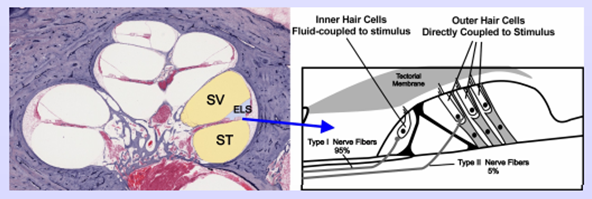
Recent basic research on the inner ear conducted by Dr. Alec Salt and colleagues at the Washington University School of Medicine in St. Louis has provided a feasible and coherent explanation of how sound that is normally not audible can result in the kinds of negative reactions reported by people who are exposed to wind turbine noise. That research has shown that extremely low-frequency sound is largely inaudible to humans because the outer hair cells (OHCs) in the inner ear detect and effectively cancel it before it reaches the inner hair cells (IHCs). The IHC stereocilia, which do not contact the tectorial membrane, are fluid-coupled and sensitive to stimulus velocity, while the OHC stereocilia are sensitive to displacement. IHCs rapidly become less sensitive as stimulus frequency is lowered.
Cross-section of the cochlea (left), with illustration of IHCs and OHCs (right). Used by permission of Alec Salt, Washington University School of Medicine.
Readers familiar with the anatomy of the ear know that approximately 95% of the fibers innervating the IHCs lead to the brain as afferent fibers, while only about 5% of the fibers innervating the OHCs are afferent fibers. Thus, we hear through our IHCs, and our hearing sensitivity is comparable to the calculated IHC sensitivity. The OHCs, which respond physiologically to infrasound, serve as a pathway for infrasound to reach the brain. Infrasonic signals that reach the brain are normally not perceived as sound, but are believed to stimulate centers other than auditory centers, resulting in perceptions that may be unfamiliar and disturbing.
Similar pathways to various centers of the brain also exist through the vestibular, or balance, mechanisms of the inner ear, meaning that it is biologically plausible for infrasound to produce the variety of sensations described by Pierpont, sensations such as pulsation, annoyance, stress, panic, ear pressure or fullness, unsteadiness, vertigo, nausea, tinnitus, general discomfort, memory loss, and disturbed sleep.
Salt and colleagues have also found that when higher-pitched sounds (150-1500 Hz) are present, they can suppress infrasound. This means that the ear is most sensitive to infrasound when higher-frequency sounds are absent. This occurs at night when wind turbine noise is present, ambient sound levels are low, and higher-pitched sounds are attenuated by walls and other physical structures.
As utility-scale wind turbines increase in size and power, the blade-pass frequency goes increasingly deeper into the nauseogenic zone.
Another relatively recent discovery is that there is likely a cause-effect relationship between AHEs and ILFN that mirrors that occurring in motion sickness. An experiment in the late 1980s, conducted using training-mission scenarios with Navy pilots, showed that motion sickness was associated with significant amounts of acoustic energy inside the flight cabin over the frequency range from just under 1 Hz to as low as 0.05 Hz (the nauseogenic range). Maximum sensitivity occurred at approximately 0.2 Hz. That experiment resulted in the conclusion that flight simulator sickness may be, to a significant extent, a function of exposure to infrasonic frequencies. This phenomenon is akin to seasickness, except that the acoustic energy causes nausea without body movement or visual stimulation.
wind noise
Dr. Paul Schomer, nationally and internationally known for his work in acoustics and acoustic-standards development, has suggested that because the Navy test subjects responded to acoustical/vibratory energy with symptoms similar to motion sickness, many of the similar symptoms reported by people living near IWTs can be explained by exposure to infrasound from wind turbines at frequencies similar to those observed in the Navy’s test environment. Persons affected by wind turbine noise appear to be responding directly to acoustic stimulation of the same nerves and organs affected in that experimental environment.
DATA SUPPORT REPORTED SYMPTOMS AS BIOLOGICALLY PLAUSIBLE
These research efforts of Salt and colleagues, Schomer, and others are leading the way in establishing the biological plausibility of the harmful effects of ILFN generated by wind turbines.
Dr. Salt dismisses the common perception that what we can’t hear can’t hurt us and has stated unequivocally that “Wind turbines can be hazardous to human health.”
Decisions regarding the siting of industrial wind turbines deserve careful attention to limiting noise exposure levels in community residents through specified restrictions on either distance or noise levels, or both. The right of the public to enjoy health and well-being should be paramount to the economic and political interests of the wind industry and governmental bodies. These rights need to be protected on a proactive, and not just on a retroactive, basis. Industrial-scale wind turbines should be sited only at distances from residents that are sufficient to minimize sleep disturbance and that do not put them at risk for a variety of other serious health problems.
Jerry Punch is an audiologist and professor emeritus at Michigan State University in the Department of Communicative Sciences and Disorders. Since his retirement in 2011, he has become actively involved as a private audiological consultant in areas related to his long-standing interest in community noise.
Richard James is an acoustical consultant with over 40 years of experience in industrial noise measurement and control. He served as an adjunct instructor in Michigan State University’s Department of Communicative Sciences and Disorders from 1985-2013 and currently serves as an adjunct professor in Central Michigan University’s Department of Communication Disorders.

 Below is the submission made by Sue and Leon Atkins, which received applause by the more than 100 local residents who attended the Preliminary Hearing of the ERT appeal for the NRWC project in West Lincoln which was held in Wellandport Dec 19/2014.





 Mothers Against Wind Turbines Inc.