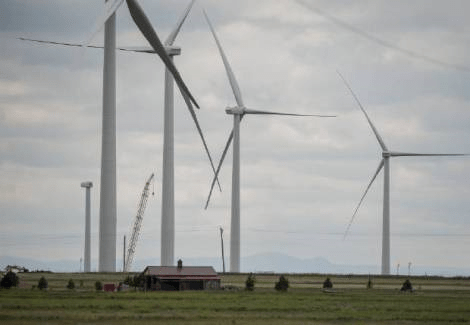
 Sheriff and NextEra to conduct infrasound study at El Paso County wind project located in United States.
|
|||
|
|||

Sheriff and NextEra to conduct infrasound study at El Paso County wind project located in United States.
|
|||
|
|||
Abingdon Community Hall, 9184 Regional Road (Silver Street): https://www.google.com/maps/d/viewer?hl=en&mid=1ToLNLuNTtV1jlj25jc1BN6lu1W4
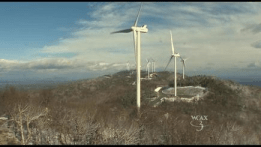 Recently the Vermont Senate voted against protecting Vermonters who live near industrial wind turbines.
The Senate voted against requiring sound monitoring to ensure compliance with noise pollution standards. Green Mountain Power’s lobbyist Todd Bailey, of KSE Partners, told senators that GMP could not afford to pay an unsubstantiated cost of $264,000 for sound monitoring for its industrial wind project in Lowell. As reported in Seven Days, “they (the army of energy lobbyists) got their message to Senator Bray and other senators in a hurry. The Senate voted 18-8 to strike sound monitoring from the bill.”
It is enlightening to understand GMP’s opposition to the cost of sound monitoring at industrial wind projects in comparison to other costs at Green Mountain Power. For instance, annual sound monitoring costs, estimated by ethical experts to be $50,000 to $75,000, pale in comparison to the annual compensation for company CEO Mary Powell.
According to the Valener Energy Company Management Proxy Circular, included with the March 22, 2016, stockholders’ meeting notice, total annual compensation to Powell for the fiscal year ending September 2015 was $1.9 million. Her total compensation for 2013, 2014 and 2015 was over $5 million. Her total compensation consists of base salary, annual and long-term incentive plan (bonus pay), current pension value and other compensation. Her current retirement benefit is $3.3 million.
Gaz Metro owns GMP and has determined that Powell’s long-term incentive compensation will be based on a program that “takes into account cash flow, asset base growth, and achievement of Merger savings.”
“Asset base growth” occurs whenever GMP completes a new energy project. Utilities make money by earning a return on the equity portion of their assets, called asset base in the proxy report or, more commonly, “rate base.” Rate base increases whenever a utility builds anything. Intermittent (renewable) generation assets such as wind and solar projects are extremely capital-intensive. It makes sense that GMP’s parent corporation would want to increase asset base, because it increases corporate income. The more projects GMP builds, the more money Powell makes.
The problem is these industrial wind projects are located close to Vermont families who feel their negative impacts. People who live near an industrial wind project, according to the Vermont Public Service Department, will experience “a significant impairment of quality of life,” and unlike the CEO of GMP will not be compensated by a higher bonus in their paycheck. Instead, Vermonters who live near industrial wind projects will see their quality of life deteriorate and their home values decrease. I have met with Vermonters who have abandoned their homes, are sleep deprived, get headaches, have been hospitalized, are awakened in the middle of the night with their heart racing due to a panic attack, get dizzy and nauseous or have sold homes at a loss, all because of the impact of unregulated industrial wind turbine noise pollution.
The GMP financial incentive to increase rate base resulted in a provision added to the proposed 30 megawatt Deerfield Wind power purchase agreement. GMP negotiated the power contract with Iberdrola, the entity that would develop and own the wind power project on U.S. Forest Service land that is poised to destroy critical bear habitat and the high elevation headwaters of Wilmington. It is no wonder that this agreement includes a provision that allows GMP to buy the project for $50 million in 10 years. After GMP’s long and ugly battle to build its Lowell industrial wind project, it may have found a new way to own wind projects without all the problems of building them. It contracts with a developer to build wind projects and buys the projects later, which adds assets and increases compensation for CEO Powell. Neighbors get the noise pollution and significantly impaired quality of life.
The opposition to continuous sound monitoring at Vermont industrial wind projects is also not consistent with established utility practice. The McNeil wood chip generating plant, part of which is owned by GMP, is required to maintain a Continuous Emissions Monitoring System. The CEMS equipment provides hourly data. The McNeil plant is smaller than the Lowell industrial wind project. Despite the wind industry’s well-funded denials to the contrary, it has been proven that industrial wind projects emit harmful sound emissions.
Sound generated by a wind turbine is directly related to its power output. More power output equals more sound. The real cost of continuous monitoring to the wind companies is that they would have to shut down when they are out of compliance, which would mean that the developer would make less money.
The Legislature must act to require third-party continuous sound monitoring to ensure compliance for all industrial wind projects. Legislators, please put people over profits.
READ ARTICLE: http://www.rutlandherald.com/article/20160424/OPINION06/160429743
The Citizen Wind Committee opposes having a wind farm in the area, and has concerns about the effect the turbines – which can measure 400 feet tall or more – could have on residents’ health and quality of life, as well as property values.
The group brought a 30-page draft to the town’s planning board Tuesday night, and received input from chairman Jim Plate and other board members.
The draft local law, which is posted on the Town of Catlin’s website, townofcatlin.com, limits the size of the turbines and their sound emissions and establishes setbacks.
It calls for wind companies to post bonds to cover any decrease in residents’ property values from having turbines near their land. It would also make the companies liable for medical bills caused by health impacts such as noise exposure and shadow flicker, a strobe-like effect created by spinning turbine blades said to cause seizures and other issues.
The draft law also would protect sensitive wildlife areas, citing the turbines’ impact on bird and bat populations.
It’s a response to plans announced in 2012 by Florida-based NextEra Energy to build a $200 million wind farm with 50 to 75 turbines in the area.
read more: By Derrick Ek ek@the-leader.com Posted Mar. 11, 2015
letter – Subject: Proposed Draft Catlin Wind Law
Catlin – Local Law Proposed Draft Doc
To:
Malcolm S. Lock, MD., M.P.H.
(A) Medical Officer of Health
Haldimand-Norfolk Health Unit
malcolm.lock@hnhu.org
Copy:
Haldimand-Norfolk Board of Health
c/o Chair, Mr. Charlie Luke
Charlie.Luke@norfolkcounty.ca
Ms Stephana Johnston
Ontario, Canada
stephjohnston519@gmail.com
February 25, 2015
Dear Dr. Lock,
Re: Response to your November 20, 2014 letter to Ms Johnston
Ms Johnston has asked that I respond to your letter of November 20, 2014. She requests that a copy of this letter be provided to the Chair and the Members of the Board of Health.
Personal disclosure: I declare no potential conflicts of interest and have received no financial support with respect to the research and authorship of this commentary.
This letter is public and may be shared.
I met Ms Johnston for the first time on April 22, 2009, during the Standing Committee on General Government, Green Energy and Economy Act, 2009 hearings. I have been in touch with Ms Johnston since that time and am aware of her circumstances. In my opinion since early 2009 Ms Johnston has explored every avenue available to her, including contacting your office, to find a remedy to her circumstances which are associated with the operation of
the wind projects in her vicinity.
There is sufficient evidence that some, including Ms Johnston are negatively affected by industrial wind energy facilities. Examples of reported adverse health effects include chronic and high annoyance, chronic sleep disturbance, stress-related health impacts and reduced quality of life.1,2,3,4,5,6,7,8,9,10,11, 12 In some cases families reporting adverse health effects have abandoned their homes, been billeted away from their homes or hired legal counsel to successfully reach a financial agreement with the wind energy developer.13
Peer reviewed and published references, testimony under oath, and/or disclosure evidence and/or witness statements, authoritative documents and other references such as those briefly
summarized in this letter have acknowledged adverse health effects.
A brief bio and summary of the peer reviewed articles and conference papers for which I am an author / co-author is provided at the end of this letter.
Assurances of Health Protection
In a communication dated pre-Green Energy and Economy Act (GEA 2009), the former Minister of Environment of Ontario, John Gerretsen states the MOE is committed to siting and operation of facilities in a manner that is protective of human health and that it is an offence to violate a condition set out in a CofA (Certificate of Approval): [excerpt] Continue reading Annoyance is an adverse health effect
NRWC ERT Presentation Companion – Michael A Jankowski (1)
here is the word for word presentation….without the accompanying slide show…. that was heard at the ERT.
Michael A. Jankowski – Presentation Companion (Exact Spoken Words at Presentation)
Slide 2:
I have come to you today because I know, based on our experiences, observations and learnings, that the HAF Wind Turbines have invoked serious health issues for my family and myself and to warn you and others that if NRWC is allowed to proceed with a much larger Wind Project nearly the same distance from our home as HAF, that not only will our issues continue to get worse, but many of the 10,000 people living in the environ of the NRWC project area will also start to suffer from serious Wind Turbine induced negative health impacts as we have and probably worse. Many who will suffer will have a difficult task to determine why they are suffering and will also need help to know where to report any such suffering. Further, if they overcome the hurdles to find out where to report, it is unlikely they will receive any meaningful response, as experienced by my family and I.
We have established a chain of causality, from the noise/vibrations which invade into our home, most often at night as we try to sleep through to the resultant health impacts we have experienced, which, are strikingly the same health impacts that studies note and the experiences of many other people also report. You should consider my presentation to be “eye witness” material. In my full submission, I’ve provided what information I can from professionals in the short time I have been afforded by the ERT process. I offer this in addition to my experiences, observation and learnings including a letter from our family doctor.
In my direct experience, the giant Wind Turbines which are the HAF Wind Power generation project do emit audible Low Frequency Noise and Inaudible Infrasound with a multi-cyclic characteristic so significant that we can hear/feel this noise/vibration in our home many nights as we try to sleep. (Similar in characteristic to 2 or 3 alarm clocks sounding) Often, when we hear/feel this, my ears feel pressurized and in some pain at times after hearing/feeling the noise/vibration from the HAF Wind Turbines. This is also consistent with what many others have noted. The sound/vibration bears a distinct monotonal predictable repetitive pattern – WHOOM, WHOOM, WHOOM, WHOOM, WHOOM which is in time with the HAF Wind Turbines and only present when they are turning as I will describe later.
Since the HAF Wind Turbines (HWTs) commenced operation on June 14th, 2014, my family and I noticed serious and negative changes to our health and wellness over time. Since my family and I have been subjected the HWTs noise/vibration, we have endured negative health consequences which we have not experienced previously and which are directly related to the parts of my body which are irritated when we hear/feel this noise/vibration. Continue reading Michael Jankowski – Presentation as heard at ERT.
This is the mother who says she will have to move if a controversial wind farm is built – or risk her nine-year-old son going blind.
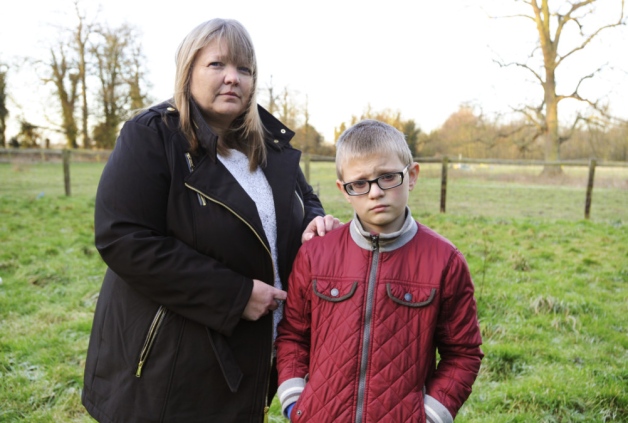
Ronnie Robinson suffers from primary congenital glaucoma, asevere visual impairment in which his eyes cannot cope with changing light conditions.
Developers of the Ongarhill wind farm, which is due to be debated by the West Norfolk Council planning committee next week, say conditions attached to any permission, and technology on the turbines themselves, will prevent shadow flicker from affecting residents.
But Ronnie’s mum Karen says she has been warned by doctors that she will have to leave her home on Hall Road, Clenchwarton if the plan goes ahead, in order to save his sight.
She said any flicker would leave Ronnie at risk of becoming disorientated and banging his head. Continue reading West Norfolk mother tells of blindness fears for son over wind farm scheme
 Mothers Against Wind Turbines Inc. has launched an Environmental Review Tribunal (ERT) against the Ministry of Environment and Climate Change (MOE) and the Niagara Region Wind Corporation (NRWC). The NRWC has been granted approval by the Ministry of the Environment to construct 77 industrial wind turbines in West Lincoln, Wainfleet and Haldimand County. These IWT’s are the largest turbines to be placed on land in North America with the smallest set back. They will generate more empty homes, hospital expenses and higher electricity bills.
Many in the reading audience may be bored with this news, or resigned to the results when little people battle huge corporations or the government, but this battle is worth fighting because more and more red flags are going up on the field. Continue reading Industrial Wind Turbines: Why the Battle is Worth the Fight
At county council’s meeting this Thursday (Jan. 8), White plans to urge politicians hire an electrical engineering consultant to determine whether the amount of stray energy being emitted from Dufferin Wind’s 230 kV transmission line is safe or not.
“It’s in the best interest of us to at least know what the levels are that we’re dealing with,” White said. “To have somebody, who is professional in the field, explain to us that this is safe, this is not safe, or under which conditions it is safe.”
Since Health Canada doesn’t consider EMF a hazard, there are no precautionary measures required when it relates to daily exposure. As such, Dufferin Wind spokesperson Connie Roberts noted the company has no testing guidelines to follow.
“We state unequivocally that all protocol has been followed in the construction of this line,” Roberts explained in an email, claiming opponents to her company’s project are requesting EMF measurements that aren’t mandated in Canada.
“DWPI has installed a safe power line,” Roberts added. “It has been built to the latest industry standards; and it is consistently operating at well under capacity.”
Continue reading County urged to study EMF levels along Dufferin Wind transmission line
 Mothers Against Wind Turbines Inc.