Category Archives: Health effects from wind turbines

Researchers respond to paid wind consultants

dscn1004
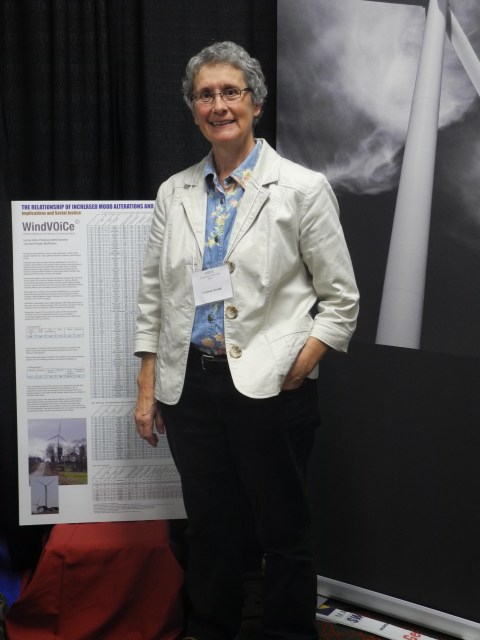
Carmen Krogh presenting her research at a Primary Health Care provider conference

Independent researchers Carmen Krogh and Dr McMurtry  provide a detailed response in the December 2016 edition of  Noise & Health publication to Dr McCunney’s et al critical commentary of the peer reviewed and published paper- Diagnostic criteria for adverse health effects in the environs of wind turbines.

“The content of the article by McCunney et al. suggests that its authors may not have understood the procedure presented for diagnosing patients suffering from ‘annoyance’ and the ‘well-known stress effects of exposure to noise’. While this response does not address all the weaknesses contained in the analysis by McCunney et al., it is our hope it will help clarify understanding of this diagnostic tool. We invite readers to explore the work of McMurtry and Krogh, and as always we welcome constructive commentary.”

Response to McCunney et al.: Wind turbines and health: An examination of a proposed case definition.  http://www.noiseandhealth.org/article.asp?issn=1463-1741;year=2016;volume=18;issue=85;spage=399;epage=402;aulast=McMurtry

Diagnostic criteria for adverse health effects in the environs of wind turbines. https://www.ncbi.nlm.nih.gov/pubmed/25383200

McCunney RJ, Morfeld P, Colby W D, Mundt KA. Wind turbines and health: An examination of a proposed case definition. Noise Health 2015;17:175-81; http://www.noiseandhealth.org/article.asp?issn=1463-1741;year=2015;volume=17;issue=77;spage=175;epage=181;aulast=McCunney

Noise: Schools next to wind turbines

school-bus

The World Health Organization is currently reviewing the European Environmental Noise Guidelines:

“The guidelines will assess several environmental noise sources such as aircraft, rail, road, wind turbines and personal electronic devices. The document will also consider specific settings such as residences, hospitals, educational settings and public venues.  In addition, the guidelines will review the evidence on health benefits from noise mitigation and interventions to decrease noise levels.”

WHO: http://www.euro.who.int/en/health-topics/environment-and-health/noise/activities/development-of-who-environmental-noise-guidelines-for-the-european-region

Below is a letter submitted for consideration.

NOISE: A startling case of two schools in proximity to wind turbines

Dear Mme Héroux,

I should be grateful if you would ensure that this report reaches the ladies and gentlemen of the panel reviewing the WHO’s noise guidelines for Europe.

In an effort to assist a society in danger, I feel obligated to make this case public. I am employed in schools within a rural area. The projects I am involved in run throughout the school year. I hope it will be understood why I cannot reveal names and locations. Sadly, I must protect myself against the professional consequences which could result from a fully detailed testimony.

During the past two years, I have worked in a school located 5 km to the east of a small wind farm, whose elevation is about 300 feet above that of the establishment. Most of the time, the school is downwind from the 2 MW wind turbines. In 2014/2015, I worked with the kindergarten consisting of 20 children aged 2.5 to 5 years of age. I’ve been engaged in this work for a long time, and I know the region and its people very well.

I was surprised how hard it was to manage this class of very young children. Actually, the teacher would systematically divide the class into two groups of 10, although I usually have no problems working with whole classes. Nonetheless, I found it hard to maintain the concentration of many of these children. In addition, a lot of pupils exhibited unusual and completely improper behaviour, which was violent and disruptive. I had rarely encountered this before with children of that age group, and never in such proportions. I did not understand why at first. It wasn’t the teacher’s fault: he was kind and rigorous at the same time, which is perfect for such small children.

During the second school year, I was again assigned to that school, but this time in two classes: the kindergarten divided into two groups, and a class with children aged 6 to 7.

This second class was absolutely unmanageable during the five first sessions. Its experienced teacher commented to me it was like that most of the time, he just could not handle those children. Yet again, nothing was wrong with the teacher. Several children seemed to be extremely ill at ease, a feeling shared by the teacher. There were instances of fits, outbursts of rage, rolling on the floor, knocking tables over and provoking each other into violent behaviour. The teacher was losing confidence and was also beginning to feel ill himself, on one occasion coming very close to a burn-out. The tiredness etched upon his face reflected his struggles. It should be noted that he also had problems with his memory, and it was becoming obvious that the children’s behaviour was not the only cause of his troubles, but that the location as well was a highly plausible culprit.

I soon made the connection with the wind turbines, because this behaviour reminded me of two children I had worked with a couple of years ago: they lived 800 yards from a wind farm. Having realised that, I started to check on the wind direction every time I drove to the school, when passing the wind turbines which in any event can be seen from the village.

From the start of the 6th session the change was dramatic: this class was the most peaceful I had ever taught. The children were remarkably calm and took part in the experiments in a very constructive way, intervening advisedly, all without pushing and shoving or fighting. Notably, the wind was blowing from the east, from the village to the wind farm, not the other way around as it did previously. I informed the teacher about my observation.

Some time later, having worked during the morning in the kindergarten, I was having lunch with their teacher in the classroom before going to another school. At noon, he was called by his third colleague. The 6-7 year olds’ teacher had left the school in tears, after a horrible morning spent with his pupils who had behaved particularly violently and unbearably. While we were eating, we stopped talking for a moment. This is when I felt the school vibrating, as if a lorry were passing on the country road 300 feet away. This vibration however, did not cease. In fact, the whole school was vibrating strongly, and we listened to that humming sound for a long moment. We opened the window, but there was no noticeable source of noise outside. It wasn’t the air extraction fan either, for we could hear its less obtrusive noise separately.

The classrooms had probably been vibrating during the whole morning, but this had been covered by the background noise of our activities. There is therefore very good reason to believe that this could have been the cause of the particularly strong malaise felt in the disruptive class of 6-7 year olds during the morning. That particular room faces the wind turbines and clearly acts as a sound box. The two other classrooms are more protected, but that didn’t prevent us from hearing strong vibrations in the kindergarten room, situated at the back of the building. The teacher of that class had also heard the noise very well. It is important to note that a sustained wind had been blowing from the direction of the wind turbines for several days.

The children all live in villages situated below the wind turbines, and were born after the construction of the wind farm. I recently met the mother of one of the children. She told me about the problems caused by the highly excitable nature of her two children and their classmates. She didn’t know what to do, so she had called a woman who claimed to be able to ‘demagnetise‘ her children. She also had special EMF electricity outlets installed. When I told her about my observations, her face immediately lit up and her comment was: « it’s quite possible ! »

I had worked previously in the same school, in the same conditions and within its ancient building before the turbines were built. I retain happy memories of these times.

I have also worked, twice, in another school, located 2 km west from a similar wind farm. First it was before the wind project was built, and I had found the children to be quick-witted, with many brilliant pupils among them, one being even recognised as exceptionally gifted. The second time around, it happened 4 and 5 years after the erection of the turbines. This was a part-time job which lasted 18 months, with 8-10 year olds.

When I took that assignment, I found that a very large proportion of the pupils had special education needs, a large number of them bound to low attainment, and many had learning disabilities officially recognised (dyslexia, dyscalculia, dyspraxia etc.). Out of a class of 25 pupils, not a single one was considered brilliant. The same problems could be found in the second class, again with no children obtaining high grades. Given the high pedagogical quality of the teachers (they were the same as before the wind turbines), the eventual social problems of some of the children (not more than anywhere else) couldn’t justify the massive failure in this primary level schooling.

I thought this failure might have been caused by EMF pollution from permanent WIFI signals, and the faint natural light in the classes. But it was the same as years ago, and the same in other schools, where I had met numerous brilliant children. Again, the only difference here was the wind farm’s proximity.

Unlike the first school, and considering the prevailing westerly winds, this one was located upwind from the turbines, and at the same altitude. The children here didn’t exhibit the same violent temperaments and behaviour as those described earlier in the first case, or as the two children living 800 yards from wind turbines. On the contrary, this was a very peaceful class, almost lifeless, lacking in concentration, vitality and reactivity, with poor oral participation. A large proportion of children exhibited serious learning difficulties. In addition, when working in that school I became dizzy whenever rising from my desk, or when leaning over a child and straightening up. Here again, I thought the WI-FI was the cause (in fact it could have contributed some).

Comparing the two schools, the first one is located downwind about 300 feet below and 5 km away from wind turbines, with pupils born after these were erected, living in homes in much the same topographical situation as the school. They exhibit severe behaviour outbursts when the wind blows from the direction of the turbines.

In the second case we have a school located upwind, 2 km from another wind farm and at roughly the same elevation as its turbines, with pupils born before the construction of the wind farm, living in the same village as the school. A high proportion of them have severe learning difficulties which didn’t exist in that school before the wind turbines.

As the inquiry is about ambient noise, generally speaking, I also wish to report the harm done by air extraction fans and milking robots, which have invaded our farms. Contrary to the earlier milking machines, they don’t only work 2 x 2 hours a day, but keep humming around the clock, causing health problems to cattle and humans alike. This is not counting with the heat pumps. Actually, sources of infrasound are springing up everywhere. And although out of topic, please allow me to briefly mention the digital boards, the operation of which requires teachers to close the blinds, thus depriving a whole generation of children of natural light for a large proportion of their school day. In short, in an increasing number of schools, all these negative impacts on health add up. But clearly, from my experience as summarised above, wind turbines are responsible for the most harmful impacts.

I hope my testimony will enable you to write directives that will protect our children from these most harmful effects. I did not sign it, because too many “politically-incorrect“ whistle-blowers have lost their jobs, which is something, you will appreciate, myself and my family cannot possibly risk or afford. Only authorised persons in very senior positions know my identity. This report is, therefore, only anonymous with regard to its release into the public domain.

I should be grateful for confirmation of receipt of this letter.

Sincerely
Signature: identity legitimely withheld (see last paragraph above)

Letter posted online Dec.13.16:  https://wcfn.org/2016/12/13/windfarms-affect-children/

Blue Water Hears about Health Study

wind-turbine-autumn-540x400Bluewater Council Hears From Wind Concerns Ontario

Councillors with the Municipality of Bluewater now have a better understanding of a wind turbine study that’s just beginning.

Warren Howard, a director with Wind Concerns Ontario, appeared before council Monday night to outline the study they are conducting with the University of Waterloo and the Huron County Health Unit.

Howard explained the goal of the study is to determine if there is a link between wind turbine noise and the symptoms being reported by people who live near them.

Many of the studies so far have been focused on audible noise, but Howard says there are other types of noise created by wind turbines and their study will look at the full spectrum of noises.

As part of the presentation, Howard asked for a letter of support from Bluewater council, and that was granted.

Howard is hoping they’ll be able to collect significant data within six months from which they can draw some conclusions.

READ ARTICLE: http://blackburnnews.com/midwestern-ontario/2016/10/04/bluewater-council-hears-wind-concerns-ontario/

Wind Turbines and Human Health

hearing

A Four-Decade History of Evidence that Wind Turbines Pose Risks

Jerry L. Punch i, Richard R. James ii

Abstract

Many expert-review panels and some individual authors, in the U.S. and internationally, have taken the position that there is little literature to support concerns about adverse health effects (AHEs) from noise emitted by industrial wind turbines (IWTs). In this review, we systematically examine the literature that bears on some of the particular claims that are commonly made in support of the view that a causal link is non-existent. Investigation of the veracity of those claims requires that multiple topics be addressed, and the following specific topics were targeted for this review: (1) emissions of infrasound and low-frequency noise (ILFN) by IWTs, (2) the perception of ILFN by humans, (3) the evidentiary bases for establishing a causative link between IWTs and AHEs, as well as the physiological bases for such a link, (4) recommended setback distances and permissible noise levels, (5) the relationship between annoyance and health, (6) alternative causes of the reported health problems, (7) recommended methods for measuring infrasound, (8)foundations for establishing a medical diagnosis of AHEs due to IWTs, (9) research designs useful in establishing causation, (10) the role of psychological expectations as an explanation for the reported adverse effects, (11) the prevalence of AHEs in individuals exposed to IWTs, and (12) the scope and quality of literature addressing the link between IWT noise and AHEs. The reviewed evidence overwhelmingly supports the notion that acoustic emissions from IWTs is a leading cause of AHEs in a substantial segment of the population.

i Professor Emeritus, Department of Communicative Sciences and Disorders, Michigan State University, East Lansing, MI, USA

ii E-Coustic Solutions LLC, and Adjunct Professor, Department of Communication Disorders, Central Michigan University, Mt. Pleasant, Michigan, USA

Download Article:  http://hearinghealthmatters.org/journalresearchposters/


Wind industry’s global attitude: blame the victims

annette%20smith-3_web

RE: “Defending wind power, turbines” [Letters, Sep. 14]:

Few Vermonters will defend wind turbines, so the national organization comes to the rescue. Go look at the American Wind Energy Association’s members: mostly large multinational corporations heavily invested in fossil fuel and nuclear.

The industry’s global attitude of blaming the victims is offensive in the extreme. Abuse people once by making them sick and unable to sleep; abuse them again by telling everyone it’s all in their heads. Same story everywhere.

At a Sept. 19 ribbon cutting in Searsburg, Governor Shumlin celebrated making people in the region sick and unable to sleep. He wants more Vermonters to suffer.

Annette Smith

Published on  September 14, 2016

READ AT:  http://www.commonsnews.org/site/site05/story.php?articleno=15609&page=1#.V-ienCErLIV

Public Health on Wind in Poland

Position of the National Institute of Public Health – National Institute of Hygiene on wind farms

Position of the National Institute of Public Health – National Institute of Hygiene on wind farms

The National Institute of Public Health – National Institute of Hygiene is of the opinion that wind farms situated too close to buildings intended for permanent human occupation may have a negative impact on the well-being and health of the people living in their proximity.

The human health risk factors that the Institute has taken into consideration in its position are as follows:

  • the emitted noise level and its dependence on the technical specifications of turbines, wind speed as well as the topography and land use around the wind farm,
  • aerodynamic noise level including infrasound emissions and low-frequency noise components,
  • the nature of the noise emitted, taking into account its modulation/impulsive/tonal characteristics and the possibility of interference of waves emitted from multiple turbines,
  • the risk of ice being flung from rotors,
  • the risk of turbine failure with a rotor blade or its part falling,
  • the shadow flicker effect,
  • the electromagnetic radiation level (in the immediate vicinity of turbines),
  • the probability of sleep disruptions and noise propagation at night,
  • the level of nuisance and probability of stress and depression symptoms occurring (in consequence of long exposure), related both to noise emissions and to non-acceptance of the noise source.

In the Institute’s opinion, the laws and regulations currently in force in Poland (regarding risk factors which, in practice, include only the noise level) are not only inadequate to facilities such noise source as wind turbines, but they also fail to guarantee a sufficient degree of public health protection. The methodology currently used for environmental impact assessment of wind farms (including human health) is not applicable to wind speeds exceeding 5 m/s. In addition, it does not take into account the full frequency range (in particular, low frequency) and the nuisance level.

In the Institute’s view, owing to the current lack of a comprehensive regulatory framework governing the assessment of health risks related to the operation of wind farms in Poland, an urgent need arises to develop and implement a comprehensive methodology according to which the sufficient distance of wind turbines from human habitation would be determined. The methodology should take into account all the above-mentioned potential risk factors, and its result should reflect the least favourable situation. In addition to landform (natural topography) and land use characteristics, the methodology should also take into consideration the category, type, height and number of turbines at a specific farm, and the location of other wind farms in the vicinity. Similar legislative arrangements aimed to provide for multi-criteria assessment, based on complex numerical algorithms, are currently used in the world.

The Institute is aware of the fact that owing to the diversity of factors and the complicated nature of such an algorithm, its development within a short time period may prove very difficult. Therefore, what seems to be an effective and simpler solution is the prescription of a minimum distance of wind turbines from buildings intended for permanent human occupation. The setback criteria are also a common standard-setting arrangement.

Having regard to the above, until a comprehensive methodology is developed for the assessment of the impact of industrial wind farms on human health, the Institute recommends 2 km as the minimum distance of wind farms from buildings. The recommended value results from a critical assessment of research results published in reviewed scientific periodicals with regard to all potential risk factors for average distance usually specified within the following limits:

  • 0.5-0.7 km, often obtained as a result of calculations, where the noise level (dBA) meets the currently acceptable values (without taking into account adjustments for the impulse/tonal/modulation features of the nose emitted),
  • 1.5-3.0 km, resulting from the noise level, taking into account modulation, low frequencies and infrasound levels,
  • 0.5-1.4 km, related to the risk of turbine failure with a broken rotor blade or its part falling (depending on the size of the piece and its flight profile, rotor speed and turbine type),
  • 0.5-0.8 km, where there is a risk of ice being flung from rotors (depending on the shape and mass of ice, rotor speed and turbine type),
  • 1.0-1.6 km, taking into account the noise nuisance level (between 4% and 35% of the population at 30-45 dBA) for people living in the vicinity of wind farms,
  • the distance of 1.4-2.5 km, related to the probability of sleep disruptions (on average, between 4% and 5% of the population at 30-45 dBA),
  • 2,0 km, related to the occurrence of potential psychological effects resulting from substantial landscape changes (based on the case where the wind turbine is a dominant landscape feature and the rotor movement is clearly visible and noticeable to people from any location),
  • 1.2-2.1 km, for the shadow flicker effect (for the average wind turbine height in Poland, including the rotor from 120 to 210 m).

In its opinions. the Institute has also considered the recommended distances of wind farms from buildings, as specified by experts, scientists, as well as central and local government bodies around the world (in most cases recommended from 1.0 to 5.0 km).

READ AT: http://www.pzh.gov.pl/en/position-of-the-national-institute-of-public-health-national-institute-of-hygiene-on-wind-farms/

An Open Letter to the Prime Minister of Canada

Below you will find a link to the open letter written to the Prime Minister of Canada, the Minister of Health and Associate Director at Health Canada requesting a meeting with the Minister to discuss compliance by the wind turbine industry with the Radiation Emitting Devices Act and wind turbine industry compliance obligations, and the need to conduct an investigation of related complaints.Wind Turbines --- say NO

The letter includes issues with the design of Health Canada’s wind turbine noise and health study with interpretation of the results, and implications regarding the fact that wind turbines fall under the Radiation Emitting Devices Act as industrial Act.

We have been informed that there are numerous signatures supporting this letter. Those who wish to add their support can do so by contacting Barb Ashbee at  barbashbee@gmail.com.

Open letter to Prime Minister Trudeau regarding industrial wind turbines June 2016 

Thank you to CCSAGE  and Barb Ashbee:  https://ccsage.wordpress.com/2016/06/23/an-open-letter-to-the-prime-minister-of-canada/

Huron Considering University Partnership On Wind Turbine Study

A study being proposed by the Huron County Health Unit on the health impacts of wind turbines may take a new direction.

Health Board Chair Tyler Hessel explains the board had a few concerns about the study, including what they were going to do with the information they collected, and how much it was going to cost them.

Hessel says the University of Waterloo is working with Wind Concerns of Ontario on a study similar to the one the Health Unit was proposing, but it would go into more detail and so they’re exploring the possibility of partnering with the university.   That would give them access to a more scientific study done by a group with better human and financial resources.

They have invited a spokesperson from the university to speak at a future Health Board meeting to discuss a partnership.

Hessel adds his understanding is the university is looking at testing in specific areas and in specific homes and doing very detailed analysis.

READ: https://blackburnnews.com/midwestern-ontario/2016/06/03/huron-considering-university-partnership-wind-turbine-study/

Protect Our Health

CONCERNED CITIZENS DISMAYED

WIND TURBINE INVESTIGATION COMES OFF THE RAILS

house and turbine 1

Huron County Ontario/ May 18,2016

Rural Ontario is up in arms today over the apparent suspension of a one-of-a-kind wind turbine health investigation that may never happen.

Medical Officer of Health for Huron County Dr. Janice Owen became aware of numerous health complaints from people in her community shortly after she was hired a year ago by the current Huron County Board of Health. Owen began researching the issues last August and contacted many in the field researching the topic.

This February 4, Owen presented to her Board the outline and components of a wind turbine health complaints investigation stating that she had visited wind projects, sought information from the Ministry of Environment and Climate Change as well as Public Health Ontario and had spoken and heard from many members of the community.

In March this year the announcement of the new investigation was posted on the Health Unit’s website and immediately people suffering as a result of wind projects began to sign up. In April Dr. Owen was informed her services were no longer needed and she was put on administrative leave. This is a devastating blow to Huron County people exposed without consent to the acoustical emissions of wind turbines in proximity to their homes.

More questions than answers arose about the investigation’s future and were addressed on May 12 when the Board put the research on hold – likely permanent – stating that it seemed to be a duplication of a long term Ontario-wide public health survey with nothing to do with industrial wind adverse reactions.

“The people of Huron County do not want to become another Flint Michigan. Health administrators and those tasked with the protection of our health and safety need to see this ground-breaking research through to the end,” says Gerry Ryan for the group Concerned Citizens for Health (CCH). “The eyes of communities around the world who are suffering the same fate as us are watching what happens in Huron County Ontario. The wind industry is watching and the Ontario government whose policy this is are also watching.”

The CCH calls upon the temporary Medical Officer of Health Dr. Meriam Klassen to be courageous like Dr. Owen and find out where this investigation will take her. This is only fair.

Contact: Concerned Citizens for Health

Gerry Ryan

519 274-5566

gerkar@tcc.on.ca

It Worked

vermont residents
If we don’t do it who will?

Vermont prides itself on having citizen legislators, as opposed to professional politicians, while the lobbying in Montpelier for special interests is done by well-funded professional lobbyists.

For the past eight years, our legislators and regulators have been bombarded by renewable-energy lobbyists. The message has been that Vermont must do “everything” and we must “do it now” to save the planet from climate change.

The urgency of the pitch has made it seem as if Vermont alone is responsible for the emissions that cause climate change.

This message has been delivered by the well-paid lobbyists at VPIRG (the Vermont Public Interest Group), REV (Renewable Energy Vermont), KSE Partners (the lobbyists who represent Green Mountain Power and Iberdrola Renewables), and a long list of people who view Vermont as a candy jar for collecting extravagant renewable-energy incentives.

The lobbyists’ circular strategy involves promoting an array of state energy goals that have no basis in our true energy and emissions profile. They then insist to the Legislature that there must be no barriers to erecting inappropriate projects because these same “state goals require it.”

The result is a state energy policy that has produced an avalanche of unintended consequences so appalling that the Selectboards of more than 160 towns signed the Rutland Resolution, which asks the Legislature to take another look at the lack of clear standards for siting renewable energy projects.

In recent days, the Senate and the House unanimously passed slightly different versions of S.230 — a bill “relating to improving the siting of energy projects” — in spite of furious lobbying by the renewable-energy industry.

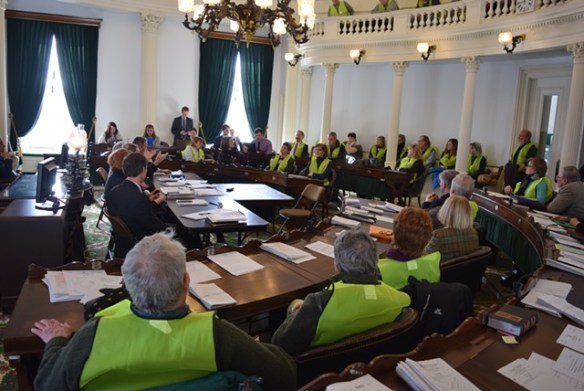
The story of S.230 is highly instructive, because the pros weren’t the only lobbyists in the capital. For weeks, the committee rooms of the Senate and House have been filled to overflowing with unofficial “citizen lobbyists,” identifying themselves by wearing neon green safety vests.

The legislators learned that the Vermonters most opposed to big wind and solar sprawl include those who know the most about the subjects because they deal with the unintended consequences every day and because they have studied the issues.

The legislators heard firsthand the bitter results of a regulatory policy of “any solar, anywhere, anytime.”

They learned about the tragedies in Lowell, Sheffield, and Georgia Mountain of nearby residents driven from their homes, or to distraction, by wind-turbine noise far exceeding what the developer promised.

To prevail on S.230, we, the people lobbied on our own behalf — tirelessly and effectively.

The result is that “we” have been heard.

“We” are the people who live near already existing large wind installations.

“We” include the folks threatened by similar projects in Swanton, Irasburg, Grafton, and Windham who want justification for issuing certificates of public good for utility generation on ridgelines and near settlements.

“We” are the people from towns where solar arrays have been placed in disregard of local policies, preferences, and Town Plans.

“We” are Vermonters who have donned our green vests in solidarity and went to Montpelier and walked the halls and haunted the cafeteria of the Statehouse, just as the big-money lobbyists do.

“We” talked to the legislators.

“We” testified before committees.

And “we” learned a lot.

None of us citizen lobbyists opposes renewable energy. None of us denies the need for Vermonters to do our part in reducing emissions.

But we do oppose allowing those who profit most having total control of what gets built and where. And we oppose squandering our state’s natural resources and heritage on projects that will not help slow climate change.

The lesson is this: in a state with a citizen legislature where big money increasingly influences policy decisions, there is no substitute for well-informed, articulate, and persistent citizen lobbyists to represent our own interests.

If we don’t do it, who will?

READ AT:  http://www.commonsnews.org/site/site05/story.php?articleno=14722&page=1#.VzPnybv2bIU