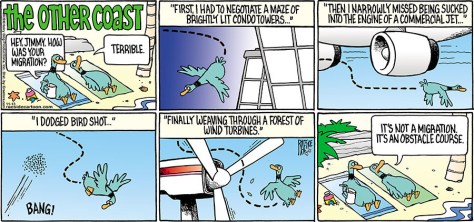
The work of cartoonist Adrian Raeside illustrates some of the cumulative harmful impacts from human activities to migrating avian species that use the global flyways. Habitat loss, avoidance and mortalities are direct adverse impacts arising from the installation of wind power generating facilities. Killing the natural world one spin at a time.
Windham and Grafton soundly voted down the industrial wind proposal for our towns. You’d think we could all take a rest. Not so. Wind-industry moles spring up in every corner of the state, begging to be whacked.
The mole of the week: the Vermont Public Service Board’s “Proposed Rule on Sound from Wind Generation Facilities.”
The gist of this rule-making is: “Help us figure out impossible rules that can’t be monitored or enforced, concerning the noise that can be legally inflicted on Vermonters by our friends, the wind developers.”
You might feel that such rules mean it’s still open season on Vermont’s communities, given that unenforceable standards amount to nothing more than a knowing nod to the wind profiteers. If you’re right, then let us give this particular mole the whacking it deserves.
This is an enchanting place, a captivating landscape.
Where eagles soar and owl sounds fill the night air.
This is a healing place, an enriching place,
Where hawks teach their young to hunt and herons stalk fish on river banks.
But soon, forty-two storey grinding eyesores.
Red strobes filling the night sky.
Hush, Hush, Hush (don’t tell your neighbours)
This is a nurturing place, a meditation place.
Where bats and dragonflies gather mosquitoes at dusk and dance their graceful reel.
This is resting place, a gathering place.
Where monarch butterflies feast on milkweed and gain strength before flight.
But soon, slicing, dicing, killing.
Blood on the fields
Hush, Hush, Hush, (don’t speak of it)
This is a place to throw off the cares of the week.
A place for hammocks and splashing water.
A family place and a place to retire.
To pitch a tent, sleep under the stars.
But soon, vibration, headache, heartache.
Twenty-four seven.
Hush. Hush. Hush (shhhh)
This was a neighborly place, a kind place.
Where neighbors shared and helped each other.
But now, the bitterness of helpless rage and loss.
What a shame.
Ontario is engaging in review of its Long Term Energy Policy and encourages public consultation. Attend a consultation session or provide your opinion online.
Ontario has a robust energy supply and it begs the question why contract for even more wind power or build projects such as Amherst Island, White Pines, Fairview Wind? Wind power continues to demonstrate it is out- of -phase with demand and we are selling the unnecessary electricity at a loss and burden of cost to ratepayers. Will the Independent Energy System Operator conduct a critical cost benefits analysis for all renewable energy power sources?
Wind power continues to create adverse harm to the environment and human health. Wind facilities remain fire walled behind the statues of the Green Energy Act shielding it from independent review. This has resulted in disabled protective standards that must be met by other sources of power generation.
Last week I was reading of an Australian study, by a Professor Gary Wittert, which had shown sleeping pill usage for those living near wind turbines was no greater than the general population . The study compared those living within 10 km of turbines with those living more than 10 km away. There have been similar studies with property values using a 5 mile or 10 km radius that showed property values are not affected by wind turbines. Had you ever thought why they pick a 10 km radius?
Consider this graphic. It shows 1 km bands with the calculated area for each band shown in blue.
Let’s keep it easy and assume that households are evenly distributed and there is one household for every 10 square kilometers.
So, within 2 km (the two innermost bands) of the turbine, the area is 3.1 + 9.4 km² (=12.5 km²) which would represent 1.2 households.
Now let’s consider the two outermost (9 km and 10 km) bands. The area of these bands is 53.4 + 59.7 km² (=113.1 km²) which represents 11.3 households. So the outermost bands have about TEN TIMES the number of households of those living within 2 km, making sure that the contribution of the inner bands is diluted, swamped, covered up or however else you would describe it.
Or consider if you live within 2 km of a turbine. The outer bands of those living from 2–10 km from the turbine adds up to 301.6 km², which would represent 30.1 households – which is 24 TIMES the number of households within 2 km.
No wonder your voice is being “drowned out”. The bigger the circle, the more “dilution” occurs.
Add this to the list of things where “size matters”, and next time you see a study like this, consider the radius and area that was chosen. The choice of the circle size plays a major role in the result obtained and speaks volumes about the motivation of the author.
by Alec Salt, Professor, Department of Otolaryngology, Washington University School of Medicine
In light of Energy Minister Glenn Thibeault’s recent announcement suspending LRP-2, we are now calling on the provincial government to also cancel the recent LRP-1 contracts, including the Strong Breeze Wind Project in Dutton Dunwich. Ontario does not need the energy and this cancellation would save Ontarians Billions of dollars!
We need your help by participating in our letter writing campaign. It is easy and will only take a quick moment of your time.
Below you will find a copy of the letter we are asking you to sign. All you need to do is send us your email address, either in an email to info@ddowt.ca, or in a private message through Facebook. You will then be emailed a ‘DocuSign’ to sign. Simply open it and follow the on screen instructions to review and sign the letter. Once we receive your signed copy, a hard copy will be printed and mailed to the addressees stated in the letter on your behalf. We encourage each member of your family to sign a copy of the letter. Just send their email address and we will send a separate letter for them. Rest assured that any information you provide will remain confidential, and will be used only to send these letters .
If you would prefer to mail a copy of the letter on your own, contact us and we will provide you the necessary information and addresses.
In addition to the letter writing campaign, our DDOWT volunteers will be going door to door with a petition to show the strong support in our community for cancelling this project. Please participate in both of these efforts as they are absolutely necessary for added pressure on the provincial government. If you would like to sign the petition, but do not receive a visit by the end of November, please contact us through email or Facebook.
If you have any questions, please do not hesitate to contact us.
Thank you for your continued support! The fight is not over!!
Why, Where and How to Report Health & Wellness Issues or Observations
Niagara Wind Contact Number: 1-884-363-6491
Call 911 for emergencies
MOECC Niagara District Office (Mon. – Friday 08:30 – 5 p.m.) 905-704-3900 or 1-800-263-1035 x 43906
Any Time: call MOECC – Spills Action Centre
1-800-268-6060
Parts of the NRWF industrial scale wind facility have become operational -that is -not only spinning, but also under load (Generating power). Now it gets interesting…
The best things we can do to protect ourselves:
Maintain a logical frame of mind:
Do not focus on any noise or vibration they might create in your home – only observe if they are present or not, then focus away.
If noise and/or vibration is present:
Keep a log of what you observed and when you observed it.
Include what you did about it
Complete the log as soon as you can after the event occurs – improves accuracy.
Please see the linked “Wellness Log” template below you may wish to use. I prefer to use Google Drive because I can access the log from anywhere on any device. (Requires a free Google Gmail account)
Report any issues through official channels:
This is the primary method by which we can effect change!
The Wind Power Corporation is bound by law to report conditions to the MOE(Ministry of the Environment), when you issue an incident report to them.
Even if you don’t get any reply – continue doing this. The reports of issues can be obtained through a Freedom of Information Act request and used.
Please circulate these materials to your friends and neighbours. We hope that no one feels any negative reaction, but if we do, we must not suffer in silence.
Through 48 years of development and policy work – eleven of them as Canadian ambassador to several Africa countries, and the last eleven as adjunct professor at Carleton and Queen’s – I have been convinced that the world faces an environmental crisis. The last thing I could imagine myself doing was, and is, to speak out against Green Energy.
Instead, I was at the forefront of those sent abroad by Canada to encourage democracy, human rights, the rule of law, transparency in business and government – and protection of the environment.
Now I am at home, teaching what I have learned to graduate students, and living on Amherst Island near Kingston. Yet even here, the issues of governance, sound policy and the environment are at the forefront – and are often overlooked or misjudged in pursuit of political and financial goals.
Yes, Amherst Island faces a calamity of governance and environmental policy. Ontario government approval has been given for the Island to become a 26-turbine wind farm. On an island no longer than 20 km and 7 km wide, this massive installation is to be pressed through despite the strong opposition of expert naturalists, environmentalists and the majority of the island’s 450 residents – very few of whom (no one knows the number because the question has never been asked) – want to see this jewel of migratory birds, natural beauty and historic heritage destroyed by what is apparently a moneymaking scheme designed by generating companies to attract and exist on government subsidies. In our hitherto-close Island community, only the few who have succumbed to opaque, secretly-negotiated offers will benefit: in return for the proverbial mess of pottage, (we are told, less than $10,000 a year) they would destroy their own heritage and that of their neighbours by accepting wind turbines on their land.
Decisions have been made which could be understood in many of the African countries in which I have worked, but in the Canadian context, seem dramatically out of place and counter-productive. A money-making scheme has been dressed up as pursuit of a noble environmental goal; a fiercely committed but far from wealthy group of Islanders and friends are pitted against substantial corporations with incomparable legal and financial resources and the promise of tax-payer subsidies. The result of this uneven battle could indeed be the destruction of the very environment that green energy is designed to preserve.
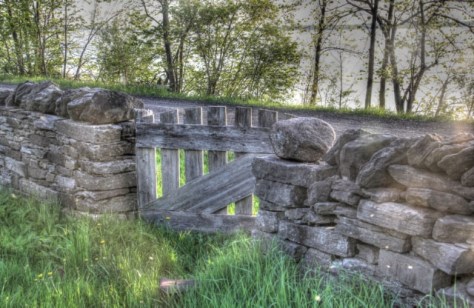
All this would appear to leave the Island community and the Island at the mercy of a provincial process which in itself is unbalanced, if not faulty. Many studies and indeed judicial findings have suggested that Ontario has a surfeit of electricity; that taxpayers’ subsidies for green energy to produce yet more electricity are misguided; and that destruction of the environment through construction of new docks and roads, a cement plant next to the public school, heavy traffic loads which our lanes cannot bear, knocking down 150-year old dry stone walls and other heritage – all are being pursued over the strenuous objection of residents and despite evidence of clear and lasting harm to the very environment green energy is supposed to protect.
Thus, though green energy is essential, and environmental concerns must be pre-eminent, the pursuit of provincial political objectives through robbing Canadians and Ontario of a valuable natural assets requires forceful public comment – not only from those immediately affected, but from those who are making the decisions and allowing it to happen.
I am compelled to speak out. I hope you will join me.
John Schram Amb (ret) John R Schram BA MA JD LLD Senior Fellow, Norman Paterson School of International Affairs Senior Fellow, Queen’s Centre for International and Defence Policy
About John Schram:
In his 36 years with the Department of Foreign Affairs, John Schram served in Nigeria and London, then worked actively in the South African struggle against apartheid and the transition to democracy. He was Director for Eastern and Southern Africa during the first South African elections and Canada’s participation in the Somalia UNITAF operation. From 1994 through 1998, he was high commissioner to Ghana and Sierra Leone and ambassador to Togo and Liberia; He was Canada’s ambassador to Ethiopia, Eritrea, Sudan and the Organization of African Unity from 1998 to 2002; and ambassador to Zimbabwe, Angola and Botswana from 2002 to 2005. He holds a law degree from the University of Toronto, and an MA in African Studies and honorary LLD from the University of Ghana. He now focuses on conflict resolution, peace building and development as Distinguished Senior Fellow with the Norman Paterson School of International Affairs at Carleton University, and the Queen’s Centre for International Relations at Queen’s University in Kingston.
In Vermont wind power developers are offering direct financial incentives to facilitate the latest proposed industrial wind turbine development. Critics are very clear that they feel the offering is a mechanism to buy the vote. Wind proponents spin it as sharing the economic benefits of wind power. The United States is not alone in having money being used as the carrot on the stick to silence opponents.
In Ontario many local municipalities fall silent opposing renewable projects when their acceptance is facilitated by the payout of Community Vibrancy Funds offered by wind developers.
Lester Green & Bill Monture (their English names) representing the interest of the Men’s Fire Council appeals against renewable energy approvals at the Ontario ERT
The Haudenosaunee people of the Six Nations located within the Haldimand tract territories are also being engaged via installed governance structures (which are bitterly contested due to historic forced installment under the Indian Act). Six Nation Band Council along side other entities such as HDI have become willing part- owners of renewable energy projects with the promise of big monetary buy outs. The price tag for good will metered against mandatory consultation about development guaranteed in the Canadian Constitution. Agreements for project ownership are funded with borrowed monies indebting cash strapped communities along the Grand River. The decision to participate fueled with promises of monies and pay outs totaling in the tens of millions of dollars for some of the renewable projects. The price point rising with each agreement according to perceived level of threat of facing opposition and fear of direct action being taken against the projects. Many residents of Six Nations Territories are demanding to be shown the money as questions continue to swirl over the legitimacy of signatory authority of consent on the contracts and in particular alarm is raised over claimed clauses extinguishing sovereign rights for the lands. Community consensus which is the traditional model of Iroquois government has not been reached. This was evidenced by the appeals from the Men’s Fire Council from the Six Nation Territories at the Environmental Tribunal. Controversy and division over wind power continues today within the close- knit community.
Community disruptions and harms caused by wind power is not and will not healed by any amount of money.
Trish and Shawn Drennan are now self- represented in the latest challenge against the K2 wind project. The date for the motion to strike and dismiss their claims is currently set for January 19, 2017 in Goderich, Ontario. Support the fight with seats in the seats or drop a line to the Drennans directly. Fighting for justice for all who have been adversely harmed by wind power facilities.
Drennan’s Renew Wind Farm Lawsuit
Thursday, October 27, 2016 9:06 AM by Peter Jackson
Ashfield-Colborne-Wawanosh couple proceeds without a lawyer against wind farm.
(Goderich) -A couple from Ashfield-Colborne-Wawanosh is making another legal attempt to recover damages from K2 Wind, for alleged harm its 140 turbine wind farm is doing to them and their neighbours.
Shawn and Tricia Drennan are representing themselves in Goderich Court.
They filed an amended statement of claim Wednesday in regard to the current operation of K2.
Drennan reminds us that his original claim was filed in the spring of 2013, which was more than two years before the 270 megawatt project was completed.
He says significant facts of the case have changed since then, and that K2 wants to strike down certain provisions of the Drennans’ original claim.
The 2013 claim asked that renewable energy approval be stayed and that K2 not be built.
The document also sought damages.
The Drennans’ Constitutional argument of the original claim was heard by the Environmental Review Tribunal and upheld by the Ontario Court of Appeal.
Drennan admits the process is a challenge since Toronto-based lawyer Julian Falconer is no longer representing the couple.
Superior Court Judge Russell Raikes advised Drennan on the correct way to file the amended claim, and has set January 19th as the date for the motion to strike to be heard in Goderich Court.



 Hello DDOWT Supporters,



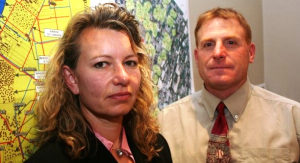 Trish and Shawn Drennan are now self- represented in the latest challenge against the K2 wind project. The date for the motion to strike and dismiss their claims is currently set for January 19, 2017 in Goderich, Ontario. Support the fight with seats in the seats or drop a line to the Drennans directly. Fighting for justice for all who have been adversely harmed by wind power facilities.

 Mothers Against Wind Turbines Inc.