Seven families which included children in a north Cork village in Ireland launched legal actions back in 2013 against the wind turbine operators for a project adjacent to their homes. The wind plant began operations in 2011 which they claimed caused them adverse health effects mainly due to noise pollution coming from the turbines. The impacts to health were severe enough that several families were forced to abandon their homes seeking relief. In January 2017 Enercon Wind Farm Services Ireland Ltd. admitted to liability leading to the court order to settle the actions for damages.
THE HIGH COURT 2011 No. 9955P Tuesday the 6th day of December 2016
And the Court records that liability has been admitted by the Defendants in the action herein and each action listed in the schedule here-after……
(Bolded for emphasis)
An announcement has been published that settlements have now been reached in the actions before the High Court.
Cork village families settle action against wind turbine operators
By Ann O’Loughlin
14/06/2017 – 12:28:35
A group of families in a north Cork village who sued a wind farm operator claiming the huge turbines adversely affected their health have settled their High Court actions.
The High Court was this morning told the cases involving seven families from the Banteer area had been settled and the cases could be struck out.
The actions were regarded as landmark cases and the High Court had been due to assess damages after liability was admitted in the case several months ago.
The cases against Enercon Windfarm Services Ireland Ltd and Carrigcannon Wind Farm Ltd were taken by the Shivnen family and others including couples, families, and one single occupant.
The seven families from Banteer area claimed they have been severely impacted, particularly through noise pollution, since the turbines began operating in Nov 2011.
In court today, Roland Budd Bl told Mr Justice Tony O’Connor the implementation of the settlement agreements had taken place and the seven actions could be struck out.
No details of the settlement were given in court. The case will be briefly mentioned next month in relation to certain costs. The Banteer action was the first of its kind in the country.
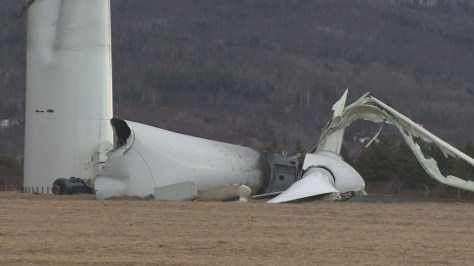
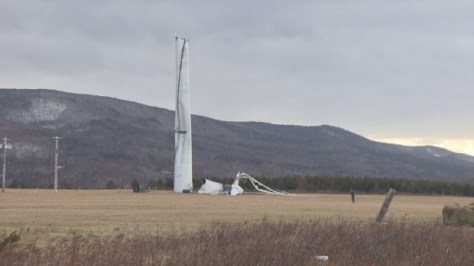
Grand Etang Vestas wind turbine collapsed January 2017. The turbine was erected in 2002.
Nova Scotia Power Inc.
Grand Etang wind turbine removal gets underway
June 12, 2017Nova Scotia Power is undertaking site cleanup and removal of the Grand Etang wind turbine, which is expected to be completed within the next two weeks.
The turbine has not been in operation since early January following an unexpected collapse of the turbine structure. No one was onsite at the time of the incident and there we no injuries.
A detailed investigation into the turbine collapse has been underway over the past few months, with further analysis of the data and equipment required before the cause of the incident can be confirmed.
Crews have been on-site cleaning up debris from the property and mobilizing a crane that will lift the wind turbine and tower components onto flatbeds for transport. It’s expected that site cleanup and removal of the turbine will be completed within the next two weeks.
Constructed in 2002, Grand Etang was one of the first wind installations in Nova Scotia, with a single 660 kilowatt Vestas V47 wind turbine. That particular turbine model is not used at any other site in the province, either by Nova Scotia Power or independent wind producers.
Nova Scotia Power purchases electricity produced from over 300 public and privately-owned wind turbines in operation across the province.
For more information:
Organization:
Nova Scotia Power Inc.Address:
PO Box 910
Halifax, Alberta
Canada, B3J 2W5 www.nspower.ca
Tel: 902-428-6230
Grand Etang Vestas wind turbine collapse 2017 in Nova Scotia
“If it’s too windy, then maybe it’s not the right place for it,” said Aucoin. “Because it is close to houses and I imagine the people up the hill … they must have been scared because it was right near to their house.”
Laurette Chiasson, a resident who has lived in the area for 59 years, said she’s never had a problem with the windmill, though she was scared after the collapse about pieces hitting the house.
Wind power promises it is clean and green using the wind to generate electricity by spinning the blades of wind turbines. Focusing on the manufacturing process “clean and green” claims are tainted with growing issues surrounding the use of known pollutants used to make turbines. Turbine blade production involves plastics and composite materials to create the finished product. Like any industrial production the chemicals used can involve toxic water pollutants. Pollutants which if released into the environment (and includes exposure risk to health for the people on the shop floor) that can be persistent. Risks and remedies are being studied by looking at known and unknown adverse effects. Drinking water contamination concerns are heightened surrounding the types of plastics being used in the construction of industrial wind turbines. Additionally it raises questions about risks of harm to the environment once the blades are exposed to the natural elements after installation.
“A highly toxic water pollutant, known as perfluorooctanoic acid (PFOA), last year caused a number of U.S. communities to close their drinking water supplies. Because of its historical use in Teflon production and other industrial processes as well as its environmental persistence, PFOA contamination is a pervasive problem worldwide.”
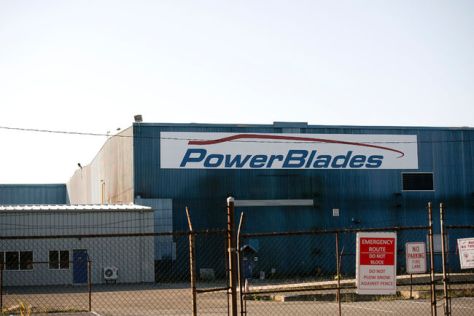
A Welland wind turbine blade plant received approval to discharge emissions into the environment from Ontario in 2014. The list of allowed discharges reads like a chemical alphabet soup and clearly states that contaminates are surrounded by unknowns and no ministry standards. Ironically this particular plant was closed shortly after citing a lack of new wind projects in Ontario. READ about the plant closure.
“Emissions to the atmosphere include ammonia, petroleum distillates, ethylbenzene and suspended particulate matter.”
“Suspended particulate matter emissions occur from the sanding of the turbine blades and includes Bisphenol-A-(epichlorhydrin), formaldehyde, 1,6-bis(2,3-epoxypropoxy)hexane, Epoxy Resin, Phenolic Novolac Resin and Glycidated Alcohol. These contaminants do not have ministry POI standards. Ministry toxicologists have determined that, based on an assessment of available toxicological information and of guidelines from the MOE and other jurisdictions, the estimated maximum POI concentrations listed in this application for these contaminants are considered acceptable.”
At the end of the day the blade production plant located in Welland, Ontario was closed after less than 2 years of production. ““Unfortunately, because of a lack of future projects we cannot continue”
Victoria Day weekend in Canada is a time for picnics and fun with family and friends, for many people.
One set of grandparents living on a farm in Ashfield-Colborne-Wawanosh Township in Huron County thought that would be fun too, and were looking forward to having their two young granddaughters come and stay for a lovely weekend in the country.
But it was not to be.
Early on the morning of the holiday Monday, the grandmother said, “there was a horrible tonal* noise — whine and whooing that made staying on the second level of our home intolerable.”
Later on that same morning, she said, she had “severe pressure and pain” in her ear.
Then, “Our eight year old granddaughter complained of a ‘sore forehead’.” The child has complained of sore ears at times in the past while visiting her grandparents’ home, but never at any other time.
Outside, the family discovered, the whining and whooing noise was everywhere.
“We had to leave here [our home] with those little girls,” the grandmother said.
“We have no freedom to do as we want in our private surroundings. It makes me weep.”
The family, who wishes to remain anonymous, like so many other families forced to endure the noise and vibration from wind turbines. They live with 11 wind turbines within two kilometres of their home, the closest of which is just over 700 metres from the house.
They filed a complaint with the Ministry of the Environment and Climate Change District Office, and added this statement:
“You are harming us.”
Ontario Minister for the Environment and Climate Change Glen Murray recently promised in the Legislature that his staff were responding to such complaints and that they would ensure the rules on noise emissions would be enforced.
Ontario families who did not ask to be exposed to these noise emissions deserve to have the Ministry fulfill its mandate, and protect all citizens from harm.
The Spills Action Line for the MOECC can be reached at 1-800-268-6060 to report excessive wind turbine noise, vibration and shadow flicker. If you call during business hours, you will be referred to the local Business Office. From the website:
You must report a spill if it:
harms or causes material discomfort to any person
injures or damages property or animal life
impairs the quality of the natural environment air, water or land
causes adverse health effects
presents a safety risk
renders property, plant or animal life unfit for use
leads to the loss of enjoyment of the normal use of property
interferes with the normal conduct of business
Pure tones are wave forms that occur at a single frequency. Tonal noise is generated by rotating equipment at a predictable frequency relating to the rotational speed of the shaft and the number of compressor vanes, fan blades, engine pistons, gear teeth, etc.
Andy Metelka is the president of Sound and Vibration Solutions Canada and is currently researching sound emitted by wind turbines. He presented some of his findings to West Lincoln residents at a talk hosted by Mothers against Wind Turbines and the West Lincoln and Glanbrook Wind Action Group. – Alexandra Heck/Metroland
Andy Metelka, an acoustics and vibrations specialist who has been studying the sound effects of wind turbines, was very careful about the conclusions he made from his studies.
He has just returned from a conference on wind turbine noise in Rotterdam, Netherlands, and shared his insights with a group of residents in Smithville.
Metelka has perfected his own sound measuring technique and a formula to isolate the sound coming from turbines from other background noise.
“There are no guidelines in Canada on infrasound regarding wind turbines,” said Metelka, explaining that further research could lay the groundwork for those regulations.
“I’m not here to discuss medical science, I’m not a medical professional,” he said. “I do not act on behalf of any party as a professional engineer.”
Metelka has been studying the sound and infrasound from turbines in Grey Highlands, a municipality just southeast of Owen Sound. Infrasound is the low-level noise that is not detected by the human ear.
Metelka concluded that both weather and the shape of the ground can affect how the sound travels, and that older farmhouses let more infrasound in than newer homes.
Metelka also concluded that infrasound is indeed present in homes near operating wind turbines, but he could not say what effect, if any, they have on human life.
Back in the 1960s, Yale psychology professor Stanley Milgram conducted a research experiment whose results shocked the nation.
Participants were told that they were taking on the role of ‘teacher’ in a study of methods to improve learning. An authority figure told the ‘teacher’ to administer increasingly powerful electric shocks to a ‘learner’ in the next room whenever a question was answered incorrectly. There actually were no shocks and the learner was part of the research team, but the ‘teacher’ heard increasing cries of pain with each ‘shock’ administered. Even as the intensity of the shocks approached the maximum of 450 volts, the authority insisted that the shocks should continue – that the anguished screams, the banging on the wall, the pleas about heart conditions, and ultimately the ominous silence from the other room should all be ignored.
It was believed that most people would defy the authority figure once they became aware that the shocks were seriously harming another person. But that was not the case: almost 2/3 of participants continued to obey the authority figure, administering ‘shocks’ until the very end.
I was reminded of the Milgram experiments recently while attending two Public Service Board hearings on new proposed sound limits for industrial wind facilities. Because there have been problems, a lower standard of 35 dBA, (down from 45 dBA) has been proposed. (The World Health Organization recommends 30 dBA.)
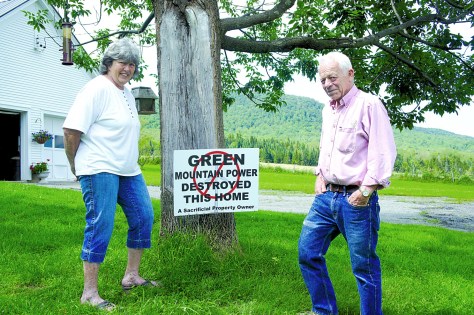
Shirley & Don Nelson- A Sacrificial Property Owner
Those who live close to Vermont’s existing industrial wind facilities have described a range of symptoms that include sleeplessness, headaches, ringing ears, and nausea. For fifteen months, Shirley Nelson, who lived less than a mile from the Lowell wind project, kept detailed recordings of decibel readings (from a monitor installed at their home by the developer, Green Mountain Power) and the health effects she and her husband were experiencing. Entries from her ‘noise diary’ clearly demonstrate the sustained and cumulative adverse effects of living near the turbines at the previous standards.
Therrien family abandoned their home after wind turbines became operational
The Therrien family, who lived near the turbines in Sheffield, pleaded for years for relief – from the PSB, the wind developer, the town of Sheffield, former governor Shumlin and other state officials – to no avail. Their symptoms? “Disturbed sleep, headaches, tinnitus (ear ringing), sense of quivering or vibration, nervousness, rapid heartbeat, high blood pressure, nausea, difficulty with concentration, memory loss and irritability.”
At the Montpelier hearing, the lawyer who represents the proposed Swanton Wind project told the Board to ignore these symptoms – dismissing them as coming from “complainers” and “outliers” whose testimony was just “anect-data”. Instead, he said, the Board should focus solely on submitted peer-reviewed studies that show no health impacts from proximity to industrial wind facilities
In other words: trust authority; ignore the pleas from the other room; continue administering the shocks.
What about other peer-reviewed studies showing that infrasound from industrial wind turbines does affect human health? And it’s hard to dismiss as mere “anect-data” the fact that deteriorating health forced the Therriens and their two young children to abandon a home they loved.
At the hearings, several residents of Lowell (perhaps believing that new standards would threaten their cash cow) not only implied that their neighbors were lying about the health impacts they’ve experienced, but claimed to live much closer to the turbines – with no ill effects – than they actually do. And the few supporters drummed up by VPIRG and industry promoter Renewable Energy Vermont callously waved off the impacts on humans, wildlife, land and water. Some actually called for raising the noise standard to make it easier on the industry.
Reading from talking points generated by VPIRG, someone commented, “There are only eight families complaining….”
What is the magic number that will elicit empathy from VPIRG? Thirty families? A hundred?
In the Milgram study, the pain the ‘teachers’ believed they were inflicting was justified by the supposed benefit of a better understanding of human learning. In Vermont, the justification from developers is that industrial wind is a ‘clean’ solution to climate change. And there are politicians, ‘environmental’ celebrities and non-profit organizations willing to put on a white coat and hold a clipboard to pose as the ‘authority’ on the industry’s behalf.
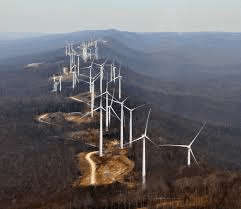
Vermont mountain ridgeline
But for those who find clear-cutting, blasting, and bulldozing mountain ridgelines, degrading water sources, eliminating wildlife habitat, and killing birds and bats ‘clean’ and ‘green’, take a look at before-and-after photos of entire valleys in China destroyed by the mining of rare earth metals, a critical component in industrial wind turbines. Where there were once thousands of acres of carbon-sequestering grasslands there are now mountains of toxic sludge. Four thousand tons of material must be mined to produce the two tons of metals needed for each 3-megawatt turbine.
Production tax credits, the sale of renewable energy credits, and the requirements of state renewable energy portfolios have made the buildout of industrial ‘renewables’ very profitable for corporations, even when the climate benefits are marginal or non-existent. Utility law professor Kevin Jones at Vermont Law School describes all this as a ‘shell game’ that has actually led to an increase in Vermont’s greenhouse gas emissions.
Clever marketing has induced some of us to engage in moral relativism, ethics without substance, and environmentalism at the cost of its soul. If you find yourself arguing in favor of throwing someone under the bus because your favorite pop-‘environmentalist’ says it’s necessary, ask yourself what you would have done in Milgram’s lab.
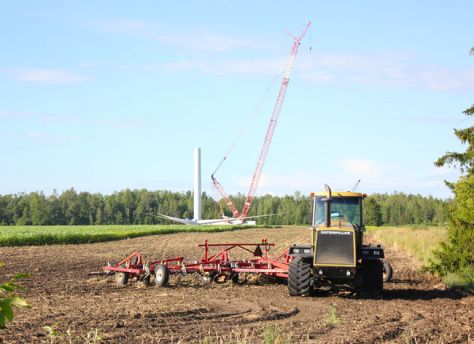
Industrial wind turbine being erected on prime agricultural land
Census of Agriculture recently released by Statistics Canada shines a light on some interesting statistics about renewable installations on Ontario farms. There are 2 465 wind turbines erected in the province as of 2016.
Renewable Energy:
“About 10,255 farms have a renewable energy system, Stats Canada reports. Of those farms, about 85 per cent had solar panels and 15.7 per cent had wind turbines.
Approximately 5,180 farms in Ontario had renewable energy systems, the most of any province. 4,428 farms (85.5 per cent) of these respondents said they use solar panels compared to 906 with wind turbines.”
Big ‘Green’ and Mean: A Wind-Energy Giant Attacks Small-Town America
by ROBERT BRYCE May 2, 2017 4:00 AM @PWRHUNGRY
The world’s biggest wind-turbine company has filed lawsuits against five rural governments because they stand between it and millions in tax subsidies.
NextEra Energy, which bills itself on its website as “the world’s largest generator of renewable energy,” is suing a tiny municipality in one of Oklahoma’s poorest counties. In mid February, NextEra, which operates 110 wind projects in 20 states, filed lawsuits in both state and federal court against the town of Hinton, population: 3,200. Why is the wind giant suing the Caddo County town? Simple: Hinton stands between NextEra and nearly $18 million per year in federal tax subsidies. NextEra isn’t suing only Hinton. Since last October, the wind giant has filed lawsuits against five rural governments from Oklahoma to Michigan, all of which have imposed limits on wind-turbine development.
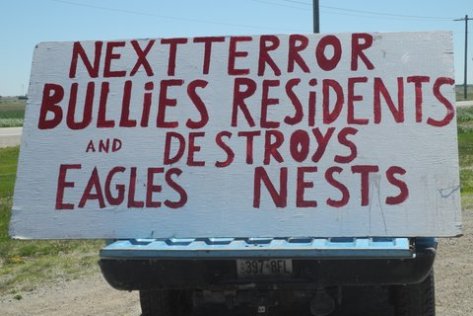
The company has also filed a libel suit against Esther Wrightman, a Canadian activist who opposed a project NextEra wanted to build in Kerwood, Ontario. Wrightman’s offense? She called the company “NexTerror” and “NextError” on her website, ontario-wind-resistance.org. That libel suit, filed four years ago, is still pending.
To be certain, the oil and gas industry has filed lawsuits against local governments that have sought limits on hydraulic fracturing. The difference is that NextEra is using taxpayers’ money to fund its courthouse mugging of small-town America. Between 2008 and 2015, according to a recent report by the Institute on Taxation and Economic Policy, NextEra accumulated profits of $21.5 billion but didn’t pay a dime in federal income taxes. Over that time frame, only ten other American companies received more in tax subsidies than NextEra. Nor does it appear that NextEra will be paying federal taxes any time soon. In its 10-K filing for 2016 with the Securities and Exchange Commission, the company reported $3 billion in tax-credit carryforwards that it can use to directly offset tax liabilities in future years. Remember, tax credits are more valuable than a deduction from revenue or accelerated depreciation. As my accounting consultant (and brother) Wally Bryce, a CPA, reminds me: “You’d much rather get a tax credit because it applies dollar for dollar against what you owe the government.”
NextEra wants more tax credits. And it’s litigating to get more. But each lawsuit NextEra files against a yet-smaller rural town or yet-smaller website owner provides another example of the backlash against Big Wind and, even more appalling, how Big Wind is using the issue of climate change as an excuse to make a run on the Treasury. Since 2015, more than 130 government entities in states from Maine to California have moved to reject or restrict the encroachment of the wind industry. And while other wind companies have also sued small towns, none can match NextEra’s scorched-earth tactics……








 Mothers Against Wind Turbines Inc.