Category Archives: Green Energy

Information Meeting- Huron County Wind Turbine Study

huron county Wind-Turbines
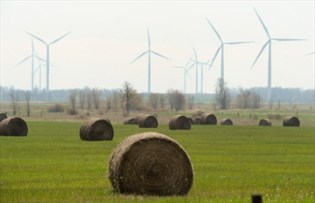
Industrial wind turbines, Huron County Ontario

By John Chippa     October 13, 2017

A date has been set for a public information meeting about a wind turbine study, being conducted by the Huron County Health Unit.

The session will present details on the upcoming study regarding reported human health concerns associated with living near industrial wind turbines.

The meeting is being held on Thursday, October 26th in the auditorium of the Health Unit’s complex, just south of Clinton.    It starts at 7:00 p.m.

Seating is limited, so you are asked to call the health unit at 519-482-3416 and dial ‘0’ to speak to the receptionist about attending.

Epidemiologist Erica Clark explains they’ll start recruiting participants for the study in a few weeks.

“We’ll be looking for people that are Huron County residents that live within ten kilometres of a wind turbine and we want to talk to both people that do have difficulties with wind turbines and also those that do not. We are very much interested in speaking with people who have both perspective”, says Dr. Clark.

“What we’re looking to do with the analysis is see if we can find some environmental factors that might account for why we have some households that are experiencing a number of difficulties with the wind turbines and then we have other households that report that they’re doing just fine.”

Read article

Read more about the Huron County Health Unit Wind Turbine Study

Ontario Gothic

“So, a developer ruins drinking water without penalty, another bullies a young mother into silence, and yet another crushes rules meant to save an endangered species. This is our Ontario. There are dozens more distressing stories just like these. Too many sad accounts of families forced to leave their homes because the noise and vibration from the massive machines proved intolerable.”

Wellington Times, Rick Conroy
Mary Shelley is said to have conceived the story of Frankenstein, a manmade monster let loose upon the countryside, while under the influence of opium in the cold summer of 1816. The gothic horror story, it turns out, was the work of a dark imagination fuelled by opioids.

It begs the question: what was Kathleen Wynne and her government smoking when they let loose their own man-made monsters across rural Ontario—in the form of industrial wind developers and speculators?

Even if you buy the sentiment that their motivations were well-intentioned, the undeniable outcome of the Green Energy Act is that Kathleen Wynne and Dalton McGuinty have spawned armies of amoral monstrous corporate creatures and have let them loose to roam unfettered across the province. To wreak havoc in rural communities. To despoil the environment. To slaughter endangered species. To make folks sick.

Worse, our government has paved the way, clearing hurdles and slashing regulations to enable these creatures to prey upon vulnerable communities, natural habitats and endangered species. Now they have lost control of their grotesque creations. Even Kathleen Wynne must know how this story ends.

Near Chatham, folks believe the wind developer working nearby has poisoned their wells—allowing toxins into their drinking supply. They have done the testing. They have spoken out. They have protested. Marched on Queen’s Park. Kathleen Wynne has ignored them.

Wynne, her government and her supporters comfort themselves believing the scourge they have unleashed—though ugly and abusive— is a necessary evil. That the greater good is being served. They ignore the folks holding up jars of black liquid, pleading with the province to test their water, drawn from wells that have become undrinkable since the wind developer began driving piles into the bedrock to secure its massive wind turbines. Even Chatham- Kent’s mayor has demanded Kathleen Wynne intervene to protect these residents. It has made no difference.

Left without the protection of the province—without the safeguards that would protect them from any other development— these folks took matters into their own hands. In August, they began blockading the construction site— neighbours joining together to form a line against the threat to their drinking water.

On Monday, in a cruel blow, the developers— a Korean conglomerate and its American partner—won a court injunction barring any further blockades of the project. The judge said he wasn’t trying to muzzle opponents, but to “prohibit unlawful acts”.

In Ontario’s perverse hunger for industrial wind turbines, it turns out Chatham-Kent residents must first prove they have been poisoned by the developer, before they may seek justice. By then, of course, the damage will have been done. Recourse will expensive and, for most, unattainable.

Four years ago, the giant American wind developer Next Era sued Esther Wrightman for defamation. On her website she had altered the company’s logo to NextError and Next Terror. They wanted the logos removed or they would litigate the mother of two young children into oblivion. All these years later, the legal action is still pending. Wrightman wakes up every morning with the weight of this action still weighing on her head. Read article

Seeking Justice for Rural Ontario

aTurbine 109_v1 CRWind turbine approval process unfair to public

JIM MCPHERSON, SPECIAL TO THE TORONTO SUN
THURSDAY, SEPTEMBER 28, 2017
Ontario’s Ministry of Environment and Climate Change (MOECC) has approved numerous wind energy projects across the province.

But what if many of these approvals were improperly done, as determined by a court?

Rural residents have appealed several wind projects to provincial tribunals, but most are denied because Ontario’s Green Energy Act permits these appeals only on very narrow grounds of irreparable harm to the environment or human health.

For that reason, a citizen’s group in Prince Edward County recently filed for a judicial review of Ontario’s wind turbine approval process, in Superior Court in Ottawa.

The appellant is a not-for-profit corporation composed of hundreds of Prince Edward County residents, who claim their Charter rights have been violated by Ontario’s Green Energy Act (GEA).

They contend their rights have been violated by the “institutional bias” of the MOECC, and by its failure to properly consider matters of direct relevance to the wind energy project approval process.

The filing also alleges “an egregious instance of regulatory capture”, of MOECC and its affiliated provincial agencies.

None of the allegations have been tested in court.

In the view of the appellants, rural Ontario citizens receive only minimal procedural fairness under the GEA.

During the project approval processes, they are not entitled to present direct evidence but are restricted to submitting comments to a website.

In many cases, the information on which they are asked to comment is incomplete, as yet undisclosed, or subject to later amendment.

Appeals to Ontario’s Environmental Review Tribunal (ERT) are possible, but again, only on very narrow grounds of proven, irreparable harm to the environment or human health.

Property owners living close to wind turbines have complained about the pollution of wells, restriction of land use, fires, flying debris, health impacts, killing of wild life, property value diminution and inhabitability of homes.

During and after construction, many municipalities are concerned about potential road damage, water pollution and financial damage to local economies.

Many residents complain that once wind projects are completed, the province fails to meaningfully enforce regulations connected with their operation.

Provincially regulated setbacks of turbines, while inadequate in the view of many rural citizens, nonetheless effectively mandate that wind energy projects are built only in rural neighbourhoods, as opposed to cities like Toronto.

Unlike cities, vote-poor rural communities are unable to successfully pressure the government to relocate wind projects they say are inappropriate.

By contrast, in vote-rich Oakville and Mississauga, urban residents convinced the Liberal government, leading up to the 2011 provincial election, to relocate two proposed natural gas-fired electricity plants at an eventual public cost exceeding $1 billion.

The Liberal government also suspended a proposed offshore wind project impacting urban ridings in Scarborough after protests by local residents.

Under the GEA, municipalities can no longer use official plans or land use bylaws to protect citizens from inappropriate land use.

Many believe this is a reprehensible failure by Ontario’s government, but it cannot be attributed solely to the provincial regulating agencies.

In many cases, skilled, professional staff working for these agencies have basically been rendered inoperative by provincial legislation that makes them ineffective.

Comparing rural citizens fighting industrial wind turbines to the Liberal government pulling the strings, one is reminded of what was said about Allied troops in the First World War: “We have lions led by donkeys”.

Perhaps the judicial review requested by Prince Edward County residents will help restore fairness to the battlefield.

Renewable Energy: A Cautionary Tale

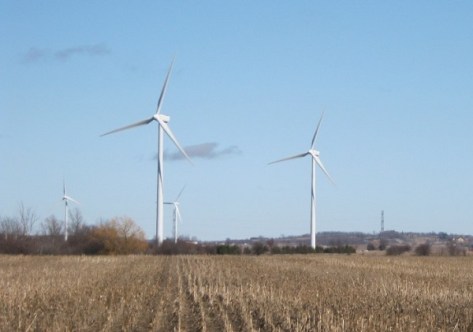
hay bales and turbinesOntario Farmer  
Opinion
August 29, 2017

Renewable energy sources are a cautionary tale. The article “600 sheep maintain the grounds around solar project” by Diana Martin in the August 1, 2017 (Ontario Farmer) paper provided much insight into the Samsung Southgate Solar project, but much was left unsaid.

The Samsung Southgate Solar Project went on line in December 2016. The nameplate capability is 50 MW of solar energy produced from 192,160 solar panels. Technically the potential production should be 50 MW of energy produced each hour, but when you look on the Independent Electricity System Operator (IESO) website – reports.ieso.ca/public/GenOutput you find that solar projects only produce energy when the sun shines so production is zero for ten hours per day.

The total days production from the Samsung Southgate Solar Project on August 17, 2017 was 90 MW or 3.75 MW per hour! According to IESO Ontario requires an average of 22,493 MW of energy produced each hour to keep the lights on, the refrigerators running and the industry rolling. The demand on Aug 18 at 8:00 AM was 16,810 MW of power.

If we consider the contribution of the Samsung Southgate Solar project to the total energy required 3.75/16810 = 0.02 % of the production required. So we would require 4,482 solar projects of this size to provide the power the province needs. Of course since no solar energy is produced at night and production decreases when the sun is not shining we would have to rely on natural gas or nuclear or hydro – the baseload power generators of the province – to provide the power needed. Actually we would be relying on baseload power for 99.98% of the power required.

This solar project required 350 acres of farm land so 350 X 4482 projects = 1,568,700 acres of farm land would be required to produce  intermittent energy rather than food for the people. The production of solar panels requires silicon solar cells, typically an aluminum frame, glass sheets, copper wire and plexiglass. Additionally, solar panels contain heavy metals such as cadmium, lead and rare earth elements such as gallium and indium. So the production of a solar panel is not really “green” and should have a C02 tax on the production side. The panels require a complex recycling mechanical and thermal treatment process. In Europe the EU dictates solar panel disposal guidelines in the waste of electrical and electronic equipment directive, but no such guidelines exist in Canada. We are not preparing for large quantities of photovoltaic solar waste. The panels may have salvage value but the process is not ‘green’. So we have a CO2 cost on the production side and a CO2 cost on the disposal side. The cradle to grave CO2 costs in the mining of components, manufacturing of parts, transportation, installation, maintenance and decommissioning all has to be calculated to get the true CO2 cost. Is a 10 year life span enough to create a positive CO2 balance in the use of solar panels?

According to Don Lewis in the Aug 1, 2017 article the contract for the solar park is for 25 years and several change outs of solar panels are expected. In fact a number of European solar farms have switched out their panels twice in the last decade! So if the 192,160 panels are switched out 3 times in the 25 years we have 576,480 – over half a million – panels on their way to a toxic waste dump.

The cost of solar panels has gone down from $750 to $220 per panel but paying to change out over half a million panels will add $127 million to the  maintenance costs of this project. Sure makes me wonder how much Ontario ratepayers are paying for the energy produced from this project!

Mr Lewis claims that the project is a “win-win” situation for him. He is paid rent for his land from Samsung and his sheep are grazing in the enclosure. My thinking is that the ratepayers of Ontario energy have been tossed to the coyotes that pace the fence.

Catherine Mitchell

Welland


Challenging Cost of Billions with Ontario’s Energy Fees

enercon turbines

The global adjustment charge is chiefly used to cover the difference between the province’s market price for power and the price guaranteed to hydroelectric, natural gas, nuclear, solar and wind generators through their regulated payments or contracts with the government, as well as the cost of conservation programs. All electricity customers in Ontario pay global adjustment, which can be a separate line or included in the commodity portion of their bill.

But the August lawsuit filed by National Steel Car (NSC) believes the revenue the IESO collects for the global adjustment, from the company “and others,” should be declared “an unconstitutional tax, not a valid regulatory charge.”

The company gives numerous reasons, including that the global adjustment allegedly “redistributes wealth from the consumers of electricity in Ontario to, among others, the generators of renewable electricity.”

Manufacturer launches challenge against power fee that has cost Ontarians billions

The lawsuit argues that the global adjustment fee is an unconstitutional tax imposed to fund the Ontario government’s policy initiatives

Geoff Zochodne September 21, 2017

READ FINANCIAL POST ARTICLE

Neighbours at odds over noisy wind project

summerbreeze“We want to be able to be outside of our home when it’s calm,” Huffman told commissioners at a hearing in Palmerston North on Wednesday.
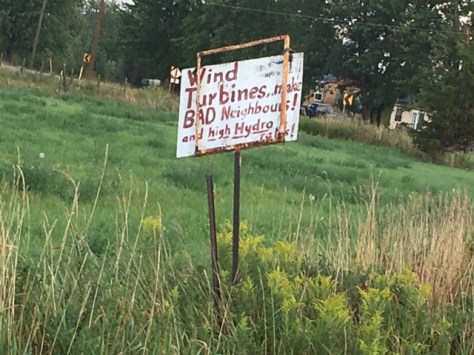
“We want to be able to open our windows and not hear the whine… or the roar.

“We want to be able to open our windows at night.”

On a still day in the countryside, there could be “whining, roaring and grinding so intrusive that we don’t want to be outside”.

The first time Huffman heard the Te Rere Hau farm, it woke her up. She wondered what her husband Graham Devey was doing. “What was he doing in the barn that was causing such a racket?”

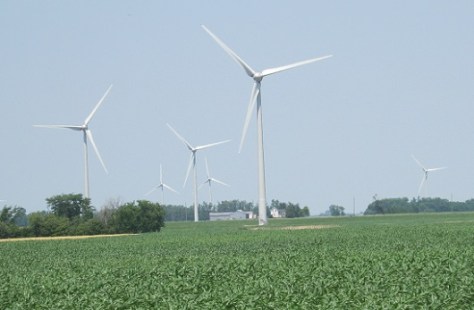
Neighbour of Te Rere Hau wind project located in New Zealand

READ  FULL ARTICLE


Ontario Government Understates Annual Deficit and Net Debt: Auditor General

Wind-Turbines-and-cornfield-2
Wind turbines marring rural landscape in Ontario

“The legislature and all Ontarians must be able to rely on the Province’s consolidated financial statements to fairly report the fiscal results for the year. This year they cannot do so”
-Auditor General of Ontario

What have been the costs of Ontario’s energy policies?  The Auditor General of Ontario highlights issues in the Government’s fiscal reports in its  recent news release. 

Impacts of energy policy decisions can be found within the example of ongoing discord over the build out of renewable energy projects such as wind facilities. The Government continues to face criticism over its failure to undertake cost and benefit analyses. Economic stress is being realized and demonstrated by the rapid and dramatic rises in electricity rates and the threat of even more bill spikes predicted.  Higher electrical bills remain the trend despite Government’s reduction measures recently introduced.

“Lysyk also warned that the accounting design the Government created for the electricity bill reduction under the Ontario Fair Hydro Plan Act, 2017 may lead to a larger understated deficit and net debt next year. A Special Report on this subject will be tabled in the fall. “

Energy poverty and economic impoverishment are personal threats to individuals, families and communities who are struggling to get by.  Politicians massage numbers to fit desired images they want to create and sell but at the end of the day it results in selling out the people they were elected to serve.

Independent Auditor’s Qualified Opinion

Court Order Bans Defenders of Clean Water

 A Blessing in disguise. Time to take the evidence to Court.

WWF chained
Defenders of clean water chained themselves at the North Kent Wind Project construction site.  Blockades continued as reports of dirty water (*11 wells & counting*) continued to rise. All adverse effects said to occur after construction began for the project located in Chatham Kent, Ontario.

North Kent Wind agrees to cease construction at turbine site until matter returns to court

By Ellwood Shreve, Chatham Daily News
Thursday, September 7, 201

Construction will cease at one turbine site for the North Kent Wind project, but a court order is prohibiting anyone from blockading, obstructing or impeding access to any other construction sites for project.

However, the matter will return to court at the end of the month, when the grassroots citizen group Water Wells First plans to be ready to make its case for stopping the project, due to the impact vibrations from constructing the turbines have had on area water wells.

In a statement released Thursday, North Kent Wind stated it appeared before the Superior Court of Justice on Wednesday seeking injunction prohibiting blockades and other interference with the construction of its wind project.

“We respect the rights of citizens who disagree with wind energy or the project to have their voices heard,” the company stated.

“The motion for injunctive relief became necessary because some protestors were engaging in what we believe was unlawful conduct, raising serious concerns about the safety of workers and protestors alike,” the statement added.

North Kent Wind said it sought the assistance of the court to enforce the rule of law and keep the peace.

“At the request of the court and out of respect for those who oppose the project and wish to be heard, we agreed to cease construction at one turbine site, which is currently blockaded and occupied by protestors, until the motion is heard by the court on Sept. 28-29.”

The court has granted an interim order restraining and preventing anyone from blockading, obstructing, or impeding access to any of the construction sites for the project.

Kevin Jakubec, spokesman for Water Wells First, called the upcoming court appearance “a blessing in disguise.”

He said when the matter returns to court, this will be the first time, that he is aware of, that evidence will be brought before a court in Ontario regarding the damage a wind farm has caused to the environment and a water resource….

READ REST OF ARTICLE

Turbine Protesters Chain Themselves Together to Stop Construction

Protecting clean water from wind turbine construction has seen residents chaining themselves together in protest to stop further damage of reported turbid drinking water that occurred after the pile driving for turbine foundations in Chatham Kent.  What is it going to take?   It is time to halt the wind project!

By Trevor Terfloth, Chatham Daily News

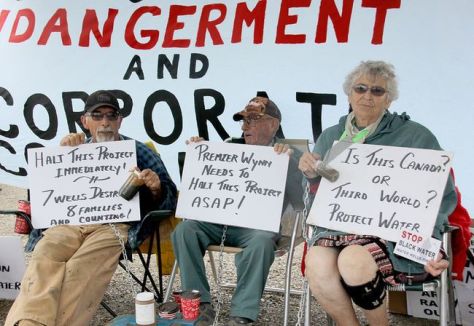
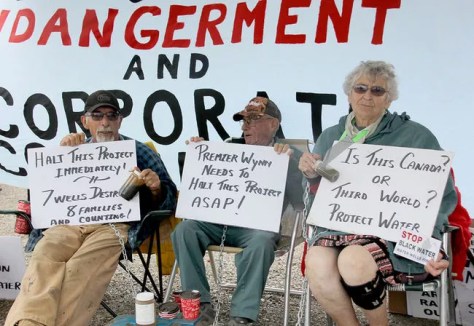
1297986670881_ORIGINAL (1)In In an effort to halt construction of a wind turbine project in North Kent, three protesters chained themselves together in a show of solidarity on Tuesday.
Sheltered from the rain, but weathering the elements, Rick Ball, Lee Montgomery and Yvonne Laevens were at the entrance to the site on Bush Line, near Highway 40 in the former Chatham Township.

“It should have never have gone this far,” Laevens said. “We have to (do this). We’ve tried just about everything else.”

Several water wells in the North Kent Wind project area, currently under construction by Samsung Renewable Energy and Pattern Energy, have been clogged with sediments shortly after recent pile-driving took place for constructing industrial wind turbines.

Tuesday’s protest was peaceful, with Laevens adding that Chatham-Kent police have been “congenial” with the group.

Ball said he appreciated the members of the public who were on hand and hopes the government takes notice.

“Start paying attention to what we’ve been saying for a year and a half,” he said.

Last week, Chatham-Kent council passed a motion asking the Ministry of the Environment and Climate Change to halt the project until water well concerns were dealt with.

Ball said a halt would allow everyone involved to work together on a solution.

Also part of the council motion was to implement independent water testing for the wells currently experiencing problems.

In a media release, the municipality stated that residents near the North Kent One wind farm project whose wells have water-quality issues will be contacted by Chatham-Kent officials this week to allow them to select a firm to test their well water at no cost.

Municipal chief administrative officer Don Shropshire said the municipality, working with public health officials, have identified 17 labs in Ontario that are licensed and accredited by the Canadian Association for Laboratory Accreditation to test drinking water for microbiological agents, organic chemicals, inorganic chemicals, and other particulate matter.

Shropshire said in the release that residents will have the option to choose any of the accredited labs.

“We want to ensure there are no concerns about who does the testing,” he said. “We’ve provided the list but the choice will be up to the residents.”

At a meeting last week between municipal officials and ministry representatives, the province also committed to contact owners of wells which have experienced issues and review those concerns with Samsung Renewable Energy and Pattern Energy.

As for the request to halt the project, the municipality’s release stated “that request is still before the premier’s office.”

In a statement e-mailed to The Daily News on Tuesday afternoon, the company said it was aware of the water well concerns.

READ REST OF ARTICLE

Protecting our children from Industrial Wind Power Emissions is our first priority!