Category Archives: Green Energy

The wind at his back

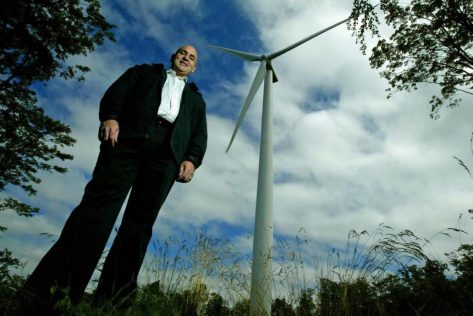
george smitherman the_wind_at_hisback.jpeg.size.custom.crop.1086x0
Former Minister of Energy & Infrastructure Georger Smitherman- 2008

The date is September 28, 2008 newly minted Ontario Minister of Energy and Infrastructure George Smitherman gushes over  a vision of the future for green-energy in Ontario.   In 2009 the Green Energy Act passes and is rapidly followed by 1 000s upon 1000s  of industrial wind turbines erected.  Ontario bowed to political push back by pausing installation of wind turbines in the Great Lakes. Today an offshore  demonstration project looms with a build date of 2018.  The project proposed in Lake Erie off Ohio’s shores.

Fast forward to 2017.  Minister of Energy Glenn Thibeault admits mistakes were made by government with its green energy plan. Ontario holds tight to its energy vision of a green energy industry.  Wind projects are forced onto unwilling host communities.   Resident’s voices of opposition muted under renewable energy legislation.   At the Federal level the wind industry is championed by many, including Minister of the Environment Catherine Mckenna.  The Minister recently declined to take up pleas to review cumulative wind energy projects along the Great Lakes 

From visions of green energy to build out of wind projects.  What do you see?

The wind at his back

By TYLER HAMILTONClimate and Economy Reporter
Sat., Sept. 27, 2008

NIAGARA FALLS–In just nine weeks George Smitherman has likely learned more about the green-energy industry than any energy minister before him, and then some.

Sitting in a meeting room at the Sheraton Fallsview Hotel in Niagara Falls, just minutes after giving his first major speech since being appointed energy and infrastructure minister in June, Smitherman enthuses like a kid who has just returned from Euro Disney.

He recounts his visit to a small community in Denmark that powers and heats itself with straw, municipal waste and geothermal energy. Then there was the neighbourhood in Freiburg, Germany, powered by rooftop solar panels atop high-efficiency homes. In Spain, he saw how the local electricity operator manages the country’s 15,000 megawatts of wind turbines and a world-class stable of solar farms.

His travels also took him to California, where he learned how the world’s fifth-largest economy used innovative conservation programs and energy-efficiency mandates to keep per-capita electricity consumption flat for the last three decades.

“Imagine a world where we could emulate their success?” asks an animated Smitherman, 44, who later turns to Amy Tang, an adviser sitting across the table. “Sorry, now I’m getting all worked up. Am I frothing at the mouth?”

The trips didn’t end there. On his home turf, he has already visited the massive Prince Wind Farm in Sault St. Marie, the Atikokan coal-fired generating station near Thunder Bay, the province’s three nuclear power stations, the massive Nanticoke coal-fired station, Hydro One’s grid control centre in Barrie, and has been inside the Niagara Falls water tunnel currently being excavated by Big Becky.

“I call it sponging. I just went out there to try and learn as much as I possibly could,” he says. “Everything I do, I learn something that’s one more piece of, let’s face it, a complex puzzle.”

Smitherman says he’s “jazzed” about his new job, a fresh change after five years as health minister. Premier Dalton McGuinty made it a promotion, insiders say, by merging the energy and infrastructure portfolios into a super-ministry.

Read article

‘It’s David versus Goliath’

“The people in this region deserve better than what they’ve received. They didn’t have a say in what happened, yet it’s happening, and happening very close to the town of Wallaceburg,” Violet said.

The group is trying to make the community aware of the project, said Violet. Not only are there concerns about potential problems with water wells, but there are also concerns about noise and low frequency sound levels, due to their large size.

cover.58754c012c143
ILLUSTRATION BY J.C. FRANCO

By David Gough, Postmedia Network
Wednesday, November 29, 2017

Preparing for what they’re calling a ‘David versus Goliath battle’, a grassroots group is organizing opposition to the Otter Creek wind turbine project proposed for north of Wallaceburg.

But money is needed to fight a large wind company. Wallaceburg Area Wind Concerns has a GoFundMe account, which has brought in $1,325 of their $50,000 goal. As well, the organization is accepting donations at the TD bank branch on James Street in Wallaceburg.

Earl Towell, a member of the newly formed group, said donations are coming in to prepare for the fight.

“These things aren’t cheap. We’re up against a company with plenty of lawyer services. If we want to be able to put forward any kind of battle against this, we have to hire experts,” Towell said.

Along with lawyers, Wallaceburg Area Wind Concerns is looking at hiring expert witnesses.

The ministry is currently undertaking a technical review of the Renewable Energy Approval application for Otter Creek, which will include reviewing and considering all comments made about the company’s REA when it was posted to the Environmental Bill of Rights Registry earlier this year. Once the review is complete the REA can be appealed…

Read article

Wind turbine woes won’t be forgotten

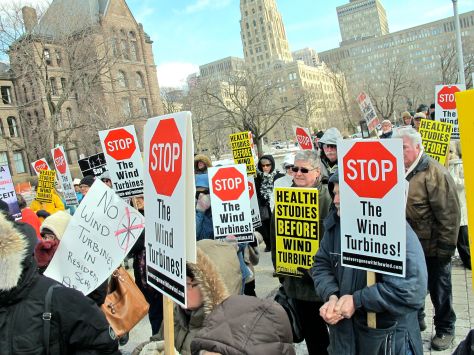
queens-park-stop-the-wind-turbines
Queen’s Park Protest 2014 -Toronto, Ontario

Editorial: Wind turbine woes won’t be forgotten

By Peter Epp, Postmedia Network

When Premier Kathleen ­Wynne announced 14 months ago that her government was suspending Ontario’s renewable energy procurement process, she and her Liberal colleagues were caught in the middle of a public backlash against skyrocketing electricity bills. Halting a costly plan that promoted wind turbine farms was a quick, convenient response. Indeed, Wynne’s own energy minister admitted Ontario didn’t need the electricity that would be produced by new turbines.

But there was a problem. Six months earlier, several wind turbine projects had been approved, and the September announcement didn’t mean they would be cancelled. The contracts would be honoured. Ontario would be allowing the development of wind turbines to produce electricity that wasn’t needed.

Among those projects are two in Chatham-Kent and another in Elgin County. One has become an enormous public relations problem for the Wynne government, while the other two have the potential to become the same.

The first project is almost complete; but the others should be halted before they begin.

The North Kent 1 wind project was mired in controversy even before Wynne announced suspension of the renewable program. Construction activity is believed to have fouled or clogged at least 16 water wells because of interference to the area’s unique geology. Residents with damaged wells have made arrangements to have clean water trucked to their property.

The problems at the North Kent 1 project have stirred up fears a few kilometres away, at the Otter Creek project. Work has yet to begin, but residents are worried the same problems will affect their water. They’re also worried proposed turbine towers, the tallest in Canada, will be erected in an important migratory bird flight path.

Local MPP Monte McNaughton (PC — Lambton-Kent-Middleses) wants Otter Creek halted.

“These turbines are being built to generate electricity we don’t need, and they’re only going to contribute to driving hydro prices even higher,” he said.

In Elgin County, meanwhile, residents in Dutton Dunwich continue to campaign against a wind farm that has yet to be built.

Kathleen Wynne may have hoped rural Ontario’s long-held discontent with the Green Energy Plan would be forgotten by the June 2018 provincial election. But that’s not about to happen as the remnants of that multibillion-dollar campaign, and its varied controversies, continue to be revealed.

Read article

Wind Overbuild- Downloaded Billions of Debt to our Children

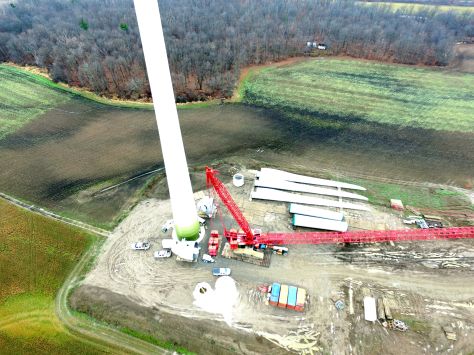
DCIM100MEDIADJI_0015.JPG
Enercon E101 industrial wind turbine Niagara Wind project

The production for the West Lincoln NRWF Industrial Wind Turbine project for the first year of production (2017), can now be calculated using the information provided by the IESO.

(The IESO publishes the hourly output of each wind generator in Ontario, from March 1, 2006 to the present in a spreadsheet on their website Hourly Wind Generator Output, 2006-present (1)

The production for West Lincoln NRWF is in column AN

The production from Nov. 2, 2016 to Nov. 2, 2017 was 492,051 MW

To calculate the hourly production divide 492,051 by 8760 hours in a year = 56.17 MW/hr.

The production for the first year of operation for the West Lincoln NRWF is 56.17/230 (name plate capacity) = 24.42%

So the over build for industrial wind turbines as an energy generator is 400%. In other words you either accept that the production is ¼ of the nameplate capacity or you need 4 times the number of industrial wind turbines. You still have an intermittent energy source that will only produce energy when the wind blows and frequently produces energy out of sync with demand.

A key question for the decision makers becomes – are industrial wind turbines financial viable at 25%? When you consider that we have already down loaded 330 billion dollars of debt on our children and grandchildren in Ontario.

The government did not conduct a cost benefit analysis of the renewable energy initiative http://www.auditor.on.ca/en/content/annualreports/arreports/en11/2011ar_en.pdf (2)-Page 97. Hindsight always provides better vision, but the money would have been better spent on other initiatives. Eg: Saskatchewan operates a zero emission coal plant. http://www.cbc.ca/news/canada/calgary/carbon-capture-history-made-in-saskatchewan-besting-once-ambitious-alberta-1.2786478(3)

Catherine Mitchell – a concerned citizen

Welland, Ontario

The above article represents the personal opinions of the the author informed by the cited sources.


Huron County wind turbine noise investigation launched

WCO_K_1194_7x5-2
Home in Huron County: Finally, tracking wind turbine noise complaints — the government isn’t doing it [Photo Gary Moon]
November 11, 2017

Here is an excerpt from a report on the recent meeting in Clinton, announcing the launch of the Huron County public health investigation into wind turbine noise.

A few notes: as far as we are aware, the “study” is actually an “investigation” under the Health Protection and Prevention Act of Ontario, in which reports of adverse health effects may be reported and investigated. The only association with the University of Waterloo was the review by the ethics committee of that university — the university is not involved in any other phase of the project.

Wind Concerns Ontario had proposed to carry out Phase II of the study which would involve follow-up measurements in homes identified as problematic by the Health Unit, as part of a research study by a multi-disciplinary team. Although federal government funding was not achieved for that proposal, efforts to fund that initiative are ongoing.

This project is the first of its kind in Ontario; it was initiated based on reports of adverse health effects by residents of Huron County made to their health unit, and is supported by them.

For more information about the Huron County Health Unit project please visit the website here.

Huron County Health Unit launches wind farm study

By John Miner

ONTARIO FARMER November 7, 2017

Huron County’s on-again, off-again study on the health impact of wind farms is moving ahead with warnings from the researchers about what it can’t accomplish.

Even if the results in the end definitely show that wind farms are damaging the health of residents, the county’s health unit will not be able to order the turbines stopped, a public meeting was told.

“We do not have the authority to curtail or shut down wind turbines. If you are thinking of participating in the study in the hope that we will shut down the turbines, we want you to understand we cannot do that,” Dr. Erica Clark, an epidemiologist with the Huron County Health Unit, announced at the start of a public information session attended by about 60 people.

Courts have determined that Ontario health units do not have the legal ability to issue orders to protect public health in cases where the provincial government has given that responsibility to another body, Clark said.

In the case of wind farms, the government has given the power to regulate wind turbines to the Ministry of the Environment, not public health units, she said.

Dr. Maarten Bokhout: “If research indicates there are health issues, that can be raised with the Ontario government”

Dr. Maarten Bokhout, Acting Medical Officer of Health at the Huron County Health Unit, said while he cannot step on the Environment Ministry’s toes and he does not have the power to write orders against wind turbines, the results of the study will be published online, including interim reports.

The health unit’s one-year study, established in collaboration with the University of Waterloo and reviewed by the university’s ethics committee, will look at how people are annoyed by noise, vibration and light [shadow flicker] from wind farms.

The goal is to establish how many people are bothered by wind turbines in the county and determine if environmental conditions that make the noise, vibration light and sensations from wind turbines worse.

The study will rely on residents living within 10 km of a wind turbine who volunteer to keep a diary of their experience within their own home.

Participants are asked to record their observations at least once a week.

The researchers will not be making any actual sound or vibration measurements for the study.

Huron County is home to more than 300 industrial wind turbines and some of the largest wind farms in the province.

Some residents have blamed the turbines for a series of health problems, including headaces, nausea, dizziness and insomnia.

Clark, who is principal investigator on the study, said they want participation from both people who have been bothered by wind turbines and those who haven’t experienced any problems.

The 10-kilometre study zone around wind turbines means thousands of Huron County residents are eligible to sign up for the project, including all of the towns of Goderich and Exeter.

See the print edition of Ontario Farmer for a related story: Rural residents skeptical government would act on wind

Source: http://www.windconcernsontario.ca/huron-county-wind-turbine-noise-investigation-launched/

Stop subsidizing the Big Wind bullies

next-era-bullies.jpg
Protest sign from Ontario

“The biggest recipient of taxpayer cash on ACENY’s roster is the world’s biggest and most-litigious wind-energy producer: NextEra Energy …NextEra is using some of that taxpayer cash to sue small towns including Hinton, Okla., and Almer and Ellington in Michigan. What did those tiny towns do to irritate the energy giant, which has a market capitalization of $73 billion? They prohibited installation of wind turbines, the latest models of which now stand about 800 feet high.”

Last month, Anne Reynolds, executive director of the Alliance for Clean Energy New York, complained that the state is a “tough place to develop” big renewable-energy projects due to a “spirited tradition of home rule.” This came after her group and the Nature Conservancy released a report lamenting the fact that siting new renewable-energy projects is often “lengthy, uncertain and sometimes unsatisfactory for both developers and communities.”

It should be. With good reason, numerous upstate towns are actively fighting the encroachment of Big Wind. To cite just one recent example: Last month, the Watertown City Council unanimously approved a resolution opposing the development of eight industrial wind-turbine projects totaling 1,000 megawatts of capacity, because the projects could impair military training capabilities near Fort Drum.

Over the past decade or so, members of Reynolds’ group — some of America’s biggest subsidy miners — have collected $18.7 billion in federal and state subsidies. The burgeoning backlash against Big Wind means a growing group of rebellious New York towns stand between Reynolds’ members and even more taxpayer gravy.

The $18.7 billion sum was obtained by matching ACENY’s membership roster with data from Subsidy Tracker, a program run by Good Jobs First, a Washington-based government-accountability organization. That $18.7 billion includes all federal grants, tax credits, loans, loan guarantees and state subsidies.

The subsidies are corrosive. They encourage wind-energy companies to use legal action to bully rural landowners and small towns. They also induce the wind industry to kill more wildlife, including bats and birds.

The biggest recipient of taxpayer cash on ACENY’s roster is the world’s biggest and most-litigious wind-energy producer: NextEra Energy, which has collected nearly $5.5 billion in federal and state subsidies. NextEra is using some of that taxpayer cash to sue small towns including Hinton, Okla., and Almer and Ellington in Michigan. What did those tiny towns do to irritate the energy giant, which has a market capitalization of $73 billion? They prohibited installation of wind turbines, the latest models of which now stand about 800 feet high.

Speaking of bullying, NextEra also has a pending defamation lawsuit against Esther Wrightman, a Canadian activist who had the temerity to call the company “NextError and “NexTerror” on her Web site.

Another ACENY member: Spanish energy company Iberdrola (the parent company of its US subsidiary, Avangrid), which has collected $2.2 billion in subsidies. In 2012, shortly after Iberdrola began operating its Hardscrabble wind project, several dozen residents of Herkimer County filed a lawsuit against the company due to the nuisance, noise and sleep disturbance caused by Iberdrola’s turbines. That case, which now has 68 plaintiffs, is still pending.

Last year, after the New York town of Clayton imposed a six-month moratorium on applications for new wind-energy projects, Iberdrola sued the town, claiming the moratorium was illegal. But a state court sided with Clayton. And last November, citizens from two Vermont towns, Grafton and Windham, voted overwhelmingly to reject a proposed Iberdrola wind project.

Multibillion-dollar subsidies for Big Wind are also fueling widespread destruction of American wildlife. While the deadly effect that wind turbines have on birds, in particular eagles and other birds of prey, has been well documented, Big Wind is also killing hundreds of thousands of bats per year.

A paper published last year in Mammal Review found that wind turbines are now the largest single cause of bat mortality. A report by the conservation group Bird Studies Canada found that “across Canada, bat fatalities were reported more often than birds, accounting for 75 percent of all carcasses found.” To be sure, bats don’t get as much good press as eagles and hawks, but they are critical pollinators and insectivores.

In short, while Reynolds and other members of ACENY claim their push for renewable energy is about climate change, the numbers from Good Jobs First show that what they really want is more corporate welfare. And more corporate welfare for the group’s members means bad news for America’s small towns and even worse news for our wildlife.

Robert Bryce is a senior fellow at the Manhattan Institute.

Read article: http://nypost.com/2017/11/09/stop-subsidizing-the-big-wind-bullies/

Peaceful Presence at Niagara Wind

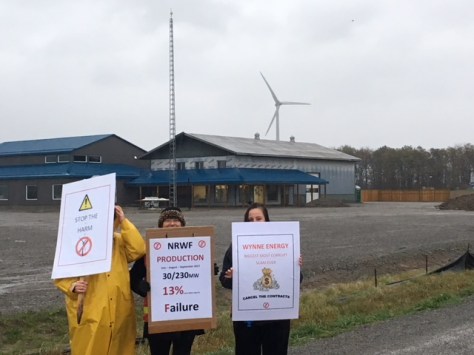
Today, November 2/17 marks the one year anniversary the Niagara Region Wind Farm (NRWF) joined the Ontario Grid with production.

In acknowledgement of this date a few of us took to the corner of Elcho Rd & Road #27, the new location of an Enercon facility, to express our varied concerns.

image1.jpeg
Enercon Facility for Niagara Wind

At this point we were being pelted with rain for just over an hour and soaked from muddy road spray from passing trucks and vehicles.  Worth every minute!  Thank you ladies!!!

image2.jpeg
Tim Horton’s coffee shop & dialogue about the impacts of industrial wind turbines

A vibrant, informed and concerned citizen, Catherine Mitchell, schooling the local gents at the nearby Tim Hortons.  She had them engaged and they asked wonderful questions.
Way to go Catherine!!!

Sandy
🚫NO INDUSTRIAL WIND TURBINES🚫

Our Hour of Greatest Need

green energy light bulb

By:  Catherine Mitchell-
A Concerned Citizen

Opinions expressed are of the author


September 25th, 2017

In times of greatest need it is always wise to know whom you can call on. The same applies to the electricity system and it is rather telling what was produced by each generator type in our hour of greatest need. The ‘Peak Demand’ for electricity in 2017 in Ontario occurred on September 25, 2017 at 5:00 PM.

Ontario can produce power from nuclear, natural gas, hydro, wind, solar and biofuel energy generators and the Independent Electricity System Operator (IESO) is responsible for the management of the resources in the system. The following chart looks at production from each fuel type during the peak demand at 5:00 PM Sept 25, 2017 to determine the adequacy of resources to meet the demand.

Generation Capacity (MW/hr) / Capability @ Peak / Output/Sept 25, 2017

Fuel Type A   Total Installed

Capacity (MW/hr)

B  Forecast Capability      @Peak

(MW/hr)

C    OutPut

Jan – Aug 31

2017

(MW/hr)

D Sept 25,2017

5:00 PM

(MW/hr)

Sept 25,  2017

Contribution

as %

Nuclear 13,009 MW  11,537 MW   7548  MW    9690  MW       48%
Hydro      8480       5786        3207    5135       25%
Natural Gas    10,277       8371          417    5268       26%
Wind       4213        533          764        67        0.3%
Solar         380          38            50        85        0.4%
Biofuel         495        439            37      100       0.4%
Total    36,853  MW/hr   26,704     MW/hr     12,023

MW/hr

 20,345 MW/hr

IESO  report – 18 Month Outlook: An Assessment of the Reliability and Operability of the Ontario Electricity System from October 2017 to March 2019:   http://www.ieso.ca/en/sector-participants/planning-and-forecasting/18-month-outlook       Page 17 -Table 4.1 provides (A) total installed capacity and the (B) forecast capability @ outlook peak.

To keep the lights on, refrigerators running and industry rolling in our hour of greatest need on September 25, 2017 at 5:00 PM we needed 21,786 MW of power. The Ontario power generators produced 20,345 MW of power and we imported 1,441 MW from Manitoba and Quebec. (It seems like natural gas generators could have been ramped up an additional 1,500 MW per hour without exceeding the IESO forecast capability at peak, but we imported power instead.)

Nuclear, one of the baseload generators for Ontario, did most of the heavy lifting and came through producing 9690 MW of power or 48% of the power produced in Ontario. This is higher than the average yearly production of 7548 MW/hr but less than the maximum capability of the nuclear plants.

Hydro – our baseload renewable energy source – produced 5135 MW of power from a potential of 5786 MW. So we were using 89% of the potential production from our cleanest, greenest, cheapest energy source. The average hourly demand from hydro is 3207 MW/hr and generally we spill water over the dams and waste that renewable energy resource. But in our hour of greatest need hydro provided 25% of the power produced in Ontario.

Natural gas, another baseload power generator that can be quickly ramped up or down, provided 5268 MW of power in our hour of greatest need. Natural gas is definitely our BFF (best friend forever). According to the IESO gas plants are capable of producing 8,371 MW of power each hour, yet on average the natural gas plants produce 417 MW of power each hour. From January – August 2017 the gas plants operated at 4.9 % of their potential!! This means that they are being underutilized and sit idle the majority of the time. But on September 25 at 5:00 PM the gas plants provided 26% of the power produced in Ontario.

And then we get to the contribution of the energy of the future – wind and solar!

The total installed nameplate capacity of all the industrial wind turbines in Ontario is 4213 MW. So the IWT’s should have made a significant contribution. But in our hour of greatest need the total power produced from all the IWT’s installed in Ontario was 67 MW!!! This represents a total contribution of 0.3% of the power produced in Ontario. Power that was required to keep the lights on, the refrigerators running and the industry rolling. Solar made a bigger contribution of 85 MW or 0.4% of the power produced in Ontario.

To understand the limits of wind power, the late Glenn R. Schleede, formerly Vice President of New England Electric System, Executive Associate Director of the U.S. Office of Management and Budget, Senior VP of the National Coal Association in Washington and Associate Director (Energy and Science) of the White House Domestic Council says it best: “Wind turbines have little or no ‘capacity value’ because they are unlikely to be producing electricity at the time of peak electricity demand. Therefore, wind turbines cannot substitute for conventional generating capacity responsible for providing reliable electricity to customers.”

According to Schleede, the true capacity value of a wind turbine or ‘wind farm’ is generally less than 10% of nameplate capacity and often 0% or slightly above — simply because, at the time of peak electricity demand, the wind isn’t blowing at a speed that will permit the turbine to produce any or much electricity. Claims of wind turbine capacity value have been exaggerated by wind industry officials and lobbyists, and by regulatory agencies. As we are finding out in Ontario – industrial wind turbines generate a minimal amount of electricity.

Wind and solar are both intermittent so we can not ramp them up or even depend on them for power because they only produce power when the wind is blowing or the sun is shining.

Wind and solar certainly let us down in our hour of greatest need!

Rally Draws Hundreds

Picton rally 1

By Tim Miller, The Intelligencer
Sunday, October 15, 2017

PRINCE EDWARD COUNTY — On Sunday opponents of wind turbine development in the County took to the streets to show that their concerns over a proposed wind energy project are about more than just a lot of air.

Hundreds of sign-waving and chanting residents marched down Main Street Picton shortly after the noon hour to kick off an anti-wind rally.

Upon reaching The Regent Theatre, marchers doffed their signs and settled in for the nearly three-hour town hall meeting to begin.

While people took their seats a video montage of anti-wind messages written by County residents in black marker on a stark white scroll of paper played on the big screen, followed by aerial drone footage of levelled and torn up fields. Over the montage played the melodic version of Dee Snider’s We’re Not Going to Take It.

Sunday’s town hall was in regards to the ongoing wpd Canada’s White Pines Wind Project which initially called for the erection of 29 wind turbines in the County.

The County has declared itself an unwilling host to industrial wind turbine projects that disrupt the lives and livelihoods of County residents and destroy the County’s historic landscapes while causing irreparable harm to the County’s wildlife and natural environment.

Because of challenges by local government and groups the initial plan of 29 turbines has been scaled back to nine — to be built near the south shore of Milford.

On stage activists sat beside entrepreneurs, doctors and local politicians. Their reasons for opposing the project was as varied as their backgrounds.

Dr Robert McMurtry, former Dean of Medicine at Western University and a member of the Order of Canada, spoke about the health impact turbines can have when placed too close to residential homes.

Read rest of article