
Category Archives: Government Misrepresentation

Wind Turbine Nuisance: a lawsuit against the Ontario Minister of the Environment

do no harm 1

May 25,2018|André Fauteux| La Maison Saine et Ecologique

(original article in French- Translation via Google Translate)

A group of Ontario citizens personally sued a minister for violating the Environmental Protection Act, allowing wind turbines to undermine their sleep and health, while respecting the limits allowed for audible noises. This law prohibits “discharging a contaminant into the natural environment or allowing or causing it to occur if the release causes or may cause a harmful consequence”. It “means bodily injury, loss of life, loss of use or enjoyment of property and loss of money”.

On April 30, Wind Concerns Ontario (WCO) served on Chris Ballard, who heads the Ministry of the Environment and Climate Change (MOECC), to attend court on the 17th. may. A judge will then decide whether or not the Attorney General of the province must lay charges.

Through the Access to Information Act, WCO obtained copies of more than 4,500 citizen complaints sent to the Ministry between 2006 and 2016, many of which had had to abandon their homes that had become unlivable. “Since the MOECC did not respond to thousands of reports of excessive noise from wind turbines, which affects the sleep and health of Ontario families, we had no choice,” said in a statement. organization, nurse Jane Wilson. According to her, “citizens report not sleeping for days, weeks, even months. Sleep disorder is linked to other health problems, such as high blood pressure and diabetes. In 2015-2016, the Ministry responded to only 7% of complaints and only to those living within 1,500m of wind farms, according to WCO. According to Ms. Wilson, the Ministry is not enforcing its own regulations to ensure that the noise level does not exceed 40 decibels dB at the nearest dwelling. “It does not respond to complaints and relies on operators who measure only the average noise in dBA. They ignore other types, including low frequencies (infrasound). ”

Scientific controversy

Health Canada has already published a study on wind turbine noise and health in 2014. Among its findings: “No statistically significant relationship was found between measured blood pressure, or resting heart rate, and exposure. to the sound of wind turbines. In addition, “the researchers did not establish a link between the noise levels of wind turbines measured outdoors, near the residences of participants, and the effectiveness of sleep, the rate of awakening, the duration of awakenings, the total time of sleep or the time needed to fall asleep “.

Findings contested by Carmen Krogh, a former Health Canada employee who has been investigating industrial wind turbines since 2007. “In rural areas, it is very difficult to obtain a statistically significant number of cases. In addition, we can estimate exposure levels, but it takes time to know the effects, “says the author 1 of various scientific articles on the subject.

In 2007, Carmen Krogh found that installing giant wind turbines in Ontario was a great idea, to replace nuclear and coal plants with renewable energy that does not pollute the air and does not contribute to climate change. A retired pharmacist, she naturally investigated whether industrial wind turbines could harm health. “I thought I would not be involved in this file for long,” says the former director of a hospital pharmacy who was also a consultant and employee of Health Canada and former editor-in-chief of the Compendium of Products and Specialties used by professionals who prescribe drugs in Canada.

For the past eleven years, she has been volunteering for wind energy, writing scientific articles and advising individuals, businesses and various levels of government. A former director of pharmacy at a hospital, Ms. Krogh was also a consultant to Health Canada’s Prescription Drug Administration and a director of its Canadian Pest Management Regulatory Agency. In addition, she is the former editor-in-chief of the Compendium of Pharmaceuticals and Specialties, which is used by professionals who prescribe drugs in Canada. She believes that the burden of proof of safety must rest with industry, just as in the pharmaceutical field. “When a wind project is contested, citizens are always asked to predict the future and prove that wind turbines will hurt them. Because of product differences, evidence of causality is rare in the health field in the absence of a biological mechanism. In the pharmaceutical sector, manufacturers must prove the safety of their products or an acceptable risk / benefit ratio. And doctors, nurses and citizens can file complaints. Thus, over-the-counter doses of ibuprofen were reduced significantly, to 200 mg, because the patients complained of unexpected adverse reactions. ”

Similarly, when it comes to industrial pollution, you always have to focus on people’s reactions to exhibitions and read independent studies, Krogh insists. In 2007, she found that installing giant wind turbines in Ontario was a great idea, to replace nuclear and coal-fired plants with renewable energy that does not pollute the air and does not contribute to climate change. But his inquisitive mind made him discover that installing them near homes could be harmful. “I have studied the symptoms declared at the international level and the points in common are remarkable. When people talk about the same sleep and cognitive problems in Japanese and other languages, it’s very convincing. Another thing that is very convincing is that those who leave their homes intermittently feel better and that their symptoms reappear when they come home. In all cases, the installation of wind turbines was the only major factor that had changed in their environment before the onset of symptoms … I have never heard of a developer of wind turbines ask if residents were sensitive noise or had pre-existing medical conditions and special needs. For example, children with autism are more sensitive to blinking. ”

Ms. Krogh is particularly interested in infrasound. These inaudible vibrations, whose oscillation frequency is less than 20 hertz, are related to a host of symptoms ranging from headaches to insomnia, through acoustic pressures, tinnitus, nausea and dizziness. “The teratogenic congenital malformations of the heart and brain due to infrasounds worry me. In particular, I asked Health Canada to provide me with details about female military pilot helicopters regarding the effects of pulsed propeller noise, which is like large fan blades. I never receive answers from the Ministry. These are important considerations. Already in 2007, a hundred German doctors sounded the alarm by advocating the precaution in infrasound.

According to toxicologist Magda Havas ( an interview she gave us ), an Ontario expert in electromagnetic pollution and a professor at Trent University, industrial wind turbines generate five types of pollutants: audible noise, inaudible noise (infrasound) , the stroboscopic effect caused when the blades shade the sun, stray currents in the ground accentuated by the water table and the interference of high transient frequencies (dirty electricity). These circulate in the air and on the domestic current and are caused by wiring errors as well as the power supplies of electronic devices. Carmen Krogh comments, “I often wonder if people are not exposed to both noise and electrical pollution. The symptoms are dramatic because they are doubly stunned. ”

Ms. Krogh said that sensitivities to pollution vary from one individual to another. “Those who move to rural areas dream of silence and are often very sensitive to noise. But every wind turbine is the equivalent of a factory. I feel that the wind turbines were installed very hastily, without knowing what would be the safe distances and the noise levels. There are some 700 industrial wind turbines in Ontario and the province requires wind farms to be located at least 550 m from homes.

In 2012, the Society for Wind Vigilance , an advisory body of which Mrs. Krogh is a member, recommended that industrial wind turbines be installed at least 2 km from any residence, as required by the Haut-Saint-Laurent RCM. Montérégie. “But some people report adverse effects up to 5 km. It is difficult to recommend a safe distance because the exposure changes constantly and varies depending on several factors, including the terrain and density of the wind farms. The power and height of wind turbines increase with the years. The blades are longer and the experts say that the slower rotations make the sound inaudible. The direction of the wind and the disposition of the wind turbines must also be taken into account. Some are aligned while others are crescent-shaped or circle-shaped. ”

For his part, US professor of internal medicine David R. Lawrence recommends holding wind turbines at least 4-6 miles (6.5-10 km). He and his wife live as much as possible in their basement since two wind turbines were installed 500 m from their home in Connecticut. He also says he also treats several patients who suffer from insomnia, pain and pressure in the head, balance problems, the brain in the heat, pressure bumping into their chest and heart rate problems. “My wife is experiencing all these symptoms, and closer to the antennas,” he wrote in a 2016 submission to the Wisconsin Public Utilities Board. Her symptoms go away when they are not in operation or she walks away at least 2-3 miles (3.2-4.8 km) away. ”

Diagnosis criteria for adverse health effects in the vicinity of wind turbines
Original Article

Ontario Blind, Deaf & Dumb to Turbine Effects & Violations


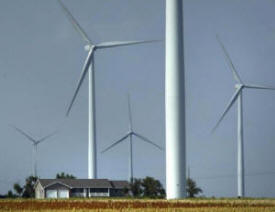
house surrounded by wind turbinesThe following is from a presentation by Anne Dumbrille, Chair of CCSAGE at the Annual General Meeting held at Bloomfield Town Hall, Saturday, May 5, 2018

SOURCE: CCSAGE

Welcome everyone, special welcome to our MPP Todd Smith, Acting Mayor Dianne O’Brien and Councillor Steve Ferguson.
I am giving an update on what is happened in Ontario regarding turbines in the last year.   The Good, the Bad and the Ugly – not always in that order.
Good
Slide 3

  • In 2017, the media has been more outspoken about adverse impacts of turbines e.g.,
  • Two major networks, Global News and Radio-Canada, carried multi-part investigative reports this past year. The three-part Global News feature spurred questions in the Legislature and forced the then-minister to act on noise complaints for several Huron County families.
  • Fraser Inst. Publication Mid- April. They published Understanding the Changes in Ontario’s Electricity Markets and Their Effects criticized the GEA, speaking to it causing high energy costs, losing manufacturing jobs, and not improving the environment.
  • Auditor General criticized Liberal accounting practices re energy costs, fair energy plan; it was well covered in major newspapers

Slide 4
Noise from turbines consists of audible and low frequency noise/ infrsound –these affect brain waves but may be inaudible.

  • A team at University of Waterloo has created a special chamber in which infrasound can be produced, in the hopes that health researchers can determine unequivocally effects of infrasound at levels produced by turbines on people.
  • Australian Court (similar to our ERT) linked wind turbine generated LFN and infrasound noise with possible diseases including hypertension and cardiovascular disease, possibly mediated in part by disturbed sleep and/or psychological stress/distress – it found an established association between annoyance (used as a medical term) and some diseases that result from prolonged stress. They say effects of LFN include motion-sickness-like symptoms, vertigo, and tinnitus -like symptoms.

It was also established that the current method adopted by windfarms to measure noise (including in Canada) — the dB(A) scale, is not suitable for the task, as it does not measure the lower frequency range. The dB(A) scale averages out the sound levels, masking the highest levels and rate of change of noise that could be causing harmful health side-effects.
This is consistent with what the UK noise association said in 2006. 12 years ago.
MOECC still will not address infrasound.
Slide 5
The Environmental Commissioner’s office wrote a report criticizing the government for approving 100% of turbine company permits to kill harm and harass endangered species.
Slide 6
But – BAD they followed that up with one that makes superficial and false statements on the health impacts of wind turbines. She says there is no link between wind turbine noise and health effects — based on ERT conclusions. She does not say that it is next to impossible to win an ERT appeal on health. She said that noise impacts are controlled through setbacks and noise limits in the REAs.
What of the over 4500 records of health/noise complaints filed by people living near turbines in Ontario with the government since 2006? And the out-of-compliance turbines. This is important as if the local turbines are built, they may not be noise compliant.
Slide 7
Bad-Turbines have been out of noise compliance with poor-to-totally lacking government response:
Port Elgin has one (Unifor) turbine – and have been complaining for years about the noise. Finally MOECC said that noise testing did show that it was out of compliance. A noise abatement protocol has to be put in place. The engineering report was filed with the MOECC in January, and then to the wrong Municipality in March – and finally to those affected. There is to be repeat testing in June–if it is out of compliance again -then what? Unknown.

Complaints regarding the Huron-Bruce Turbines in K2 Wind power project led to noise testing a year ago. Turbines were found to be out of compliance with Ontario regulations (April 2017). Since then, MOECC has done nothing.

Kincardine area has made multiple noise complaints over years, have been told testing is ongoing, but somehow, the tests are never completed, and the problem continues. In December they were told by MOECC that nothing was being done. And MOECC will not respond to complaints during an audit. The audit process started in December 2011 and is still not complete.

Slide 8

  • Last summer, a Brinston area resident wrote to Minister Murray about the complete lack of response to her reports of excessive noise (she has had to sleep in her basement on occasion because of the noise and vibration). An officer telephoned her and said:
    • Ministry staff were completely unprepared for wind turbine noise complaints.
    • They still don’t really know what to do.
    • They “lost” her records — even though she had so many reports that the MOECC actually installed equipment and did noise measurement for several days.
    • Last, it was too bad they lost everything pertaining to her situation and reports but it didn’t really matter, she was told because “You’re the only one complaining.”
    • With thousands of noise complaints recorded with the government unresolved, MOECC still refuse to acknowledge the problem, and refuses to look for causes.

Slide 10

  • Good: The MOECC finally admitted previous guidelines resulted in underestimating the noise at nearby homes – the modelling used to predict these impacts was wrong.
  • Last April 21, MOECC released a new protocol intended for “assessing noise from wind turbines that have already been built. It is used by industry and ministry staff to monitor compliance.” And compliance documents are to be publically available.
  • The result of non-compliance is: 1 – Remodel turbines; 2 – conduct a receptor audit at worst affected receptor from that turbine –or mitigation is required

Slide 9 Bad: However:

  • Still no recognition of low frequency noise. And, it hasn’t resulted in any effective changes.
  •  Still – when WCO complained about the lack of response regarding noise and lack of a posted compliance report, they were told that the report cannot be posted as the turbine company’s documents are incomplete. (The turbines had been running for 3 years)

Slide 11

  • Although the government knows the modeling done by wind companies is wrong, they are allowing 5 new large-scale wind projects to follow the old guidelines. If they followed the new guidelines, about 3/4 of these turbines would have to be relocated or removed as they are predicted to be out of compliance with the new noise guidelines. At one project 11 of 12 would be out of compliance.
  • So in January, 5 affected communities filed a JR application against MOECC as surely, Ontario regulations and directives that limit the amount of noise any residence in the province should have to be followed. The claim is – transition provisions were put in place by the ministry to allow those wind turbine companies to use the old regulations without having to provide evidence that they were unable to comply with the new noise modelling guidelines (Dutton Dunwich, North Stormont, La Nation, and Wallaceburg)

Slide 12
Brilliant:

  • Wind Concerns Ontario taking Minister Murray to court May 18 for violating the Environmental Protection Act for permitting noise that causes adverse health events. According to WCO Access to information requests, of 4500 complaints noise/sleeplessness and other health-related effects received, few were followed up – only ~7% in 2015-16.

Slide 13
Ugly

  • In SW Ontario, in an area with sedimentary rock similar to that here, during and after IWT construction, well contamination has been reported – such that some wells are completely clogged, some failed simultaneously from pile-driving during construction. Some have not used their well for 4 years.
  • Before and after tests sent to Laboratories in Michigan show an exponential increase [in] turbidity among the affected wells, including [a] large proportion that can be attributed to black shale particles that are known to contain heavy metals, including uranium, arsenic and lead.
  • An ERT had warned that water wells in that area could be damaged.
  • A professional geologist said: the relationship between the installation of wind turbines and the contamination of wells is obvious. When you have a [pure] water source for years and [transforms] a few days after the construction of an industrial facility. You do not have to be a genius to see that there is a link of cause and effect.
  • He had agreement from geoscientist and geological engineer.
    The project’s owner claims it has nothing to do with the problem.

MOECC’s response — While there’s been an admission that wells have indeed been contaminated, contamination can only be attributed to “unidentified factors.” They maintain that pile-driving activities associated with wind turbine development are not to blame. This conclusion was based on evaluations prepared by the power developer’s consultant.

MOECC say that you should only test your water for bacteria.

Quinte Region Proposed Source Protection Plan Version 8.1 Aug 2012: Section 2.4: “Due to the shallow soil conditions, the entire Quinte area was identified and mapped as a highly vulnerable aquifer. This designation was a direct result of the ease with which a contaminant can move into the underlying fractured bedrock aquifer.” 

Slide 14

  • In 2017 alone, reported in the media:
  • 181 accidents.* Note that there is massive underreporting. RenewableUK confirmed that of 1500 wind turbine accidents and incidents in the UK alone between 2006 and 2011, only 9% are on the global report. So there may have been more like 1800 accidents.

*  http://www.caithnesswindfarms.co.uk/fullaccidents.pdf 

But it gives information on a cross-section of accidents: –

  • Of the 181, there were 17 fatal accidents, 13 injury accidents, 16 blade failure (blade or partial blade throws, travelling up to 1 mile), 24 fires, 14 structural failures (storm damage, tower collapse), 19 transport – related (biggest cause of public injury/fatalities, e.g. ram through a house, turbine parts falling off).

Slide 15

  • Turbine collapse in Chatham-Kent January
  • And in Germany, bits of blade travelled over 500 m –yes, the distance to neighbouring houses by Ontario regulations.

Slide 16
CONCLUSION

  • MOECC, MNRF – Apparently – still blind, deaf and dumb regarding turbine effects and violations
  • All rules and regulations can be broken for the precious GEA
  • Compliance is only met only if citizens fight (and pay) for it
  • Feds (Health Canada, Environment Canada) – no better

Green Energy Black Water

6_Brooks_Water_2crop_700_461_c1_c_c_0_0_1
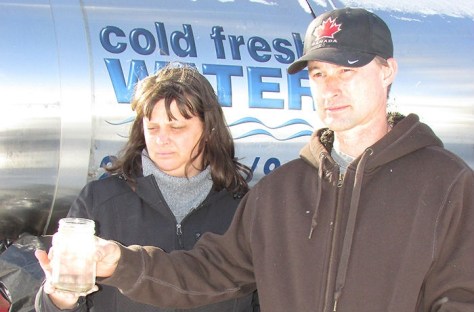
THE BROOKS FAMILY CAN NO LONGER DRINK OR WASH WITH WATER FROM THEIR WELL. | PHOTO: THE CHATHAM VOICE

Green Energy, Black Water
Living in the footprint of industrial wind turbines.

Posted Apr 9, 2018 Christian Courier / by Jessica Brooks / in Media & Culture

In the article “Renewable Energy’s Dilemma” (CC Jan. 22), Candice Goodchild introduced the perspective of a grassroots group in Chatham-Kent, Ontario called Water Wells First. This group was formed to protect the sensitive aquifer in the area from vibration damage caused by the construction and operation of industrial wind turbines (IWT). I am a member of that group, and I would like to share my story with you.

My family and I live inside the footprint of the North Kent Wind 1 (NKW1) project, built in the northeast part of Chatham-Kent, Ontario. The wind farm is built and managed by Pattern Energy (out of Texas) and Samsung (out of Korea). We live on an acre of land, surrounded by farmland. We have enjoyed quiet country living that included an unlimited supply of good, clean water from our well. However, last summer, during the construction of the NKW1 project, our property was surrounded by three pile drivers. The particular style of construction for industrial wind turbines requires the use of piles to support the foundations. In this case, 18 to 24 piles are used for each of the 34 wind turbines in this project. Three turbines were erected within one kilometre of our house.

Pile driving began on July 27, 2017. The next day, while my husband was in the shower, the water stopped running. Upon investigation we found that the sediment traps we had installed on our water line were choked with thick, black sediment – something we had never seen before.

Chatham-Kent sits on a unique geological bedrock formation called Kettle Point Black Shale. The aquifer that feeds hundreds of wells in Chatham-Kent is shallow and quite fragile. It rests on that black shale, trapped in layers of glacial sediment. Black shale is known to naturally contain lead, mercury, arsenic and uranium.

In 2012, the East St. Clair wind project was constructed in northwest Chatham-Kent, which has the same black shale formation as other areas of the county. Many well owners in the area experienced the same black water we found in our well.

Health hazards
Investigation by private citizens and scientists hypothesized that the vibration from pile driving and the operation of wind turbines had disturbed the aquifer under the East St. Clair project, causing the release of sediments into the aquifer. As a result, the water turned black from the shale particles. When the NKW1 project was to begin, farmers and residents from the area mobilized to inform government officials about the potential danger to the aquifer from pile driving. This became the group Water Wells First. Our warnings and pleas were ignored, and construction began.

Today more than 20 wells within the footprint of the NKW1 project are experiencing black water. Many of these families had received water tanks from the wind company, which was required by the Renewable Energy Act permit – an alternative water supply in the case of any well issues during construction. Our family has had a tank on our property since the first weekend of August. It froze during the coldest winter days, and ran dry when there were delays in delivery, or when the hose leaked. At the time of writing, we have been informed that the tank will removed from our property by the end of March…

Read article

We aren’t stupid.


egg

Today I attended the @WaterWellsFirst press conference. The egg shown in the picture was prepared with the contaminated well water that the Province says is safe to drink. Would you eat this egg @Kathleen_Wynne ? #healthhazzardstudynow pic.twitter.com/4TJXeSKcoq
— Mayor Todd Case (@ToddCaseLKM) April 11, 2018


Never assume|The Chatham Voice|April 11, 2018

The people of Chatham-Kent aren’t stupid and it makes us a little angry when the powers that be assume we are.

The news this week about the EBS Geostructural Consultant blog that had a key phrase removed regarding the company’s advice to Hydro One about using micro-piling methods instead of deep piling to avoid “potential for driven pile installation to cause issues with nearby active water wells” is disturbing on so many levels.

First, the advice to Hydro One is proof at least one government agency used alternative methods of pile-driving to avoid disturbing area water wells, with the blessing of the Ministry of the Environment, as the blog states.

Second, it refutes the claims by the North Kent One wind farm that there couldn’t possibly be any connection between deep pile driving methods used to construct the turbine foundations and the complaints of sediment contamination in several water wells in the project area.

And finally, removing the line referring to water wells doesn’t make us “unsee” the information. We now know at least one government agency – Hydro One – sought advice on how to construct towers with the least impact to area wells and went with that advice, keeping in line with the company commitment to “identify and evaluate environmental risks to ensure that hazards are eliminated or controlled” as it states on its website.

So asking us to disregard what we read because it wasn’t being “used properly” and expecting us to believe this advice is not in any report to Hydro One is utterly ridiculous and, frankly, insulting.

If Samsung and Pattern are going to stick to their assertion their construction methods couldn’t possibly be the problem for well owners, and if the environment ministry and municipal officials are going to buy into that when other sources say otherwise, it is time for us all to demand better from our deciison makers.

The well owners have been dealing with dirty water for long enough. We need to start questioning why the environment ministry and the municipality are letting the turbine companies dictate what we consider unsafe for our rural residents, and why these well owners have to fund their own investigation into the potential carcinogenic sediment in the water the government insists is safe to drink.

And because our chief medical officer of health says so isn’t a good enough reason. Until the governments – local and provincial – step up and demand answers from an unbiased third party, we will continue to be treated as naïve sheep who need to be neither seen nor heard.

Yeah, we don’t think so.

The Chatham Voice

Council needs to protect Residents

a - WindFarm_6Letter to Editor published April 6, 2018| Opinion: North Country Now
To the Editor:

My wife and I live south of 72, in Hopkinton. We are totally against the North Ridge Wind Project and the expansion south of 72.

Do I feel the wind law is strict enough? No, but there has already been enough compromises on our part.
Time after time the majority of residents have voiced they are against this project.

And, yes, we all know what we signed and do know what a PILOT is, so please stop insulting our intelligence and insinuating that these signatures are not legal residents.

I commend the three women on Hopkinton town board for wisely listening to the majority of your constituents and the Wind Advisory Boards recommendations.

Unfortunately, I question if the two men on the board have drank the Kool-Aid.

One’s dad is a lease holder so ethically must recuse himself and the other being Hopkinton’s fire chief and Avangrid publically stating thousands of dollars ear marked for the fire district, appears he may have some ethically questionable motives and perhaps he should also recuse himself.

A no brainer: Guaranteed 100 percent assessment. If you own a shack or a mansion — we each pay the same assessment. This company has a lot more money than any of us and if this is such a good financial deal for our town, lets guarantee that by making them be fair to each of us.

Pay your full 100% assessment like we all do!

When all is said and done and Avangrid has packed their bags and “gone with the wind,” we will still be here. We have thrived for over 200 years and will continue to thrive.

As our elected town representatives: Will you be able to hold your head high knowing you took your position to represent and protect the majority of the towns people in the highest regards?

Robert Blum

Hopkinton, New York

More about: North Ridge Wind Farm

Next Era selling Ontario Wind & Solar

Beyond words…..

DSCN1859
Wind Turbines Summerhaven project- Haldimand County

NextEra selling Ontario wind & solar assets

NextEra Energy Partners, LP announced that it has entered into a definitive agreement with Canada Pension Plan Investment Board (CPPIB) for the sale of its portfolio of wind and solar generation assets in Ontario, Canada, for a total consideration of about $582.3 million. This includes the net present value of the O&M origination fee, subject to customary working capital and other adjustments, plus the assumption by the purchaser of approximately $689 million USD in existing debt.

Wind turbines
The transaction includes the sale of six fully contracted wind and solar assets with an average contract life of about 16 years.

“We are pleased to reach this agreement with CPPIB for the sale of our Canadian portfolio, which we expect will be accretive to NextEra Energy Partners’ long-term growth,” said Jim Robo, chairman and chief executive officer. “The sale of these assets, at a very attractive 10-year average CAFD yield of 6.6%, including the present value of the O&M origination fee, highlights the underlying strength of the partnership’s renewable portfolio.”

An affiliate of NextEra Energy Resources will continue to operate all of the facilities included in the transaction under a 10-year services agreement with CPPIB.

As discussed during our earnings call in January, we expect the sale of the Canadian portfolio to enable us to recycle capital back into U.S. assets, which benefit from a longer federal income tax shield and a lower effective corporate tax rate, allowing NextEra Energy Partners to retain more CAFD in the future for every $1 invested. We expect to accretively redeploy the proceeds from this transaction to acquire higher-yielding U.S. assets from either third parties or NextEra Energy Resources,” added Robo.

The transaction includes the sale of six fully contracted wind and solar assets, with an average contract life of approximately 16 years and 10-year average CAFD of $38.4 million. Located in Ontario, the portfolio has a combined total generating capacity of approximately 396 MW and consists of:
◾Bluewater, a 59.9-MW wind generating facility;
◾Conestogo, a 22.9-MW wind generating facility;
◾Jericho, a 149-MW wind generating facility;
◾Summerhaven, a 124.4-MW wind generating facility;
◾Moore, a 20-MW solar energy generating facility; and
◾Sombra, a 20-MW solar energy generating facility.

NextEra Energy Partners expects the sale to close during the second quarter of 2018. The transaction is subject to receipt of regulatory approvals and satisfaction of customary closing conditions.

NextEra Energy Partners continues to expect a Dec. 31, 2018, run rate for adjusted EBITDA of $1.00 billion to $1.15 billionand CAFD of $360 million to $400 million, reflecting calendar year 2019 expectations for the forecasted portfolio at year-end 2018.

Citi and CIBC Capital Markets are serving as financial advisors to NextEra Energy, and McCarthy Tétrault LLP and Gowling WLG (Canada) LLP are legal counsel.

READ ARTICLE

Life without clean water after the wind turbines came

cropped-coffee-and-waterWhere We’ve Been, Where We’re Going

It’s been longer than I would have liked, to post another update.  That’s the funny thing…as the information changes quickly, its hard to stay ahead of it.

I want to give a bit of a back story.  We have been at this water protection thing for almost two years.  But our lack of water started in July, 2017.  In our case, pile driving for wind turbines near our house started on July 27, 2017.  By the end of the next day the water quit coming into the house in the middle of someone’s shower.

We found that the sediment traps we had installed to monitor our water quality ahead of the construction were clogged with sediment.  We had never seen this before…..

A new blog  coming from Ontario detailing the serious changes to daily life as a family struggles  every day with the loss of clean water  that occured after the wind turbines were built.  It highlights the lack of meaningful resolution not only by the wind industry and project operators but also the failures of the government to be protective and serve the people.

The View with Coffee
Our fight for clean water and quiet country living.

Taxpayers pay proving government compromised safety

“As the community proved at the ERT hearing, this project should not have been approved in the first place,” he said. “It’s outrageous the government could be so negligent, making it necessary for the citizens to protect the public, then hide behind flawed legislation that robs the tribunal appointed by them in overlooking their bad decisions to award costs to the citizens who successfully proved the government compromised people’s safety.”

STA_winddecision02_au24_ia_Super_Portrait
Clearview Township councillor Kevin Elwood. – Metroland file photo

ERT rules no cost relief to challenge Clearview wind turbine decision

By Ian Adams|Wasaga Sun | Feb 27, 2018

Local taxpayers will be on the hook for the successful challenge to a plan to erect eight turbines in Clearview Township.

The same goes for Kevin and Gail Elwood, John Wiggins, and the residents’ group Preserve Clearview, after the Environmental Review Tribunal dismissed an application for costs related to their appeal of a decision to grant WPD a renewable energy application for the Fairview Wind Project.

The tribunal ultimately ruled last August to revoke that approval on the basis the planned 500-foot-tall turbines presented a serious risk to human health because of the proximity of the project to the Collingwood Regional Airport and the Clearview Aerodrome owned by the Elwoods.

Read article

Wind Turbines & Human Distress

scream-2

In 1987 the US Government published a document outlining a propose metric for assessing wind turbine noise and impacts at a community level.

A Proposed Metric for Assessing the Potential of Community Annoyance from Wind Turbine Low-Frequency Noise Emissions; N.D. Kelley ,November 1987

What is wrong with our system?

randy hope.jpg
Mayor Randy Hope poster boy for CANWEA

Letter to Editor|The Chatham Voice| Published February 12, 2018

Sir: Our illustrious mayor spoke on a local radio station recently responding to the opinion poll, in which the number one local concern was wind turbines and water wells concerns. His conclusion, in essence, was that they were not involved except for taking $1,575,000 in taxes from the 450 turbines with an average tax rate of about $3500 each per year.

I wonder how much taxes would be for an industrial plant that would have been built and cost approximately $2 million to build. Did the mayor, council and administration ever think that there might be a cost to this extra income? Did they ever consider using this money to do a thorough investigation of the effect on the aquifer? Did they ever go to see the difficulties experienced by those families living off water tanks, especially in the recent freezing weather?

Apparently, mayor, council and administration for Chatham-Kent are willing to trade rural water wells for that price. The people losing their wells must prove that there is a problem and then the municipality may look at a solution.

The mayor says that they take concerns seriously. That is the exact same B.S. statement made by Premier Wynne when she was in Chatham a couple of months ago and the mayor was looking over her shoulder. No one in government, provincially or municipally, has done anything constructive for years; when the first complaints were lodged in Dover Township in about 2009 and again in 2012.

What is wrong with this story?
If a bank is robbed, does the bank have to find the criminal and prove his guilt? Isn’t that what police do? If you are in a car accident caused by another person, do you have to pursue and prove the guilt of the offender? Isn’t that what police do? For every injustice, there is a third party whose duty it is to find the perpetrator and proof for the case against them. Since these third parties are no longer doing their jobs, are we reverting to the law of the old west?

In the case of the harm done to water wells and the standard of living for those with now contaminated wells, these agencies are not acting in the offended parties’ interests. There are many directions that fingers can point.

The provincial government, with its Green Energy Act, which is being used as an excuse by everyone as a document that overrules every other law in the land. This is not true as the health and safety of the citizens of this province still rule supreme, if our Ministry of Health, and local public health unit would get off their backsides and study health effects of the Kettle Point Black Shale that infiltrated our water wells.

I believe that somewhere in their health education process they were made aware that lead, mercury, arsenic and uranium are not to be used as vitamins. Why have they never run any comprehensive tests to find out what is in the water now and what are the health effects of those contaminants?

The Ministry of Environment and Climate Change is certainly the ministry that is supposed to protect the citizens of this province from anything that environmentally has a negative effect on the enjoyment and use of property, be that by health effects or any other source of irritation. The trouble with the MOECC is that it is the same ministry that issued the permits to build wind farms and are certainly not going to admit that they did not do “due diligence” before issuing these permits. Were there any studies done on possible problems with the style of foundations used in an aquifer sensitive area?

Then we get to our local mayor, council and administration. What have they done other than become shareholders in wind farms? Do they value the rural wells of Chatham-Kent at $1.5 million per year? Are they going to use this money to replace the water supply that has been lost by several known residents in the former Dover and Chatham Townships?

Are there other townships that lost their wells as well, even before the wind companies went to the pile driving method from spread foot of securing foundations? Was our local government blinded by the visions of a cash windfall without any expense?

I still have three questions that I would like to have answered:

~How much money was paid by the wind industry to individuals, political parties and the Ontario government for the privilege of building turbines in Ontario without interference?
~How much money was paid by the wind industry to individuals, and the municipality to become friendly hosts for turbine construction?
~How much money would it take to stop construction and operation of turbines until their negative impact on environment issues, especially water, are properly assessed by an independent party, since our politicians, local and provincial, obviously have not done “due diligence” prior to signing agreements?
Where can these questions be answered? Are elected representatives not supposed to answer to their constituents?

Peter Hensel

Dover Centre