


“Tens of billions in tax subsidies have failed to make “green” energy the steady source of power promised. And now, for instance, Germany’s subsidies for wind power are coming to an end, so as many as 20% of German wind turbines will have to be decommissioned each year with nowhere to dispose of the 30-metre concrete bases or the huge turbine blades.”
Lorne Gunter|Toronto Sun|July 21, 2018

Credit: Andre Coyne| National Post| June 29, 2018
McKenna’s tweet was just the usual non-stop, 24-hour moralizing we’ve come to expect from the primly ideological fanatics in this increasingly ridiculous government
It’s probably nothing. It was just a tweet, after all.
But when the federal environment minister, Catherine McKenna, posted her approval of a recent Canada Pension Plan Investment Board decision, it caused a little flutter of alarm among those who follow these things.
“Now, this is something that Canadians can be proud of,” she cheered, linking to a story about the CPPIB’s plans to invest more than $3 billion in green energy projects, “as it prepares for the global transition to a lower-carbon economy.”
Ministers of the Crown do not normally comment on CPP investment decisions, approvingly or otherwise, and with good reason. Though the federal and provincial governments set the broad terms of the plan’s operations — how much it collects in “contributions” from employers and employees, etc — the CPPIB, which is responsible for investing the $356 billion accumulated in the CPP Fund, is supposed to operate at arm’s length from all of them.
Now, this is something that Canadians can be proud of. The CPP
is planning to invest more than $3 billion in renewable energy as it prepares for the global transition to a lower-carbon economy. https://t.co/hsssiwYE47— Catherine McKenna 🇨🇦 (@cathmckenna) June 26, 2018

Published: Nation Valley News|June 23, 2018
The Editor:
Dear John [Fraser, interim Ontario Liberal leader],
Over the past four years we have written, faxed, emailed you and your previous fellow MPP’s many times and clearly told you one of the ways the Liberal party of Ontario was going wrong.
The Liberals’ callous, cruel disregard for the rights of the people of Ontario was very clearly demonstrated right up to the last week of parliament when over 3,000 people signed petitions simply asking your party to recognize your own lower, safer noise levels for industrial wind turbines. Late Friday, May 3 MOECC approved the Nation Rise Wind project using the higher noise levels (EDP Renewables of Portugal had surveyors on local roads Monday, May 6) and your party leader dissolved parliament May 7. The approval inflicted an additional debt on all people of Ontario of $1.8 million/month guaranteed for 20 years to a foreign county.
Over the years we asked you and your party, why? Why the damage to Amherst Island, the 20 wells in Chatham-Kent, the ignored noise complaints, the removal of rights of the municipalities and people of Ontario under the Green Energy Act?
John, your party has a lot to answer for including the anguish your party has inflicted. We sincerely hope you do not achieve official party status; a party such as yours that treated the people of Ontario as you did does not deserve to be anywhere near the democratic government of Ontario.
Ruby and Joe Mekker
14117 Con. 1 – 2
Finch ON
Nation Rise Wind (proposed to be located southeast of Ottawa)

Source: American Thinker| By: John Droz| Published June 20, 2018
The number-one challenge of our times is to separate the wheat from the chaff. To assist in this task, we are blessed with more information than ever before – but we are also simultaneously burdened with more misinformation than any prior generation has ever had to deal with. We look back and wonder how trusting citizens were so easily victimized by snake oil salesmen, but today, in the golden age of cons, we are being duped on a daily basis.
As a representative matter (and a national issue of great significance), let’s look at what’s happening with industrial wind energy.
The primary reason why wind energy has been a success has nothing to do with wind energy! Instead, its success is 100% due to the fact that wind energy proponents are masterful lobbyists. If one reads The Business of America Is Lobbying, it’s apparent that the wind industry has used every trick in the book, and then written some of its own.
For example: Wind lobbyists have successfully infiltrated our language with totally inaccurate and misleading terminology, such as “wind farms” and “clean energy.” Neither exists.
For example: Wind marketers have successfully portrayed their product as “Free, Clean, and Green” – despite it being none of those. The reason they have coined these malapropisms is simple: those who control the words control the narrative.
For example: Wind salespeople have successfully convinced financially distressed communities that hosting a wind project will be a economic windfall – even though numerous studies from independent experts indicate that the net local economic impact could well be negative.
For example: Wind-peddlers have successfully sold technically challenged local representatives that the wind-developer is their friend and business partner – even though these sophisticated and aggressive entrepreneurs typically look at these rural people as rubes and marks, and their number-one focus is to make as much money as possible, at the rubes’ expense.
For example: Wind developers have successfully persuaded much of the public that wind energy is an inevitable matter, so fighting it is a lost cause. The reality is that in many cases, local communities can effectively defend themselves by simply passing a proper wind ordinance.
For example: Wind-supporters have successfully imparted the belief that a certain wind project will power 20,000 homes – even though that project will not actually power a single home 24/7/365.
For example: Wind advocates employ a sleight-of-hand tactic to dismiss noise complaints by claiming that “wind turbines don’t make any more noise than a refrigerator.” The fact is that the main acoustical concern with wind turbines is the infrasound generated (which is below our level of hearing). So discussing the audible part of turbine noise purposefully distracts from the serious inaudible (but still very much experienced) noise issue.
For example: Wind propagandists say that wind energy is saving the environment – even though the evidence indicates that it is environmentally destructive on multiple fronts.
For example: Wind-promoters have successfully conveyed the idea that wind energy is a low-cost option of electricity – even though when all its costs are fully accounted for, wind energy can be three to five times as expensive as traditional electricity sources.
For example: Wind advocates have successfully communicated the notion that using more wind will directly result in the closure of coal plants – even though 10,000 wind turbines could never equal the performance of even a single coal facility.
For example: Wind-boosters have successfully disseminated the impression that wind is a major and essential contributor to preventing climate change – even though there is no empirical scientific proof that wind energy saves any consequential CO2.
For example: Wind champions have successfully relayed the conviction that the DoD Clearinghouse assures us that wind projects will not adversely affect the mission or operational readiness of our military or our national security – even though the DoD Clearinghouse was set up to accommodate wind energy (not the military), and the actual process is much more about promoting political correctness than protecting our national defense.
I could go on and on, as the list of wind lobbyists’ deceptions is distressingly long. That said, there is an additional major falsehood that needs to be exposed: that there is such a thing as wind energy by itself. This seemingly innocuous deceit is actually extraordinarily important.
The fact is that there is no such animal on the grid as wind energy by itself. What actually typically exists is a “Wind+Gas” package. This is mandated by the inescapable reality of wind energy’s unrelentingly unpredictable and uncontrollable output. No conventional source of electrical energy has these characteristics, so none need this special augmentation.
The importance of understanding this reality is that when we are talking about wind energy economics or environmental consequences, the only truthful analysis is objectively and comprehensively looking at the results of the Wind+Gas package.*
For example, it should be apparent that wind energy (i.e., the Wind+Gas package) is not a CO2 zero-emitter. In fact, due to other technicalities (never acknowledged by wind lobbyists) some studies have concluded that gas (combined cycle) by itself produces less CO2 than the Wind+Gas package.
Let me restate that extraordinary finding: gas can produce less CO2 than wind energy does!
Is the success of wind energy due to the sophistication of the con artists they’ve engaged or to our gullibility? In either case, the takeaway is that lobbyists are not reliable sources of information, especially when it involves significant money, our health, or our national security. The bottom line is that wind energy is palliative pabulum, not suitable for prime time.
*Some sample studies and reports about the Wind+Gas package: one, two, three, four, five, six, seven, eight, nine, ten and eleven.
 Dear Mr. Ford,
I am writing to you and your esteemed colleagues requesting that the new PC majority government repeal the Green Energy Act with the swiftest possible speed. I know you have railed against this misguided piece of legislation. Indeed, your estimate of its low caliber is echoed by Pierre-Olivier Pineau, Associate Professor and Electricity Market Expert, University of Montreal HEC Business School, who opined that “Ontario is probably the worst electricity market in the world.” (https://www.forbes.com/sites/judeclemente/2016/03/30/ontarios-high-electricity-prices-crush-business/#2a8c5ab44587)
As you know, this Act has been a disaster on many fronts – its inability to effect the desired reduced CO2 emissions, its harmful effect on the environment, its negative impact on the economy and our electricity rates, its stripping of municipal planning and zoning rights, and importantly, its deleterious impacts on rural residents who only want a safe and quiet place to enjoy their homes and properties.
1. Tweaking the GEA is folly, as the very Act is based upon faulty foundations – that the wind is free, clean, and always blowing somewhere. This myth fails to take into account that wind is unpredictable, non-dispatchable, unreliable and inherently intermittent. When added to a power grid designed entirely around dispatchable sources, it leads to grave system instability. As renewable energy sources are added into the mix, their impact is exacerbated by an inability to match loads (demand) with supply, as supply would be increasingly and inconveniently dictated by phenomena like the weather (and sunset). The green mantra also fails to acknowledge the requisite concomitant use of fossilk fuels (particularly, gas) run in an open cycle, stop and go, inefficient mode like the Don Valley at rush hour. And it fails to deal with the vast stretches of weather system patterns and the transmission requirements necessary to connect with Dorothy in wind-blown Kansas.

https://www.masterresource.org/droz-john-awed/21-bad-things-wind-power-3-reasons-why/
2. Furthermore, mere enforcement of GEA regulations is an insipid approach. The regulations fail to include infrasound, low frequencies, high frequencies, amplitude modulation, stray voltage, vibration, the trespass of shadow flicker, the destruction of prime agriculture lands, disturbances to water wells, impact on livestock and wildlife harm/harassment/ kill/displacement, among other winning features of IWTs. Nor does it address the legality of gagging lease holders from discussing health impacts, thereby precluding public safeguards. Moreover, the existing regulations regarding acoustic testing and monitoring, when implemented at all, are cumbersome by design, rarely feasible, and statistically dishonest.
3. The only honourable approach to addressing the Green Energy Act is to cancel it. In a Financial Post article entitled “Yes, Ontario’s Liberals can cancel their terrible renewable power contracts—and they should do it now”, (Lawrence Solomon, September 2016) argues for “cancelling Ontario’s odious renewables contracts”. He writes:

Mr. Solomon’s argument is further substantiated by the case of Trillium Power Wind Corporation v. Ontario (2012):

Furthermore, in the Supreme Court case, Wells vs Newfoundland, 1999, the Judges’ decision states (Paragraph 48):

https://scc-csc.lexum.com/scc-csc/scc-csc/en/item/1730/index.do?site_preference=normal
Mr. Ford, many rural residents have been holding on for a June 7th PC win as their last hope in dealing with the adverse living circumstances imposed upon us by the McGuinty-Wynne dynasties. I encourage you to repeal this disastrous Green Energy Act and return our homes and our pastoral farmlands to their idyllic pre-GEA state.
Sincerely,
A Concerned Citizen.

Renewable Energy World|June 8, 2018|By
Everybody loves renewable energy, right? That’s what surveys tell us with global support for renewable energy consistently polling above 80 percent.
But don’t tell that to the people of the Province of Ontario, Canada. On June 7, the electorate handed a stunning defeat to its Liberal Government after 15 years of reign. The election winner: Conservative Doug Ford, brother of Toronto’s infamous crack-cocaine smoking mayor, Rob Ford. The issue in the forefront of voters’ minds: sky high electricity prices.
Ever since the Ontario Government invoked its Green Energy Act in 2009 to transition away from coal power to wind and solar energy, electricity prices have risen a whopping 75 percent. In Ontario, electric bills have become as frequent a topic of water-cooler conversation as apartment rents are in Manhattan or San Francisco.
Without question, on every measure of ratepayer protection Ontario is an egregious case of how not to design a renewable energy program:
Most Feed-in-Tariff (FIT) rates set not by competitive bidding but instead by Government decree at levels as high as $C 80.2 cents ($US 62 cents) per kWh for 20 years
No mechanism to automatically adjust FIT rates downward as capacity deployment thresholds were reached
Domestic Content requirements that raised domestic equipment prices above global average selling prices
A rule that ratepayers still provide FIT payments for energy even when energy production is curtailed
An allowance of five years after FIT contract execution for facility construction, creating windfall gains for developers as equipment costs declined while preventing ratepayers from participating in any of those savings.
How did Ontario get their renewables policy so wrong?
By Christine Legere |May 31, 2018 |Cape Cod Times
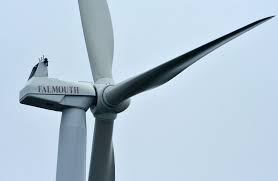
FALMOUTH — An eight-year legal battle between the town and residents who live near two controversial wind turbines at the municipal wastewater treatment plant off Blacksmith Shop Road has been brought to a close with the recent settlement of three remaining court cases involving monetary damages.
The town’s insurer paid the 10 complainants named in the suits a total of $255,000, according to Town Counsel Frank Duffy.
Eight litigants agreed to settlement amounts in March and have already been paid. Linda Ohkagawa, Kathryn Elder, Brian Elder, Todd Drummey, Terri Drummey, Robbie Laird, Mark Cool and John Ford each received $22,500.
While those amounts fell short of their legal expenses, the group decided to accept the payments.
“It was not wanting to pay any more for the grease to turn the wheels of the justice system,” Cool said. “Everybody was so tired.”
Diane and Barry Funfar agreed to a settlement amount last week as part of a separate nuisance complaint and will be paid in about a month. Each was awarded $37,500, for a total of $75,000.
That award won’t balance the financial books for the couple, who had to remortgage their home three times to cover the cost of their attorneys during years of court hearings.
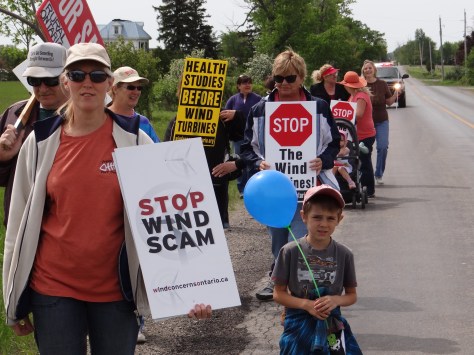 The mothers and their children took a walk on May 27, 2013 protesting the Summerhaven Wind project that was under construction at the time. We marched together providing a record and demonstration of our non consent to the wind project. It also spiked a lot of interest from the Ontario Provincial Police and wind project security. The police decided they needed to be present with a marked police escort and their undercover members.
Mothers Against Wind Turbines remains firm in giving a thumbs down to industrial wind. We have not remained silent. We will not remain silent. No still means no.
Ontario Wind Resistance posting May 2013: Mothers March to Say NO!

A key question at the top of my Hydro One electricity statement is “What am I paying for?” According to Hydro One the charge includes:
1) The cost of generating the electricity used – ‘the Ontario Energy Board (OEB) sets the cost and the money collected goes directly to the electricity generators.’
2) The delivery – ‘money collected by Hydro One to build, maintain, and operate the electrical infrastructure which includes power lines, steel towers, and wood poles covering 960,000 sq km’
3) Regulatory charges – the Independent Electricity System Operator (IESO) uses this money to manage electricity supply and demand in the province.
4) HST – harmonized sales tax
5) 8% Provincial Rebate.
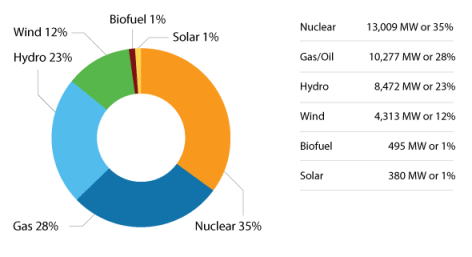
In Ontario we can generate power from three nuclear power plants, 45 hydro generating stations, 30 gas plants, 38 industrial wind turbine installations, 5 solar installations and 5 biofuel generating stations. The website gridwatch.ca provides an hourly overview of power generated, Ontario demand and imports and exports.
The Cost of Electricity Generation in Ontario –
| GENERATOR
TYPE |
UNIT COST/ MWh (1) | OUTPUT / HR
(2) |
OUTPUT / DAY | COST / DAY | COST / YEAR (3)
+ constrained Power |
| HYDRO | $ 62.00 /
MWh |
3143 MW /hr | 75,442
MWh / day |
$ 4,677,379
/ day |
$ 1,707.243
Million / year |
| NUCLEAR | $ 77.00 /
MWh |
7551.5 MW/hr | 181,236.6
MWh / day |
$13,955,218
/ day |
$ 5,093.66
Million / year |
| WIND | $ 159.00 /
MWh |
765 MW / hr | 18,353
MWh / day |
$ 2,918,057
/ day |
$ 1,065.09
Million / year |
| NATURAL GAS | $ 188.00 / MWh | 489 MW / hr | 11,736
MWh / day |
$ 2,206,368
/ day |
$ 805.324
Million / year |
| SOLAR | $ 513.00 /
MWh |
45 MW / hr | 1086
MWh / day |
$ 556,872
/ day |
$ 203.258
Million / year |
| BIO FUELS | $ 236.00 /
MWh |
37 MW / hr | 884 MWh /
day |
$ 208,718
/ day |
$ 76.182
Million / year |
| 12,030.5 MW
/ hr |
$24,522,612
/ day |
(1) Total Electricity Supply Costs Source:Power Advisory p.16 https://www.oeb.ca/sites/default/files/RPP-Supply-Cost-Report-20180501-20190430-correction.pdf
(2) IESO Generator Output by Fuel Type Monthly Report 2017
http://reports.ieso.ca/public/GenOutputbyFuelMonthly/PUB_GenOutputbyFuelMonthly_2017_v12.xml
(3) Cost per Year is for power produced so payment for constrained power must be added to the cost.
According to the IESO we have a total installed capacity of 36,853 MW of power that could be produced per hour if all generators were running flat out. To allow for maintenance and emergencies the IESO forecasts capability at peak demand rather than using total installed capacity. The forecast capability at peak demand for Ontario is 26,704 MW/hr, which is the production of power generation we count on.
The demand for power fluctuates with time of day, day of the week, weather conditions, and season. In 2017 the average hourly demand for power was 12,031 MW per hour. Therefore, we have tremendous capacity in the Ontario power system.
It is further complicated because not all generators are equal – nuclear, hydro and gas are reliable baseload generators that can be ramped up or down. But wind and solar are unreliable, intermittent and only produce power when the wind blows and the sun shines.
To accommodate a fluctuating supply considerable flexibility exists in the system. We pay for production, but we also pay for generation that is constrained or held back from the grid. Some generators are underutilized, and we pay them to sit idle and provide backup.
Using the information provided by the Independent Electricity Systems Operator (IESO):
The least expensive power Ontario generates is HYDRO. Our cleanest, greenest, cheapest renewable energy costs $62.00 per MWh. The Ontario Hydro power generating system has a total installed capacity of 8480 MW per hour potential production, with a capability at peak demand of 5786 MW / hr. On average the output from the Hydro generating system for 2017 was 3143 MW/hr. Although we only used 54% of the capability of Ontario hydro generation plants (the rest of the time we ran the water over the dam) Hydro provided 26% of our hourly generation of power in Ontario in 2017. The Hydro supplied to the electrical grid cost $1.707 billion dollars in 2017.
The second least expensive power generated in Ontario is NUCLEAR which cost $77.00 per MWh. Nuclear is the work horse for Ontario providing more than 63% of the power produced in this province. The average hourly output for 2017 was 7551 MW per hour. Costing $5.093 billion dollars per year.
Ninety percent of the power produced in Ontario is from Hydro and Nuclear and we underutilize both these systems to accommodate wind and solar energy. The daily cost for Hydro and Nuclear power produced is $18.6 million dollars per day or $6.8 billion dollars per year.
The total unit cost for WIND power is $159.00 per MWh produced (two and one-half times the cost of hydro and double the cost of nuclear). Wind has an installed name plate capacity of 4213 MW/hr but is an intermittent and unreliable energy source and only provided 765 MW per hour or 6% of the hourly generation of power for Ontario in 2017. Using the installed capacity wind energy should be providing 35% of the power production of this province, but due to the unreliable nature of wind the production could be 0% so nineteen gas plants were built since 2003 to back up wind and solar. The daily cost of wind energy that was produced was $2.9 million dollars per day or $1.065 billion dollars per year. This does not include the amount paid for constrained wind energy so under-represents the actual cost.
If we add in the cost of constrained wind which was 3.396 million MWh in 2017 and pay that out at $120.00 per MWh then the cost increase for constrained wind in 2017 was $407.5 million. The total cost of wind energy for 2017 then is closer to $1,065 + 407.5 = $1,472.5 million dollars or $1.4725 billion dollars per year.
The total unit cost for NATURAL GAS is $188.00 per MWh produced. Because natural gas is used as a back-up power for wind and solar the demand fluctuates hourly and again we have an energy source that is also paid when constrained. The gas plants are capable of producing 10,277 MW/ hr but only produced 489 MW/ hr in 2017. So we operated the gas plants at 5% of their potential! The daily cost of natural gas energy that was produced was $2.2 million per day or $ 805 million per year plus cost for constrained natural gas.
Constrained natural gas is paid $10,000.00 per month per potential MWh of production. So with a potential production of 10,277 MWh X $10,000 X 12 = $1,233,240,000 per year. The total for natural gas would be closer to $2,038.24 million dollars per year or $2.038 billion dollars.
The elephant in the room is definitely SOLAR weighing in at $513.00 per MWh produced (eight times the cost of hydro!) The contribution of roughly 1000 MWh per day is minimal but the cost is phenomenal at just over $0.5 million per day. A cost of $203 million per year. Again, we have not accounted for the huge amount of solar energy that is embedded in the local distribution systems eg small solar installations and panels mounted on your house. So the cost of solar is grossly under-represented, probably to keep us in the dark.
If the embedded solar is indeed 2,300 MW of installed capacity (using 13% as the potential production) we have an additional 299 MW/hr solar to pay for. At $513.00 per MWh that would be an additional 299 X 24 hr per day X $513 = $3.693 million per day or $1.348 billion dollars per year. So, the total cost of solar could be closer to $1.551 billion per year. ($1.348 +$0.203)
Only 10% of our power is produced from wind, solar and natural gas, made possible by underutilizing our nuclear and hydro power generation. The total cost for wind energy in 2017 was upwards of $1.4725 billion dollars plus solar at $1.551 billion dollars plus natural gas at $2.038 billion dollars for a total of $5.062 billion dollars!
That final 10% of the power generated in Ontario is probably costing us closer to $5 billion dollars – over 40% of the total cost of the generation of electricity in this province! And we still need to include the cost of the delivery charges, the regulatory charges and the HST!! Waste, waste and more government waste as we pay for duplication, underutilization and huge government subsidies for the generation of power in Ontario.
Catherine Mitchell – a concerned citizen
 Mothers Against Wind Turbines Inc.