Category Archives: fighting big wind.

Samsung Files Legal Action Against Protesters

Has Samsung SLAPP’ ed  back at protesters of its North Kent Wind project?

“Strategic litigation against public participation (SLAPP) has been defined as a lawsuit started against one or more people or groups who speak out or take a position on an issue of public interest. The purpose of a SLAPP is to silence critics by redirecting their energy and finances into defending a lawsuit and away from their original public criticism. Concerns have been raised that SLAPPs also act as a warning to other potential critics. The effect of SLAPP suits is to discourage public debate.”

Read more about SLAPP lawsuits

Council of Canadians slams heavy-handed Samsung Energy legal tactics

Media Release
October 11, 2017

Chatham, ON – The Council of Canadians is condemning Samsung Energy for filing a million dollar plus statement of claim against Chatham area residents who blocked construction at one of 34 wind turbines the company is erecting as part of its North Kent One* wind power project.

Many of the people who took part in the 11 day blockade have filed well interference complaints against the developer, citing the vibrations from the company’s pile driving activity as the cause of the sudden influx of black silt in their wells. At least thirteen well interference complaints have been made since the company started pile driving for the turbine foundations last June.

According to the developer’s Statement of Claim, the impact of the construction delay caused by the blockade “amounts to costs ranging from $50,000 to $100,000 per day, covering only the current amount of labour and equipment idle.”

The Statement of Claim names Water Wells First spokesperson Kevin Jakubec and Cindy Soney as defendants. It also includes “other individuals who have been involved in the unlawful conduct….who have not yet been identified and have been named as John Doe and Jane Doe.”

The well water on the Jakubec family’s farm became polluted with black silt shortly after pile driving began nearby.

“Our well water was crystal clear for decades before the pile driving started,” said Jakubec. “Now, Samsung is claiming that we damaged them to the tune of millions of dollars. I wonder how they sleep at night because I sure can’t.”

In 2016, Kevin Jakubec challenged the government’s approval of the North Kent One project at the Environmental Review Tribunal where expert witnesses warned specifically that vibrations from pile driving could cause the pollution problems seen in the last few months.

“Million dollar lawsuits are usually meant to intimidate,” said Mark Calzavara, Ontario Organizer for The Council of Canadians. “But people don’t back down when it comes to protecting their water. The evidence clearly shows that the construction is causing the pollution. Samsung must stop this project now.”

* North Kent One Wind is owned and developed by Samsung Energy and Pattern Energy.

For more information or to arrange interviews:

Dylan Penner, Media Officer, Council of Canadians, 613-795-8685, dpenner@canadians.org. Twitter: @CouncilOfCDNs

Ontario Gothic

“So, a developer ruins drinking water without penalty, another bullies a young mother into silence, and yet another crushes rules meant to save an endangered species. This is our Ontario. There are dozens more distressing stories just like these. Too many sad accounts of families forced to leave their homes because the noise and vibration from the massive machines proved intolerable.”

Wellington Times, Rick Conroy
Mary Shelley is said to have conceived the story of Frankenstein, a manmade monster let loose upon the countryside, while under the influence of opium in the cold summer of 1816. The gothic horror story, it turns out, was the work of a dark imagination fuelled by opioids.

It begs the question: what was Kathleen Wynne and her government smoking when they let loose their own man-made monsters across rural Ontario—in the form of industrial wind developers and speculators?

Even if you buy the sentiment that their motivations were well-intentioned, the undeniable outcome of the Green Energy Act is that Kathleen Wynne and Dalton McGuinty have spawned armies of amoral monstrous corporate creatures and have let them loose to roam unfettered across the province. To wreak havoc in rural communities. To despoil the environment. To slaughter endangered species. To make folks sick.

Worse, our government has paved the way, clearing hurdles and slashing regulations to enable these creatures to prey upon vulnerable communities, natural habitats and endangered species. Now they have lost control of their grotesque creations. Even Kathleen Wynne must know how this story ends.

Near Chatham, folks believe the wind developer working nearby has poisoned their wells—allowing toxins into their drinking supply. They have done the testing. They have spoken out. They have protested. Marched on Queen’s Park. Kathleen Wynne has ignored them.

Wynne, her government and her supporters comfort themselves believing the scourge they have unleashed—though ugly and abusive— is a necessary evil. That the greater good is being served. They ignore the folks holding up jars of black liquid, pleading with the province to test their water, drawn from wells that have become undrinkable since the wind developer began driving piles into the bedrock to secure its massive wind turbines. Even Chatham- Kent’s mayor has demanded Kathleen Wynne intervene to protect these residents. It has made no difference.

Left without the protection of the province—without the safeguards that would protect them from any other development— these folks took matters into their own hands. In August, they began blockading the construction site— neighbours joining together to form a line against the threat to their drinking water.

On Monday, in a cruel blow, the developers— a Korean conglomerate and its American partner—won a court injunction barring any further blockades of the project. The judge said he wasn’t trying to muzzle opponents, but to “prohibit unlawful acts”.

In Ontario’s perverse hunger for industrial wind turbines, it turns out Chatham-Kent residents must first prove they have been poisoned by the developer, before they may seek justice. By then, of course, the damage will have been done. Recourse will expensive and, for most, unattainable.

Four years ago, the giant American wind developer Next Era sued Esther Wrightman for defamation. On her website she had altered the company’s logo to NextError and Next Terror. They wanted the logos removed or they would litigate the mother of two young children into oblivion. All these years later, the legal action is still pending. Wrightman wakes up every morning with the weight of this action still weighing on her head. Read article

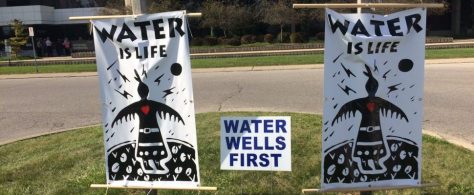
Water is Life

Developers of North Kent Wind were granted an injunction to stop unlawful protests. Impacted residents meanwhile wait for Ministry of Environment and Climate Change (MOECC) responsible for issuing the approval of the project to take meaningful action over rising number of reports of disturbed and dirty water wells (current count: 13 wells impacted since construction for the wind turbines began).

Water Wells First Told To Play Nice

water-wells-first-injunction-970x400
North Kent Wind located in Chatham Kent- Ontario was granted an injunction against unlawful protests at its construction sites

BY PAUL PEDROOCTOBER 2, 2017 5:23PM@PaulPedroNews
Water Wells First cannot continue unlawful protests at North Kent Wind sites.

Justice Kirk Monroe made the decision at an injunction hearing on Monday afternoon, saying trespassers and law breakers will be arrested.

He agreed with North Kent Wind that an injunction to stop blockades and the occupation of the turbine sites is the only remedy to continue the work.

Water Wells First spokesperson Kevin Jakubec says lawful protests will continue around North Kent Wind sites and Ministry of Environment offices, adding that the injunction ruling doesn’t weaken their resolve.

“To say that Samsung has been done irreparable harm, I understand where they come from, but then turn around and say these families have had no harm done to them. I think that’s scandalous and an injustice,” says Jakubec.

North Kent Wind isn’t seeking any damages for, what they call, “irreparable harm.”

Water Wells First claims that wind turbine pile driving is causing well water to go murky with sediments, clogging filters and stopping the flow of water into homes….

READ REST OF ARTICLE

Court Order Bans Defenders of Clean Water

 A Blessing in disguise. Time to take the evidence to Court.

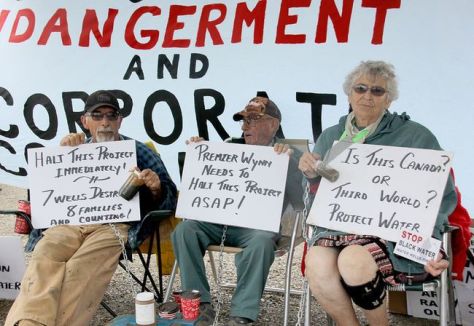
WWF chained
Defenders of clean water chained themselves at the North Kent Wind Project construction site.  Blockades continued as reports of dirty water (*11 wells & counting*) continued to rise. All adverse effects said to occur after construction began for the project located in Chatham Kent, Ontario.

North Kent Wind agrees to cease construction at turbine site until matter returns to court

By Ellwood Shreve, Chatham Daily News
Thursday, September 7, 201

Construction will cease at one turbine site for the North Kent Wind project, but a court order is prohibiting anyone from blockading, obstructing or impeding access to any other construction sites for project.

However, the matter will return to court at the end of the month, when the grassroots citizen group Water Wells First plans to be ready to make its case for stopping the project, due to the impact vibrations from constructing the turbines have had on area water wells.

In a statement released Thursday, North Kent Wind stated it appeared before the Superior Court of Justice on Wednesday seeking injunction prohibiting blockades and other interference with the construction of its wind project.

“We respect the rights of citizens who disagree with wind energy or the project to have their voices heard,” the company stated.

“The motion for injunctive relief became necessary because some protestors were engaging in what we believe was unlawful conduct, raising serious concerns about the safety of workers and protestors alike,” the statement added.

North Kent Wind said it sought the assistance of the court to enforce the rule of law and keep the peace.

“At the request of the court and out of respect for those who oppose the project and wish to be heard, we agreed to cease construction at one turbine site, which is currently blockaded and occupied by protestors, until the motion is heard by the court on Sept. 28-29.”

The court has granted an interim order restraining and preventing anyone from blockading, obstructing, or impeding access to any of the construction sites for the project.

Kevin Jakubec, spokesman for Water Wells First, called the upcoming court appearance “a blessing in disguise.”

He said when the matter returns to court, this will be the first time, that he is aware of, that evidence will be brought before a court in Ontario regarding the damage a wind farm has caused to the environment and a water resource….

READ REST OF ARTICLE

Turbine Protesters Chain Themselves Together to Stop Construction

Protecting clean water from wind turbine construction has seen residents chaining themselves together in protest to stop further damage of reported turbid drinking water that occurred after the pile driving for turbine foundations in Chatham Kent.  What is it going to take?   It is time to halt the wind project!

By Trevor Terfloth, Chatham Daily News

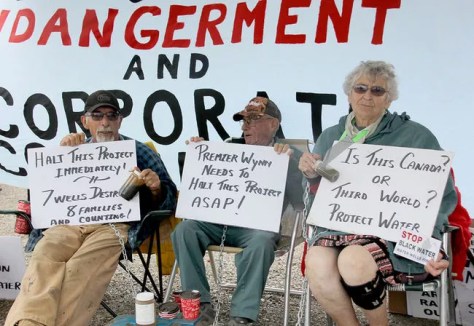
1297986670881_ORIGINAL (1)In In an effort to halt construction of a wind turbine project in North Kent, three protesters chained themselves together in a show of solidarity on Tuesday.
Sheltered from the rain, but weathering the elements, Rick Ball, Lee Montgomery and Yvonne Laevens were at the entrance to the site on Bush Line, near Highway 40 in the former Chatham Township.

“It should have never have gone this far,” Laevens said. “We have to (do this). We’ve tried just about everything else.”

Several water wells in the North Kent Wind project area, currently under construction by Samsung Renewable Energy and Pattern Energy, have been clogged with sediments shortly after recent pile-driving took place for constructing industrial wind turbines.

Tuesday’s protest was peaceful, with Laevens adding that Chatham-Kent police have been “congenial” with the group.

Ball said he appreciated the members of the public who were on hand and hopes the government takes notice.

“Start paying attention to what we’ve been saying for a year and a half,” he said.

Last week, Chatham-Kent council passed a motion asking the Ministry of the Environment and Climate Change to halt the project until water well concerns were dealt with.

Ball said a halt would allow everyone involved to work together on a solution.

Also part of the council motion was to implement independent water testing for the wells currently experiencing problems.

In a media release, the municipality stated that residents near the North Kent One wind farm project whose wells have water-quality issues will be contacted by Chatham-Kent officials this week to allow them to select a firm to test their well water at no cost.

Municipal chief administrative officer Don Shropshire said the municipality, working with public health officials, have identified 17 labs in Ontario that are licensed and accredited by the Canadian Association for Laboratory Accreditation to test drinking water for microbiological agents, organic chemicals, inorganic chemicals, and other particulate matter.

Shropshire said in the release that residents will have the option to choose any of the accredited labs.

“We want to ensure there are no concerns about who does the testing,” he said. “We’ve provided the list but the choice will be up to the residents.”

At a meeting last week between municipal officials and ministry representatives, the province also committed to contact owners of wells which have experienced issues and review those concerns with Samsung Renewable Energy and Pattern Energy.

As for the request to halt the project, the municipality’s release stated “that request is still before the premier’s office.”

In a statement e-mailed to The Daily News on Tuesday afternoon, the company said it was aware of the water well concerns.

READ REST OF ARTICLE

Fairwind Project Approval Revoked

Collingwood_Airport_12[7] As described in greater detail below, the Approval Holder has proposed an amendment to the REA to include additional curtailment measures designed to reduce little brown myotis mortalities. The Tribunal finds that these additional measures, provided they are amended to require that they be implemented from sunset to sunrise, is likely to significantly reduce little brown myotis mortality over the life of the Project. However, as neither the Approval Holder nor the Director has proposed effective means to mitigate the serious harm to human health, as found by the Tribunal in its October 2016 Order, the Tribunal concludes that the decision of the Director should be revoked. As such, an amendment to the REA to address harm to little brown myotis via an amended mitigation plan is rendered unnecessary.


READ FULL DECISION & ORDERS HERE : 16-036 WIGGINS V. ONTARIO (MOECC)

brown bat
little brown myotis


The Definition Of ‘Nuisance’

Words and their meanings have powers that can impact our very well- being.  Judge Cornelius J. Moriarty II, of the Justice of the Superior Court ordered the cessation of the operations of the wind turbines in Falmouth, Massachusetts.  In giving his judgement he discusses findings and reasons while interpreting and applying the meanings of the words injurious and nuisance.

“Despite the Town’s insistence that Barry Funfar is hypersensitive to sound, it is clear that he is no lone voice crying in the wilderness.  Other residents of the neighbouring area have registered similar complaints which was the very reason the Town commissioned the HMMH study in the first place.”

falmouth_vermont-1473171761-2525

The Falmouth Enterprise  August 11, 2017

A neighbor of the town’s turbines e-mailed us last week to say that we have been misleading the public by stating in recent stories that Judge Moriarty ruled that the turbines were a nuisance to the Funfar property. A nuisance, he wrote, is generally thought of as a neighbor mowing the lawn on a Sunday morning, whereas Judge Moriarty defined nuisance not only as an inconvenience but also a danger. He attached a copy of the judge’s decision for our reference.

In fact, Judge Moriarty went into a good deal of detail in a five-page discussion of his findings and decision.

First, he pointed out that the Zoning Board of Appeals’ decision that the turbines constituted a nuisance could not be overturned, as the board would have had to have been unreasonable or on legally untenable grounds. The appeals board found that the turbines were a nuisance to the Funfars’ property because, based on a DEP sound study, they directly affected the health and well-being of the Funfars. “The decision here was hardly arbitraray and capricious,” Judge Moriarty wrote.

But the issue here, of course, is the definition of nuisance. Judge Moriarty pointed out that nuisance is difficult to define and, as much testimony as there was about sound levels, none of it applies to the definition because there are no numerical standards. “The issue is,” he wrote, “whether, on the facts found, the operation of the wind turbines was offensive because of injurious or obnoxious noise or vibration, a nuisance in violation of the by-law.”

He pointed out that, while the town argued that Mr. Funfar was hypersensitive to sound, “it is clear that he is no lone voice crying in the wilderness. Other residents of the neighboring area have registered similar complaints…”

The judge discussed the definition of “injurious,” at some length and concluded that “the physical effects of the turbine-generated sound upon Mr. Funfar have been certainly harmful and have tended to injure him.”barry funfar

There should be no mistake among the residents of Falmouth; when the appeals board and Judge Moriarty called the town turbines a “nuisance,” they did not mean it in the way of ants at a picnic or a dog barking in the night.

Judgement Town of Falmouth vs Falmouth Zoning Board of Appeals et al

A New Enemy To Unite Us

The common enemy of humanity is man.
In searching for a new enemy to unite us, we came up
with the idea that pollution, the threat of global warming,
water shortages, famine and the like would fit the bill. All these
dangers are caused by human intervention, and it is only through
changed attitudes and behaviour that they can be overcome.
The real enemy then, is humanity itself
.
– Club of Rome; The First Global Revolution (page75)–


Nothing Brings a Community Together Like Wind Energy

To The Editor:

Not many things bring together a community like an Industrial Wind Energy Installation. In Illinois, the Concerned Citizens for the Future of Clinton and DeKalb Counties have banned together to fight Industrial Wind. Their lawyers took NextEra and the wind industry’s parade of “experts” to task in sworn testimony.

In Michigan’s Thumb, their “Wind Capital” has their own group of citizens calling themselves the Interstate Informed Citizen’s Coalition who helped to discover that townships could call for a referendum vote on whether or not they wanted any more wind energy. 12 townships, 12 votes, 12 times the answer was a resounding NO.

Vermont is working on enacting a much stricter IWT noise ordinance as well as setbacks 10x the height of the turbine. Minnesota has a similar bill in the works.

Oklahoma ended its wind subsidies early because of the overwhelming cost of Industrial Wind. Their former Governor Frank Keating released a statement saying that he regrets his part in funding Industrial Wind.

There are over 300 groups that have been formed for the singular reason of opposing Industrial Wind in North America alone. Europe and Australia have many groups of their own. They are people who may have thought that Industrial Wind was good or at least benign until they educated themselves, or where educated by their close proximity to turbines. There is well over a decade of testimonials, documentation, expert witness accounts and research into the negative impacts of Industrial Wind. The wind industry also has come up with its own testimonials, documentation, expert witness accounts and research that seeks to reframe or refute all the opposition’s evidence just as tobacco companies have done. Why are these negative impacts still listed within their contracts if there are not major problems?

People like to say that landowners can do whatever they want to on their own land but you know that is not true. If what you are doing (or not doing) negatively impacts your neighbor whether it be the length of your grass or the number of vehicles in your yard, it is not allowed. In our townships where the wind development is being proposed only a few people were willing to sign over land where they actually live. 4-5 people alone were responsible for signing over of the land for the proposed installation. That leaves 100s of people directly impacted but left with no choice to opt out.

Lastly people equate turbines with CAFOs. If they are allowed to annoy neighbors then Industrial Wind should get the same right is how the thinking goes. Our Planning and Zoning Board asked for mile setbacks for IWT, same as CAFOs but the wind companies said that they would leave. Our Supervisors shortened the setback to bring in revenue. Their first consideration needed to be people impacted, not the money to be made. Though industry supported with tax money is like cutting off the top foot of a blanket and sewing to the bottom to make it longer.

(signed) Janna Swanson

Coalition for Rural Property Rights

Ayrshire, IA

Published June 15, 2017 Emmetsburg News

ridgesrenotrenewble

No Bats? Not if a wind developer takes a look

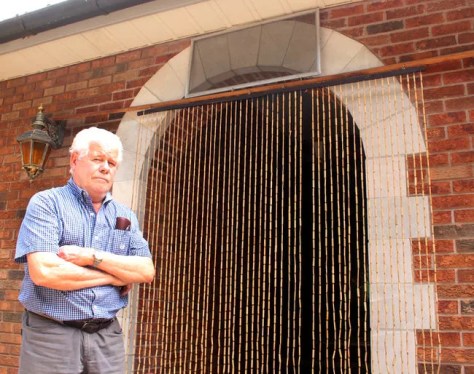
Bats are being killed at a rate by wind power plants that  have experts raising the alarm about sustaining population levels (in blunt terms for some bat species- extinction level threat). In Ontario 3 of our 8 species of bats are considered critically endangered and are facing possible extinction.   Kills by wind turbines add to existing pressures for their survival. Evidence mounts daily and it has the wind industry on the defensive.  It is more than convenient that a recently study of a woodlot being steward by an Ontario landowner was reported not to have any bats detected.   Bats which are so numerous that Theo Heuvelmans has had to hang a bamboo curtain over his home’s entrance to stop them from flying into his home.  What other industry is allowed to kill, harm and harass endangered species?   Wind power is allowed to not only self evaluated risks but once the projects are built they employ the clean- up crews to collect any found bodies and self report the deaths.  Time for being polite and time to say it out loud- bull!   It stinks.

1297962607967_ORIGINAL
Theo Heuvelmans in front of the bamboo curtain he has hung to stop the bats from flying into the entrance of his home (Photo published with article below)


Study says winged critters not detected in woodlot near where turbines to be erected

By Ellwood Shreve, Chatham Daily News

DRESDEN – To put it politely, Theo Heuvelmans doesn’t believe the results of a yet-to-be-seen study that says there are no bats in a 36-acre woodlot on his property near here.

As of Friday, Heuvelmans still hadn’t heard or received any information about what biologists found after they went through his woodlot several times last spring and summer ahead of the North Kent 1 industrial wind farm project which is about to be built nearby by Samsung Renewable Energy and Pattern Energy.

However, he was astounded when The Chatham Daily News informed him on Friday that the newspaper had received a response that no bats were found in the area.

“They’re telling me there’s no bats here? I can’t believe it,” Heuvelmans said.

“The study found there were no bats detected on his property,” according to an e-mail The Daily News received from Pattern Energy’s media spokesperson.

The e-mail also noted the firm that completed the study will be reaching out to Heuvelmans to discuss their findings with him.

The Daily News has requested a copy of the study or to be able to speak with someone about it.

Heuvelmans recently contacted The Daily News after growing frustrated that repeated calls to try to get information about the study have not been returned.

For the past five years he has had to put up a bamboo curtain and a screen to the entrance of the alcove that is part of the entrance to his home, because it attracts so many bats.

“This is the only way I could keep them out,” Heuvelmans said.

He initially refused a request by the wind farm developers to have his woodlot be studied. However, he noted company officials with AECOM Canada, an engineering consulting firm hired by the wind developers to study his woodlot, persisted and told him if bats were present it could impact where the turbines are built.

Heuvelmans agreed, hoping the presence of the bats would result in the wind turbines being constructed further from his woodlot.

However, judging from roads recently built on nearby fields, it appears two turbines will each be constructed within 300-400 metres of the woodlot – one on the west side and another to the north.

Heuvelmans said he put up several bat houses in the woodlot and nearby meadow about a year ago, with the hopes of moving the bats away from his home. He also admits he hoped it would help ensure the turbines would be built farther from the woodlot.

Heuvelmans also said he was told if bats were found in the woodlot, the turbines could be shut down at night to accommodate that.

He is worried that the turbines will negatively impact the wildlife living there, noting great horned owls are regularly seen flying from the woodlot to another nearby bush.

Heuvelmans questions why the turbines can’t be built farther way from woodlots. He would also like to see the Municipality of Chatham-Kent, which is purchasing a 15 per cent stake in North Kent 1, take a more active role in protecting these kinds of areas.

However, the approvals for industrial wind farms are provided through the Green Energy Act, which is under the jurisdiction of the province of Ontario.

eshreve@postmedia.com

Original article