Mother’s Against Wind Turbines Inc. (MAWTI), is calling for an immediate moratorium on the operations of current wind energy facilities in the province and the cessation of approvals of future projects. We have prepared the following brief which has been delivered to the Premier Doug Ford, as well as mailed to all MPP’s with a portfolio and a mailed copy was also sent to each MPP that is an assistant to a minister with a portfolio.
Please consider our document and distribute as you determine.
Dear John [Fraser, interim Ontario Liberal leader],
Over the past four years we have written, faxed, emailed you and your previous fellow MPP’s many times and clearly told you one of the ways the Liberal party of Ontario was going wrong.
The Liberals’ callous, cruel disregard for the rights of the people of Ontario was very clearly demonstrated right up to the last week of parliament when over 3,000 people signed petitions simply asking your party to recognize your own lower, safer noise levels for industrial wind turbines. Late Friday, May 3 MOECC approved the Nation Rise Wind project using the higher noise levels (EDP Renewables of Portugal had surveyors on local roads Monday, May 6) and your party leader dissolved parliament May 7. The approval inflicted an additional debt on all people of Ontario of $1.8 million/month guaranteed for 20 years to a foreign county.
Over the years we asked you and your party, why? Why the damage to Amherst Island, the 20 wells in Chatham-Kent, the ignored noise complaints, the removal of rights of the municipalities and people of Ontario under the Green Energy Act?
John, your party has a lot to answer for including the anguish your party has inflicted. We sincerely hope you do not achieve official party status; a party such as yours that treated the people of Ontario as you did does not deserve to be anywhere near the democratic government of Ontario. Ruby and Joe Mekker
14117 Con. 1 – 2
Finch ON
Dutch fisherman take protest against offshore wind to Amsterdam
Fishermen take protest to Amsterdam
Published by FiskerForum, 03-06-2018 · info@fiskerforum.dk
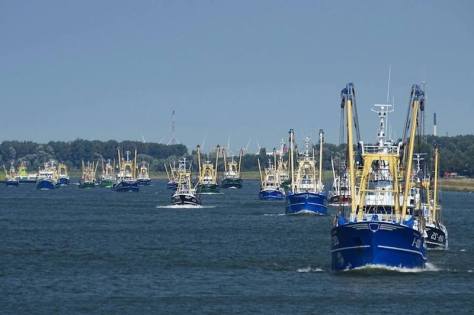
Hundreds of fishermen from Holland and Belgium took their grievances against the discard ban and the loss of fishing grounds due to the expansion of wind farms to Amsterdam this weekend, making plain their dissatisfaction with the way their industry is heading.
Seventeen fishing vessels docked in the centre of Amsterdam, a city that built its wealth and prosperity on the herring fishery. Between 600 and 700 fishermen from Holland and Belgium arrived in the city for a peaceful but highly visible protest that was followed by dozens of journalists.
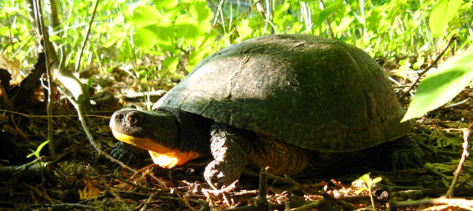
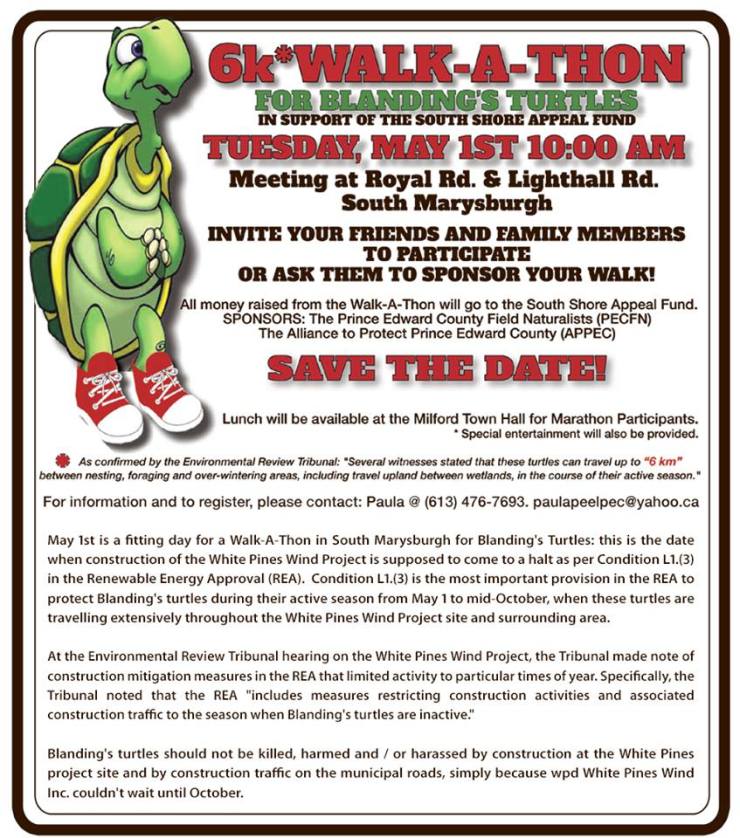
May 23rd is celebrated as world turtle day. Ontario residents take to the courts battling its own government in order to protect and save globally endangered Blanding’s turtles from harm and destruction habitat of its due to wind turbine construction.
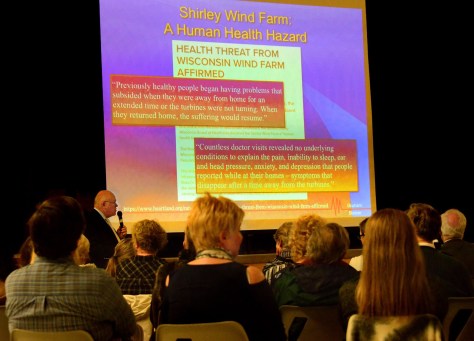
The following is from a presentation by Anne Dumbrille, Chair of CCSAGE at the Annual General Meeting held at Bloomfield Town Hall, Saturday, May 5, 2018
Welcome everyone, special welcome to our MPP Todd Smith, Acting Mayor Dianne O’Brien and Councillor Steve Ferguson.
I am giving an update on what is happened in Ontario regarding turbines in the last year. The Good, the Bad and the Ugly – not always in that order. Good Slide 3
In 2017, the media has been more outspoken about adverse impacts of turbines e.g.,
Two major networks, Global News and Radio-Canada, carried multi-part investigative reports this past year. The three-part Global News feature spurred questions in the Legislature and forced the then-minister to act on noise complaints for several Huron County families.
Fraser Inst. Publication Mid- April. They published Understanding the Changes in Ontario’s Electricity Markets and Their Effects criticized the GEA, speaking to it causing high energy costs, losing manufacturing jobs, and not improving the environment.
Auditor General criticized Liberal accounting practices re energy costs, fair energy plan; it was well covered in major newspapers
Slide 4
Noise from turbines consists of audible and low frequency noise/ infrsound –these affect brain waves but may be inaudible.
A team at University of Waterloo has created a special chamber in which infrasound can be produced, in the hopes that health researchers can determine unequivocally effects of infrasound at levels produced by turbines on people.
Australian Court (similar to our ERT) linked wind turbine generated LFN and infrasound noise with possible diseases including hypertension and cardiovascular disease, possibly mediated in part by disturbed sleep and/or psychological stress/distress – it found an established association between annoyance (used as a medical term) and some diseases that result from prolonged stress. They say effects of LFN include motion-sickness-like symptoms, vertigo, and tinnitus -like symptoms.
It was also established that the current method adopted by windfarms to measure noise (including in Canada) — the dB(A) scale, is not suitable for the task, as it does not measure the lower frequency range. The dB(A) scale averages out the sound levels, masking the highest levels and rate of change of noise that could be causing harmful health side-effects.
This is consistent with what the UK noise association said in 2006. 12 years ago.
MOECC still will not address infrasound. Slide 5
The Environmental Commissioner’s office wrote a report criticizing the government for approving 100% of turbine company permits to kill harm and harass endangered species. Slide 6
But – BAD they followed that up with one that makes superficial and false statements on the health impacts of wind turbines. She says there is no link between wind turbine noise and health effects — based on ERT conclusions. She does not say that it is next to impossible to win an ERT appeal on health. She said that noise impacts are controlled through setbacks and noise limits in the REAs.
What of the over 4500 records of health/noise complaints filed by people living near turbines in Ontario with the government since 2006? And the out-of-compliance turbines. This is important as if the local turbines are built, they may not be noise compliant. Slide 7 Bad-Turbines have been out of noise compliance with poor-to-totally lacking government response:
Port Elgin has one (Unifor) turbine – and have been complaining for years about the noise. Finally MOECC said that noise testing did show that it was out of compliance. A noise abatement protocol has to be put in place. The engineering report was filed with the MOECC in January, and then to the wrong Municipality in March – and finally to those affected. There is to be repeat testing in June–if it is out of compliance again -then what? Unknown.
Complaints regarding the Huron-Bruce Turbines in K2 Wind power project led to noise testing a year ago. Turbines were found to be out of compliance with Ontario regulations (April 2017). Since then, MOECC has done nothing.
Kincardine area has made multiple noise complaints over years, have been told testing is ongoing, but somehow, the tests are never completed, and the problem continues. In December they were told by MOECC that nothing was being done. And MOECC will not respond to complaints during an audit. The audit process started in December 2011 and is still not complete.
Slide 8
Last summer, a Brinston area resident wrote to Minister Murray about the complete lack of response to her reports of excessive noise (she has had to sleep in her basement on occasion because of the noise and vibration). An officer telephoned her and said:
Ministry staff were completely unprepared for wind turbine noise complaints.
They still don’t really know what to do.
They “lost” her records — even though she had so many reports that the MOECC actually installed equipment and did noise measurement for several days.
Last, it was too bad they lost everything pertaining to her situation and reports but it didn’t really matter, she was told because “You’re the only one complaining.”
With thousands of noise complaints recorded with the government unresolved, MOECC still refuse to acknowledge the problem, and refuses to look for causes.
Slide 10
Good: The MOECC finally admitted previous guidelines resulted in underestimating the noise at nearby homes – the modelling used to predict these impacts was wrong.
Last April 21, MOECC released a new protocol intended for “assessing noise from wind turbines that have already been built. It is used by industry and ministry staff to monitor compliance.” And compliance documents are to be publically available.
The result of non-compliance is: 1 – Remodel turbines; 2 – conduct a receptor audit at worst affected receptor from that turbine –or mitigation is required
Slide 9 Bad: However:
Still no recognition of low frequency noise. And, it hasn’t resulted in any effective changes.
Still – when WCO complained about the lack of response regarding noise and lack of a posted compliance report, they were told that the report cannot be posted as the turbine company’s documents are incomplete. (The turbines had been running for 3 years)
Slide 11
Although the government knows the modeling done by wind companies is wrong, they are allowing 5 new large-scale wind projects to follow the old guidelines. If they followed the new guidelines, about 3/4 of these turbines would have to be relocated or removed as they are predicted to be out of compliance with the new noise guidelines. At one project 11 of 12 would be out of compliance.
So in January, 5 affected communities filed a JR application against MOECC as surely, Ontario regulations and directives that limit the amount of noise any residence in the province should have to be followed. The claim is – transition provisions were put in place by the ministry to allow those wind turbine companies to use the old regulations without having to provide evidence that they were unable to comply with the new noise modelling guidelines (Dutton Dunwich, North Stormont, La Nation, and Wallaceburg)
Slide 12 Brilliant:
Wind Concerns Ontario taking Minister Murray to court May 18 for violating the Environmental Protection Act for permitting noise that causes adverse health events. According to WCO Access to information requests, of 4500 complaints noise/sleeplessness and other health-related effects received, few were followed up – only ~7% in 2015-16.
Slide 13 Ugly
In SW Ontario, in an area with sedimentary rock similar to that here, during and after IWT construction, well contamination has been reported – such that some wells are completely clogged, some failed simultaneously from pile-driving during construction. Some have not used their well for 4 years.
Before and after tests sent to Laboratories in Michigan show an exponential increase [in] turbidity among the affected wells, including [a] large proportion that can be attributed to black shale particles that are known to contain heavy metals, including uranium, arsenic and lead.
An ERT had warned that water wells in that area could be damaged.
A professional geologist said: the relationship between the installation of wind turbines and the contamination of wells is obvious. When you have a [pure] water source for years and [transforms] a few days after the construction of an industrial facility. You do not have to be a genius to see that there is a link of cause and effect.
He had agreement from geoscientist and geological engineer.
The project’s owner claims it has nothing to do with the problem.
MOECC’s response — While there’s been an admission that wells have indeed been contaminated, contamination can only be attributed to “unidentified factors.” They maintain that pile-driving activities associated with wind turbine development are not to blame. This conclusion was based on evaluations prepared by the power developer’s consultant.
MOECC say that you should only test your water for bacteria.
Quinte Region Proposed Source Protection Plan Version 8.1 Aug 2012: Section 2.4: “Due to the shallow soil conditions, the entire Quinte area was identified and mapped as a highly vulnerable aquifer. This designation was a direct result of the ease with which a contaminant can move into the underlying fractured bedrock aquifer.”
Slide 14
In 2017 alone, reported in the media:
181 accidents.* Note that there is massive underreporting. RenewableUK confirmed that of 1500 wind turbine accidents and incidents in the UK alone between 2006 and 2011, only 9% are on the global report. So there may have been more like 1800 accidents.
But it gives information on a cross-section of accidents: –
Of the 181, there were 17 fatal accidents, 13 injury accidents, 16 blade failure (blade or partial blade throws, travelling up to 1 mile), 24 fires, 14 structural failures (storm damage, tower collapse), 19 transport – related (biggest cause of public injury/fatalities, e.g. ram through a house, turbine parts falling off).
Slide 15
Turbine collapse in Chatham-Kent January
And in Germany, bits of blade travelled over 500 m –yes, the distance to neighbouring houses by Ontario regulations.
Slide 16 CONCLUSION
MOECC, MNRF – Apparently – still blind, deaf and dumb regarding turbine effects and violations
All rules and regulations can be broken for the precious GEA
Compliance is only met only if citizens fight (and pay) for it
Feds (Health Canada, Environment Canada) – no better
“Windlectric (AQN-T) was advised of the presence of a nesting Blanding’s Turtle on Front Road on Amherst Island in immediate proximity of collector installation. Instead of stopping work in accordance with its own protocol, the company continued to install collector lines, transport cement and use heavy equipment.
Honourable Chris Ballard, Minister MOECC, has been requested to require compliance and protect endangered species.
Blanding’s Turtles nest at maturity and live to be 70 to 100 years. The loss of one turtle or one nest devastates the species.
The ERT in its decision understood the grave harm to the population of Blanding’s Turtles and said without equivocation:
[325] Additionally, the Tribunal finds that the mitigation measures incorporated as conditions of the REA have all but eliminated the potential for turtle mortality and have minimized the potential for indirect impacts to habitat during the construction phase. The construction window of November 1 to March 31 for those portions of the Project closest to the coastal wetlands, and the window of September 1 to March 31 for the remainder of the Project, will ensure that construction takes place outside the period during which turtles are active outside of their resident wetlands. Additionally, in the rare event that a turtle remains active during construction, the Tribunal is satisfied that the exclusionary fencing to be used, mostly on private agricultural land, will ensure that turtles are not able to access construction areas.
[337] Despite having made this finding, due to the uncertainty around the location of temporary areas of flooding and water bodies, and recognizing that there is a chance that a turtle may nest on an access road while Project staff are not present and nests may remain hidden from view, the Tribunal makes two recommendations as follows:
a. that no access roads be used during any flooding events during the active season for Blanding’s Turtle in order to ensure that should any turtles be present that they are given time to vacate the access road before Project staff use it; and
b. that no road grading take place during the nesting season for Blanding’s Turtles in order to ensure that any road-side nests are unharmed as a result of grading activities on access roads.
[338] The Tribunal is of the view that these two additional measures will add an additional layer of protection in the unlikely event that a turtle finds itself, or nests, on an access road.
Windlectric Inc. has violated the timing restrictions every business day since April 1 and most recently has worked on Sunday.
What say you Robert Wright and Justin Duncan?”
To contact Minister Chris Ballard ,MOECC (Minister of Environment & Climate Change): Email:minister.moecc@ontario.ca Phone: 416-314-6790 Mail: Ferguson Block 11th Flr, 77 Wellesley St W, Toronto, ON M7A 2T5
Residents fight to protect endangered Blanding’s turtles as unwanted construction of industrial wind proceeds with the invasion of Amherst Island. Ontario meanwhile fails to enforce its own rules and ruling of the Environmental Review Tribunal.
[325] Additionally, the Tribunal finds that the mitigation measures incorporated as conditions of the REA have all but eliminated the potential for turtle mortality and have minimized the potential for indirect impacts to habitat during the construction phase. The construction window of November 1 to March 31 for those portions of the Project closest to the coastal wetlands, and the window of September 1 to March 31 for the remainder of the Project, will ensure that construction takes place outside the period during which turtles are active outside of their resident wetlands.
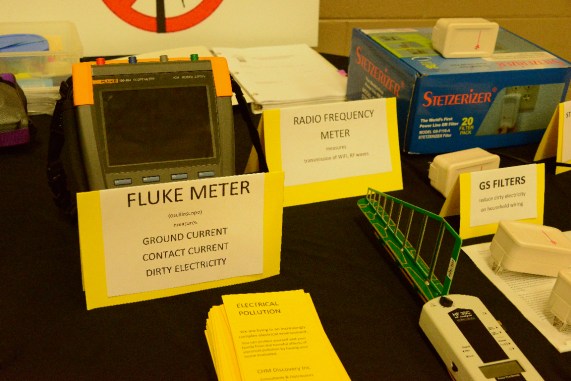
David Stetzer speaking about electrical pollution at public information event held in Smithville Photo Credit: News Alert Niagara
Saturday afternoon over ninety members of the public attended an electrifying community information session on “Understanding Stray Voltage and Industrial Wind Turbines” held at Covenant Christian School in Smithville.
The keynote speaker was Mr. David Stetzer an electrician with 30 years’ experience. Stetzer specializes in power control in industry, municipalities, and motor control centers. For the last decade, Stetzer has focused his attention on power quality analysis and troubleshooting. He is a senior member of the IEEE (Institute of Electrical & Electronic Engineers), an expert witness in litigation suits in ground currents and power quality, co-author of peer reviewed papers in journals as well as a producer of the documentary ‘Beyond Coincidence: The Perils of Electrical Pollution’.
Stetzer attributes much of the dirty electricity – frequently referred to as ‘stray voltage’ that exists in Ontario – to the overloading of the single return wire in our power supply. Eighty percent of the power that returns to the substation is “dumped” onto the ground. We do not see, hear, feel, taste or smell electromagnetic energy. Yet the proliferation of electrical pollution creates problems for people who have a biological reaction to the poor power quality that is generated by industrial wind turbines, power transmission lines and distribution lines.
Any power generator in Ontario has an obligation to transmit ‘clean power’. Using an oscilloscope, it is possible to measure the pure sine wave of clean power and determine what harmonics, transients or intermediate frequencies which produce poor power quality or ‘dirty electricity’ are also present.
Tuned filters at the site of power generation prevent some of the distortion. But according to Stetzer the best solutions are to enforce current and existing codes and standards like the IEE519. Stop using the earth as a return circuit for the neutral current, by increasing the size of the utility’s Primary Neutral or utilize a 5-wire system to accommodate power returning to the substation.
Photo Credit: News Alert Niagara
Much of Stetzer’s work has been done with dairy cows to identify causes of decreased milk production. Poor production costs time, money and health.
As one member of the audience pointed out – industrial wind turbines are an intermittent power generator and only produce 28% of the nameplate capacity. “It’s like buying a one-titted cow” she said.
The second speaker was Carmen Krogh – a full time volunteer and published researcher regarding health effects and industrial wind energy facilities. She shared her preliminary research on why people in communities with industrial wind turbine generators leave their homes. Community members were invited to participate in a community-based study to explore the circumstances which may influence individuals and families to vacate or remain in their home when living near a wind energy project. Participation was voluntary, and 67 community members shared their experiences.
Based on preliminary results, sleep disturbance appears to be the most common reason people vacate. Other symptoms included: sensations such as pressure in the ears, chest, head, heart, bladder: ear problems such as tinnitus, burning, popping in ears; heart palpitations such as racing heart, increased blood pressure; headaches such as, migraines, stomach aches; nausea, vomiting, dizzy, vertigo; nose bleeds, skin infections, stress, anxiety, extreme agitation/ irritability, depression, cognitive, loss of concentration, and a sense of panic.
Krogh’s next steps are to finalize her data analysis and submit a number of papers for publication in peer reviewed journals. In addition, these findings will be shared with government authorities both domestically and globally.
Barb Ashbee – a member of the panel discussion – provided the victim impact perspective. Ashbee and her husband were happy, healthy involved community members before a wind turbine project started up near their home. The serious adverse health effects drove them out of their community. Testing in their home showed out of compliance noise, infrasound and electrical pollution. It was a battle to get any meaningful information or assistance from the government. After hiring a lawyer, they settled with the company, were able to relocate and their symptoms subsided after moving. Almost 10 years later, the anger and dismay at what the government is doing to citizens has not lessened as the toll rises. Ashbee continues to advocate for resolution for victims impacted by wind energy.
The supper speaker was Mr. Alan J Whiteley, an attorney for over 30 years. He has negotiated government defense contracts and served as counsel for the arbitration of international commercial disputes. Whiteley is legal counsel for the County Coalition for Safe and Appropriate Green Energy (CCSAGE) based in Prince Edward County, and is challenging various aspects of Ontario’s Green Energy Act via a Judicial Review.
According to Mr Whiteley, the Green Energy Act (GEA) has harmed the health of rural residents, the sustainability of the natural environment, water quality, local economies, rural roads, property values, municipal assessment taxes, heritage properties and the safety of residents and communities.
The implementation of the GEA is biased in favour of proponents of renewable energy projects and against individuals, communities and municipalities. In many cases the Ministries improperly delegate their statutory powers to others, and continually grant consent to renewable energy projects without any cost/benefit analysis.
Industrial wind facilities must be placed in rural agricultural areas of Ontario and the result has been an industrialization of rural Ontario. Unwilling host municipalities and their residents can not exercise sound planning principles with respect to industrial uses of land within their jurisdiction.
The Fire Protection and Prevention Act was changed to prohibit owners of abutting lands from claims for damages caused by fires originating from renewable energy projects.
The Assessment Act, deems the assessed value of a $2.2 million wind turbine tower at only 4.6% of the current value of the industrial wind turbine. This discrimination violates section 15 of the Canadian Charter of Rights, which guarantees equal protection and equal benefit of the law to all Canadians. The GEA contravenes several international conventions to which Canada is a party, including the Universal Declaration of Human Rights, and the Rio Declaration on Environment and Development.
According to Whiteley, the Canadian legal system faces an access to justice crisis. The Supreme Court of Canada has stated that there must be practical and effective ways to challenge the legality of state action. However, ordinary citizens have unequal access to costly justice that wealth can provide. Huge corporations can bully and manipulate the law in their own interests while ordinary citizens lack the means to begin a legal proceeding. If the traditional cost rules of the justice system are revised, citizens will regain their right to challenge government action.
The day provided information on issues that affects us all – dirty power and limited access to legal justice.
Catherine Mitchell – a concerned citizen
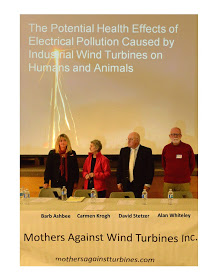
Barb Ashbee, Carmen Krogh, David Stetzer, Alan Whiteley. Photo Credit: News Alert Niagara
Information event held April 21, 2018 co- hosted by MAWT and WLGWAG
Spring has returned and with it turkey vultures ( Scientific name: Cathartes aurahave). These raptors soar long distances riding high on thermals of air with long outstretched wings. They hunt not by sight, but by an acute sense of smell searching for carrion to feast upon. Social, gregarious and highly intelligent they are often seen flying, feeding and roosting in communal groups.
One of their unique forms of protection against threats is the ability to projectile vomit acidic stomach contents at will. Difficult birds to launch from the ground they take running leaps to lift off and can jettison stomach contents to lighten their weight to aid becoming airborne. They are meticulous about their personal hygiene and serve an essential function as clean- up crews for the environment.
A kettle of turkey vultures seen thermalling in the blade sweep of an Enercon wind turbine part of Niagara wind project. (Video filmed April 2018)
Notice the wind turbine blade sweep movement results in driving a bird downwards out of a soaring climb.
Turbine blade sweep is part of increasing environmental habitat fragmentation and disruption created by wind facilities construction and operations. Mortality strikes (kills) occur in airspace directly disrupted by turbine blade sweeps. As increasing numbers of wind turbines are erected increased adverse environmental impacts are occurring for avian species. Habitat disrupted or avoidance= habitat loss.
Impacts are not only local but include those on a global scale. Flying the global flyways has become an even more dangerous journey with annual migrations spiked with increasing 1000s of wind turbines. Wind power is disrupting avian movements and prefered habitat use on a local and world-wide basis which begs the question: How sustaining and green is that?





 The following is from a presentation by Anne Dumbrille, Chair of CCSAGE at the Annual General Meeting held at Bloomfield Town Hall, Saturday, May 5, 2018

 Spring has returned and with it turkey vultures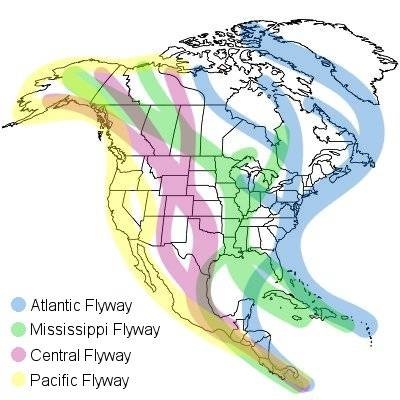

 Mothers Against Wind Turbines Inc.