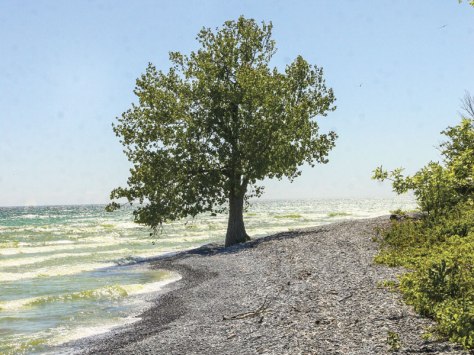
Ontario has officially terminated the Ostrander Point wind project.
Trout Creek and Clarington projects are also cancelled by IESO.
READ: http://fit.powerauthority.on.ca/program-updates/program-reports

Ontario has officially terminated the Ostrander Point wind project.
Trout Creek and Clarington projects are also cancelled by IESO.
READ: http://fit.powerauthority.on.ca/program-updates/program-reports
By John Miner, The London Free Press
Wind turbines are killing bats, including ones on the endangered species list, at nearly double the rate set as acceptable by the Ontario government, the latest monitoring report indicates.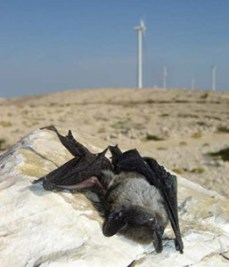
Bats are being killed in Ontario at the rate of 18.5 per turbine, resulting in an estimated 42,656 bat fatalities in Ontario between May 1 and October 31, 2015, according to the report released by Bird Studies Canada, a bird conservation organization.
Ontario’s Ministry of Natural Resources has set 10 bat deaths per turbine as the threshold at which the mortalities are considered significant and warrant action.
The bats being killed by turbines in Ontario include the little brown bat, tri-coloured bat, eastern small footed bat, and northern long-eared bat, all on the endangered species list.
The Birds Studies Canada report draws its information from a database that is a joint initiative of the Canadian Wind Energy Association, Canadian Wildlife Service, Ontario Ministry of Natural Resources and Bird Studies Canada.
Brock Fenton, an expert in the behaviour and ecology of bats and professor in Western University’s department of biology, said the bat deaths are a concern.
Bat populations across North America have been plunging with the emergence of a fungal disease called white nose syndrome.
Birds are taking less of a hit from wind turbines, according to the report, with an estimated 14,144 non-raptors killed by wind turbines and 462 raptor fatalities between May 1 and October 31 in 2015.
The report noted that some wind farms have moved to reduce bat mortalities by cutting their turbine speeds from dawn to dusk in the late summer and early fall.
A spokesperson for the Canadian Wind Energy Association said the association is concerned about reports that are based on limited data that have the effect of boosting estimates.
In response, CanWea is developing its own system that will be released this fall that is designed to improve existing and proposed bat regulations, said Brandy Giannetta, CanWea’s Ontario regional director.
“It aims to achieve this in part by enhancing knowledge of the existing data in order to drive science-based policy decisions and also by providing avoidance, minimization, and mitigation options that we hope operators and regulators alike will find useful in conservation efforts,” Giannetta said in an email.
Wind Concerns Ontario, a coalition of provincial groups opposed to wind farm development, said it is concerned that birds and, significantly, bats are being killed in numbers that were not forecast by either the Ontario government or the wind power developers.
“The population of the Little Brown Bat in particular is now at 5-10 per cent of its historical levels, so, as the Environmental Review Tribunal stated in the White Pines decision in Prince Edward County, even a few deaths will have a serious impact on the species as a whole. And we know for a certainty that bats are killed by wind turbines,” Jane Wilson, president of Wind Concerns Ontario, said.
It is critical to understand that wind power projects shouldn’t be approved without a full and objective assessment of all factors in any given location. The government’s push for wind power has to be balanced with the continuing need to protect the natural environment, Wilson said….
Ostrander Point Tribunal drags scrutiny of wind and solar projects out into the open
Only when time has passed and the memories of the years long struggle begin to fade, will we know that industrial wind turbines have been banished from Ostrander Point for good. But for now, the creatures who occupy or pass through this bit of land on Prince Edward County’s south shore may do so without the threat of bulldozers rolling across the terrain or 50-story machines whirring overhead. Maybe forever.
The Ostrander Point wind project has been stopped. Its appeal period has expired. There remain scenarios in which the project could be revived, but that likelihood is now remote, according to the lawyer acting for the Prince Edward County Field Naturalists (PECFN).
“There is rarely a final chapter written in these types of sagas,” said Eric Gillespie. “It is fair to say, however, that the odds of this going further are extremely low. To the best of our understanding, the Gilead Power permit is revoked. That decision is not being appealed. The file has concluded.”
The volunteers who form PECFN allowed themselves to exhale on Thursday evening—after the developer’s appeal period had expired.
“It is particularly wonderful to finally realize that the battle is over,” said Cheryl Anderson of PECFN.
WHAT IT MEANS
The decision by the Environmental Review Tribunal—written by Heather Gibbs and Robert Wright—fundamentally alters the future for Ostrander Point, and has the potential to disrupt other projects involving land where Blanding’s turtles are known to nest, including White Pines and Amherst Island. But it has the potential to reach much further. Indeed, it has the potential to shake the very foundations of the Green Energy Act (GEA).
In 2009, the provincial government, led by Dalton McGuinty, was unsatisfied with the pace of wind and solar energy development in the province. Deadline after deadline had passed and his targets for renewable energy had gone unmet. A panel of experts had reported a year earlier that the regulatory process— the safeguards that protect human health, the environment and even the electrical grid itself—were causing the delays to wind and solar development across the province.
The GEA set out to remove these hurdles—eliminating safeguards in the Ministry of the Environment, Ministry of Natural Resources and Forestry, Ministry of Energy and the Ontario Energy Board, among others.
Since the GEA was enacted, industrial wind and solar projects have been reviewed and approved behind closed doors in a mostly tightly controlled process. The only nod to public transparency and accountability was a single Environmental Review Tribunal…..
Published Wellington Times July 15, 2016
READ MORE: http://wellingtontimes.ca/developmentApril16/pierced/

‘Water Wells First!’ Public Protest Coming to Chatham-Kent,
Ontario
FOR IMMEDIATE RELEASE
Strathroy, Ontario – June 27, 2016 – “On Wednesday, June 29, 2016, residents of the municipality of Chatham-Kent, Ontario, embark on their Water Wells First! campaign to protest and advocate for protection of their water wells, says the Ontario Ground Water Association.” These residents understand that renewable energy is important to the future of Ontario and in the battle that is climate change but the safety and security of their water is their priority. The Ontario Ground Water Association (OGWA) became aware of increased water quality issues in the region when inquiries intensified from Chatham-Kent and Lambton County residents for well water testing through the OGWA’s ‘Well Wise’ water testing program. The OGWA is fully supportive of the Chatham-Kent residents in this endeavor.
Existing Wind Farm developments in this area are disregarding known science on vibration and seismic coupling, causing adverse effects on local ground water and drinking water wells. The pile driving of foundations began the onset of water quality deterioration during the construction phase. After the wind mills are in service, the vibrations transfer into the concrete foundations and continue to vibrate the rock and soil formations of the surrounding areas. This activity directly affects the sources of the residents’ water wells. The result is dirty, turbid water. These residents are also rightly concerned about what effects this vibration has in an area known to have elevated levels of Radon gas.
Water Wells First! is a call to action from the affected residents of Chatham Kent to have the Ministry of Environment and Climate Change (MOECC), the Provincial Government, and the wind industry recognize these adverse effects. This appeal is for the prohibition of pile driven foundations in this area, to demand vibration suppression, and to require assessment of seismic coupling on any wind developments. The OGWA shares the concerns and goals of these citizens in their efforts to ensure the sustainability of their water wells and ground water in Chatham-Kent.
The Ontario Ground Water Association is a not for profit organization representing ground water professionals in the Province of Ontario. Established in 1952, the OGWA is “Dedicated to protecting and promoting Ontario’s most precious resource – ground water”

Contacts:
K.C. Craig Stainton
Executive Director
Ontario Ground Water Association
www.ogwa.ca
Phone: 519-282-0063 (Cell)
Fax: 519-245-7196
Email: executivedirector@ogwa.ca
and
Kevin Jakubec
Water Wells First!
Phone 519-683-2771
jakubechome@gmail.com

U.K. voters’ decision to exit the European Union sent shock waves through world markets today, including the energy sector. The consensus from policymakers, clean-energy advocates, and analysts was that while “Brexit” will not completely derail the EU’s efforts to reduce carbon emissions under the Paris climate accord, it will certainly throw a spanner in the works.
READ AT: https://www.technologyreview.com/s/601776/brexit-brings-chaos-to-europes-clean-energy-goals/
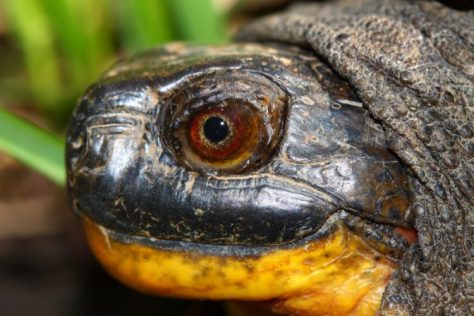 Risk of Harm to Blanding’s Turtles from a Wind project
“This is the first time that the Tribunal has exercised its remedial powers in relation to the successful appeal of an REA on the grounds that it would cause serious and irreversible harm to the environment.”
On June 6, 2016, the Environmental Review Tribunal (Tribunal) issued a ruling revoking the renewable energy approval (REA) granted by the Director of the Ministry of Environment and Climate Change (MOECC) to Ostrander Point GP (Ostrander) for the installation of nine wind turbine generators and supporting facilities, including new access roads and upgrades to existing roads, on the south shore of Prince Edward County.
Appeal of the Ostrander REA
The Director’s decision to grant the Ostrander REA was appealed to the Tribunal by the Prince Edward County Field Naturalists (PECFN) in 2013 on the grounds that engaging in the wind turbine project under the REA would cause serious and irreversible harm to plant life, animal or the natural environment.[1] In its July 3, 2013 decision, the Tribunal found that PECFN had met this “environmental harm test” and revoked the Ostrander REA. Specifically, the Tribunal found that the installation of access roads and improvement of existing roads for the construction, maintenance and monitoring of the wind turbines would pose serious and irreversible harm to the Blanding’s turtle, a species listed in Ontario as “threatened,” through increased vehicle traffic, poachers and predators.

The Devil whispers “You can’t withstand the Storm”.
The Warrior replies “I am the Storm”.
For Amherst Island and Prince Edward County, the Blanding’s Turtle symbolizes the need to protect Ontario’s sensitive environment.
“Road Warrior”, a limited edition print numbered and signed by esteemed artist Peter G. S. Large is now available. Only 50 hand-tinted, numbered prints have been created. Derived from an original drawing the prints are 19 X 13 inches printed on acid-free archival watercolour paper and are sold unframed and unmatted. The “Road Warrior” watermark does NOT appear on the print.
Peter G. S. Large is an award-winning Canadian artist. He is Past President of the Society of Canadian Artists, Member of the Ontario Society of Artists, Professional Member and Past-President of the Arts and Letters Club of Toronto.
The price is $200 with all proceeds generously donated by Peter to the Association to Protect Amherst Island.
Free delivery is available on Amherst Island, in Prince Edward County and in Kingston. Otherwise shipping is $25.
Please etransfer $200 to protectai@kos.net or make your cheque payable to APAI and send along with your contact information to Box 6 Stella ON K0H 2S0.
Contact protectai@kos.net to arrange to see the print or visit Peter in his studio on Saturday July 9 from 9 to 5 as part of the Amherst Island Art Tour. Start at the Neilson Store Museum and Cultural Centre 5220 Front Road Stella ON to obtain your map and directions.
Thank you for your support of the Association to Protect Amherst Island: http://www.protectamherstisland.ca/
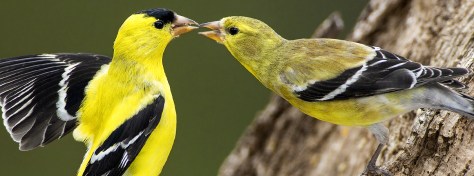
LS: Why is the Great Lakes region so critical to birds?
KK: All three of the major migratory routes birds follow during spring migration intersect over northwest Ohio. When the birds get here, they confront the daunting expanse of Lake Erie. When you’re a songbird that weighs less than an ounce—and you don’t swim!—you need to rest and refuel before these long crossings. With so much lakefront habitat sacrificed to development, large concentrations of migratory birds gather in these remaining patches of wooded habitat to fuel up before crossing the lake.
………
Wind energy is an intense issue for us right now. With the need for alternative energy on nearly everyone’s mind, there seems to be a mad rush to install as many turbines as quickly as possible. The wind industry doesn’t understand the complexities of bird behavior, yet it’s making decisions about whether turbines will impact birds.
The Observatory has more than 30 years of data documenting the volume of birds that pass through this region during spring and fall migration. The entire Western Basin of Lake Erie has been designated as a Globally Important Bird Area. We’ve brought tremendous economic development to the region through our efforts to market the sensational birding here, and a whole host of environmental agencies and organizations are on record stating that this area is not suitable for wind energy development. Yet we still can’t keep turbines out. We need industry regulations—fighting these projects one at a time isn’t enough.
American Bird Conservancy.
READ MORE: https://abcbirds.org/passionate_voice_to_protect_birds/
“The project is putting children’s safety at risk and that is something that I don’t think we, as Ontarians, want to tolerate”
Kingston Heritage Published June 8, 2016
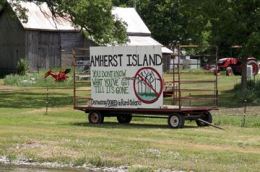
On June 7, members of the Association to Protect Amherst Island (APAI), along with many Island residents, gathered at St. Paul’s Presbyterian Church to hear the final submissions in their appeal against Windlectric Inc.
The submissions were the final part of the more than six month long Environmental Review Tribunal (ERT) that took place regarding the project, and members of APAI were feeling optimistic.
“It has been a long process and we are very proud of what we have accomplished and we are very confident,” said Michele Le Lay, a member of APAI before the final hearing. “We feel we had a fair hearing.”
The final instalment of the tribunal started with a statement from island resident and concerned parent Amy Caughey, who originally spoke to the tribunal in December. Caughey’s main concern is the proposed placement of a concrete batching plant and high-voltage substation directly next to the school on the island.
“It seems like all the industrial activity will be occurring next to the school and I think it is too close,” she said. “Also, the cumulative impacts of this project, especially on the school, have not been assessed. It seems that each component is looked at individually, but it is not looked at as a whole and I think that is a major problem.”
Caughey explained that after six months of hearings she still has numerous unanswered questions about the safety of the project, especially in relation to the school, and she worries that her children and others will be at risk.
“The project is putting children’s safety at risk and that is something that I don’t think we, as Ontarians, want to tolerate,” she said. “We don’t have enough information and if we just go ahead and do this, it is actually our children who become the test to see if the directive is right or wrong and I think that is entirely inappropriate in Canada in 2016.”
“Yippee! Hooray!” said Cheryl Anderson, a member and past president of the Prince Edward County Field Naturalists. “It’s been a long haul.”
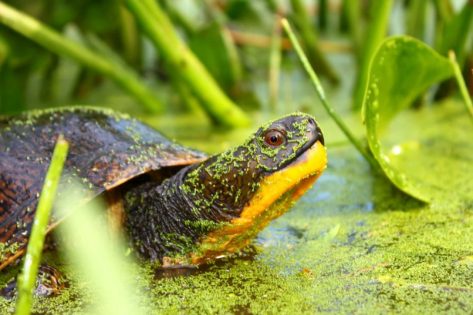
The Blanding’s turtle, a sunny little reptile already prone to smiling, must be beaming this week like somebody who’d won a lottery the same day they were awarded the Nobel Prize.
For the third time in the past three years, a legal decision was handed down in favour of the endangered species, and against a proposed wind turbine development in Prince Edward County, east of Toronto, that threatened to cause the turtle “serious and irreversible harm.”
 Mothers Against Wind Turbines Inc.