Category Archives: Animals and turbines

Public Information Meeting 2016

“This Great Blue Heron was found injured along a fenceline south of Smithville on August 28, 2016. Its location was approximately 600 meters west of an Industrial Wind Turbine that had been in testing phase for several previous days. The SPCA was called and the bird was taken away. Remediation was not practical, for both legs were broken. The bird was euthanized a few days later.”    Loretta Shields presentation

West Lincoln Glanbrook Wind Action Group(WLGWAG) held their annual general meeting which was followed by a public information meeting held in alliance with Mothers Against Wind Turbines Inc. (MAWTI). Good eats, good people and good discussions ensued. The meeting was well attended including local West Lincoln Council members and the newly elected MPP of Niagara West- Glanbrook, Sam Oosterhoof.  The MPP took multiple questions ranging from rising electrical rates and included impacts and harms of the wind projects.  The area is the unwilling host of several wind projects including HAF Wind Energy and Niagara Wind.  The groups are hard at work to ensure protection of all residents from the risks now present in our communities.

Public Information Meeting and AGM – December 1st, 2016

The following documents were presented and discussed at WLGWAG & MAWT’s Public Information Meeting session;

1.) What’s New? – Dec. 2016 Update – By Mike Jankowski:
In Niagara, one of the world’s largest wind power generation facilities has risen above our landscape. Here, we discussed a brief overview of recent events, what we are doing about it and who we will work with to see it through.
Click here to view Mike’s presentation.

2.) The High Costs of Keeping the Lights On – By Deb Hughes:
From 2006-15, electricity costs have risen over 60% and continue to. Here, Deb discussed how this happened and explains how Wind Power Generation is playing a significant part in this.
Click here to view Deb’s presentation.

3.) Why We Didn’t Need Wind Capacity and What Really Replaced Coal? – By Catherine Mitchell:
In Ontario, businesses are challenged to be profitable and people struggle to pay their bills due to the high cost of electricity. Here we discuss why we already had extra power capacity without wind and that actually Hydro and Solar did more to replace coal than wind.
Click here to view Catherine’s presentation.

4.) Tree Cutting: Consequences to Ecological Services & Destruction of our Roadside Landscape – By Loretta Shields:
One of the main drivers behind the Green Energy Act was to reduce carbon dioxide emissions.  Carbon dioxide is considered a greenhouse gas, and shown to have a role in climate change.  Trees absorb or “sequester” carbon dioxide, and provide a means to store atmospheric carbon for many, many years.
West Lincoln, Wainfleet and Haldimand lost thousands of trees which were cut down or trimmed to make way for industrial wind power.  Ironically, no remediation plans for the replacement of these trees has been announced by the Niagara Region Wind Farm.  Our Community is now in a deficit position in terms of carbon sequestration.  Other ecological services provided by trees, including oxygen production, habitat for wildlife, the reduction of home emissions due to shading homes (cooling effects) and windbreaks (reducing heating costs) are now also reduced.

US Forest Carbon Calculator:  Click here

Click here to view Loretta’s presentation.

5.) Reporting Issues: What and Where Should I Report? – By Anne Fairfield:
The Ministry of Environment and Climate Change has authority over wind power generation and is the regulator mandated to protect communities. If you experience issues you suspect are due to wind turbines, it is essential you report them. If you do not report – it didn’t happen as far as the documented record is concerned – they can’t manage what they can’t see. Learn what to report and how.

Spills Action Centre: 1-800-268-6060     Call at any time to report
Click here to view Anne’s presentation.
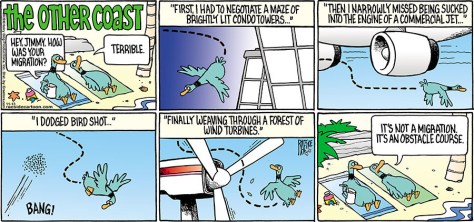
It’s not a migration it’s an obstacle course

not-a-migration

The work of cartoonist Adrian Raeside illustrates some of the cumulative harmful impacts from human activities to migrating avian species that use the global flyways.  Habitat loss, avoidance and mortalities are direct adverse impacts arising from the installation of wind power generating facilities.  Killing the natural world one spin at a time.

Enjoy his work at:

https://www.creators.com/read/the-other-coast/11/16/188957


My Haldimand

dscn1859

My Haldimand

This is an enchanting place, a captivating landscape.
Where eagles soar and owl sounds fill the night air.
This is a healing place, an enriching place,
Where hawks teach their young to hunt and herons stalk fish on river banks.

But soon, forty-two storey grinding eyesores.
Red strobes filling the night sky.

Hush, Hush, Hush (don’t tell your neighbours)

This is a nurturing place, a meditation place.
Where bats and dragonflies gather mosquitoes at dusk and dance their graceful reel.
This is resting place, a gathering place.
Where monarch butterflies feast on milkweed and gain strength before flight.

But soon, slicing, dicing, killing.
Blood on the fields

Hush, Hush, Hush, (don’t speak of it)

This is a place to throw off the cares of the week.
A place for hammocks and splashing water.
A family place and a place to retire.
To pitch a tent, sleep under the stars.

But soon, vibration, headache, heartache.
Twenty-four seven.

Hush. Hush. Hush (shhhh)

This was a neighborly place, a kind place.
Where neighbors shared and helped each other.
But now, the bitterness of helpless rage and loss.
What a shame.

Pat Morris, Dunnville

Canadian Wind “Farms” deadly to thousands of bats

Canadian Wind Farms Kills Ten of Thousands of Bats

Wednesday October 5, 2016   |    

Hoary bats like this one are the species most often killed by wind turbines in Canada. ©Nessie Grace
A bat lies dead beneath a wind turbine in southern Ontario. ©Mike Anissimoff

Each wind turbine in Canada kills an average of 15.5 bats per year, adding up to a death toll that could someday threaten populations, according to new research. In Canada’s first comprehensive analysis of wind farm casualties, researchers found that turbines were killing about 47,000 bats per year in 2013. That number will only rise as Canada’s investment in wind energy increases.

“We have about 50 percent more turbines now, so, as of 2016, somewhere around 70,000 bats are being killed in Canada per year,” said Ryan Zimmerling, a wildlife biologist with the Canadian Wildlife Service and first author of a recent study in the Journal of Wildlife Management. “It is possible that those levels of mortality, if they’re not already causing impacts to some species now, could be causing impacts into the future.”

Wind energy companies in Canada are required to monitor bat mortality at newly built wind farms, regularly searching the area under turbines for carcasses. The companies report these data as part of post-construction monitoring, but until now, no one had combined them into a single nation-wide analysis. To see the big picture, Zimmerling and his colleagues analyzed carcass counts from 64 wind farms in nine provinces, using statistical corrections to estimate how many carcasses the surveyors missed.

Offshore Turbines in Great Lakes facing International Opposition

Plans to install wind turbines in the Great Lakes is facing international opposition by environmentalists and like minded organizations.  Globally significant flyways intersect and traverse the large lake systems which are located in North America. Wind development sites such as Wolfe Island in Ontario have documented high avian and bat mortalities due to wind turbines. Pressures of development are intensified with proposed multiple wind projects such as those in the Amherst Island area on Lake Ontario.  Next Era’s Summerhaven facility on the shores of Lake Erie has reported deaths of 24.99 bats per turbine in 2014. It is a widely held criticism that death rates are under reported as they are generated by the wind developers.  READ: http://www.nexteraenergycanada.com/pdf/summerhaven/BirdBatMonitoring/Summerhaven_2014_BirdBatMonitoringSummary.pdf

The threat of imminent extinction of several bat species in North America due to white nose syndrome ( a deadly spreading fungal infection) combined with high mortality rates arising from turbine operations is raising alarms world wide.  The Great Lakes still supports a strong commercial and sports fishery. The impacts of wind power to fresh water species remains a large unknown.  It is never too late to do the right thing.  Wind generation complexes do not belong in such sensitive habitats.

Offshore wind plan in Lake Erie criticized internationally

By John Miner, The London Free Press

lake-erie-ice

The fight to keep industrial wind turbines out of Lake Erie has become an international effort.

Environmental groups from Spain, France and the United Kingdom have now joined North American organizations in opposing a plan to build a pilot wind farm in western Lake Erie, near the Ohio shore, along the U.S. side of the border.

“I really feel there is a good chance of stopping it. Public outrage can do this,” said Sherri Lange, chief executive of North American Platform Against Wind Power, a Toronto-based coalition opposing wind farm development.

Known as the Icebreaker Project, the wind farm proposed for Lake Erie near Cleveland would involve the installation of six turbines to test the feasibility of building larger wind farms in the lake. It would be the first industrial wind farm in a fresh water lake in North America.

Ontario, meanwhile, has kept a moratorium slapped in place on offshore wind farms in the Great Lakes along its borders with the waterways.

Proponents have described Lake Erie as the Saudi Arabia of wind energy, with the potential for more than 1,000 wind turbines.

But the project has sparked intense opposition from a broad range of environmental groups who say the offshore turbines will disrupt migration routes for birds and bats, damage marine life and pose a pollution hazard.

Lange said she and others thought the Icebreaker Project had been defeated in 2014 after U.S. state officials cited a string of deficiencies, but then the project was given a $40-million grant earlier this year by the U.S. Department of Energy.

David Karpinski, vice president of operations for Leedco, the wind farm developer, said the project is continuing to move forward to gain the necessary government approvals.

“We are continuing to build momentum,” he said. “The detailed engineering is completed and we are moving into the commercial relationships for contractors to source and build what we need here.”

The current plan is to start construction the summer of 2018, Karpinski said.

Last week, the Ontario government said it has no plans to lift its moratorium on Great Lakes wind-farm development that had been imposed five years ago.

Industrial wind farms, with their highrise-sized turbines, have been deeply polarizing in Ontario, especially in the province’s southwest that is home to the largest wind farms and the most number of turbines. Some communities have declared themselves “unwilling hosts” for the projects, which Ontario’s Liberal government embraced with its green-energy law in 2009 as it took away local control over where the projects can be built.

Announced in the run-up to a provincial election, the Ontario government originally justified its moratorium on offshore wind development on the grounds there wasn’t enough scientific information on the potential impact of the turbines in the lakes.

jminer@postmedia.com

twitter.com/JohnatLFPress

wolfe-island
Wolfe Island- One of the highest recorded site for avian and bat deaths due to wind turbines in North America

READ ARTICLE AT: http://www.lfpress.com/2016/10/23/offshore-wind-plan-in-lake-erie-criticized-internationally

Scant disclosure on wind turbine bird mortality

esther-and-daughterDear Editor

I just read “What’s a few chopped up birds” (From The Top of the Pile, Sept. 22) on wind turbines and bird deaths in Alberta and Saskatchewan. Way to go Saskatchewan for actually taking this issue seriously. We’ve never had this happen in Ontario!

I’m from southwestern Ontario, but moved to New Brunswick two years ago when the turbines went up. For six years I fought them, went to tribunal hearings, videotaped the scummy company Nextera destroying an active eagle nest, got sued by the same company because I parodied their logo as NexTerror and organized and attended uncountable protests during that time. If I would have stayed, remained surrounded by turbines, the kids’ school surrounded by turbines, I would have continued, but our health came first and we left the land I was born and raised on.

I’ve since realized the wind companies are killing way more birds and bats than the media or researches know, with impunity. The last report on bird/bat mortality that any wind developer released to the public was in 2012 (Transalta’s Wofle Island), then all of a sudden the whole industry stopped releasing these reports. I couldn’t find them anywhere.

Bird Studies Canada wouldn’t release the documents. They are confidentially working with the wind companies, on a voluntary basis. I asked the wind company Nextera for it. They told me they could give me a two-page summary in a couple months.

Other avenues were also blind alleys calling for freedom of information requests for what should be public documents.

After many months, and a faked ‘appeal’ by the wind company to delay the release, they came. My heart sank and my blood boiled. In six months the two local Nextera projects killed eight red-tailed hawks and 14 vultures. You can imagine what the raptor population will be in that area when the 20-year lifespan of this project is over. We lived on flat, prairie-like farmland, with small woodlots, good raptor habitat. But not now that there are more than 200 wind turbines there.

I decided to file freedom of information requests for all the wind projects in Ontario. There are more than 110 projects. I had to source out and make a comprehensive list and then presented it to the FOI office and the Renewable Energy co-ordinator for the MNRF. You know what the Ministry of Natural Resources and Forestry guy said? “I didn’t even know about half of these projects.” This is the guy in charge of wind turbines and wildlife in the province, and he doesn’t even have a list of the wind projects there? I asked them if they are studying the massive cumulative impacts these projects will be having on the bird and bat populations. His answer was no, not unless there is some secret study going on. So nobody is looking into it. Not a soul. It’s all eyes closed to these massive killers.

They told me it will probably costs me thousands of dollars to retrieve these documents through the FOI. I took a breath and said, “Do it.” I’ll set up a Go Fund Me, or something. These need to be made public. I’ve posted what I have so far on a Google Drive page open to the public. At some point it might be a good idea to do this in Alberta as well. We asked the New Brunswick Ministry of Natural Resources for these documents and they just emailed them to us, free of charge, in two days. We asked the Nova Scotia government and they mailed us the documents, through an FOI request, for $5. But in Ontario “It’ll cost you thousands”. Obviously information they don’t want getting out when they put an enormous price tag on it. /that’s not open government.

Esther Wrightman

St. Andrews, N.B.

Letter Published Battlefords News- Optimist: http://www.newsoptimist.ca/opinion/letters/scant-disclosure-on-wind-turbine-bird-mortality-1.2351436

Eagle Kills & Wind Projects

“How do you report that birds are taken, are you counting them, and are they reporting them?” Kasperik asked.

“The short answer is, no,” Abbott said.

“Pretty much with all the projects out there, unless the company that is running that operation is going out there and conducting surveys of their own, there are no data being collected in terms of the number of migratory birds being taken.”

d958faf2-0e59-46f3-881d-6d1823c8c7df
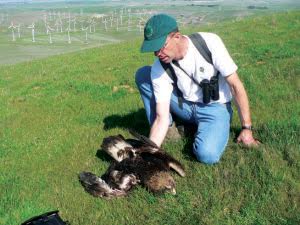
Doug Bell of the East Bay Regional Park District, in a 2007 photo with a golden eagle found near turbines in California’s Altamont Pass Wind Resource Area. The raptor, which had a compound wing fracture, later was euthanized. Janice Gan/Courtesy East Bay Regional Park District

Eagle Take Permit Considered at Hearing

A new federal regulation that would give the wind industry 30-year permits for unintentional eagle deaths was the topic of a recent legislative committee hearing in Casper.

The issue centers on a 2013 U.S. Fish and Wildlife decision that increased the length of eagle take permits from the current five years to 30, but only for wind energy projects and related infrastructure, such as transmission facilities.

A federal judge in California struck down the rule in 2014, shortly after it was issued, after conservation groups challenged it on environmental grounds. This past February the federal government decided it was not going to appeal the court’s decision.

Tyler Abbott, a deputy field supervisor for the U.S. Fish and Wildlife Service, Wyoming Ecological Services, told the Select Federal Natural Resources Management Committee that a new rule was emerging as a result of those actions.

“The Fish and Wildlife Service … is in the process of developing some definitions, some draft regulations and an environmental impact statement that could potentially lead to the authorization of an incidental take permit in the future, but right now it’s in development, and it’s not active legally,” Abbott said.

The proposed new rule would continue to allow 30-year permits for wind energy, but it now also includes a review every five years, bringing it somewhat in line with present permit length. The rule also has stipulations that companies seeking eagle take permits work collaboratively with Fish and Wildlife on a bird protection plan.

READ MORE:  http://casperjournal.com/news/local/casper/article_6c745815-e428-56e1-a79d-7c8883380802.html

“Road Warrior” Prints

road warrior

The Devil whispers “You can’t withstand the Storm”.
The Warrior replies “I am the Storm”.

Prints Now Available:

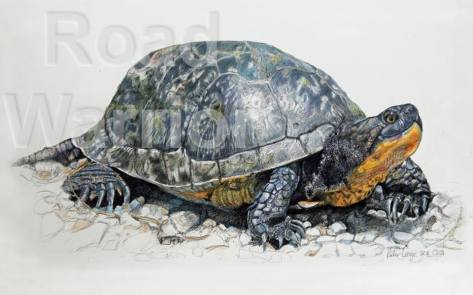
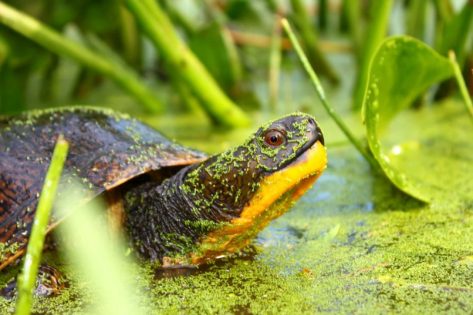
For Amherst Island and Prince Edward County, the Blanding’s Turtle symbolizes the need to protect Ontario’s sensitive environment.

“Road Warrior”, a limited edition print numbered and signed by esteemed artist Peter G. S. Large is now available. Only 50 hand-tinted, numbered prints have been created. Derived from an original drawing the prints are 19 X 13 inches printed on acid-free archival watercolour paper and are sold unframed and unmatted. The “Road Warrior” watermark does NOT appear on the print.

Peter G. S. Large is an award-winning Canadian artist. He is Past President of the Society of Canadian Artists, Member of the Ontario Society of Artists, Professional Member and Past-President of the Arts and Letters Club of Toronto.

The price is $200 with all proceeds generously donated by Peter to the Association to Protect Amherst Island.

Free delivery is available on Amherst Island, in Prince Edward County and in Kingston. Otherwise shipping is $25.

Please etransfer $200 to protectai@kos.net or make your cheque payable to APAI and send along with your contact information to Box 6 Stella ON K0H 2S0.

Contact protectai@kos.net to arrange to see the print or visit Peter in his studio on Saturday July 9 from 9 to 5 as part of the Amherst Island Art Tour. Start at the Neilson Store Museum and Cultural Centre 5220 Front Road Stella ON to obtain your map and directions.

Thank you for your support of the Association to Protect Amherst Island: http://www.protectamherstisland.ca/


Along Lake Erie

A Passionate Voice to Protect Birds

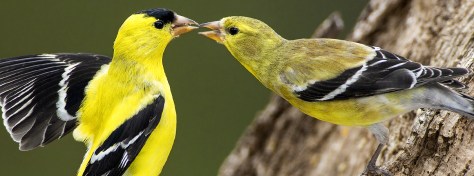
American-Goldfinches_Gerald-Marella_SS

LS: Why is the Great Lakes region so critical to birds?

KK: All three of the major migratory routes birds follow during spring migration intersect over northwest Ohio. When the birds get here, they confront the daunting expanse of Lake Erie. When you’re a songbird that weighs less than an ounce—and you don’t swim!—you need to rest and refuel before these long crossings. With so much lakefront habitat sacrificed to development, large concentrations of migratory birds gather in these remaining patches of wooded habitat to fuel up before crossing the lake.

………

Wind energy is an intense issue for us right now. With the need for alternative energy on nearly everyone’s mind, there seems to be a mad rush to install as many turbines as quickly as possible. The wind industry doesn’t understand the complexities of bird behavior, yet it’s making decisions about whether turbines will impact birds.

The Observatory has more than 30 years of data documenting the volume of birds that pass through this region during spring and fall migration. The entire Western Basin of Lake Erie has been designated as a Globally Important Bird Area. We’ve brought tremendous economic development to the region through our efforts to market the sensational birding here, and a whole host of environmental agencies and organizations are on record stating that this area is not suitable for wind energy development. Yet we still can’t keep turbines out. We need industry regulations—fighting these projects one at a time isn’t enough.

American Bird Conservancy.

READ MORE: https://abcbirds.org/passionate_voice_to_protect_birds/

Rare Blanding’s Turtle Scores Win against Wind

“Yippee! Hooray!” said Cheryl Anderson, a member and past president of the Prince Edward County Field Naturalists. “It’s been a long haul.”

blandings-turtle-wind-turbine_jpg_size_custom_crop_1086x724

The Blanding’s turtle, a sunny little reptile already prone to smiling, must be beaming this week like somebody who’d won a lottery the same day they were awarded the Nobel Prize.

For the third time in the past three years, a legal decision was handed down in favour of the endangered species, and against a proposed wind turbine development in Prince Edward County, east of Toronto, that threatened to cause the turtle “serious and irreversible harm.”

READ MORE:  https://www.thestar.com/news/canada/2016/06/07/blandings-turtle-protected-as-turbine-approval-revoked.html