Category Archives: Adverse Health Effects

Noise from Wind Turbines cause residents to vacate their home

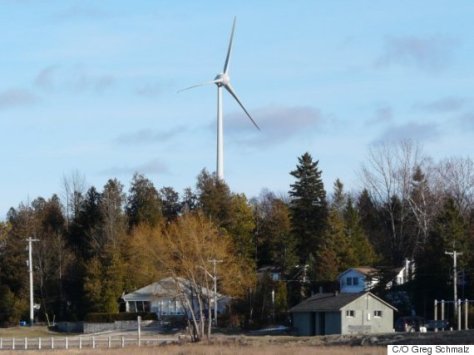
adelaide wind turbineSuncor wind turbines located in Adelaide Metcalfe, Ontario have generated another documented case of residents forced to abandon their home due to wind turbine noise. The letter from James and Heather Dymond reaches out to Mayor and Council demanding they find a solution. If you are also impacted it is important no matter what they say or what you are told know this- you are not alone.  Please continue to speak up and send in your letters to those who are mandated to protect us.

February 15, 2016

I’m writing today to ask Adelaide Metcalfe council to find a solution to the issues surrounding Suncor wind turbines, that are causing us to have to vacate our house at night, as well as some days – since April 2015. We pay taxes to the township for a home that we can no longer enjoy. We have to leave at night to get a break from the incessant infrasound emitted from the turbines. It is a sound that one can feel more than hear.

I am suffering from nausea, vertigo, and at times extreme headaches, wherein I have to leave the house immediately to get any relief. I’ve spent countless hours in the searing sun in the summer, because I couldn’t stay in the house without feeling like vomiting. I am now on prescription meds for vertigo which I have never experienced before. The meds help somewhat, but don’t eliminate the problem. My work is livestock based on the property, and I have noticed negative effects on my livestock as well.

Suncor has been contacted, and has informed me that I am the only one with any problems and that the turbines are running within guidelines. We have not signed a contract with any wind company, yet are forced to live with the problems they create.

Since the family of Mary Ann Hendrikx has approximately six wind turbine contracts with Suncor, I have not included her on this email as it is a conflict of interest.

Sincerely,
James Dymond

STOP the CAW Wind Turbine

unifor wind turbine aCouncil Deputation – March 13, 2017

Council thank you for the opportunity to once again speak on behalf of the local residents’ advocacy group S.T.O.P. whose resident members continue to be tortured, and I don’t use that word lightly, in their homes and on their properties by the audible and inaudible emissions from Unifor’s for profit wind turbine. Tonite you will consider a motion to conduct testing of the noise compliance of this turbine at the same time as Unifor’s upcoming test.

This 35 story industrial machine located in the cottage resort area of Gobles Grove has no noise safety setbacks to homes as do virtually all turbines in Ontario. After record numbers of noise and health complaints and recognizing the failure of approving this machine in this neighbourhood so close to homes, the Ministry of the Environment and Climate Change actually changed its laws making this Unifor turbine illegal to build today without the 550 m noise safety setback to surrounding homes.

Besides no setback protection the MOECC allowed this Gobles Grove cottage residential area to be incorrectly classified as urban, like downtown Toronto, while their own measurements showed nighttime background noise levels the same as would be found on local farms. This incorrect urban vs rural label allowed the Unifor wind turbine to emit much louder levels of noise than allowed by turbines in the country and without the setback protection.

Saugeen Shores residents have the perfect storm. Nights as quite as those on farms but being exposed to 45 dB city noise levels much louder than the 40 dB of rural residents. And living without the 550 m sound reducing setbacks for their homes.

Despite residents demonstrating evidence of harm and the municipality calling for the turbine to cease operating, the Unifor wind turbine has been allowed to operate four years without ever even being officially tested for legal noise compliance.

Further salt in the affected residents’ wounds is the fact that the Ministry of the Environment and Climate Change’s Wind Turbine Approvals Director, the head of the noise police, promised the town and residents in writing on approving the turbine, that the turbine would be tested for noise compliance during its first two years of operations. Then CAW president Ken Lewenza did the same going even further to allay residents’ fears by promising open sharing of this required noise testing.

There are now approximately 350 official complaints filed with the Ministry of the Environment and Climate Change( MOECC ). Numerous noise tests showing apparent non compliant readings have been conducted by Unifor staff and by MOECC field staff using the same hand held noise meter.

On April 27, 28, 29 in 2014 the CAW’s acoustic engineer Martin Ince set up to perform the required Section D audit noise test in full knowledge of the MOECC. On April 27 at 10 pm within 15 minutes of the turbine test start up the engineer recorded a maximum allowable noise level of 45 dB for 20 minutes. The next night at the same time with the wind blowing at 1 m/sec or just 3.6 km/hr faster than the previous night, the CAW engineer measured 57 dB for 20 minutes with peaks of 74 dB. On both nights the test was called off due to call in complaints. Residents obtained these facts from a 2,000 page Freedom of Information search as all requests for noise test data from our own MOECC local office was refused. Unifor have refused to do any further official noise audit compliance testing since those two nights in April 2014.

The MOECC now informs the community that Jade Acoustics, Unifor’s acoustic engineering company used in the CAW OMB hearing to oppose the town has been hired to do a Section D audit test this spring. Will it be done before noise interfering leaves appear on trees? No one yet knows.

Jade Acoustics have been doing “pre audit testing“ according to MOECC for the past year and have reported to the MOECC no good data was measured in this extensive period due to poor wind conditions and that further testing would have to occur in spring 2017.

The upcoming noise audit tests are long awaited by the community and the municipality. Given the four year history of noise impacts on residents these tests must be done with the utmost in community co operation, integrity, openness and utilizing the latest in noise testing equipment and methods.

After being denied the results of noise compliance testing for 4 years the residents trust has been broken. We are looking to the municipality to perform independent, parallel audit noise testing at the same time as Unifor. This simultaneous joint testing has been done on other wind energy projects most notably the Shirley Wisconsin project where 4 separate testers co operated to obtain and share results.

The benefit to all parties is the trust created that assures the integrity of the noise compliance measurements collected. All parties will benefit by knowing all the collected data will be evaluated for compliance to government standards. The local MOECC office has voiced no objection to parallel testing. There are no guarantees that weather conditions will occur to measure the highest noise levels possible during the test period. Measurements meeting the test criterion in the period will be used to determine conformity.

The MOECC criterion of choosing a tester is that they be experienced at noise testing. This tester could be an engineering company or an individual both of whom would need be familiar and capable of performing the test according to the MOECC protocol. The cost can range from $12,000 upwards depending on the tester with the determinant factors being the agreed upon duration of the test and number of locations tested. In 2014 Saugeen Shores residents used an environmental engineering company to test 3 homes for 3 weeks charging less than $15,000.

S.T.O.P. will undertake to share information with staff on testing entities as well as discuss cost sharing in excess of amounts already allocated. We will endeavour to obtain our members’ approvals to test on their properties. Assuming council approves the initiative it is our hope that staff discussions with Unifor to conduct parallel testing will lead to a transparent effort to establish noise level compliance.

Thank you,
S.T.O.P. ( Saugeen Shores Turbine Operation Policy )

caw shame on you

Facebook: https://www.facebook.com/StoptheCawWindTurbine/ 

Saugeen Shores Turbine Noise Testing

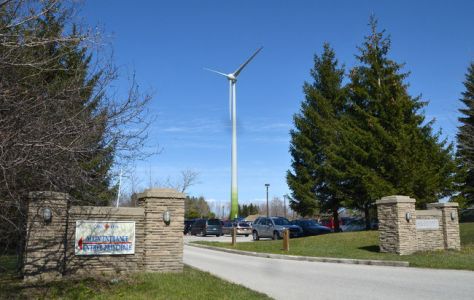
unifor wind turbineThe Unifor wind turbine continues to generate ongoing noise complaints and the residents are fed up with the Ministry of the Environment and Climate Change failure to act. 100’s of complaints and counting. The industrial wind turbine is located adjacent to at least 100 homes within 550 metres of proximity and no independent third party noise audit completed to date.  Turbines and their noise do not make good neighbours.

Saugeen Shores wind turbine testing

Credit:  By Jordan MacKinnon | Blackburn News | March 14, 2017 | blackburnnews.com ~~

Saugeen Shores council is once again taking aim at the Unifor wind turbine.

Council passed a resolution seeking to hire a third-party to conduct parallel testing when the union carries out an acoustic audit this spring of its wind turbine, located at its family education centre at the south end of Port Elgin.

Mayor Mike Smith says there’s ongoing frustration with the Ministry of Environment and Climate Change over inaction toward the turbine, pointing hundreds of complaints have been filed and preliminary data suggests the turbine has operated outside of its noise regulations in the past.

The acoustic audit of the Unifor wind turbine had been slated to be completed last year, but was delayed on several occasions and is now scheduled to be completed by the end of June.

Smith says they are fed up with the Ministry of Environment.

The delays in completing the acoustic audit prompted Saugeen Shores council to file a complaint with the Ontario Ombudsman’s office this past October and Smith says he recently received confirmation that the ombudsman is still investigating the complaint.

About 100 homes and cottages are located within the 550-metre setback typically required for industrial wind turbines.

READ AT: http://blackburnnews.com/midwestern-ontario/midwestern-ontario-news/2017/03/14/saugeen-shores-wind-turbine-testing/

GoodBye to Peace & Quiet

quiet

“When I first came inside, it almost sounded louder inside than outside.” Yes, it does. It’s like living inside a drum.

I sat in my living room reading this article last night with painfully throbbing ears and a headache, due to turbine noise that penetrates through the walls of my house. The noise kept me awake until 3 a.m. I had to write a reply to the tripe that was published in the OBSERVER (Feb. 19).

I bought my home to reside, because of its semi-secluded, quiet and peaceful nature. There is a river across the road from me and wooded area that surrounds me. I enjoyed listening to the river and birds, which is about all I ever heard, until a wind farm was erected around my property. There is a never-ending, jet-like sound that rips through my property and house. There is nothing natural about the noise that comes from these turbines and they are loud! The peaceful existence I once enjoyed here has been stolen from me!

EDP Renewables and the town of Chateaugay’s Jericho Rise Wind Farm was planted too close to my house. There are four 482-foot turbines approximately 1,800 to 2,600 feet from my home. The industry standard for turbine “setbacks” from residences are ridiculously too close.

Much of the time, sound levels at the west and south side of my home is above the allowable 50 dBA which the town of Chateaugay has deemed to be acceptable and legal. The lower frequency dBC levels for sound, or infrasound, are not even taken into account. According to acoustic engineering experts, dBC sound levels have a much higher pressure rating than dBA readings. This noise is detrimental to human health and is well documented throughout the world. I am living proof. The noise inside and outside of my home is a completely menacing nuisance.

I am not a “naysayer.” I am living with these behemoths that surround my property. In fact, I have been living with wind turbines from an older wind farm approximately 3-4 miles from me for the past 6 1/2 years. About 7 months out of the year, due to leafless trees, I can see 15 of them from my front porch. They really don’t bother me. I can’t say I like them, but I can’t hear them either.

I was never an opponent of wind power. I am a science teacher of 11 years and teach about sound and alternative energies. It is in the state curriculum. I even went to an all day wind power teacher’s workshop to get a better understanding of wind energy eight years ago. The wind industry has been setting us up for a fall a long time ago.

By the way, standing directly underneath a turbine is the quietest place to listen to them. Stand back 500, 1000, 1500 feet and downwind from them, and if you still think they are not loud, then you must be deaf. If anyone would like to come to my home in Chateaugay to get a true experience of what these monsters sound like, you are welcome to visit. A town councilman from a neighboring town was here yesterday and he said, “When I first came inside, it almost sounded louder inside than outside.” Yes, it does. It’s like living inside a drum.

As far as a tax base for your community is concerned, there will be none. They will not pay any business property tax whatsoever. The wind farm company will cram a Payment in Lieu of Taxes (PILOT) Program down your throat. The county, town and possibly school district will receive a pittance compared to what the wind developer receives in government subsidies. This is how they can afford to build these wind farms.

The absurdity of saying that birds will just fly around the towers is also ridiculous. Birds of prey are looking down to the ground for food, not what’s in front of them. Migratory birds are flying in excess of 40 miles per hour. They do not have the ability to just stop in mid-air and fly around.

Putting “hope and trust” in the wind company is dangerous. I have made many complaints to EDP Renewables and Chateaugay about the nuisance noise. They have been to my house once to take a sound test. It was taken on a day with 2-3 mph wind speeds, and in between my house and garage which blocks all of the south wind. The town engineer said the reading was 38.5 dBA.

Folks, it is not a far stretch from 38.5 dBA to over 50 dBA when the winds are from the west or south in excess of 12 miles per hour. I know, because I have been taking my own sound level readings since Jan. 1. The town and EDP Renewables said they would be taking multiple tests. Two days later, with no notice, town board members popped into my backyard at 9:30 a.m. with a sound meter. I wondered what they were doing here, because it was a legal holiday and again, practically no wind. They acted as though they didn’t realize I was home. They didn’t even knock on my door.

They stated they would be back. Just before they left, one town board member stated, “We wouldn’t want these in our backyard either.” I called the town supervisor later in the day and asked to be notified 24 hours in advance and that I want to be present when these tests were done. They have not been back since. It has been almost two months. I have been lied to and ignored.

During this time, I was introduced to a well credentialed acoustic engineer through a friend. He sent me data on what a proper sound test should include. I have continued to call the EDP Renewable complaint hotline. They were supposed to take more tests last week. I sent EDP Renewables operations manager, town engineer and town supervisor data from the acoustic engineer about what I would be expecting for a proper sound test. I am being ignored once again. So, if anyone thinks that the process of developing a wind farm (before, during or after) is honest and trustworthy, you really should be talking to people that are living in the middle of a wind farm.

Please, do not be fooled by any wind farm company! Also, if you are a non-participating landowner, do not sign their “Neighbor Agreement.” You will lose all your rights (on, under, over, around, etc.) as a property owner. If you have any of the problems I am experiencing right now, you will lose the ability to do or say anything to anyone about it. It is a “gag order” for a very small annual payment.

In closing, I need to say that I gain nothing by writing this. It is only to help those that may be in danger of having to live with a wind farm near their home.

Kevin Sigourney is a resident of Chateaugay, which is located in Franklin County in northern New York near Massena.

Published in Observer March 12, 2017:  http://www.observertoday.com/opinion/commentary/2017/03/once-turbines-arrive-say-goodbye-to-peace-quiet/

Noise Measurement, Assessment & Control for Wind Facilities

111882606XWind Farm Noise: Measurement, Assessment and Control

Colin H Hansen, University of Adelaide, Australia

Con J Doolan, University of New South Wales, Australia

Kristy L Hansen, Flinders University, Australia

A comprehensive guide to wind farm noise prediction, measurement, assessment, control and effects on people

Wind Farm Noise covers all aspects associated with the generation, measurement, propagation, regulation and adverse health effects of noise produced by large horizontal-axis wind turbines of the type used in wind farms.

The book begins with a brief history of wind turbine development and the regulation of their noise at sensitive receivers. Also included is an introductory chapter on the fundamentals of acoustics relevant to wind turbine noise so that readers are well prepared for understanding later chapters on noise measurements, noise generation mechanisms, noise propagation modelling and the assessment of the noise at surrounding residences

Key features:

  • Potential adverse health effects of wind farm noise are discussed in an objective way.
  • Means for calculating the noise at residences due to a wind farm prior to construction are covered in detail along with uncertainty estimates.
  • The effects of meteorological conditions and other influences, such as obstacles, ground cover and atmospheric absorption, on noise levels at residences are explained.
  • Quantities that should be measured as well as how to best measure them in order to properly characterise wind farm noise are discussed in detail.
  • Noise generation mechanisms and possible means for their control are discussed as well as aspects of wind farm noise that still require further research to be properly understood.

The book provides comprehensive coverage of the topic, containing both introductory and advanced level material.

ORDER YOUR COPY:  http://ca.wiley.com/WileyCDA/WileyTitle/productCd-111882606X.html 

Noise emitting devices taken down after complaints

Noise-emitting devices installed in a downtown parkette in Toronto were removed following complaints. Begging the question:  WHY NOT REMOVE WIND TURBINES?

Toronto Parkette

Noise is unwanted sound.

Where you live (urban vs. rural) and the  noise emitting source of your acoustical tormentor creates a dichotomy in accessing protections to safe guard personal well- being. Particularly if the noise happens to be from a wind turbine generator.

Noise used to discourage vagrancy and repeal youth from loitering is shut off due to complaints. An urban example with a different outcome than 1 000s upon 1 000s of  turbine complaints  arising in rural areas. Turbine noise is adversely  impairing sleep and creating increasing numbers of families driven out of their homes.  Noise from turbines is allowed secure in the knowledge it is shielded by laws enacted to further the day’s energy policies.  The wind industry hides behind the skirts of its protectors deflecting any compelled action using legalese as a shield and regulations of the Green Energy Act as its sword. Silencing the voices of the hurting and harmed.

READ ARTICLE: https://www.thestar.com/news/gta/2017/03/09/city-investigates-noise-emitting-devices-installed-near-downtown-parkette.html

Noise Device identified as The Mosquito: http://www.movingsoundtech.com/

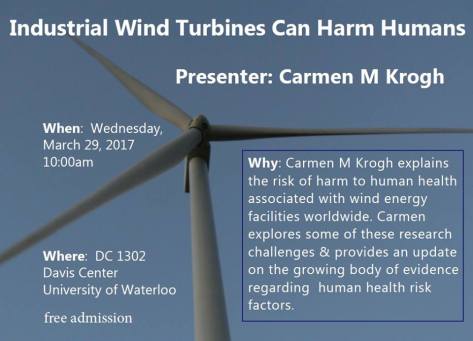
Industrial Wind Turbines Can Harm Humans

Carmen KroghTALK ANNOUNCEMENT

TITLE:   Industrial Wind Turbines Can Harm Humans
PRESENTER:  Carmen M Krogh

DATE:  Wednesday, March 29, 2017. 10:00am.
LOCATION:  DC 1302 (Davis Center), University of Waterloo

ABSTRACT:
The topic of the risk of harm to human health associated with wind energy facilities is controversial and debated worldwide. On May 7, 2014, Carmen Krogh presented a seminar at the University of Waterloo which considered some of the research dating back to the early 1980’s. A snapshot of some of the current research available in 2014 was provided. The research is challenged in part by the complexities and numerous variables and knowledge gaps associated with this subject. This presentation will explore some of these research challenges and provide an update on the growing body of evidence regarding human health risk factors. Included will be the emerging research indicating risks to those working in this field.

BIO:
Carmen M Krogh is a full time volunteer and published researcher regarding health effects and industrial wind energy facilities and shares information with communities; individuals; federal, provincial and public health authorities, wind energy developers; the industry; and others. She is an author and a co-author of peer reviewed articles and conference papers presented at wind turbine scientific noise conferences. Ms Krogh is a retired pharmacist whose career includes: senior executive positions at a teaching hospital (Director of Pharmacy); a drug information researcher at another teaching hospital; a Director of a professional organization; and a Director (A) at Health Canada (PMRA). She is the former Director of Publications and Editor in Chief of the Compendium of Pharmaceuticals and Specialties (CPS), the book used by physicians, nurses, and health professionals for prescribing information in Canada.

There will time available for questions and discussion.

Deniers in Wind Industry

hear-no-evil

The human health consequences of manipulated measurements

Science deniers in the wind industry

By: Helen Schwiesow Parker, PhD, LCP

Like the tobacco industry before it, the wind industry has spent decades vehemently denying known harmful consequences associated with its product, while promoting its fraudulent feel-good image. Dismissing or denying the serious health impacts of industrial-scale wind turbines is wishful thinking, akin to insisting that tobacco is harmless because we enjoy it.

The problem with wind energy is not just its costly, subsidized, unreliable electricity; the need to back up every megawatt with redundant fossil-fuel power; or its impacts on wildlife and their habitats.

Infrasound (inaudible) and low-frequency (audible) noise (slowly vibrating sound waves collectively referred to as ILFN) produced by Industrial-scale Wind Turbines (IWTs) directly and predictably cause adverse human health effects.  The sonic radiation tends to be amplified within structures, and sensitivity to the impact of the resonance increases with continuing exposure.

These facts have been known to the wind industry and the US government since the 1980s when it became a ‘hot topic,’ with numerous studies presented and published by acousticians working under grants from the Departments of Energy, Defense and NASA. The wind industry response?

Deny the science.  Insist that “what you can’t hear can’t hurt you.” Claim that “neighbors will get used to it.” Measure only outside dwellings, and allow only noise measurements in the field that reflect the relative loudness perceived by the human ear, while drastically reducing sound-level readings in the lower frequencies that are known to cause problems……….

Read More: http://canadafreepress.com/article/science-deniers-in-the-wind-industry


Bat remedy hearing concludes

brown-bat

Simcoe-Grey MPP Jim Wilson demands to know why wind power developers get a remedy hearing on endangered bats when harm has been proven. Minister Murray replied he would have to resign if he intervenes in the independence of the Environmental Tribunal process but it is the Green Energy Act that allows wind projects to be approved. Under the Green Energy Act the Minister has authority to intervene.  The Minister to resign over the harm caused by wind projects?  What an interesting idea!

Wednesday, March 1, 2017

Turbine Hearing Concludes

Collingwood | by Catherine Thompson  

yet more submissions in long-running case

A hearing to do with a wind turbine proposal near Stayner took one day instead of three.

The Environmental Review Tribunal allowed WPD Canada to have a Remedy Hearing to present ways to reduce harm to natural heritage, mainly the Little Brown Bat.

The hearing, held in Collingwood council chambers, was originally to start on Monday, but that day was cancelled because a witness was unavailable. The hearing, on Tuesday, heard from three witnesses.

Dr. Scott Reynolds, presenting for WPD Canada, via Skype, says they would slow down the turbine speed when bats are in the air in an effort to decrease the number of bat deaths.

The second witness, Susan Holroyd, a wildlife biologist specializing in bats, appeared by Skype, on the appellant, Preserve Clearview’s side.

The third and last witness was Ecologist Sarah Mainguy, also for the opponent’s side. She told the hearing there are huge uncertainties in this application such as the number of bats and their exact route in the areas of the turbines. She added that the mitigation suggestions from WPD Canada are not good enough.

Witnesses and lawyers could not comment on the hearing proceedings, but Chuck Magwood of Preserve Clearview, was in the audience.  He says he agrees with their witnesses that one dead Little Brown Bat, which is an endangered species, is too many.

WPD has until March 31st to make written submissions, the opponents have four weeks to reply and then another two weeks for WPD to rebut the reply, taking the latest round in the turbine discussions to May 12th.

Magwood says he expects a decision by the Environmental Review Tribunal in June.

READ AT: http://www.bayshorebroadcasting.ca/news_item.php?NewsID=91434