Recent posting spotted on an online sell & buy website:
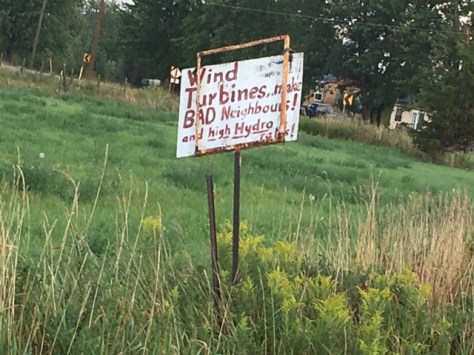
Don’t buy anything in a wind farm (Everywhere)


Recent posting spotted on an online sell & buy website:
Protecting clean water from wind turbine construction has seen residents chaining themselves together in protest to stop further damage of reported turbid drinking water that occurred after the pile driving for turbine foundations in Chatham Kent. What is it going to take? It is time to halt the wind project!
By Trevor Terfloth, Chatham Daily News
Tuesday, August 29, 2017
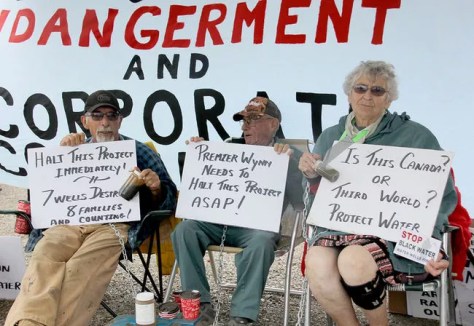 In In an effort to halt construction of a wind turbine project in North Kent, three protesters chained themselves together in a show of solidarity on Tuesday.
Sheltered from the rain, but weathering the elements, Rick Ball, Lee Montgomery and Yvonne Laevens were at the entrance to the site on Bush Line, near Highway 40 in the former Chatham Township.
“It should have never have gone this far,” Laevens said. “We have to (do this). We’ve tried just about everything else.”
Several water wells in the North Kent Wind project area, currently under construction by Samsung Renewable Energy and Pattern Energy, have been clogged with sediments shortly after recent pile-driving took place for constructing industrial wind turbines.
Tuesday’s protest was peaceful, with Laevens adding that Chatham-Kent police have been “congenial” with the group.
Ball said he appreciated the members of the public who were on hand and hopes the government takes notice.
“Start paying attention to what we’ve been saying for a year and a half,” he said.
Last week, Chatham-Kent council passed a motion asking the Ministry of the Environment and Climate Change to halt the project until water well concerns were dealt with.
Ball said a halt would allow everyone involved to work together on a solution.
Also part of the council motion was to implement independent water testing for the wells currently experiencing problems.
In a media release, the municipality stated that residents near the North Kent One wind farm project whose wells have water-quality issues will be contacted by Chatham-Kent officials this week to allow them to select a firm to test their well water at no cost.
Municipal chief administrative officer Don Shropshire said the municipality, working with public health officials, have identified 17 labs in Ontario that are licensed and accredited by the Canadian Association for Laboratory Accreditation to test drinking water for microbiological agents, organic chemicals, inorganic chemicals, and other particulate matter.
Shropshire said in the release that residents will have the option to choose any of the accredited labs.
“We want to ensure there are no concerns about who does the testing,” he said. “We’ve provided the list but the choice will be up to the residents.”
At a meeting last week between municipal officials and ministry representatives, the province also committed to contact owners of wells which have experienced issues and review those concerns with Samsung Renewable Energy and Pattern Energy.
As for the request to halt the project, the municipality’s release stated “that request is still before the premier’s office.”
In a statement e-mailed to The Daily News on Tuesday afternoon, the company said it was aware of the water well concerns.
Niagara Wind’s Enercon Industrial wind turbines & others from adjacent complexes disturbing human, plant and animal life in Lowbanks, Ontario.



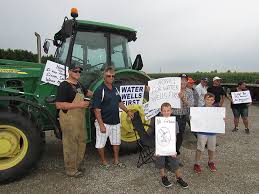
Protesters blocked the entrances to three wind turbine construction sites near Chatham Thursday morning. Five families are now reporting dirty water in their wells after pile driving for the construction of industrial wind turbines began.
Source: Fight to save water wells
“At the press conference were the people whose wells have been affected in the North Kent Wind 1 project area – Theresa Pumphrey, Paul and Jessica Brooks, Valerie and Wayne Brooksbank, and a representative for Mark Moir (Countryview Line).
Visibly upset, the property owners talked about the impact on their families’ health and fear about the black shale that is visible in the water that is known to carry arsenic, mercury and other harmful chemicals in it.”
 [7] As described in greater detail below, the Approval Holder has proposed an amendment to the REA to include additional curtailment measures designed to reduce little brown myotis mortalities. The Tribunal finds that these additional measures, provided they are amended to require that they be implemented from sunset to sunrise, is likely to significantly reduce little brown myotis mortality over the life of the Project. However, as neither the Approval Holder nor the Director has proposed effective means to mitigate the serious harm to human health, as found by the Tribunal in its October 2016 Order, the Tribunal concludes that the decision of the Director should be revoked. As such, an amendment to the REA to address harm to little brown myotis via an amended mitigation plan is rendered unnecessary.
READ FULL DECISION & ORDERS HERE : 16-036 WIGGINS V. ONTARIO (MOECC)

Words and their meanings have powers that can impact our very well- being. Judge Cornelius J. Moriarty II, of the Justice of the Superior Court ordered the cessation of the operations of the wind turbines in Falmouth, Massachusetts. In giving his judgement he discusses findings and reasons while interpreting and applying the meanings of the words injurious and nuisance.
“Despite the Town’s insistence that Barry Funfar is hypersensitive to sound, it is clear that he is no lone voice crying in the wilderness. Other residents of the neighbouring area have registered similar complaints which was the very reason the Town commissioned the HMMH study in the first place.”

The Falmouth Enterprise August 11, 2017
A neighbor of the town’s turbines e-mailed us last week to say that we have been misleading the public by stating in recent stories that Judge Moriarty ruled that the turbines were a nuisance to the Funfar property. A nuisance, he wrote, is generally thought of as a neighbor mowing the lawn on a Sunday morning, whereas Judge Moriarty defined nuisance not only as an inconvenience but also a danger. He attached a copy of the judge’s decision for our reference.
In fact, Judge Moriarty went into a good deal of detail in a five-page discussion of his findings and decision.
First, he pointed out that the Zoning Board of Appeals’ decision that the turbines constituted a nuisance could not be overturned, as the board would have had to have been unreasonable or on legally untenable grounds. The appeals board found that the turbines were a nuisance to the Funfars’ property because, based on a DEP sound study, they directly affected the health and well-being of the Funfars. “The decision here was hardly arbitraray and capricious,” Judge Moriarty wrote.
But the issue here, of course, is the definition of nuisance. Judge Moriarty pointed out that nuisance is difficult to define and, as much testimony as there was about sound levels, none of it applies to the definition because there are no numerical standards. “The issue is,” he wrote, “whether, on the facts found, the operation of the wind turbines was offensive because of injurious or obnoxious noise or vibration, a nuisance in violation of the by-law.”
He pointed out that, while the town argued that Mr. Funfar was hypersensitive to sound, “it is clear that he is no lone voice crying in the wilderness. Other residents of the neighboring area have registered similar complaints…”
The judge discussed the definition of “injurious,” at some length and concluded that “the physical effects of the turbine-generated sound upon Mr. Funfar have been certainly harmful and have tended to injure him.”
There should be no mistake among the residents of Falmouth; when the appeals board and Judge Moriarty called the town turbines a “nuisance,” they did not mean it in the way of ants at a picnic or a dog barking in the night.
Judgement Town of Falmouth vs Falmouth Zoning Board of Appeals et al
A North Kent Wind Project manager referred to a family’s water as “visually clear” in a press release, despite tests and photos that show otherwise.

Aecom, the engineering consultant behind the wind project, scheduled a site visit to sample the family’s water on Wednesday. According to Law, the tests show no issues.Senior Manager of Development Jody Law says the Ministry of Environment (MOE) notified him of Paul and Jessica Brooks’ complaint on Monday. Paul and Jessica Brooks live on Brook Line in North Kent and say they have been experiencing a plugged water pump from nearby wind tower pile driving.
“The sample was visually clear and colorless with no visible sediment. We have requested expedited analysis from the lab but, at this point, there is no empirical evidence of an issue,” says Law.
However, Water Wells First spokesperson Kevin Jakubec points out that a Ministry of Environment provincial officer made a visit to the home on Tuesday and found drastically different results.
According to Jakubec, the test results from the MOE show extremely high turbidity levels at 86.8 NTU. The Ontario Drinking Water Standard’s objective turbidity level is 5.0 NTU.
To meet conditions of the wind project’s permit, Pattern Development delivered a 2,000 gallon water tank from Ingersoll to the Brooks residence on Saturday.
“He said that there is no empirical evidence of an issue. I think the delivery of a water tank is recognition of an issue. Given that Mr. Law is the project manager, you’d hope he would know what is going on with this project,” says Jakubec.

Paul and Jessica Brooks demand that North Kent Wind executive Jody Law issues a full apology and retraction of his press release.Jakubec adds the project permit ensures that families, like the Brooks, who complain that their well has been affected by the turbines, do not have to pay for the costs of the investigation or water tanks……
READ ARTICLE: Blackburn News August 8, 2017
Pile driving for turbine foundation installations are again being associated to changes in a water well. Another day and another well impacted…


Eugene Clune who lives in Ballinvalley shared his family’s trauma and said that if he had the chance now he would approach things very differently.
‘My house is situated 800 metres from an industrial turbine and my four-year-old has slept, maybe two nights since last winter.
‘She would ask us why her granddad is outside on the digger in the middle of the night – because that is what it sounds like,’ he said.
Source: Crouck Substation Action Group
Published July 29, 2017: Independent IE
 Mothers Against Wind Turbines Inc.