All posts by pbiljan

NA-PAW News Release on the Health Canada Study Summary

Donna Quixote's avatarQuixotes Last Stand

FOR IMMEDIATE RELEASE

North American Platform Against Wind Power

November 9, 2014

A case of widespread consumer fraud and systemic government abetted torture:  Health Canada’s study further victimizes wind turbine refugees and cohabitants.

Ontario Anti Wind Groups along with International groups, react strongly with anger to the Health Canada wind turbine noise study, knowing that projects will be exponentially promoted and sanctified worldwide, via this 2 million dollar, taxpayer funded, fraudulent study.

Indeed, hours later, at most a day, thumbing its nose at victims of wind, numbering hundreds with thousands of serious complaints of widespread chronic sleep deprivation and other adverse health effects, and communities with lost or greatly depreciated homes and dead or reduced livestock, Ontario’s Liberals announced approval of a massive turbine array in Niagara, to install the largest turbines ever in Canadian history. NA-PAW notes the similarities to the Tobacco lobby, which utilized medical personnel to ignore…

View original post 1,278 more words

wind turbines … a free pass to kill

Tom Harley's avatarpindanpost

It just gets worse:

[…] Wildlife consultant Jim Wiegand has written several articles that document these horrendous impacts on raptors, the devious methods the wind industry uses to hide the slaughter, and the many ways the FWS and Big Green collude with Big Wind operators to exempt wind turbines from endangered species, migratory bird and other laws that are imposed with iron fists on oil, gas, timber and mining companies. The FWS and other Interior Department agencies are using sage grouse habitats and White Nose Bat Syndrome to block mining, drilling and fracking. But wind turbines get a free pass, a license to kill.

Big Green, Big Wind and Big Government regulators likewise almost never mention the human costs – the sleep deprivation and other health impacts from infrasound noise and constant light flickering effects associated with nearby turbines, as documented by Dr. Sarah Laurie and other researchers.

In…

View original post 223 more words

Health Canada Wind and Health study unhelpful

t’s been a tough week for some fighting Ontario’s wind whimsy: part two

On Thursday Health Canada released Wind Turbine Noise and Health Study: Summary of Results. Media headlines in reporting on the release were largely along the lines of CBC’s ignorant Wind turbine noise not linked to health problems, Health Canada finds, with some exceptions, including the Toronto Star’s No definitive link between wind turbines and poor health, says Health Canada study, It seems to me the discussion now will be whether it is industrial wind turbines making people unwell, or people like me arguing that’s possible that harms people.

The Star’s introductory paragraphs do, I think, introduce the topic well:

Living near towering wind turbines can be extremely annoying but there is no connection between exposure to the wind turbine noise and health effects, says a new comprehensive Health Canada study.

Noise from wind turbines did not have any measurable effect on illness and chronic disease, stress and quality of sleep, the study found. But the louder the noise from the turbines, the more people got annoyed by different aspects — from the noise to the aircraft warning lights atop the turbines to the way they caused shadows to flicker.

But Health Canada said the study on its own cannot provide definitive answers and more research may be needed. It also pointed out that annoyance isn’t trivial — those who were annoyed were more likely to report other health issues.

From Health Canada’s release:

Annoyance is defined as a long-term response (approximately 12 months) of being “very or extremely annoyed” as determined by means of surveys. Reference to the last year or so is intended to distinguish a long term response from one’s annoyance on any given day. The relationship between noise and community annoyance is stronger than any other self-reported measure, including complaints and reported sleep disturbance.

and…

  • WTN [wind turbine noise] annoyance was found to be statistically related to several self-reported health effects including, but not limited to, blood pressure, migraines, tinnitus, dizziness, scores on the PSQI, and perceived stress.
  • WTN annoyance was found to be statistically related to measured hair cortisol, systolic and diastolic blood pressure.
There’s pieces of other interesting things in the study, but nothing new and nothing particularly informative – certainly nothing that would incent me to change what I recently wrote on the issue:

Nature Conservancy partially funded by wind developers

The Nature Conservancy (TNC) took out a full page ad in the November issue of Downeast Magazine to thank its benefactors. The list includes:

Wind Developers: First Wind, Emera Maine, Patriot Renewables, Brookfield Renewables (NH)

Contractors: Cianbro, Reed & Reed, James Sewell Co., Sargent Corp. 

Law Firms: Verrill Dana, Pierce Atwood, Preti Flaherty

Scenic Consultant: Terrence J. DeWan & Associates

Don’t get me wrong: I don’t condemn these companies for donating to TNC and I don’t condemn TNC for accepting their money.

But I do condemn the wind developers for having TNC testify in support of their projects without disclosing that there is a financial relationship between TNC and the developers, their contractors and the law firms retained by the developers.

NatureConservancyDonors

Citizens’ Task Force on Wind Power – Maine


Wisconsin Wind Turbines Declared Health Hazard

. In Ontario 40 families have abandoned their homes to get away from the effects of wind turbines.”

First of its kind ruling; similar to Michigan situation

In what appears to be the first of its kind ruling in the United States, the Board of Health in Brown County, Wisconsin, where Green Bay is located, has declared a local industrial wind plant to be a human health hazard. The specific facility consists of eight 500-foot high, 2.5 megawatt industrial wind turbines.

images (2)The board made its finding with a 4-0 vote (three members were not present) at an Oct. 14 meeting after it had wrestled with health complaints about the wind plant for more than four years. Ultimately, the board’s ruling was based on a year-long survey which documented health complaints and demonstrated that infrasound and low-frequency noise emanating from the turbines was detectable inside homes within a 6.2-mile radius of the industrial wind plant.

Jay Tibbetts, a physician and a member of the Brown County Board of Health, said the board based its position that the turbines constitute a health hazard on the weight of evidence.

“I can tell you that we are absolutely not an anti-wind energy board,” Tibbetts said. “We worked on this for four and a half years before making this decision. Three families have moved out. I knew all of them. We also know that this isn’t only happening here. In Ontario 40 families have abandoned their homes to get away from the effects of wind turbines.”

read  more: CAPCON, Michigan Capitol Confidential, By JACK SPENCER | Nov. 8, 2014

Those Who Move Away Not Part of Turbine Study

Dr. Hazel Lynn says an important segment of the population has been left out of a Health Canada study into the impact of industrial wind turbines on peoples’ health.

images (1)The Health Canada study, released Thursday, found no link between wind turbine noise and negative health effects in people. But Lynn, the medical officer of health for Grey-Bruce who has done a review of such studies, said some of the best survey findings are from the people who have moved away because they simply couldn’t live near turbines.

“These folks are still living there so obviously they are not in that 10% of people who actually abandoned their homes,” Lynn said of those who participated in the study.

“Although the wind folks would pooh-pooh those people (who have moved away) as being especially difficult, I think they are especially sensitive and if you are living in a place where you are afraid to go to sleep at night then you are going to move. Obviously this study didn’t pick up any of those folks.”

The study by Health Canada of more than 1,200 households living near industrial wind turbines concluded there was no evidence to support a link between exposure to wind turbine noise and adverse ill effects including dizziness and migraines, chronic illnesses such as heart disease and high blood pressure and decreased quality of sleep.

The study did find there was a relationship between wind turbine noise and annoyance towards several features associated with turbines including noise, vibration, shadow flicker and the warning lights on top of them.

More than 400 properties approached for the study were deemed not valid dwellings. David Michaud, a research scientist at Health Canada and principal investigator in the study, said they were deemed not valid for various reasons.

“(Statistics Canada) would visit an address and find out in some cases it could have been a church or could have been an industry, it could have been a vacant home and it could have been a home that is being constructed, so those are considered to be out-of-scope homes because they are not valid addresses for the purpose of this study,” said Michaud.

“If somebody has potentially left their homes because of wind turbines, we would have no way of knowing that in a study like this.”

Health Canada partnered with Statistics Canada for the study, which was launched in 2012 and cost $2.1 million. It included three parts – a questionnaire done by participants; a collection of physical health measures that assessed stress levels using hair cortisol, blood pressure, resting heart rate and measures of sleep quality; and more than 4,000 hours of wind turbine noise measurements conducted by Health Canada.

read more: By Rob Gowan, Sun Times, Owen Sound Friday, November 7, 2014

Province gives greenlight to wind farm

Niagara region Wind Corp’s turbines to be largest in North America

The largest turbines in North America will soon rise over West Lincoln.

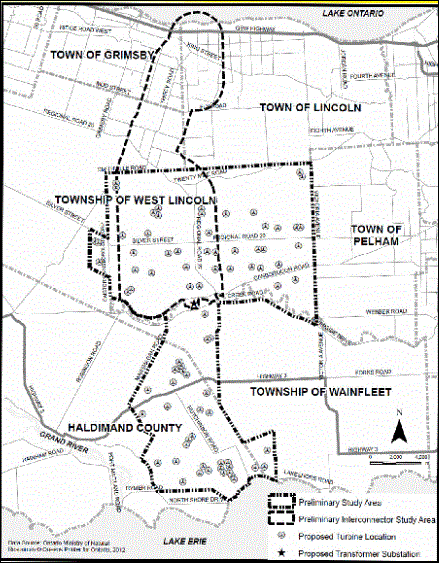
turbine sizeOn Thursday, the provincial government announced it had approved Niagara Region Wind Corporation’s renewable energy application to operate a 77-wind turbine project in the West Lincoln area. The announcement was made the same day that Health Canada released results of its study into the impacts on human health from industrial wind turbines which concluded with the findings of Ontario’s chief medical officer of health, Dr. Arlene King, in 2010.

turbine mapHealth Canada’s assurances however do little to calm the fears of those living in the project’s vicinity.

“The real problem is the health issues for the people in the footprint of the project,” said Catherine Mitchell, who herself lived in the project area before moving to Welland. She is a board member with Mothers Against Wind Turbines which will hold an emergency meeting as it now has 14 days to launch an appeal.

“It’s been approved by the Ministry of Environment but not by the people impacted by this decision,” Mitchell added, noting there were 2,572 comments on the application listing concerns ranging from property values and health impacts to rising energy costs and environmental impacts. “The concerns go on and on for pages.”

Mitchell, who is most concerned with low frequency sound and has been studying it, said she was shocked and awed by the government’s approval.

West Lincoln Mayor Doug Joyner said he was also surprised to see the approval come this soon.

“We expected this to come through but we didn’t expect it until after Christmas,” said Joyner. “It’s a little sooner than expected.”

The ministry’s approval doesn’t come without stipulations however, and Joyner said the township would do what it can to ensure NRWC adheres to the rules and regulations.

As a result of comments received by the municipality and local residents a condition of the approval requires Niagara Region Wind Corporation to:

  • •   not construct or operate more than seventy-seven out of the eighty wind turbine generators identified in the approval
  • •   comply with the ministry’s noise emission limits at all times
  • •   carry out an acoustic emission audit of the sound levels produced by the operation of the equipment at five receptors
  • •   carry out an acoustic emission audit of the acoustic emissions produced by the operation of two of the wind turbine generators
  • •   manage stormwater, and control sediment and erosion during and post construction
  • •   develop and implement a pre- and post-construction ground water monitoring program
  • •   carry out specific items if foundation dewatering or water takings by tanker exceed 50,000 L/day
  • •   apply the Department of Fisheries and Oceans Operational Statement, if during construction, waterbodies that were previously not identified are discovered
  • •   design, construct and operate a spill containment facility for each of the Transformer Substations
  • •   implement the pre and post construction Natural Heritage monitoring program, which includes bird and bat monitoring
  • •   undertake the supplementary monitoring program discussed with Environment Canada and determine next steps as part of the program including the implementation of mitigation measures in response to any potential unanticipated adverse effects
  • •   ensure that activities requiring authorizations under the Endangered Species Act are not commenced until authorizations are in place
  • •   create a Community Liaison Committee with members of the public and applicant
  • •   undertake ongoing Aboriginal consultation and fulfill all commitments made by it
  • •   prepare a Traffic Management Plan to be provided to the upper and lower tier municipalities, and
  • •   notify the ministry of complaints received alleging adverse effect caused by the construction, installation, operation, use or retirement of the facility.

A representative of NRWC was not immediately available for comment. Check back for updates.

The Standard, Grimsby Lincoln News By Amanda Moore

Wynne government approval of Niagara Region Wind worst energy decision in years

It’s been a tough week for some fighting Ontario’s wind whimsy: part one

I co-wrote a piece with Parker Gallant that was put out by Wind Concerns Ontario on Wednesday, which received some attention before Health Canada released conclusions from a study regarding people and wind turbines the next day as Ontario’s government approved the Niagara Region Wind Corporation (NRWC)project to erect 77 of the “largest turbines in North America” in West Lincoln. I hope to cover all these things today, but I must start with the NRWC decision, because I had planned to communicate why this rose to be the worst planned wind project after the contract for Big Thunder was eliminated – which was after I’d written that it was a big mistake.

The NRWC project is poor because of the environment it occurs within. The project was offered a feed-in tariff (FIT) contract on February 24th, 2011. At that time there was speculation this was a petulant award, placing industrial wind turbines in the opposition leader’s riding shortly after suspending the possibility of turbines off the coast of the energy minister’s riding. Said that minister at the time:

“Ontario could have taken the easy route and we could have not have made these critical investments – that was the advice of, frankly, both opposition leaders here in Ontario who have demonstrated a remarkable lack of leadership, fortitude and commitment when it comes to building a clean, reliable and modern energy system,”

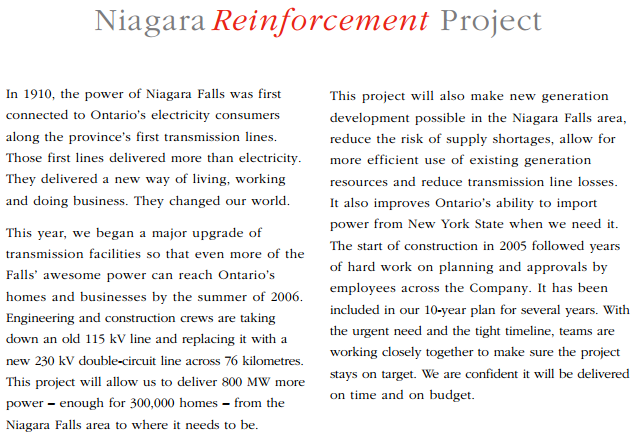
NiagaraReinforcementLet’s talk about leadership, fortitude and commitment again – as I did inwasted on the traditional territory of the Mississaugas.

The NRDC project is located to the north of a transmission line the government has avoided entering into service for many years. That line was seen critical to increased trade, and growing the ability to “deliver 8000 MW more power … from the Nagara Falls area to where it needs to be.”

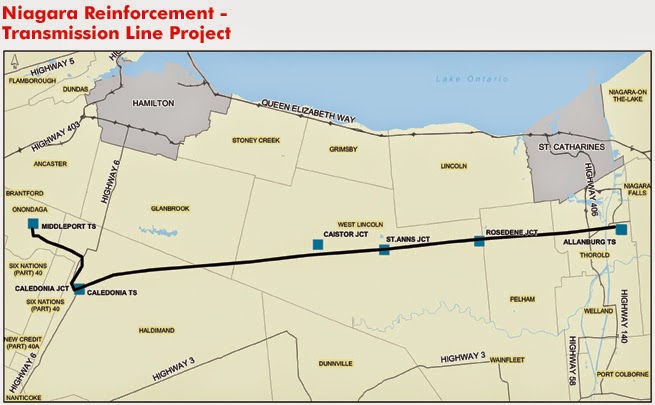
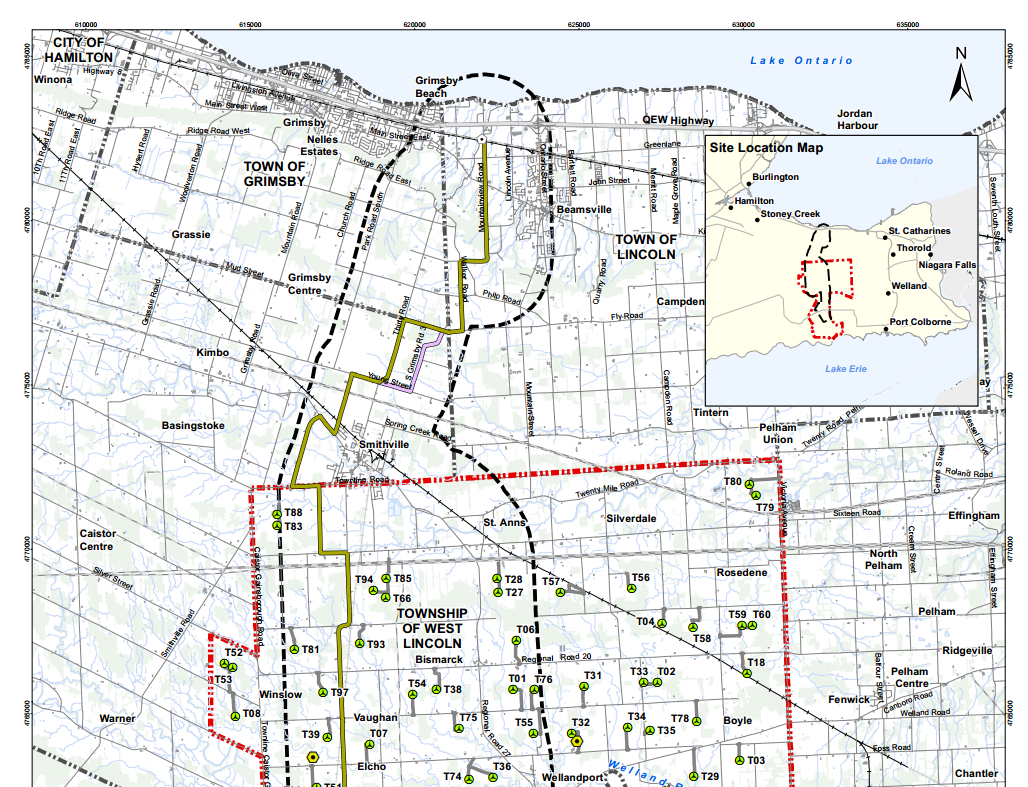
I’ll try to show, with 2 maps, how the non-completed transmission project and the NRWC project relate.

map_niagaraThe Niagara reinforcement line runs east west (it’s not connected because of a nonsense, and the nonsensical response to nonsense, outside Caledonia).

Hydro One is essentially required to provide renewable energy projects access to the grid, so the NRWC project will connect by crossing the inactive Niagara Reinforcement line south to Lake Ontario where Hydro One will dutifully construct capacity to accommodate the “renewable” energy project.
NRWCThe generation project planned in conjunction with the Niagara Reinforcement line, was a tunnel to increase the output of Niagara Falls. It was announced “in-service” March 2013. I upset some people I respect when I wrote on generation not improving anywhere near the extent expected (if at all) and attributed that failure to the transmission reinforcement project not getting done.
Unfortunately, nobody did explain how I was wrong and why the tunnel wasn’t increasing output.

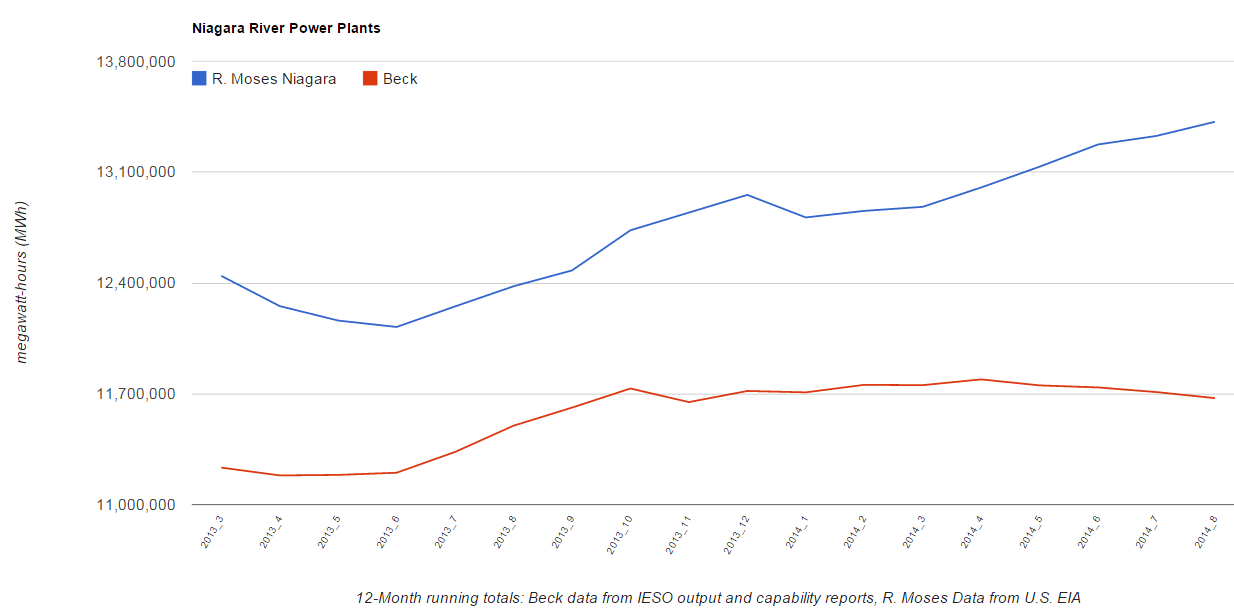
Here is an update on how 12-month running total generation has changed since, with a comparison to the facilities on the U.S. side of the river. (I understand that water rights are equal):

NiagaraPP (1)
Oops! The upgraded Canadian side isnt’ getting more power, but the American side is benefiting from the higher lake levels recently. It not only continues to look like the legacy asset beraing Sir Adam Beck’s name are underutilized due to transmission restraints, it looks more likely today than ever before.We don’t improve transmission for trade and to access affordable public power assets anymore – just for hugely expensive and often unnecessary generation from private party funders/power producers.

It would be lovely if it was possible to teach Brad Duguid what “ fortitude and commitment ” can be. Given Ontario’s kangaroo courts – which includes its real ones – I doubt that’s possible, but if you have faith, I know the Smithville Turbine Opposition Party would welcome support.

MOH Disappointed in Turbine Study

Dr Lynn says more information is needed on Health Canada study.

page_Wind_Turbines_110The Medical Officer of Health for Grey Bruce is disappointed with a Health Canada report on wind turbines.

Doctor Hazel Lynn says the study leaves a lot of questions unanswered, including how the study was conducted.

Health Canada says it found no evidence linking exposure to wind turbine noise and health effects reported by people living near the towering structures.

However, the study did find a relationship between increasing levels of wind turbine noise and residents’ annoyance related to noise, vibration and shadow flicker from the structures.

The year-long study included a detailed questionnaire to adults in more than 1,200 households in southwestern Ontario and P.E.I. living at various distances from almost 400 wind turbines.

It explored the relationship between exposure to noise and health effects reported by people living near wind turbines.

Doctor Lynn wonders if the people questioned in the study were compared to people living a further distance away, and also what Health Canada means by saying there is a link between wind turbine noise and residents annoyance.

She says it doesn’t have a definition and we don’t have a way of measuring it.

Overall, the MOH says she doesn’t know what to make of the study without more information.

The Health Canada report concludes by saying the study alone cannot provide definitive answers and more research may be needed.

Bayshore Broadcasting, Friday, November 7, 2014 by Kevin Bernard