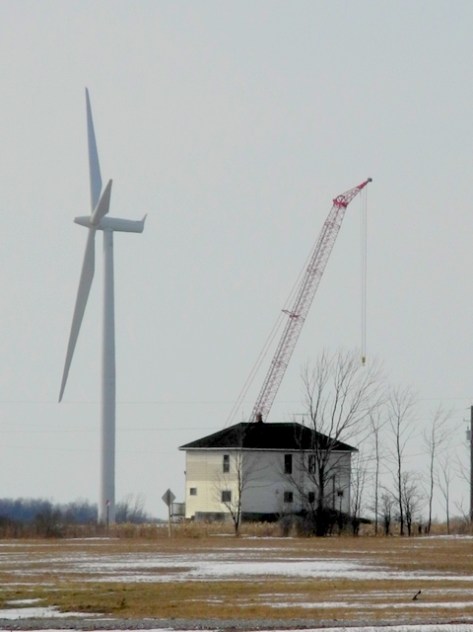
The following is a letter to the Standing Committee on the Green Energy and Economy Act in back in April, 2009. It could have been written a month ago. Clearly the “Economy” target of the Liberals Act took precedence over health and safety as billions have been funneled out of the tax coffers to the owners of these projects. Thousands of complaints have been suppressed. Untold number of families have been impacted. Most irreparably.
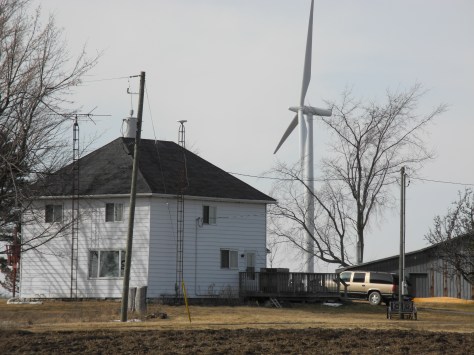
“The windmills started up at the end of November/early December 2008 and it was only after they started them up full time that we started having problems. They were so loud we could not sleep. It was aggravating and exhausting. The one closest to us is 456 metres behind us to the west and the next is just less than 700 metres to the east. We can hear them equally well and they cause terrible noise…
Norma Schmidt of Kincardine is no longer able to live at home due to health effects suffered after the wind turbines became operational.
The Schmidts of Kincardine in Ontario left their home in 2009 when debilitating health symptoms occurred after the wind turbines of an Enbridge project became operational. They are currently pressuring the Ministry of the Environment and Climate Change (MOECC) to undertake noise testing in a full sound spectrum including infrasound (inaudible) measurements.
Monday, April 10, 2017
Couple seeks help on wind turbine concerns.
Kincardine | by Craig Power
Kincardine residents want new tests done on Enbridge project.
A Kincardine couple is seeking Council support in their quest to have the Ministry of the Environment and Climate Change to investigate noise emissions from the Enbridge Wind turbines on Concession 6.
Norma and Ron Schmidt have had to move from their home due to health related issues they say are associated with infrasound from the nearby wind turbines.
Rachel Thompson, spokesperson for the Central Bruce-Grey Wind Concerns Group, says the project began in 2009 and they still don’t know if Enbridge is in compliance.
So far the Ministry has only done testing on the ‘audible’ noise emissions but they have not yet tested the ‘inaudible’ or ‘infrasound’ emissions which are known to cause adverse heath effects.
A noise modelling report conducted by Valcoustics Canada Incorporated showed an asterisk beside 6 properties within what they refer to as ‘ground zero’ for noise emissions, with the Schmidt home among them.
Thompson says “the report also stated that we cannot be certain that these 6 homes will not fall within the safe range of audible noise.”
At the April 5th meeting, Kincardine Council voted to support the Schmidt’s letter of request for further investigation by the Ministry of the Environment and Climate Change.
The pressure is being applied to the Owen Sound Office of the MOE with hope that testing will be conducted and answers reached.
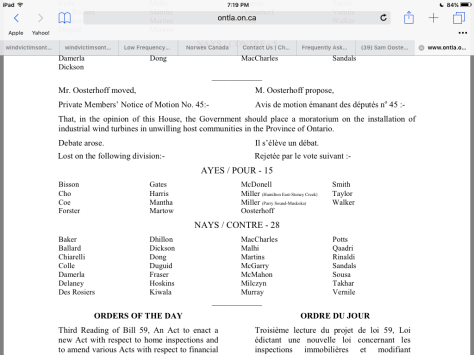
Motion tabled at Queen’s Park to halt industrial wind turbines by MPP Oosterhoff
(Queen’s Park) April 6, 2017
Niagara West-Glanbrook MPP Sam Oosterhoff :
“The Liberal government forced turbines on municipalities across rural Ontario against the wishes and concerns of residents and communities such as West Lincoln,” said Oosterhoff. “This stubborn initiative of the Liberals shows no respect for municipalities or for the ordinary concerns of Ontarians.”
“Industrial wind turbines are one of the causes of our sky-rocketing energy costs because of the unaffordable contracts made by the Liberals,” noted Oosterhoff. “Heat or eat is not a decision people should have to make.”
“The Liberals have a long history of ignoring municipalities and local residents. The NDP pretend to support local decision-making, but instead they supported the legislation that left municipalities without a voice on the placement of industrial turbines,” said Oosterhoff. “Tomorrow, they will have a chance to make amends and show respect for our communities by voting for my Motion.”
Motion:
“That in the opinion of this House, the Government should place a moratorium on the installation of industrial wind turbines in unwilling host communities in the Province of Ontario.”
“This brings us to indefatigable wind warrior Esther Wrightman, an Ontario wind turbine refugee who fled to New Brunswick. Last year she filed a Freedom of Information request (FOI) with the Ontario Ministry of Natural Resources and Forestry in order to obtain the wind industry’s mandatory bird and bat mortality reports. In January she finally received “loads” of them, for a hefty fee. The mortality numbers are disturbing. Esther writes:
As the bird and bat mortality reports are slowly uncovered, the numbers just seem to get worse and worse. I never imagined it could get this low, but then again nobody was releasing this info to the public, so how were we to know?”
You’ve heard that wind turbines are no louder than refrigerators at 40 decibels? That measurement is taken a foot or two away from the bottom of the refrigerator.
If 40 decibels is acceptable to you, then maybe refrigerators should be installed on your night stand next to your bed. Please make sure the refrigerator is set to turn on and off, on and off every two seconds to simulate the wind turbine blade’s movement. Do you really think that two-second intermittent noise all night long will lull you to sleep?
The scientific studies referred to by wind energy companies are often wind energy-funded studies. And when recent studies from many independent researchers are published that comment on audible noise, pulsation/vibration, and shadow flicker affecting nearby residents, the wind faction is quick to dismiss, trivialize, debunk, and simply ignore that information.
Michigan State University has been promoting sample zoning for wind energy systems that was highly permissive toward wind development and darn near hostile to neighbors of wind turbines. The animosity created in communities with unsafe wind development favoring wind developers may take years to disappear.
It’s a brand new ball game because, on March 6, MSU released its new wind energy sample zoning regulations. MSU researchers don’t condone prohibiting turbines. They condone safe setbacks.
The study informs the uninformed about wind development and reasonable land use regulations. These new recommendations are extremely important and confirm all of the things so many people in Michigan have worked so hard for.
Here are some highlights of the MSU recommendations:
Sound Level — On-site use wind energy systems shall not exceed 40 dB(A) at the property line closest to the wind energy system. This sound pressure level may be briefly exceeded during short term events such as utility outages and/or severe wind storms.
One MSU recommendation is a turbine setback of 2,500 feet from the property line of any parcel which is not receiving compensation for the Utility Grid Wind Energy System.
And, to show how wind energy is losing its grip in Michigan, here is a recent straw poll: In Ingersoll Township, Michigan (just south of Midland), board officials took a poll of 88 people at their March 22 board meeting. Results?
• 75 against wind development in township
• 3 for wind development in township
• 10 undecided
The money a community can make and the money a large landholder can make certainly is important. But, it’s the only bullet the pro wind faction has. However, to allow so many large landholders a financial gain is to throw the neighbors of wind turbines under the bus.
Norm Stephens
Caro
New wind energy resource for planning commissions; Michigan State University
Abstract: Large numbers of migratory bats are killed every autumn at wind energy facilities in North America. While this may be troubling from a population perspective, these fatalities provide an opportunity to learn more about bat migration and the origins and summer distributions of migratory bats by using endogenous markers. Such markers include stable isotope values, which have been used to answer questions about ecological systems, such as trophic levels and food webs, and the origins and migratory routes of animals. To estimate the origins of migratory bats, we determined nitrogen (δ¹⁵N), carbon (δ¹³C), and hydrogen (δ²H) stable isotope values of fur (δ¹⁵Nf, δ¹³Cf, δ²Hf, respectively) from hoary bats (Lasiurus cinereus) and silver-haired bats (Lasionycteris noctivagans) killed at a wind energy facility in southern Alberta, Canada. We determined that mean isotope values varied among species, year, sex, and age class. δ¹³Cf and δ²Hf values indicated that silver-haired bats likely originated in the boreal forest, farther north and/or at higher elevations than the aspen parkland-like habitat suggested by the isotope values of hoary bats. IsoMAP analysis indicated that bat fatalities may have originated from a large catchment area potentially hundreds of kilometers away. Our data provide further evidence for a migration route along the eastern slopes of the Rocky Mountains that is used by bats from across Alberta and beyond, and suggest that fatalities at a single wind energy site have the potential to have far-reaching ecological and population consequences.
E. F. BAERWALD, W. P. PATTERSON, and R. M. R. BARCLAY
Department of Biological Sciences, University of Calgary, Calgary, Alberta, Canada; and Saskatchewan Isotope Laboratory, Department of Geological Sciences, University of Saskatchewan, Saskatoon, Saskatchewan, Canada
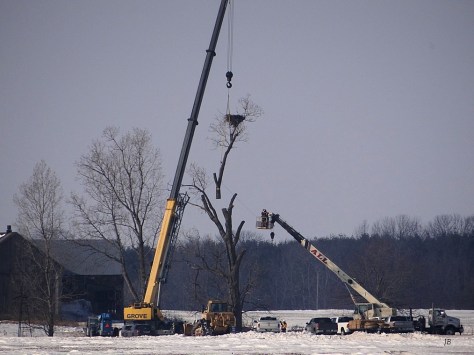
PHOTO BELOW: University of Calgary bat researchers Cori Lausen, left, and Erin Baerwald, perform a bat carcass search at a wind energy site in Southern Alberta.
The judicial review of the White Pines cultural heritage process, brought by Liz Driver and Edwin Rowse against wpd Canada and Ontario, will take place on Thursday and Friday, April 6–7, at Osgoode Hall, in Toronto. The hearing begins at 10 am each day.
It will be important to show the court that the community cares about the project’s visual impacts and construction vibrations on the County’s cultural heritage.
Osgoode Hall is at the northeast corner of Queen and University. There is Green P parking underground next door at City Hall or parking across the street under the Four Seasons Centre for the Performing Arts. Osgoode Subway Station is at the intersection.
MPP Niagara West-Glanbrook: Sam Oosterhoff Legislative Assembly of Ontario
Today, I tabled a motion in the Legislature to place a moratorium on industrial wind turbine development, that will be debated this coming Thursday, April 6. Queen’s Park
SHARE this post if you want to see the Liberals stop the wind turbines!
Across Niagara, and across the province, residents and municipalities have seen industrial wind turbines shoved down their throats by a government that fails to recognize local decision making.
My motion reads as follows:
“That, in the opinion of this house, the Government should place a moratorium on the installation of industrial wind turbines in unwilling host communities in the Province of Ontario.”
Summerhaven Wind Turbine (Next Era) Haldimand County, Ontario
TV reception in many areas suffers with the installation of industrial wind turbines. The Summerhaven wind (Next Era) project located in Haldimand County as one example responded to multiple complaints about poor TV signals by commissioning a cheeky report in 2014 ( posted online shortly after that project became operational). The conclusions of the hired opinion was that complaining people were ever so pleased and delighted to receive proper direction on how to improve TV reception by not using misaligned and broken antennas. One project operator’s response to reported problems but has it succeeded in redirecting criticism that turbines are to blame or fixed the problem? In 2017 deteriorated TV signals persists as an unresolved issue as demonstrated in the following letter recently published in the local paper.
“I see problems for broadcasters and the wind turbine operators. They are required to work in accordance with the requirements of the federal government. I feel that a petition signed by a number of citizens with their addresses and locations would have a possibility of resolving the situation.”
While removing a recent snowfall from our porch deck, the telephone rang and a volunteer from TV Ontario was asking for their annual donation. I have the highest regard for their TV programs, presence and availability — especially with the conversion from analogue to digital a few years back.
We had over-the-air TV for many years at our location and it has been quite successful with the conversion to digital, with improved picture and sound.
However, with the commissioning of wind turbines, we frequently notice a decline of the TV signal’s strength — resulting in unacceptable audio quality, which in turn, makes the entire TV signal unwatchable. If a satisfactory TV signal strength can be maintained, the process will correct itself and the TV becomes highly desirable.
Canadian TV for the east end of the Niagara peninsula is basically fed from transmitters on the CN Tower in Toronto in a straight line to the various over-the-air antennae, and passes by many wind turbines — and their associated impulse noises — resulting in the aforementioned problems. The principal TV transmitters are CBC, CTV, TVO and Global, as well as several smaller stations.
The wind turbine operation and TV system may be a question of co-ordination between the turbine power generator and associated electrical demand, as well as the population’s desire for TV — both for necessity and enjoyment.
Satellites in the upper stratosphere can be used whereby signals from the transmitter — CN Tower — can be reflected off to be received at a customer’s home, thereby obviating the wind turbine problem. However, this results in a cost for installation and ongoing rental of equipment.
To my TV Ontario fund requester, I felt I had to explain that they were a worthy charity that does a superb job, but I would not want to spend the funds and be unable to enjoy the fruits of their effort. Due to the havoc caused by wind turbines, I therefore declined their request until signal improvements can be made.
I see problems for broadcasters and the wind turbine operators. They are required to work in accordance with the requirements of the federal government. I feel that a petition signed by a number of citizens with their addresses and locations would have a possibility of resolving the situation.
We have put together this petition and have over 70 signatures at present. We feel we need more and request readers of the The Sachem to endorse this petition.
Hopefully this can provide Haldimand with better television reception.
V. Huxtable
Dunnville
905-774-6822
Summerhaven Wind Turbine (Next Era) being erected in 2013 Haldimand County, Ontario
Three people were arrested and various homes and office buildings were raided on Tuesday in an investigation into 8 million euros worth of fraud committed by Dutch investment company Hollandsche Wind. The Public Prosecutor and tax investigative service FIOD also seized several cars, Tubantia reports.
According to FIOD, the now bankrupt Hollandsche Wind was used to commit Ponsi fraud – an illegal pyramid scheme. Investors paid a minimum of 5 thousand euros and were promised high returns on wind energy projects. But their returns were paid with money from new investors. No money was ever invested in wind farms or real estate. According to the Prosecutor, the fraud amount is around 8 million euros…..