O!M!G! Wynnes new $400M Trade Deal in China is with … WAIT FOR IT!!!! … A COAL COMPANY!!!!

Donna Quixote's avatarQuixotes Last Stand

Tip o’ the hat to Glenn for this revelation!!!

From Kathleen Wynne’s FB page:

“The China trade mission has confirmed that Greenland Group is investing $400 million in Ontario and will create up to 200 new Ontario jobs!”

How wonderful.  I wonder what the Greenland Group does!!   DIRECT FROM THEIR WEBSITE:
“At present, Greenland Group has formed a complete industrial chain including production, processing, storage, transport and distribution of coal as well as storage, transport, trade and retail of petroleum, and owned several coal mines in Inner Mongolia and Shanxi Province, with gross resource reserve amounting to 700 million tons, annual output of more than 13.5 million tons, and distribution amount of over 55 million tons.
As for the product deep-processing field, Greenland Group has successfully acquired a coal deep-processing project in Dandong, Liaoning Province and a petroleum production-supply-marketing integration base in Zhoushan, Zhejiang Province, both of which substantially…

View original post 107 more words

Adverse Health Effects of Industrial Wind Turbines

wind turbine noise health

Adverse Health Effects of Industrial Wind Turbines  Jerry Punch PhD  Richard James INCE, BME

This article, the first of three installments, provides a broad overview of the topic. The second installment will review the major research findings linking low-frequency noise and infrasound from industrial wind turbines with effects on health and quality of life, and the third will discuss the relationship between various health effects and the processing of infrasound by the ear and brain.[1]

Cary Shineldecker was skeptical about the wind project the Mason County, Michigan, planning commission was considering for approval. His home, two miles from Lake Michigan, was located in an area where nighttime noise levels were around 25 dBA, with only occasional traffic and seasonal farmland noises. The rolling hills, woodlots, orchards, fields, and meadows surrounding his property contributed to its peaceful country setting. He voiced his skepticism about the wind turbines repeatedly in community meetings held beforeConsumers Energy was finally granted approval to construct 56, 476-foot, turbines that would place one turbine 1,139 feet from his property line (Figure 1), six within 3,000 feet, and 26 that are visible from his property.

He and his wife Karen started to suffer symptoms of ear pressure, severe headaches, anxiety, irritability, sleep disturbance, memory loss, fatigue, and depression immediately after the turbines began operating.

Gradually, as sleep disturbance turned into sleep deprivation, they felt their home was being transformed from a sanctuary to a prison. Deciding to sell their home of 20 years, they put it on the market in March 2011, and it has remained unsold for 3-1/2 years. For the past 1-1/2 years, their nightly ritual is taking sleeping medications and retreating into their basement to try to sleep on a corner mattress. They received few offers to buy their home, and recently accepted an offer that would mean a substantial financial loss. They are scheduled to go to trial against Consumers Energy, and if their case goes to settlement without a trial, they will likely be forced into a confidentiality agreement about their case.

Similar complaints of adverse health effects (AHEs) associated with living near utility-scale wind turbines have become commonplace in the U.S. and other developed countries. Energy companies in the U.S., motivated by lucrative tax subsidies available for developing wind resources as a form of green energy, are pushing aggressively to install more wind turbines, typically locating them near residential properties. Many rural residents now have one or more industrial machines that stand over 40 stories tall on the property alongside their home. Complaints about noise from people living within the footprint of wind energy projects are very similar to those experienced by the Shineldeckers.

Those who have never visited a wind project or who visit one only during the daytime often leave believing that the complaints of noise are unfounded, and commonly assume them to be psychologically motivated or a form of NIMBYism [1]. Those living near wind turbines say that unless one is willing to spend several nights in the area they have not experienced the noise that causes the complaints.

Article can be read here.

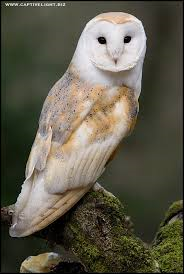
Barn owl halts turbine project | Simcoe Reformer

barn owl

By Daniel R. Pearce

The barn owl has done what no anti-wind turbine protester in Port Ryerse has been able to do to date: halt construction of a green energy project in their village.

A woman walking her dog this summer spotted one of the birds — they are on the endangered species list in Ontario — flying into a barn.

An investigation ensued, photographs of the owl perched on a woodpile were taken, and the sighting was confirmed. The evidence was then presented to an environmental review tribunal hearing, which last week slapped a five-month moratorium on the project.

Boralex, the company that wants to construct a four-turbine 10-megawatt wind farm next to Lake Erie, must now apply to the Ontario government for what’s known as an “overall benefit permit” if it wants to continue with the project.

It must submit an amended plan showing how the wind farm will avoid having a negative impact on the owls and that it has explored alternative sites. It must also show it will do something to help the birds, such as creating new habitat.

The tribunal hearing has been adjourned until March 31.

The Port Ryerse case is the first time a project in Ontario has been ordered back to the drawing board due to the presence of barn owls.

As a result, “there are a number of unknowns right now that will take some work and some time to bring to a conclusion,” Sylvia Davis, legal counsel for the Ontario Ministry of the Environment and Climate Change, wrote in an email to the parties to the hearing.

The barn owl is so rare there have only been four confirmed nesting sites in the province in the past decade and maybe a dozen or more confirmed sightings, said Bernie Solymar, a member of the Ontario Barn Owl Recovery Team who happens to live in Port Ryerse.

Read rest of article here.

And this related article as well.                                                          Barn owl killed by wind turbine-they said such a thing could not happen.

Vanishing Legacies: A Celebration in Film of the County’s South Shore

Save Ostrander Point

Thursday, 27 November 2014 from 7:00 PM to 9:30 PM (EST)

Picton, ON

CaptureVANISHING LEGACY, a film by Suzanne Pasternak, traces the history of the Lake faring families of South Marysburgh, Prince Edward County from the end of the American Revolution when they landed as United Empire Loyalists on Prince Edward’s shores to the final years of the commercial fishing industry.
Since 1983 Suzanne Pasternak has been documenting and preserving the unique maritime history of the south end of Prince Edward County, Ontario. She has created a large catalog of multimedia archival material she is currently organizing to form a major collection for Prince Edward County Archives and the Museum of the Great Lakes in Kingston. Her award winning documentary: Vanishing Legacy: The History of the Lakefaring Families of Prince Edward County is a culmination of her research since 1983 to 2013.

THE LIGHTHOUSES OF THE SOUTH SHORE – Presentation by Marc Seguin of Save Our Lighthouses: Between 1828 and 1914, one of the world’s greatest concentrations of lighthouses and light towers was constructed in eastern Lake Ontario waters. Five of these aids to navigation were built along the south shore of Prince Edward County in an area known by mariners as “the graveyard of Lake Ontario”.
Heritage enthusiast, historian and founder of Save Our Lighthouses, Marc Seguin, has documented the history of these lighthouses in his upcoming book, “For Want of a Lighthouse”. He will give an illustrated talk highlighting the lighthouses of the County’s south shore and the important role that they played in guiding ships to safety through some of the most dangerous waters of the Great Lakes.

HISTORY MOMENTS by Peter Lockyer of History Lives Here: Peter Lockyer, former CBC Radio and Television Broadcaster, has produced a series of film vignettes detailing the history of Prince Edward County and the Quinte area. We will screen selected vignettes about the activities historically carried out along the South Shore.

Musical Performance: Suzanne Pasternak and Tom Leighton will perform songs from the movie.

https://www.eventbrite.ca/e/vanishing-legacies-a-celebration-in-film-of-the-countys-south-shore-tickets-14093248285

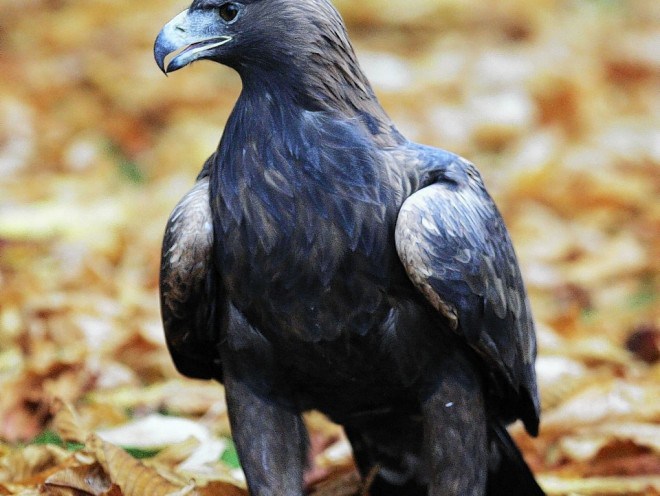
‘Windfarm cover-up over golden eagle deaths’ – claim campaigners

Environmentalists and anti-windfarm campaigners suspect a cover-up over the number of golden eagles killed by wind turbines.
golden-eagle-660x496They believe a decision to put back a census of bird numbers by two years is an attempt to hide the facts from the public.

Scottish Natural Heritage said there was nothing sinister about the move, and there were practical and official reasons for extending the 10-year gap between censuses from 2003 to 2015.

Scotland Against Spin chairman, Graham Lang, said: “If the news is bad, bury it – which is why the census will not report until next year.”

Anti-windfarm campaigner Lyndsey Ward, from Kiltarlity, said protecting the population of the iconic golden eagles must be of “paramount importance”.

“Perhaps officials don’t want to know, or the public to know, what is really happening to the eagle population in Scotland so they can allow this turbine tsunami to continue unabated,” she said.

The RSPB said that while the population of golden eagles had been “static” for years, the cause was not windfarms but “ongoing illegal persecution”.

A Scottish Natural Heritage spokeswoman said that under a periodic review of the rolling programme of species surveys carried out by the Joint Nature Conservation Committee it was decided to move to a 12-year cycle.

This was partly to make sure that the rolling programme was affordable and to fit in with EU Bird Directive requirements for six and 12-year monitoring.

The spokeswoman added interim data suggested no decline in eagle numbers meant the census could be moved to a 12-year cycle, unlike hen harriers and capercaillie which were prioritised on a six-year cycle.

The claim of a cover-up followed last week’s revelation that wind turbines have killed more birds of prey this year than poisoning and shooting combined.

Mark Duchamp, chairman of the World Council for Nature and president of Save the Eagles International, said there was no reason to delay the survey into golden eagle numbers.

“The reason in my opinion, they have something to hide,” he said.

“They don’t want to show the population of golden eagles in Scotland has fallen quite substantially since the windfarms were built.”

Anti-windfarm campaigners shared the concerns of Spain-based Mr Duchamp.

The Press and Journal, By Tim Pauling, Nov 3 2014

West Grey County Stands up to Big Wind.

West Grey County are acting to protect their county’s best interests by delaying a signature on a road use agreement.

The outcome is presumed to be predictable (ie they will be forced to sign against their best judgement) but that didn’t stop them from standing up for what is right!!  

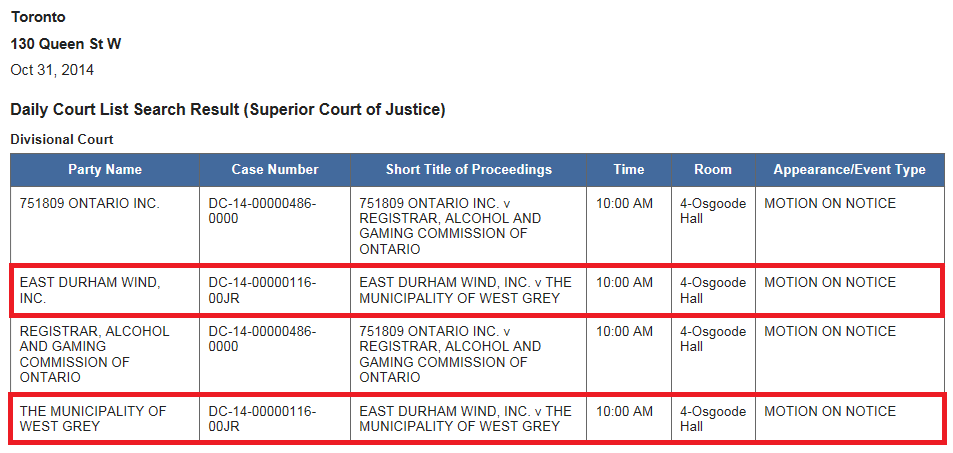
Municipality of West Grey in Toronto Courts Fights For Justice

west-grey-superior-court-of-justiceEast Durham Wind (NextEra), the wind energy company is taking the Municipality of West Grey back to court because the Municipality of West Grey did not approve road allowances​ when East Durham Wind did not give comprehensive routes of how they intend to bring in and use our county roads to build their wind turbines.

How Green Is This, Oct 30 2014

MPAC and Wolfe Island, again.

INTRO

Several months ago Stewart Fast, a new professor at Queens University in Kingston, Ontario, undertook a study of why southern Ontario was such a hotbed of anti wind energy sentiments.  His conclusions were interesting, and I’ll be having more to say about them in a future posting.  As part of his study he looked at property values and in particular he looked at MPAC (the Ontario real estate assessors), Wolfe Island and the property assessment reductions thereon.

As it happens, I had also looked at MPAC and Wolfe Island and posted on it about 18 months ago.   It seems that Fast and I used the same FOIA-obtained spreadsheet.  My main conclusion was that there seemed to be a large number of large reductions on Wolfe Island, but there wasn’t enough of a pattern to convincingly tie the reductions to the 86 wind turbines on Wolfe’s west end.

I’ve also posted on MPAC and property assessments in a 4-part series.  My main conclusion, contained in part 1′s section, was that MPAC seemed to be hiding the reductions by lowering the values in neighborhoods that just coincidentally happened to be around wind turbines, but not formally incorporating distance to a wind turbine into their regressions.

What Dr. Fast’s work added to mine was that (1) he was able to group MPAC’s reductions on Wolfe Island by their distance to the nearest wind turbine, and (2) he reminded me of how to usechi-square to test the differences between the bands for statistical significance.  The quick summary is that MPAC has been providing reductions to properties close to wind turbines significantly more often that those further away.  And I’m not using the word “significantly” in some fuzzy qualitative manner – I mean “significantly” in the hard statistical quantitative manner.  In other words, the odds of the getting a wind-turbine-centered pattern just randomly are vanishingly small.  Wolfe Island provides a good hard-to-refute example of how MPAC is finessing the numbers to deny the obvious. Continue reading MPAC and Wolfe Island, again.

Green energy vs. the protection of endangered species.

Appellants from Port Ryerse opposing the Boralex project

Because of the barn owls the MOE has asked for an additional adjournment of 5 months until March 31st 2015. 

However, Boralex has requested an” Overall benefit permit”  for the Owl predicament.

  • This means they have requested to be able to disturb the owls nesting habitat 
  • They can also get a permit if killing the birds will improve the economy of Ontario.

THIS will be THE FIRST ever benefit permit in Ontario given ( or not) for barn owls . Please read :

Dear Ms. Pietrzyk and counsel

In preparation for tomorrow’s teleconference, MOECC has been in communication with MNRF and proponent’s counsel regarding the ongoing process under the Endangered Species Act.

We understand from MNRF that staff at MNRF have reviewed the information submitted by the proponent on the recent confirmed siting of a Barn Owl. MNRF Aylmer District staff have advised the proponent that:

  1. Based on the information provided, MNRF can confirm that the proponent will require an overall benefit permit under section 10 (habitat) and section 9 (harm or harass a species) under the Endangered Species Act; and
  2. The proponent will now be required to move forward on submitting an Avoidance Alternatives Form and an application for the Overall Benefit Permit.

MNRF has also informed MOECC that this will be the first Barn Owl Overall Benefit permit developed in the Province and there are a number of unknowns right now that will take some work and some time to bring to conclusion – including some identification work through the Royal Ontario Museum.

In light of MNRF’s position on the ESA permit, the Director requests a further 5 month adjournment, with the caveat that:

(a) the Director agrees to immediately inform the Tribunal and other parties if the permit is issued prior to the end of the five month period; and
(b) a teleconference is arranged 4 ½ months into the adjournment to provide the Tribunal and other parties with an update (should the permit still not be issued at that point).
Please read the benefit permit requirements at:  http://www.ontario.ca/environment-and-energy/endangered-species-act-overall-benefit-permits

Because the owl is also protected at the Federal level a letters should go to the ministers at both Federal and Provincial levels.   This is a significant permit being developed, please write your own letters to:

The Honourable Leona Aglukkaq
Minister of the Environment

Minister@ec.gc.ca 

Points would be:

  • the first sighting in 5 years.
  • benefit will not be to the owls nor to Ontario
  • this a federally protected species so therefore the Federal Minister needs to get involved.
  • describe the small land area and how the owls feel safe here.
  • any construction activity will  destroy not only where they are nesting but also the roadside ditches where they are finding their food.
  • how it is in close proximity to a conservation area which gives protection.
  • the proponents own staff and the Provincial MNRF concurred eagles would not nest here and two months later we had eagles nesting.
  • they didn’t get that right- how can we trust them to get this very significant permit – the first one ever to be asked for 
  • ask that the Federal minister over see this permit development.

Please come out to this presentation:


CaptureA Special Presentation
AT RISK IN PT. RYERSE!

Learn how to identify species-at-risk
and how you can help protect them.


Speakers:
James Cowan, Canadian Raptor Conservancy and
Bernie Solymár, EarthTramper Consulting Inc.

Pt. Ryerse Memorial Church
Thursday, November 6th
at 7 P.M.
Meet a live Barn Owl and Bald Eagle!

A small donation will help defray the cost of the room rental.

Printable PDF: A Special Presentation AT RISK IN PT. RYERSE! FLYER

Vote NO on Big Wind

The debate is no longer about the fear of change or aesthetics. It’s about preserving the health, safety, and welfare of communities from developers hell-bent on sticking turbines on every free acre with transmission access no matter who’s in the way. More than twelve active lawsuits are pending against wind projects in as many states, and more are sure to follow.

no_wind_400x400U.S. voters are unhappy with the direction of the country. The big ticket issues — ISIS, Ebola, the sluggish economy — are dominating the national dialogue and will sway votes.

But for many thousands of Americans, next week’s election is deeply personal. For them it’s their best opportunity to drive back the spread of industrial-scale wind power that’s plowing through quiet communities and destroying families. On November 4th, they will be checking the box next to those candidates who promise to permanently end the wind production tax credit (PTC). Continue reading Vote NO on Big Wind

How green energy is fleecing Ontario electricity consumers

Adding renewable generating capacity triggers changes throughout the system that multiply costs for consumers

Ontario’s green energy transformation – initiated a decade ago under then-Premier Dalton McGuinty – is now hitting consumers. The Nov 1 increase for households is the next twist of that screw. As Ontario consumers know all too well, the province has gone from having affordable electricity to having some of the highest and fastest-increasing rates in Canada.

But complex financial structures and a lack of official disclosure around large embedded costs have let supporters of the green energy act deny that green power is responsible for the price hikes. Green industry advocates, including the consulting firm Power Advisory and advocacy group Environmental Defense, have added up the direct payments to new renewable generators, and concluded that since those costs are relatively small, the impact of renewables on the total cost of power is likewise small. Continue reading How green energy is fleecing Ontario electricity consumers

Protecting our children from Industrial Wind Power Emissions is our first priority!