Category Archives: Ontario Wind

No guarantee town safe from turbines

No guarantee town safe from turbines

Niagara This Week – St. Catharines

Re: Grimsby to examine turbine question, Nov. 7.

I chuckled at comments made by Mayor Bentley and Ald. Seaborn assuring residents that Grimsby will not be considered for wind turbines.

Mayor Bentley seems to think that there is a lack of wind that makes Grimsby unsuitable but I suggest that residents check out the wind speed maps on the Ministry of Natural Resources website. They will see that the wind speeds in Grimsby may actually be slighter better than those documented for both Wainfleet and West Lincoln where wind projects have been approved or are in process. In fact, the maps show many parts of Ontario where the wind speed is no different than that experienced in Grimsby yet they now have hundreds of wind turbines.

Mayor Bentley and Ald. Seaborn are dead wrong if they think Grimsby is somehow safe from the onslaught.  The wind speed maps on the MNR website show many areas where the wind speed is considered less than acceptable yet wind turbine projects have been approved.

Once the wind projects start, they continue to get approved. Look at the experience of other areas where over the past few years; many projects were approved and have resulted in hundreds of wind turbines. It starts with one small project and then it continues. Chatham-Kent has 629 wind turbines either already erected or in process, Huron is at 512 and Thunder Bay is at 537.  Check out the wind speed maps for those areas and then ask if Grimsby is safe.

I would suggest that the part of Grimsby above the escarpment is a very likely target, particularly after the infrastructure for transmission is in place. Two projects have now been approved for Niagara and the third is in process. It won’t stop there, and residents in other parts of Niagara should be aware of that. Chatham-Kent is approximately the same size as Niagara and to achieve the numbers that the provincial government is committed to, they will have to look beyond Wainfleet and West Lincoln.

Courts have recently ruled that Trillium Energy could sue the province for pulling their contract to place wind turbines in Lake Ontario. It was the Liberals that chose to declare a moratorium on off-shore wind turbines prior to the last election. The recent court decision may affect the province’s policy on wind turbines in the Great Lakes. Residents of Grimsby could very well find themselves looking at wind turbines in the lake and atop the escarpment, as they can be seen from miles and miles away.

Mayor Bentley and Ald. Seaborn should not be making promises that they may not be able to keep. Although it doesn’t guarantee anything, residents of Grimsby should be demanding that Council declare the town to be a unwilling host.

 Henry Van Ryn,

Grimsby


No guarantee town safe from turbines.

OFA takes the blinders off!!!

http://quixoteslaststand.com/2013/11/26/ontario-federation-of-agriculture-tables-motions-against-wind-turbines-and-their-impacts

The OFA is finally waking up to the fact, that turbines are more trouble than they’re worth!

Istockphoto image of a farm, barn

The Human Cost of the Green Energy Act

Garth Manning – November 17,  2013 – Toronto Sun

In 2009, the Ontario government, seeking to appear green, expropriated our property rights and democratic freedoms with its Green Energy Act (GEA).

The GEA removed the power of municipal politicians to represent their constituents in green energy matters and imposed 550 meters as a regulated setback in an attempt to protect rural citizens from industrial wind developments.

Many governments also fell in line with the worldwide movement to appear green, led by wind energy developers.

But not all governments had the good fortune of hearing firsthand from people already adversely impacted elsewhere by wind turbines near their homes, as was the case for Ontario.

And yet the Ontario government proceeded.

Unlike the costly Ontario process of appealing a wind project, Alberta has a different approach.

There, appeals to Environmental Review Tribunals are substantially subsidized by the developer.

By order of the Alberta Utilities Commission, developers pay a portion of appellant costs in advance, according to need.

In stark contrast, in Ontario, where turbines are much closer to rural neighbourhoods, each local or regional group must raise hundreds of thousands of dollars to cover all legal costs for each appeal and to challenge not only the wind company but also the Ontario environment ministry.

To defend their rights, Albertans and Ontarians are up against exceedingly well-funded, corporate lawyers and government-paid lawyers.

Toronto human rights lawyer Julian Falconer argues that the GEA and the government’s approval of wind projects “implicates their right to security of the person” as guaranteed by the Canadian Charter of Rights, in view of potential health impacts.

These health impacts were noted on Oct. 17, 2013 when the Ontario government’s Research Chair for Renewable Energy Technologies and Health at the University of Waterloo reported a statistically significant correlation between proximity to industrial wind turbines and sleep deprivation, tinnitus and vertigo.

The government of Ontario has been widely criticized, even by its own agencies, for its roll out of the GEA four years ago. Ontario’s Auditor-General reported in 2011 that a cost-benefit analysis was never done and there was no impact study of the effects on property values, tourism and health.

Ontario’s Environmental Commissioner and Ontario’s Environmental Review Tribunal opposed the effect of industrial wind turbines on wildlife at Ostrander Point.

Economists, health care providers, mayors, and those affected have consistently made their views known, but concerns have fallen on deaf ears.

Around the world, politicians have succumbed to corporate promises of “quick and easy” methods to save the planet from greenhouse gases.

Ratepayers pay the costs on their monthly hydro bills at ever-increasing government-set rates that include massive subsidies to multinational energy companies on the wind bandwagon.

This is heading toward a global scandal.

Governments don’t bother with cost-benefit analyses because most of the costs don’t show on their own books.

The result is much costlier electricity and no net reduction of greenhouse gas emissions.

But human costs are massive, including the loss of fundamental rights and freedoms, loss of our right to a good night’s sleep and good health, lost market value of homes, and loss of the right to enjoy non-industrialized rural landscapes.

So citizens are taking this high-priced battle to the courts where they hope our beloved Canadian Charter of Rights and Freedoms can protect us and our democracy.

— Manning is the Chairman of the County Coalition for Safe and Appropriate Green Energy (CCSAGE), Prince Edward County, Ontario

Original Article Here: http://www.torontosun.com/2013/11/15/the-human-cost-of-the-green-energy-act

Our prov. government is criminal!

http://quixoteslaststand.com/2013/11/15/ontario-are-new-moe-noise-guidelines-being-brought-in-to-further-hamper-wind-turbine-opposition/  Present noise guidelines do NOTHING to protect residents.  Now it is going to be even worse!  They change the laws to benefit the windweasels.

IWT Study – Results Statistically Significant

University of Waterloo Research Chair

Hello everyone,

The attached commentary is public and may be shared.

There seems to be a lot of interest in the results of the University of Waterloo Research Chair study on IWT health effects.

Attached is a commentary which indicates the social and perceptional circumstances regarding industrial wind development in Ontario.

These circumstances are based on reports from rural residents.

Reports of IWT related health effects are international in scope.  Some of the circumstances being reported in Ontario may be similar in other jurisdictions.

It is unclear whether the Ministry of Environment will react to the evidence available and the statistically significant results reported by the University of Waterloo study.

It remains to be seen if the MOE will respond by invoking prevention and precaution, and whether there will be a pause before approving more IWT projects.

Those reporting health issues in operating projects should not be forgotten and should be given remedy as soon as possible.

If you would like a copy of the poster which reported the study results, please let me know.

Respectfully submitted,

Carmen Krogh BScPharm

Ontario, Canada

carmen.krogh@gmail.com

Turbines affect you, too

Amanda Moore – Nov 8, 2013 – Grimsby Lincoln News
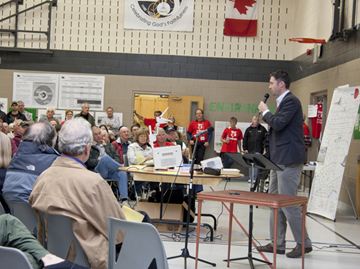
Industrial wind turbines affects everyone in Ontario. That is the key message a citizen’s group delivered to roughly 300 people in attendance at Smithville Covenant Christian School Thursday night.

“Just because you don’t live in West Lincoln, doesn’t mean it won’t affect you,” said Deb Murphy, a Dunnville resident who is vice president of the West Lincoln Glanbrook Wind Action Group. “There is a misconception that if you don’t live near them, they won’t affect you. It doesn’t matter if you live 550 metres from one or 550 miles. If you live in Ontario, they do so affect you.”

The information meeting held by WLGWAG was meant to target those living at a distance from the existing and proposed industrial wind turbines in West Lincoln. The group had hoped to attract residents from nearby Grimsby and Lincoln.

“We can see the ones in Caistor from our place, and they are the small ones,” said Grassie resident Cindy Poziomka, whose children and grandchildren live in Smithville. “I’m worried about the affects of children. Some of them are so close to Leisureplex. How can they put them so close?”

Cindy said she has not been following the battle between local residents and the corporations erecting the 80- and 140-metre high turbines. Her husband Rick, however, has been. Thursday’s meeting was the second one he attended. He said though the turbines won’t affect him at home, they will affect him in his pocket book.

“They won’t go near where we live because of flight paths, but it just doesn’t make sense to put them up anyway,” said Rick. “I’m not in favour of them for many reasons. The main reason being the effect on real estate. Some people are making tonnes of money at the expense of their neigbhour.”

The Posiomkas say they have seen how the issue has divided the township.

“You have kids on hockey teams who are fighting because one of them is getting a wind turbine,” said Cindy. “It’s divided the town.”

Members of the wind action group spoke on the many ways industrial wind turbines affect more than those who live near them.

Catherine Mitchell was given the difficult task of demonstrating the “true cost of industrial wind turbines.” While some will be directly affected by a hit to their property value (according to Mitchell’s research, property values in the Huron area fell between 25 and 60 per cent with the onslaught of wind turbines), all of Ontario will pay for it through the province’s costly Feed-in-Tariff program.

“Installed or in the que to be approved are 6,736 wind turbines,” said Mitchell. “Ontario will look like a pin cushion and we will not be able to afford to keep the lights on.”

Using a calculation of megawatts x operating efficiency x hours per year x cost, Mitchell said industrial wind turbines will cost more than $58.7 million a year in subsidies in the Niagara region alone. Over the 20-year span of the provincial contracts, that number totals more than $1.17 billion, she said.

“Who do you think is going to pay that bill,” Mitchell said as a warning to those in attendance.

Eric Ames, communications director for the Family Coalition Party, said the question Ontarians, including those awarded FIT contracts, failed to ask in the early days of the Green Energy Act was where is the money coming from.

Corporations and individuals with FIT contracts are guaranteed a set rate per kilowatt hour.

“Where does that money come from? From you and me,” said Ames, who attended Thursday’s meeting not to sway voters but to help spread the message of how these turbines will affect everyone in Ontario. “They were given contracts with the expectation that taxpayers would pay for this.

“If we continue down this road, we will all lose,” he said. “It affects everyone in this province.”

Another hidden cost of the Green Energy Act, Mitchell explained, is lawsuits. Anne Fairfield and Ed Engel know all about that. The West Lincoln couple is fighting IPC Energy’s HAF Wind Project, even as all five turbines stand a short distance from their home.

“Just to get this far, our legal bill was over $25,000,” said Fairfield. “This was paid by donations. It is going to take all of this community’s financial contributions to fight this problem and have a successful end.”

Engel and Fairfield are waiting on the outcome of several Charter of Rights and Freedoms challenges being heard across the province. These cases challenge the constitutionality of the Green Energy Act and its siting of industrial wind turbines.

“Your health, your safety, your wealth, your environment and this community are worth protecting now,” she said. “Help us to do this job for you.”

The crowd also heard from Mothers Against Wind Turbines chair Marianne Kidd about the impacts of turbines on children, Loretta Shields on the impacts to environment, Mary Kovacs on the dangers of transmission lines and Sidney Thompson on the loss of democratic rights.

West Lincoln mayor Doug Joyner attended the meeting for more than a show of support to his constituents.

“I’ve always said, knowledge is power,” said Joyner. “I am here to support the residents of West Lincoln and Wainfleet, but the biggest reason I am here is to have better information on this.”

The mayor and council have heard from several of Thursday’s speakers in council chambers over the past three years.

Turbines affect you, too.

NIMBY Information Evening – West Lincoln Glanbrook Wind Action Group

 West Lincoln Glanbrook Wind Action Group

www.wlwag.com

NIMBY-171x300NIMBY Hosting an Information Evening

Thursday 7th November 2013

Covenant Christian School Gym 6470 Regional Road 14, ( Town Line ) Smithville.

Doors Open 6:30 pm. Presentation 7:00 – 8:00 pm

Fund Raising Raffle – Silent Auction offering Great Prizes
(cash only please)

Discover why these topics do so effect you !

Proposed 77 Turbine project by Niagara Regional Wind Corp.
●Routing of Electricity Transmission Lines in your vicinity.
●Caistor Centre current installation of 5 Turbines by IPC.
●The Cost of Wind Energy and Your ‘Skyrocketing’ Electricity Bills.
●The Environment and Your Family’s Health.
●The Injustice of The Green Energy Act.

Get the information you need – Help us to support your case

All residents of WEST LINCOLN, GRIMSBY & LINCOLN are Encouraged to Attend
Make this a Standing Room Only Event – Bring your neighbour too

wlwag.com *** S-T-O-P.ca **** mothersagainstturbines.com

SHARE, SHARE, SHARE, SHARE, SHARE, SHARE, SHARE, SHARE

Weighing Ontario’s controversial choice on nuclear power

The Long-Term Energy Plan review now underway in Ontario demands our attention despite its sleep-inducing name. The choices the Wynne government makes will affect your pocket book, our economic competitiveness and the health of our environment.

And already the review has delivered a bombshell. Earlier this month, without waiting for the final analysis, expected later this year, Energy Minister Bob Chiarelli announced that “new nuclear will not be part of the long-term energy plan.” He maintains Ontario has a “comfortable surplus of electricity” and won’t need to spend upwards of $26 billion to build new nuclear plants.

I don’t get it .   Chiarelli states that we here in Ontario have a comfortable surplus of energy.  If that is the case and we have no need to build new nuclear facilities..then what is the point of adding more useless wind turbines?  Does anyone have a clue yet that, although the wind back-up gas plants are economical now..in a short time as those prices become tied into the global market, running those plants will also become expensive.  If the Liberal government is committed to conservation and planning wisely for the future then that practical path should include rethinking their our investment in useless wind and solar.

Predicting the province’s energy future is not an exact science. New technology will change the relative advantages of our different energy sources. Greater attention to conservation could further shrink demand. At the same time, massive developments like the “Ring of Fire” mineral find in Northern Ontario and a slow renaissance in manufacturing could increase demand.

Saving billions by not investing in new nuclear plants is supported by the best available analysis. With that decision made, the minister should shift his attention to containing future energy costs for consumers and business.

Rest of article here:

http://www.pennenergy.com/wirenews/powernews/2013/10/25/weighing-ontario-s-controversial-choice-on-nuclear-power.html

Also this interesting graph from the UK.

Read the rest of this article here:

http://blogs.telegraph.co.uk/news/willheaven/100243023/nuclear-power-vs-wind-farms-the-infographic-the-government-doesnt-want-you-to-see/

Wind power is blowing taxpayer dollars

Monday, October, 21, 2013 – 4:04:00 PM

Grant Church, Cayuga

Remember Premier Kathleen Wynne’s statement from the billion-dollar gas plant cancellation, “It will never happen again”?  It’s not worth the paper it’s printed on.

In the Auditor General’s 2011 report, he stated, “Based on our analysis of net exports and pricing data from the Independent Electricity System Operator (IESO), we estimated that from 2005 to the end of our audit in 2011, Ontario received $1.8 billion less for its electricity exports than what it actually cost electricity ratepayers of Ontario.” (2011 Annual Report of the Office of the Auditor General of Ontario page 112)

A total of $1.8 billion flushed down the toilet. Has the hemorrhaging stopped? Not at all. We continue to lose hundreds of millions dollars per year on exports, and it’s getting worse as more wind turbines are deployed.

Further in his report, he revealed, “In 2010, 86 per cent of wind power was produced on days when Ontario was already in a net export position.”

Has anything changed? Absolutely nothing. Wind power most often comes when we don’t need it and doesn’t come when we need it. Wind power is routinely bought at 13.5 cents/kWh and exported for 2.5 cents/kWh. All power is exported without the Global Adjustment, currently at 5.81 cents/kWh. We are supplying tens of thousands of homes and industry as the wind industry claims. It just happens to be at a subsidized rate in other jurisdictions.

So billions more are being blown despite our Premier’s assurances. The government is in a state of denial on these matters. The new rules to pay wind turbines to sit idle remain idle themselves, as the IESO lacks the resolve to use them.

Just remember how they insisted the Oakville gas plant cancellation would only cost $40 million.

My money is on the Auditor General.

See original article here: http://www.sachem.ca/opinion/wind-power-is-blowing-taxpayer-dollars/