Category Archives: Uncategorized

What I needed to say to the Anti-SLAPP Bill committee

thumbBill 52 was finally sent to committee last week and today was the first day of the hearing. I called in my appeal to reinstate the retroactive clause that the Liberals removed last December. The Liberals seem to be the only ones saying ‘no’ to this. Here’s what I said, (or what I wanted to say, I had to quickly cut a paragraph or two out to make it 5 minutes on the mark – I hate those hammers that tell you to stop speaking!)

read more:  http://ontario-wind-resistance.org/2015/09/24/what-i-needed-to-say-to-the-anti-slapp-bill-committee/

Vanishing Canada: Why we’re all losers in Ottawa’s war on data

Records deleted, burned, tossed in Dumpsters. A Maclean’s investigation on the crisis in government data

CANADA-storyWhen told that his small Prairie town had, in profound ways, fallen off the statistical map of Canada, Walter Streelasky, mayor of Melville, Sask., is incredulous. Streelasky had no idea Melville had been rendered a “statistical ghost town” after the mandatory long-form census was cut in 2010, and fewer than 50 per cent of Melville’s 4,500 residents completed the voluntary National Household Survey that replaced it in the 2011 census. Melville still exists—but as a shadow. We know how many people live there, but nothing about them—where they work, their education levels, whether they’re married, single or divorced, how many are immigrants, how many are unemployed, how many live in poverty. Melville’s numbers, then, aren’t factored into Canadian employment numbers or divorce rates or poverty rates. According to Sask Trends Monitor, the high non-response rate in the province resulted in “no socioeconomic statistics about the populations in about one-half of Saskatchewan communities.” Nationally, we’re missing similar data on 20 per cent of StatsCan’s 4,556 “census subdivisions,” making a fifth of Canada’s recognized communities statistical dead zones.

“To be dropped off the face of the Earth is pretty frightening,” says Streelasky, noting that Melville appears very much alive from his office: “We can smell the wildfires burning.” He plans to discuss the situation with his MP: “It’s the obligation of the federal government to make national data collection as complete as possible.”

Towns like Melville are far from the only entities vanishing from official Canadian records. Physicist Raymond Hoff, who published more than 50 reports on air pollution in transport and toxic chemicals in the Great Lakes—including pioneering work on acid rain—at Environment Canada between 1975 and 1999, doesn’t seem to exist, either. “Nothing comes up when I type my name into the search engine on [Environment Canada’s] website,” says Hoff, now a professor emeritus at the University of Maryland. Also gone are internal reports on the oil sands experiments of the 1970s. “That research was paid for by the taxpayer. Now, the people who need to protect Canada’s environment can’t get access.”

Protecting Canadians’ access to data is why Sam-Chin Li, a government information librarian at the University of Toronto, worked late into the night with colleagues in February 2013, frantically trying to archive the federal Aboriginal Canada portal before it disappeared on Feb. 12. The decision to kill the site, which had thousands of links to resources for Aboriginal people, had been announced quietly weeks before; the librarians had only days to train with web-harvesting software.

read more: McLean’s, Anne Kingston September 18, 2015

Kincardine Turbine Sound Study

Kincardine to get a “before and after” report on infrasound created by wind turbines

Kincardine council has approved spending over $60,000 to get a “before and after” report when it comes to noise and infrasound issues created by wind turbines.

CAO Murray Clarke tells Bayshore Broadcasting News Swallow Acoustics Consultants of Mississauga will undertake a study of infrasound levels while also studying current wind turbine installations in Kincardine.

Clarke says the consultants will determine benchmark background levels of audible sound and then set benchmarks for the upcoming Armow project, being developed by Samsung and Pattern Energy.

He says once the Armow project is up and running in 2016, and if council approves, they’ll revisit the area to see what difference, if any, is detected in audible and infrasound levels.

Clarke says the consultants will get to work on the study almost immediately with a final report in councillors’ hands expected by the end of October.

Pattern and Samsung Energy plan to have 90-plus turbines in the Armow area with most in operation by 2016.

read more:  Saturday, September 19, 2015 12:25 PM by John Divinski

ENGINEERS HIRED FOR WIND TURBINE INFRASOUND STUDY

Acoustics engineers are set to begin sound level testing in the area of the Armow Wind Project.

The Municipality of Kincardine council gave staff the green light to hire Swallow Acoustics Consultants Ltd., based in Mississauga, to do the work before construction on the wind energy project is complete and the turbines become operational. Engineers will perform baseline acoustic sound and infrasound testing on five properties within the boundaries of the wind farm.

CAO Murray Clarke said municipal staff heard from several interested companies after issuing a Request for Proposals (RFP) to do the sound testing, including one from Edinburgh, Scotland. Some companies were taken out of the running because of their affiliation with wind energy companies including those operating in this region.

In the end, the municipality received three submissions, including Swallow Acoustics, which presented a cost of $60,300 for the work, to be completed in the span of a week. The lowest bidding firm, Valcoustics Canada Ltd., which submitted a quote for $41,400, was excluded because it has an ongoing relationship with Enbridge doing consulting work for its wind energy developments, including its project in Underwood.

The third company, Sound and Vibration Solutions Canada Inc., submitted a bid for $87,500. Though it presented an impressive proposal, Clarke said, it did not clearly respond to the terms of reference the municipality had set out for the project.

The municipality wants a critical analysis of the determination by SP Armow Wind that the project is categorized as a Class 3 Area for noise levels under the province’s Noise Guidelines for Wind Farms. It also wants to establish typical baseline receptor infrasound levels inside homes within the wind project boundaries and interpret the data collected from the field investigations and compare it to current academic research on the potential impacts of infrasound, provide conclusions and possible mitigation measures.

“Swallow has had experience in the infrasound environment and in Alberta developing infrasound acoustics regulations for the Alberta government,” Clarke told council.

read more: 16/09/2015, 03:54 By Barb McKay

Fraud and corruption in the power generation industry

Tonight I speak about corruption and fraud in the power generation industry.

The Senate Wind Turbine Inquiry’s final report made 15 important recommendations. Today, I rise to speak in support the Labor senators’ Dissenting report’s fifth recommendation:

that state and territory government consider reforming the current system whereby windfarm developers directly retain acoustic consultants to provide advice on post-construction compliance.

Avoiding noise from wind turbines is an expensive bother that does not hold any appeal to windfarm operators.  Slowing down turbines increases costs and slows down profits.

So I was not surprised to learn that in the seven years of its controversial operation, the adjustments necessary to ensure Cape Bridgewater Windfarm operated in compliance with its planning permit have never been applied.

Mr President, wind farm operators have found a far less expensive and simple process to game the system. They employ compliant “experts.”

In 2006, Marshall Day Acoustics with consultant Christophe Delaire prepared a pre-construction Noise Impact Assessment for the Cape Bridgewater Windfarm.

The report predicted that compliance could not be achieved at Cape Bridgewater windfarm without operating 13 of 29 wind turbines in reduced operational noise modes.

Before it was even built, developers knew this windfarm would operate in breach of permit unless adjustments were made.

But Delaire told the committee of inquiry:

following measurements on site, it was found  that noise optimisation was not required.

How did Delaire’s “expert” pre-construction and post construction reports come to draw such contrasting conclusions?

The answer is simple.  Pacific Hydro didn’t noise optimise turbines at Cape Bridgewater because they knew they wouldn’t have to!  They only had to commission a post-construction noise report to say the windfarm was compliant.

On both occasions, Pacific Hydro got exactly the report they wanted from MDA.  But the compliance assessments were not compliant with the standard and neither were the reports!

Questions of multiple reports reaching opposite conclusions were raised at the Portland Hearing.

During the Cape Bridgewater windfarm’s noise monitoring program, measurements were taken every month and monthly noise reports were generated to assess compliance at dwellings.

Let’s look at a few from House 63.

October 2008: “windfarm noise levels exceed the NZ noise limits.”

June 2009:  “the NZ limits are significantly exceeded”.

July 2009: “the NZ limits are significantly exceeded”.

MDA’s original reports identified noncompliance at multiple homes and every wind speed.

This didn’t satisfy the client.

On 22 July, MDA reissued revised monthly reports for every house and every month.  These reports were to Pacific Hydro’s satisfaction (but not the permit’s.)

The reissued versions for October and July said: there is reasonable correlation between measured noise levels and wind speeds.

References to exceeding the NZ limits, erased.

Without incriminating original reports, MDA’s final report concluded:  noise emissions from the Cape Bridgewater Windfarm comply with the NZ noise limits at all houses and at all assessed wind speeds.

Pacific Hydro submitted it to the Planning Minister as “proof” the Cape Bridgewater Windfarm was compliant.

But how?

MDA combined all the reissued monthly reports and averaged them out for each property.

There is nothing in the 1998 NZ standard that allows acousticians to find “average” post- construction noise levels and yet Pacific Hydro told the Committee:

Current noise standards require the average post-construction wind farm noise level.

There is no tolerance within the Standard that would allow a windfarm to casually comply with its noise limits, in some months but not others. Condition 13 does not allow the windfarm to occasionally comply with its permitted use.

NZ Standard is supposed to protect amenity and night time sleep. Windfarm planning permits are issued with conditions that decision-makers expect will protect the communities that host them – in real time.

In February 2009, the panel assessing the Lal Lal windfarm stated:

There is little point in giving permission for a windfarm to operate under certain conditions unless compliance with those conditions can be demonstrated.

adding,

Any exceedance of the limit should be considered as a breach of the condition.

An “average” noise level means nothing.  That’s why the permit requires that when the windfarm is operated it must comply with the NZ noise limits at all dwellings and clearly, this one doesn’t.

The Cape Bridgewater windfarm has never been compliant, despite the falsified conclusions drawn by MDA and the claims of its master, Pacific Hydro.

A Victorian Planning officer told the Committee: “studies need to be done in a way which is robust.  That is why the peer review of the work is important.”

So why wasn’t a review of the Cape Bridgewater report commissioned as a matter of due diligence, not to mention consistency?

When Acciona gave the Minister its report, the Minister sent a copy to the EPA and within a week, he had commissioned an independent technical review.

He promptly wrote to Acciona describing multiple breaches of permit and expressing his dissatisfaction that compliance had been achieved with the noise monitoring program required by condition 17.

He said that the report shows that the operation of the Waubra Windfarm does not comply with the noise standard at several dwellings and he was not satisfied in accordance with Condition 14 that the operation of the facility complies with the relevant standard.

read more: SENATOR JOHN MADIGAN, September 16, 2015


Dear Community Members:

We would like to draw your attention to the recent Regulation and Policy Proposal Notices (EBR Reg. No. 012-4493)posted by the MOECC. Many of the proposed amendments are issues that we raised with the MOECC through letters, submission of comments to the registry and in our witness statements to the Environmental Review Tribunal. Now, the ministry is planning to make amendments to the rules governing approval of wind turbine projects and the changes include “fixing” the very same errors we raised.  Had these amendments been in place for the NRWC project, the project would have been denied.  In other words, they are now planning to change the law to fit this project.  

Please submit as many comments to the registry as you wish.  Below is a response to some of the proposed amendments.  Feel free to copy and paste.  The more responses/comments that are submitted, the stronger our case will become.  Comments must be submitted to the registry before Sept 18, 2015.  MAWTI has also submitted a formal response to this issue through various government agencies.

To see the document outlining proposed changes to the regulations and to submit comments, go to the following link:
http://www.ebr.gov.on.ca/ERS-WEB-External/displaynoticecontent.do?noticeId=MTI1MzYz&statusId=MTg4ODU1%20&language=en

Thank you,

MAWTI


Item 1

After considerable research by MAWTI’s working group, the MOECC was notified that all other jurisdictions used a value of 106 dBA for the sound power level of an Enercon E-101.  Suspiciously, NRWC used 104.8 dBA to maintain noise levels at a predicted value of 40.0 dBA which is the maximum allowed.  The project would have exceeded the 40 dBA with a higher sound power level. MAWTI efforts in this regard fell on deaf ears.  The MOECC is now proposing that the proponent must use sound power levels that are reflective of the value used by other jurisdictions.  Therefore the NRWC project (REA #4353-9HMP2R) was evaluated and approved incorrectly by the ministry. 

Item 2

The MOECC now proposes to use the “apparent” sound power level.  By definition, the apparent  sound power level is determined using several turbine noise tests – not just one test as was used for the NRWC project.  MAWTI raised this issue as well and the MOECC dismissed our concerns.  Now the MOECC is acknowledging that one test is insufficient. Therefore REA #4353-9HMP2R was evaluated and approved incorrectly by the ministry.

Item 3

The wind turbine manufacturer recommends that positive uncertainties be included in determining sound levels but no such uncertainties were included for the NRWC project.  If the uncertainty factor had been included, the project would have exceeded permissible noise limits and could not have been approved.  This issue was raised in correspondence in a multitude of correspondence submitted by MAWTI.  With this amendment, the MOECC is now proposing that positive uncertainties be included. Therefore REA #4353-9HMP2R was evaluated and approved incorrectly by the ministry.


Item 4

The current legislation requires that the sound power level of a wind turbine be rounded to the nearest whole number yet the project was approved with a sound power level of 104.8 dBA.   As stated earlier, only a sound power level of 104.8 dBA would fit.  The project would have exceeded permissible noise levels if the sound power level had been rounded off to the closest whole number (105 dBA). In response to MAWTI’s concerns with this issue, the MOECC stated that the “rounding” requirement did not apply.  In the proposed amendment however, the MOECC states that they are “clarifying” that sound power levels do not need to be rounded to the nearest whole number.  Since the MOECC is amending this issue, it is clear that rounding to the closest whole number was required for the NRWC project.  Therefore REA #4353-9HMP2R was evaluated and approved incorrectly by the ministry.

Item 5

At the ERT hearing, none of the above items were allowed to be presented as factual evidence.  The MOECC argued that none of the issues were relevant.  However, a few months later, the MOECC is acknowledging these very issues and is now attempting the correct them.  This would imply that REA #4353-9HMP2R was evaluated and approved incorrectly by the ministry.


Item 6

The proposed amendment is not retroactive and will only apply after 2016.  If the NRWC project were to be submitted after 2016, it would be denied because of harm to human health.  The same turbines are presently being erected in our community but since the proposed amendments do not apply retroactively, the MOECC is knowingly allowing for harm to human health.   Nothing has changed in regard to the wind turbines, their sound power level, their positioning or the harms to be incurred.  The only change occurs in the amendments to the legislation.   It is unconscionable of the MOECC to amend the rules to “fix” the gaps and issues identified by the public but at the same time, attempt to indemnify itself by applying the changes only to new projects.  Therefore REA #4353-9HMP2R was evaluated and approved incorrectly by the ministry. With the proposed amendments, the MOECC appears to be acknowledging their own errors and is attempting to fix them.  However, since the new rules will not apply retroactively, the ministry seems to be clearly dismissing the impact that those errors will have on the health of people within the project area.  

Wind project opposition grows

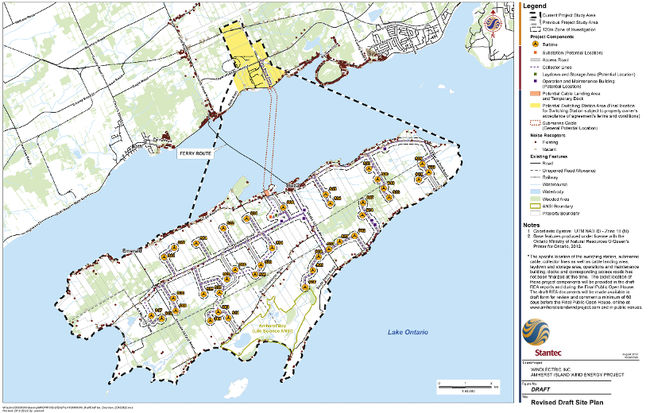
Four area naturalists groups are opposing Ontario’s approval of the Amherst Island Wind Energy Project.

1297385641108_ORIGINALThe Ministry of Environment and Climate Change announced Aug. 24 that the project received renewable energy approval, pending more than two dozen conditions. The project, to be build by Windlectric Inc., is to include up to 26 wind turbine generators and one substation transformer.

Nature Canada, Ontario Nature, the Kingston Field Naturalists and the American Bird Conservancy have come forward to ask the project’s approval be overturned. The Association to Protect Amherst Island (APAI) and Randy Hillier, MPP for Lanark-Frontenac-Lennox & Addington, already publicly opposed the project.

Stephen Hazell, director of conservation for Nature Canada, called the approve another ‘tough on nature’ move by the ministry and asks the Environmental Review Tribunal to overturn the approval.

“Given the clear breaches of the federal Migratory Birds Convention Act, the federal government should in future apply its environmental assessment process to wind energy projects,” Hazell said in a release.

Joshua Wise, greenway program manager for Ontario Nature, said the 35 kilometres of new roads will destroy habitat for species at risk.

“Amherst has the largest breeding population of the at-risk short-eared owl in southern Ontario,” Wise said. “During the winter, Amherst supports the largest concentration of owl species of anywhere in eastern North America as far as we know. “We are all for green energy, but not at the expense of nature.”

Kurt Hennige, president of the Kingston Field Naturalists (KFN), said his group opposes the Amherst Island Wind Energy Project because they know the turbines on Wolfe Island are killing area birds such as ospreys, red-tailed hawks, purple martins and the wilson snipe.

Read more:   Steph Crosier, Kingston Whig-Standard Monday, September 7, 2015

Ministry expert admits he advised not to allow initial ‘kill, harm and harass’ permit

The tribunal’s two-person panel, lawyers Robert Wright and Heather Gibbs, confer.

Admission by an MNR senior manager that his initial advice was not to allow a permit to “kill, harm and harass” the Whip-poor-will and Blanding’s turtle at Ostrander Point halted the third day of Environmental Review Tribunal proceedings Friday in Demorestville.

Witness Joe Crowley, a species at risk expert herpetologist with the Ministry of Natural Resources and Forestry, was on the stand Friday to provide a statement and answer questions about the effectiveness of various mitigation measures proposed by industrial wind turbine developer Gilead Power to protect the endangered species Blanding’s turtle.

Cheryl Anderson, of the Prince Edward County Field Naturalists, said this unexpected turn came at the end of the day when Crowley was asked about his role in the granting of the Endangered Species Act permit for the project on the south shore of Prince Edward County.

“Mr. Crowley stated his advice at the time was not to allow the permit because the project roads would prove a risk to the site’s indigenous Blanding’s Turtles,” said Anderson.

read more:  http://countylive.ca/blog/?p=55256

ERT day 3 Great News!

Myrna Wood at 4 pm today:  “From the beginning several years ago, we were astounded that the Ministry of Natural Resources would issue a permit that allowed development of a site as important to species at risk as Ostrander Point.  Over the years we continually have reminded the Ministry of Environment and the Ministry of Natural Resources that their responsibility to protect species at risk was being ignored by allowing development at Ostrander Point.”

What began as a usual day in the extended Environmental Review Tribunal appeal of the Ministry of the Environment and Climate Change plan to allow development at Ostrander Point in the PEC South Shore Important Bird Area finished with an unexpected ruling.

The witness was Joe Crowley from the Ministry of Natural Resources and Forestry, who was qualified as a species at risk herpetologist with expertise in Blanding’s Turtles.  Mr. Crowley has a long history of interest in and working in the field of herpetology in Ontario and helped to develop the Ontario Herpetology Atlas, a citizen science project, while working with Ontario Nature before he started his tenure with MNRF.  At MNRF his responsibilities included being the species at risk expert on herpetology, giving advice to staff and partners and conservation groups on the development of species at risk protection plans.  He was instrumental in developing the provincial task team forestry policy regarding amphibians and reptiles. He is a member of the reptile and amphibian sub- committee of COSEWIC (Committee on the Status of Endangered Wildlife in Canada), reviewing reports for that committee of technical and scientific information which informs decisions regarding listing species at risk.  He is the Vice President of the Canadian Herpetology Society responsible for web site development and communication.

Mr. Crowley’s witness statement was concerned with the attempts to mitigate harm to the indigenous turtle population at Ostrander Point through the installation of gates on the turbine access roads and a program of monitoring, signage and staff training.  Mr. Crowley answered many questions about the effectiveness of the various mitigation measures proposed to protect the turtles.  Gates are proposed on about 6 road intersections on the site including the intersection of Helmer Rd and Petticoat Point Lane.  Mr. Crowley indicated that he felt that those gates would reduce the risk of turtle mortality to public vehicular traffic; however the presence of roads would increase the probability of turtles nesting in a place that would make them more vulnerable to predation and the roads were unlikely to deter poachers.

The unexpected part of the day came when Mr. Crowley was asked about his role in the granting of the Endangered Species Act permit granted allowing the proponent to “kill harm and harass” the Whip—poor-will and the Blanding’s Turtle at Ostrander point.  Mr. Crowley stated that his advice at the time was not to allow the permit because the project roads would prove a risk to the site’s indigenous Blanding’s Turtles.

This new information caused an abrupt halt in the proceedings.  The legal argument was made by PECFN counsel, Eric Gillespie that it appeared that a senior manager at MNRF had advised against approval of the Ostrander project at the very onset. Mr. Gillespie requested documentation of that advice. Mr. Crowley was unable to produce any documentation and asserted that the final decision on the project was not his. Ultimately after much legal discussion the Tribunal issued a ruling:

That the Ministry of Natural Resources and Forestry witnesses produce forthwith all papers and electronic correspondence to date relating to roads and/or Blanding’s Turtle and this renewable energy approved project and site.

The Tribunal resumes on September 23, 24 and 25.

Cheryl Anderson

@saveostranderpt

www.saveostranderpoint.org