Category Archives: Uncategorized

Canadian Wind Energy Association pulls out of B.C.

While the announcement does nothing to change the status of the Meikle Wind Energy project near Tumbler Ridge, it does put the future of other projects in doubt, including the $480-million Red Willow Wind project


The country’s largest wind energy organization has announced it is pulling out of British Columbia to chase better opportunities in Alberta and Saskatchewan.  

Jean-Francois Nolet, vice-president of the Canadian Wind Energy Association (CanWEA), made the announcement in a letter to members of the association’s B.C. caucus Feb. 5, and obtained by the Alaska Highway News.

“In the last few months we have seen significant new commitments to renewable energy in Alberta and Saskatchewan, but much work remains to be done to make those commitments a reality,” Nolet wrote. 

“At the same time, despite the hard work and efforts of CanWEA and other stakeholders over many years in British Columbia, we have not yet secured any significant new opportunities for wind energy in the province and both the B.C. Government and BC Hydro have indicated that they do not expect to proceed with a new call for power within the next decade.”

In response, CanWEA determined it must shift its focus from B.C. to emerging markets in Alberta and Saskatchewan. With the announcment comes the closure of CanWEA’s B.C. office. Regional director Ian Baille will be leaving the organization.

– See more at: http://www.alaskahighwaynews.ca/regional-news/canadian-wind-energy-association-pulls-out-of-b-c-1.2172268#sthash.PqRmWoAq.dpuf

Ontario Gas Scandal Doppelgänger

On Monday, a NAFTA arbitration panel will start oral hearings in Toronto arising from a dispute between the Delaware-incorporated renewable power developer, Windstream Energy, and the Government of Canada (notice how awkward it is for the public to attend). At stake is Windstream’s claim for damages of $475 million plus interest and costs over an alleged breach of NAFTA obligations by the Ontario government. Windstream had a Feed-In Tariff (FIT) contract granted by the Ontario Power Authority in 2010 to develop a 300 megawatt, 130-turbine offshore wind project west of Wolfe Island, but says it was thwarted by the Ontario government prior to construction.

My main interest in the Windstream litigation is how it illuminates the chaos inside official Ontario’s administration of the province’s electricity future. The case also illustrates how international trade agreements can leave the federal government on the hook when provincial government engage in shenanigans, an important but previously known fact of life in our imperfect federation. (As if our provincial governments need more incitement for irresponsibility.)

(Three short appendices are included at the end of this piece, one briefly glancing at other litigation going on initiated by other unsuccessful wind developers, another noting what appears to be special treatment by the Ontario government for a Samsung solar project, and finally links to other coverage of the Windstream case.)

Sources

The litigant’s pleadings are linked here.

Connecting to the Gas Scandal

Represented by a team of lawyers from Torys LLP lead by John Terry, Windstream’s arguments draw heavily on evidence arising from the Ontario gas plant scandal. That event precipitated the exit of then Premier McGuinty from politics in 2012 and criminal charges against McGuinty’s former Chief of Staff and Deputy Chief of Staff. Their next court date is February 24. The government’s business decisions in the Windstream and gas plant cancellation and relocation cases arose contemporaneously in the period from 2010 through 2012.

In defending the NAFTA claim, the government has made legal arguments that much of the gas scandal evidence is privileged and inadmissible. I am unable to weight the strength of those arguments.

read more: Tom Adams, Feb 12 2016


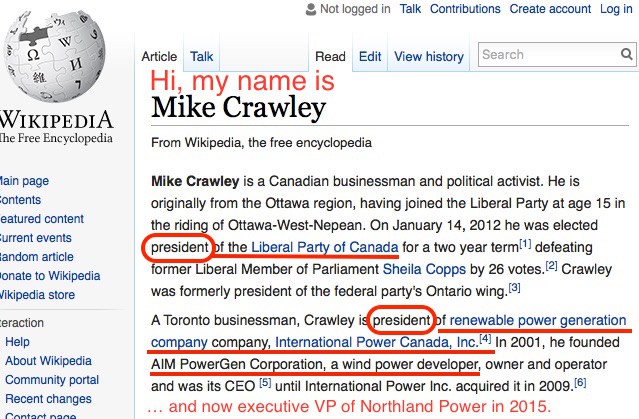
Dear Mike Crawley (Liberal Wind Pusher for AIM PowerGen, IPC, GDF Suez, and now Northland Power)…

From: Mike Crawley
Sent: Tuesday, February 02, 2016 10:18 AM
Subject: Mike Crawley – Contact information

crawleyAs some of you may know, I joined Northland Power this past July.   Belatedly, attached and below please find my new contact information.  For those in the power sector, Northland Power (www.northlandpower.ca) is pursuing  wind, solar, pumped storage and thermal generation opportunities in Canada, Europe and Mexico.  We are also open to considering good opportunities in other jurisdictions that meet our investment criteria.

mike1Best regards,
Mike

Mike Crawley | Executive Vice President
Northland Power Inc.
d: 647 288 1066 | m: 416 554 8513

From: Ginny Stewart
Sent: Tuesday, February 02, 2016 3:05 PM
To: Mike Crawley
Subject: Re: Mike Crawley – Contact information

Hello Mike,

You cannot imagine how surprised I was to hear from you especially in light of the fact that you have not responded to any of my emails or complaints since the Plateau Wind Project went online in early 2012.

I would like to take this fortunate opportunity to bring you up to date on my current situation. I am very much aware that you will say there is little you can do from your new position at Northland Power, but I would like to bring to your attention how your investment opportunities are destroying the lives of people in all the jurisdictions which you target.

You might be interested to know that from April 17, 2012 through April 7, 2015 I filed nearly 70 complaints with the MOECC, copying Plateau Wind Inc. on many of them. I have incident numbers for each and every complaint. It is also my understanding that the obligation of the MOECC and the Owner/Operator of a Wind Generating facility are to report the complaints to each other. In order to keep a record of my complaints and their acknowledgement and because a record of my complaints was not available to me without a freedom of information request but ironically available to Plateau Wind Inc.,  I began to send my complaints electronically; the only acknowledgement of such to me by your company was one email in 2013 that my emails would be responded to through the Ministry of the Environment.

read more: Ontario Wind Resistance, Feb 3 2016

Acoustic Engineering Investigation at Cape Bridgewater Wind Facility

Acoustic Engineering Investigation into Airborne and Ground-Borne Pressure Pulses from Pacific Hydro’s Wind Turbines at Cape Bridgewater

Waubra Foundation Definitive Document
1 February, 2015

A Simplified Explanation of the Findings, Previous Research, and the Consequences

1. Background

  • Turbines create “waste energy” in the form of airborne pressure waves (sound) and ground-borne pressure waves (vibration).
  • Noise is that part of the sound frequency spectrum which is audible, but “noise” is also defined by psychoacousticians as “unwanted sound”.
  • The strength (sometimes expressed as a loudness in the case of noise) of the sound is measured in decibels (“dB”).
  • The wavelength of individual sound waves is a measure of the distance between the peaks of the pressure waves. The speed of sound divided by the wavelength gives the frequency of the sound and is expressed in hertz (Hz).
  • Where the frequency of the sound waves is below 20 Hz, the distance between the waves is relatively long, and the general term for this portion of the frequency spectrum is known as infrasound. Infrasound is only audible at very high levels (dB). However it can be damaging to the human body at levels well below audibility.
  • Impulsive infrasound from a variety of industrial sources has long been known to have the potential to be harmful to humans, especially with chronic exposure. For example, human and animal studies have shown infrasound directly causes both physiological stress, and collagen thickening in a variety of tissues including cardiac valves, arteries, and pericardium which themselves lead to a variety of cardiovascular diseases.
  • Infrasound persists for much greater distances than audible sound and, unlike audible sound, penetrates well insulated building structures (including double glazing) with ease; and often increases the impact by resonating within the house, like a drum. This occurs, regardless of the source of sound & vibration energy. Penetration of buildings and amplification via resonance can also occur from sound and vibration from natural sources such as earthquakes and thunder.
  • Standards for wind turbine noise pollution in Australia are set in audible decibels (“dBA”) outside houses. Use of dBA excludes accurate measurement of frequencies below 200 Hz, including both infrasound (0 – 20 Hz) and low frequency noise (20 – 200 Hz). These Standards do not require infrasound (either within or outside homes) to be predicted in planning submissions nor to be measured in the required compliance testing to the planning permit noise conditions. Most jurisdictions do not require wind turbine generated low frequency noise to be predicted or measured either (unlike other sources of industrial noise). In fact most noise measuring instruments and microphones are unable to measure accurately in the infrasound range, especially below 8 Hz., and some Standards explicitly specify the use of equipment which cannot measure infrasound.

read more:  http://waubrafoundation.org.au/resources/acoustic-engineering-investigation-at-cape-bridgewater-wind-facility/

100-MW North Kent wind farm posted despite surplus power in Ontario

Ontario electricity customers pick up the tab for unneeded power development, again

$1.5 million paid out already today for curtailed wind power

wind-contract-bannerThe huge, 100-megawatt North Kent 1 wind power project proposed by the Samsung-Pattern Energy consortium was posted yesterday on the Ontario Environmental Registry. The announcement comes despite the Ontario Auditor General’s report in 2015 that Ontario has a significant oversupply of electrical power, and that Ontario ratepayers are paying too much for “renewables.”

In just the first eight hours today, the day after the announcement for North Kent 1, the Independent Electricity System Operator or  IESO curtailed about 11,000 MWh of wind generation alone.  It could have provided power for 1200 average households; instead it has cost Ontario electricity ratepayers $1.5 million … for nothing.

The power developers claim the power produced from this project during its 20-year agreement with the province will generate “electricity equivalent to the annual electricity needs of 35,000 homes.”

read more: http://www.windconcernsontario.ca/100-mw-north-kent-wind-farm-posted-despite-surplus-power-in-ontario/


Industrial Wind Siting: Getting Tough (Part 1: New York)

Abstract: Governor Andrew Cuomo, who supports an energy quotaforcing New York to buy half of its energy from qualifying renewables by 2030, does not see the problems that would be caused by coating Upstate, Central and Western New York with sprawling, low-output, intrusive, bird-unfriendly wind turbines. All would be paying for the high upfront costs of the unneeded investment, including additional power lines that will be necessary to run the intermittent, unreliable wind energy from rural New York to New York City. Fortunately, the people are fighting back with proposed ordinances against wind turbines. This is not only good for residents and the environment, it is good for ratepayers across the state and taxpayers across the nation. (Part II tomorrow will overview Ohio’s wind turbine siting debate.)

The New York towns of Yates and Somerset are faced with the prospect of up to 70 massive turbines, 600–630 feet tall, which would tower over everything else. The project by APEX Clean Energy, Lighthouse Wind LLC, now has to deal with the implications of a new 54-page bylaw by Somerset that could well prove to be insurmountable.

Yates has already unanimously rejected the project. Stated Town Supervisor James Simon: “It puts the political and municipal opposition all in a monolithic setting.Both towns, both counties, both boards of health, Sen. Ortt, U.S. Congressman Collins, they’re against this project.”

Enter Somerset’s strongly placed and well researched proposed bylaw. The WIND ENERGY zoning bylaw is being viewed as thoughtful and detailed.  Here are some of our favorite inclusions or clauses (at times paraphrased or variously quoted). (The entire bylaw proposal, to be revisited Feb 1, is here.)

The preamble states the importance of what communities have faced with industrial wind proliferation:

read more: Master Resource,By Sherri Lange — February 2, 2016