Category Archives: Health

Wind Turbine Noise and Health Study: Summary of Results

*(the results are being reviewed and further commentary will be available)

Capture


http://www.hc-sc.gc.ca/ewh-semt/noise-bruit/turbine-eoliennes/summary-resume-eng.php

Good day:

As you know, we informed the membership earlier today that a summary report of Health Canada’s wind turbine noise study (also called the community noise study) was to be released this morning.

We intend to undertake a detailed study of this summary report, together with information we hope to get at a meeting with Health Canada, and prepare a formal response.

However, as of this morning, we can say that we are very disappointed in the summary of results, that we have deep concerns about the methodology and conclusions and that, finally, these results do not reconcile with either the experience of Ontario communities, or other peer-reviewed research.

You may view the study summary report here: http://www.hc-sc.gc.ca/ewh-semt/noise-bruit/turbine-eoliennes/index-eng.php

Jane Wilson

President

Wind Concerns Ontario

NRWC WIND TURBINE PROJECT APPROVED FOR WEST LINCOLN, WAINFLEET AND HALDIMAND

bring-itIt is with great sadness that we post this advisory to you.  Today the Ministry of Environment and Climate Change approved the Niagara Region Wind Corporation industrial wind turbine project for West Lincoln, Wainfleet and Haldimand.
  If you wish to view the approval notice, you can click on the link that is provided below. 

MAWT Inc is committed to challenging the approval but financial assistance is required to make that happen.  If you have not donated yet, cheques can be mailed to:  

Mothers Against Wind Turbines Inc.
Box 132
Wellandport, ON
L0R 2J0 

Abandoned Homes Help Understand Wind Turbine Annoyance

stopthesethings's avatarSTOP THESE THINGS

William Palmer Bill Palmer

At the recent 168th Meeting of the Acoustical Society of America, a session was dedicated to research papers related to wind turbine noise and noise standards. Here are the slides and notes from one of these presentations – made by William Palmer, a Professional Engineer based in Canada who listened to what people were saying and used their abandoned homes to better understand the annoyance from wind turbines.

Wind Turbine Annoyance – a clue from acoustic room modes
William Palmer
Acoustical Society of America
29 October 2014

01

Abstract

When one admits that they do not know all the answers and sets out to listen to the stories of people annoyed by wind turbines, the clues can seem confusing. Why would some people report that they could get a better night’s sleep in an outdoor tent, rather than their bedroom?

Others reported that they could sleep better in the basement recreation room…

View original post 3,715 more words

Winning The War of Words- Wind Warriors Voices are Being Heard

This from Renewable Energy Magazine.

 [Anti-wind sentiments can attract supporters near and far even though a community, province, or country favors the use of renewable sources as a whole. The silent majority of supporters must be awoken to counter the misinformation and let public officials know they favor a transition to renewable power in their community. Without a strategic plan to build support from the start, wind projects in Ontario will continue to experience the wrath of a well-connected and organized opposition network.]

Supporters of Wind just might be surprised when they realize that the “silent majority” turn out not to be in support of wind but a well educated public BECAUSE of a well-connected and organized network!!  Well done Wind Warriors!  Proof that there is indeed strength in numbers…

Ontario Wind Proposals Increasingly at Risk for Public Defeat

A 2013 study conducted by The Environics Institute found that in Ontario, 68 percent of residents held the belief that their province could make the shift from fossil fuels to renewable power. Despite this majority of those surveyed, Ontario has experienced considerable controversy over the implementation of renewable policies since the Green Energy Act of 2009, and Premier Kathleen Wynne’s pro-wind initiatives continue to generate public scorn at speaking engagements on unrelated topics.

From Ontario residents’ wider perspectives, it seems that a transition to renewable energy is ideal. However, once a wind project is proposed in residents’ own backyards, public opposition forms to bring the project to a screeching halt. Despite the political support that exists on a macro-level, careful measures must be taken locally to build the support necessary to guide the project through the approval process with ease.

Despite an extensive two-year approval process with various environmental studies conducted, opponents of a 140-turbine wind proposal by K2 Wind in Goderich, Ontario recently filed a construction stay application to halt the project in its tracks.

The injunction filed intended to allow for the completion of a Health Canada study, which seeks to understand the impact of industrial wind projects on nearby residents. Already anti-wind groups have been successful on placing a moratorium on off-shore wind until the potential for impacts on marine life are identified.

However, Divisional Courts sided with K2, noting the “serious financial consequences” the company will suffer as a result of a minor delay in construction in contrast to the “lack of harm appellants will suffer” without granting their motion. Despite K2’s narrow escape of costly delays in this case, the opponents’ efforts continue.

When the $850 million K2 project was permitted, the Environmental Review Tribunal upheld approvals finding no evidence of health hazards imposed upon residents living near turbines. However, opponents of the K2 project have joined together with opponents of a 92-turbine Armow wind farm near Kincardine, Ontario and a smaller St. Columban project to appeal the Tribunal’s findings, which the group collectively claims violates their constitutional rights due to the potential health impacts.

A decision in this appeal is expected later this month. While Ontario looks on to see what will happen to K2 and future wind proposals in the province, these cases demonstrate opponents’ abilities to band together to impact the success of a proposal at any stage of development.

Anti-wind sentiments can attract supporters near and far even though a community, province, or country favors the use of renewable sources as a whole. The silent majority of supporters must be awoken to counter the misinformation and let public officials know they favor a transition to renewable power in their community. Without a strategic plan to build support from the start, wind projects in Ontario will continue to experience the wrath of a well-connected and organized opposition network. Continue reading Winning The War of Words- Wind Warriors Voices are Being Heard

Adverse Health Effects from Industrial Wind Turbines

Negative Health Effects of Noise from Industrial Wind Turbines: Some Background

This article, the first of three installments, provides a broad overview of the topic. The second installment will review the major research findings linking low-frequency noise and infrasound from industrial wind turbines with effects on health and quality of life, and the third will discuss the relationship between various health effects and the processing of infrasound by the ear and brain.[1]

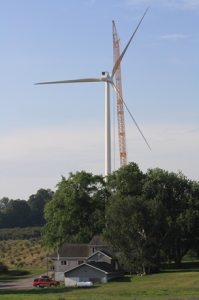
Figure 1-An industrial-scale wind turbine during installation near the Shineldecker home in Mason County, Michigan.

By Jerry Punch, PhD, and Richard James, INCE, BME

Cary Shineldecker was skeptical about the wind project the Mason County, Michigan, planning commission was considering for approval. His home, two miles from Lake Michigan, was located in an area where nighttime noise levels were around 25 dBA, with only occasional traffic and seasonal farmland noises. The rolling hills, woodlots, orchards, fields, and meadows surrounding his property contributed to its peaceful country setting. He voiced his skepticism about the wind turbines repeatedly in community meetings held beforeConsumers Energy was finally granted approval to construct 56, 476-foot, turbines that would place one turbine 1,139 feet from his property line (Figure 1), six within 3,000 feet, and 26 that are visible from his property.

He and his wife Karen started to suffer symptoms of ear pressure, severe headaches, anxiety, irritability, sleep disturbance, memory loss, fatigue, and depression immediately after the turbines began operating.

Continue reading Adverse Health Effects from Industrial Wind Turbines

O!M!G! Wynnes new $400M Trade Deal in China is with … WAIT FOR IT!!!! … A COAL COMPANY!!!!

Donna Quixote's avatarQuixotes Last Stand

Tip o’ the hat to Glenn for this revelation!!!

From Kathleen Wynne’s FB page:

“The China trade mission has confirmed that Greenland Group is investing $400 million in Ontario and will create up to 200 new Ontario jobs!”

How wonderful.  I wonder what the Greenland Group does!!   DIRECT FROM THEIR WEBSITE:
“At present, Greenland Group has formed a complete industrial chain including production, processing, storage, transport and distribution of coal as well as storage, transport, trade and retail of petroleum, and owned several coal mines in Inner Mongolia and Shanxi Province, with gross resource reserve amounting to 700 million tons, annual output of more than 13.5 million tons, and distribution amount of over 55 million tons.
As for the product deep-processing field, Greenland Group has successfully acquired a coal deep-processing project in Dandong, Liaoning Province and a petroleum production-supply-marketing integration base in Zhoushan, Zhejiang Province, both of which substantially…

View original post 107 more words

Adverse Health Effects of Industrial Wind Turbines

wind turbine noise health

Adverse Health Effects of Industrial Wind Turbines  Jerry Punch PhD  Richard James INCE, BME

This article, the first of three installments, provides a broad overview of the topic. The second installment will review the major research findings linking low-frequency noise and infrasound from industrial wind turbines with effects on health and quality of life, and the third will discuss the relationship between various health effects and the processing of infrasound by the ear and brain.[1]

Cary Shineldecker was skeptical about the wind project the Mason County, Michigan, planning commission was considering for approval. His home, two miles from Lake Michigan, was located in an area where nighttime noise levels were around 25 dBA, with only occasional traffic and seasonal farmland noises. The rolling hills, woodlots, orchards, fields, and meadows surrounding his property contributed to its peaceful country setting. He voiced his skepticism about the wind turbines repeatedly in community meetings held beforeConsumers Energy was finally granted approval to construct 56, 476-foot, turbines that would place one turbine 1,139 feet from his property line (Figure 1), six within 3,000 feet, and 26 that are visible from his property.

He and his wife Karen started to suffer symptoms of ear pressure, severe headaches, anxiety, irritability, sleep disturbance, memory loss, fatigue, and depression immediately after the turbines began operating.

Gradually, as sleep disturbance turned into sleep deprivation, they felt their home was being transformed from a sanctuary to a prison. Deciding to sell their home of 20 years, they put it on the market in March 2011, and it has remained unsold for 3-1/2 years. For the past 1-1/2 years, their nightly ritual is taking sleeping medications and retreating into their basement to try to sleep on a corner mattress. They received few offers to buy their home, and recently accepted an offer that would mean a substantial financial loss. They are scheduled to go to trial against Consumers Energy, and if their case goes to settlement without a trial, they will likely be forced into a confidentiality agreement about their case.

Similar complaints of adverse health effects (AHEs) associated with living near utility-scale wind turbines have become commonplace in the U.S. and other developed countries. Energy companies in the U.S., motivated by lucrative tax subsidies available for developing wind resources as a form of green energy, are pushing aggressively to install more wind turbines, typically locating them near residential properties. Many rural residents now have one or more industrial machines that stand over 40 stories tall on the property alongside their home. Complaints about noise from people living within the footprint of wind energy projects are very similar to those experienced by the Shineldeckers.

Those who have never visited a wind project or who visit one only during the daytime often leave believing that the complaints of noise are unfounded, and commonly assume them to be psychologically motivated or a form of NIMBYism [1]. Those living near wind turbines say that unless one is willing to spend several nights in the area they have not experienced the noise that causes the complaints.

Article can be read here.

Vanishing Legacies: A Celebration in Film of the County’s South Shore

Save Ostrander Point

Thursday, 27 November 2014 from 7:00 PM to 9:30 PM (EST)

Picton, ON

CaptureVANISHING LEGACY, a film by Suzanne Pasternak, traces the history of the Lake faring families of South Marysburgh, Prince Edward County from the end of the American Revolution when they landed as United Empire Loyalists on Prince Edward’s shores to the final years of the commercial fishing industry.
Since 1983 Suzanne Pasternak has been documenting and preserving the unique maritime history of the south end of Prince Edward County, Ontario. She has created a large catalog of multimedia archival material she is currently organizing to form a major collection for Prince Edward County Archives and the Museum of the Great Lakes in Kingston. Her award winning documentary: Vanishing Legacy: The History of the Lakefaring Families of Prince Edward County is a culmination of her research since 1983 to 2013.

THE LIGHTHOUSES OF THE SOUTH SHORE – Presentation by Marc Seguin of Save Our Lighthouses: Between 1828 and 1914, one of the world’s greatest concentrations of lighthouses and light towers was constructed in eastern Lake Ontario waters. Five of these aids to navigation were built along the south shore of Prince Edward County in an area known by mariners as “the graveyard of Lake Ontario”.
Heritage enthusiast, historian and founder of Save Our Lighthouses, Marc Seguin, has documented the history of these lighthouses in his upcoming book, “For Want of a Lighthouse”. He will give an illustrated talk highlighting the lighthouses of the County’s south shore and the important role that they played in guiding ships to safety through some of the most dangerous waters of the Great Lakes.

HISTORY MOMENTS by Peter Lockyer of History Lives Here: Peter Lockyer, former CBC Radio and Television Broadcaster, has produced a series of film vignettes detailing the history of Prince Edward County and the Quinte area. We will screen selected vignettes about the activities historically carried out along the South Shore.

Musical Performance: Suzanne Pasternak and Tom Leighton will perform songs from the movie.

https://www.eventbrite.ca/e/vanishing-legacies-a-celebration-in-film-of-the-countys-south-shore-tickets-14093248285

Press Release: Wind farms generate below 20% of their supposed output for 20 weeks a year, a new report finds

  • A new study has found that wind farms generate below 20% of their supposed output for 20 weeks a year, and generate below 10% for 9 weeks a year.

  • Wind farms, on average, only exceed 90% of their rated output for 17 hours a year.
  • Though the government acknowledges that wind farms produce much less energy than their sticker capacity would suggest, the report shows that even the average production (of around a quarter of capacity) is extremely misleading about the amount of power wind farms can be relied up to provide.

Wind farms are extremely volatile, with outputs fluctuating by five percentage points over short periods of time, a report based on new data by the Adam Smith Institute and Scientific Alliance has found. These findings suggest the UK’s energy infrastructure can never be reliant on them in any significant way.

Specifically, the study found that wind farms generate below 20% of their supposed output for 20 weeks a year, and generate below 10% for 9 weeks a year. Wind farms, on average, only exceed 90% of their rated output for 17 hours a year.

The paper, “Wind Power Reassessed: A review of the UK wind resource for electricity generation”, (http://www.adamsmith.org/wp-content/uploads/2014/10/Assessment7.pdf) looks at previously unexamined wind speed data reported by anemometers located at various airfields, used as a proxy for nearby wind farms, and concludes that UK wind farms, on average, exceed 80% of their supposed output for less than one week every year.

The study also looks at the short-term (30 – 90 minute) variability of wind generation and reveals swings in output are far higher than is normal from conventional energy generation, such as from gas or nuclear plants. Swings of five percentage points of output are not uncommon, which contradicts the claim that a widespread wind fleet installation will smooth variability. There are frequent but unpredictable periods where wind energy generation fails for days on end.

The report will severely undermine the case for a move towards yet more wind generation because it suggests that wind can never be a major, reliable source of energy for the UK. It also suggests that the UK’s drive to reduce its carbon footprint through expanding wind power is misguided. Wind power is so unreliable and intermittent that it makes much more sense to look to nuclear and gas as better low emission alternatives to the status quo.

In his research, the report’s author Dr. Capell Aris looked at 6.5m individual recordings from 22 sites in the UK and 21 from Ireland and the continent.

Commenting on the report, Dr Aris said:

The current reliance on wind energy to reduce carbon dioxide emissions is inefficient and compromises energy security. Power output of the studied system is below 20% of nominal capacity for over 20 weeks of the year, and below 10% for 9 weeks.

When we study those periods when production falls below 20% of rated capacity, more than three quarters of this occurs in periods longer than 12 hours. Each winter has periods where wind generation is negligible for several days.

The situation across the whole of northern Europe is much the same, so a Europe-wide power grid would provide no extra security; the study demonstrates that interconnectors will not solve wind’s intermittency problem.

Head of Policy at the Adam Smith Institute, Ben Southwood, said:

Wind farms are a bad way of reducing emissions and a bad way of producing power. They are expensive and deeply inefficient and it seems like they reduce the value of housing enormously in nearby areas. We probably do want to reduce carbon emissions, because according to the IPCC global warming will begin to slow economic growth in one hundred years, but nuclear and gas power are our best ways of doing that until cheap and efficient energy storage options are available on a vast scale to smooth the highly variable output of renewables.

Director of the Scientific Alliance, Martin Livermore, said:

This study is a graphic illustration that wind turbines cannot provide a secure supply of electricity, no matter how large the distribution grid.

Notes to editors:

For further comments or to arrange an interview, contact Kate Andrews, Communications Manager, at kate@adamsmith.org / 07584 778207.

The Adam Smith Institute is an independent libertarian think tank based in London. It advocates classically liberal public policies to create a richer, freer world.

The Scientific Alliance was formed in 2001 to encourage politicians to make policy on the basis of scientific evidence rather than lobbying by vested interests.

Adam Smith Institute, Written by Kate Andrews | Monday, October 27th, 2014


Chevallier: wind turbines, eco sham and new Public Health drama

A number of doctors have already identified multiple health problems related to ownership with these industrial machines. …On the evidence currently available, it would seem sensible in principle of responsibility to recommend minimum distances of 5 km between industrial wind turbines and homes. Ideally, it would be desirable to freeze all ongoing projects now and not induce new diseases on a large scale. 

Ecology is still good. European companies seeking by all means to implement giant wind (we approach the 200 m high) in the French countryside, close to the houses. It is clear that wind turbines do not have anything green about the energy with the thousands of tons of concrete needed to support these steel monsters; it is far from the account feedback from those already established. 

My concern, as a physician and member of the European Association Physicians for a healthier environment being created, focus on health. A report by the National Academy of Medicine, published in 2006, concluded that the need to suspend (or prohibit) the construction of wind turbines with a capacity greater than 2.5 megawatts located within 1500 meters of housing. These are actually real industrial plants inducing nuisance, including noise. 

Industrial wind turbines are in fact classified as ICPE: installations and plants that generate risks or dangers. Several scientific studies are being published, the results recommend that wind turbines are not located within 2.5 kilometers of homes. Thus, clinical observations of Dr. Michael Nissenbaum two wind farms in the state of Maine to the United States indicate that there is a correlation between the distance residential wind turbines and health problems for residents.

The responsibility of prefects engaged

A number of doctors have already identified multiple health problems related to ownership with these industrial machines. A medically defined the “wind syndrome” which includes increasing headache (noise and turbulence as triggers of migraines), ringing in the ears like tinnitus, sleep disorders, an increase of anxiety and depressive disorders, sometimes the appearance “nausea, dizziness, palpitations, all of these chronic conditions can promote authentic depression” as Dr. Jean-François Ferrieu said.

This dimension is not taken into account, or insufficiently, by the government, probably through lack of information. During this time, various local businesses, which more often sell the exploitation rights to legally well structured international companies continue to put pressure on municipalities to accelerate project starts at close as 500 meters from housing, The responsibility of prefects is committed to this day, since it is they who issue building permits.

Gel ongoing projects 

On the evidence currently available, it would seem sensible in principle of responsibility to recommend minimum distances of 5 km between industrial wind turbines and homes. Ideally, it would be desirable to freeze all ongoing projects now and not induce new diseases on a large scale. 

It may also come to the conclusion that, for the health of humans and animals such as birds, farm animals or bats, precious natural “insecticides” which have been the subject of a report of the American Academy of Sciences (PNAS, September 29, 2014), it is sufficient to ban industrial wind turbines on land.

As noted by Nicolas Hulot , “initially, wind energy is a great idea, but upon arrival, it is a tragic realization. If we were told that at least it would close plants, but this is not the case. “

French to English translation assisted using Google Translate

Wind Action The Point – Laurent Chevallier, MD – October 24, 2014 * Opinion

Original source in french